

Phase 1: 공감 (Story Opening)
안녕하세요! 매일한글 에디터입니다.
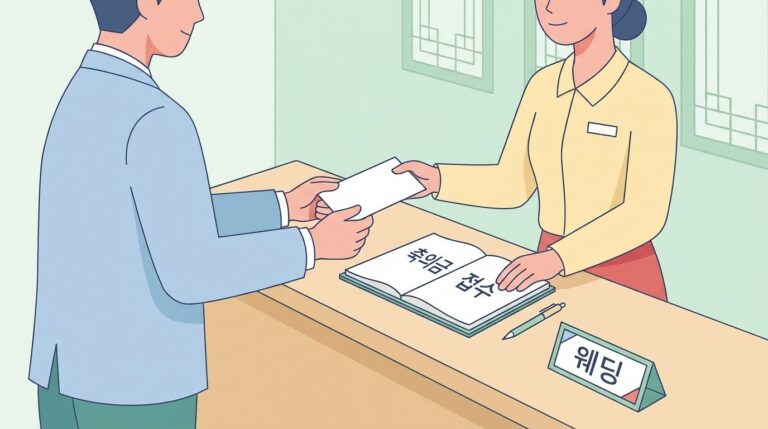
Imagine this: You dress in your sharpest semi-formal outfit, step out of a subway station in Gangnam, and enter a grand, flower-scented wedding hall. You are thrilled to celebrate your Korean coworker’s special day! But as you walk into the buzzing foyer, the scene feels completely different from weddings back home. There is no quiet usher showing you to an aisle. Instead, there is a busy, counter-style table crowded with people pulling out crisp white envelopes.
You stand frozen for a second with your envelope in your sweaty hands. “Which table is for the groom? What do I say? How do I write my name? And wait—where do people get those little paper tickets everyone is holding for the famous wedding buffet?”
Don’t worry at all! Every international guest in Korea experiences that exact moment of hesitation. Handing over your cash gift (chuk-uigum) and receiving your meal ticket (sik-gwon) is a smooth 30-second ritual once you know the steps. This guide will walk you through the exact phrases, cultural gestures, and reception desk manners so you can breeze through like a seasoned Seoulite!
Phase 2: 핵심 표현 3선 심층 분석
1. 축하드려요 (Chukadeoryeoyo)
- Pronunciation: Choo-kah-deu-ryeo-yo (Sounds like “Choo-car” + “due” + “row” + “yo”)
- Meaning: “Congratulations!” (Literal: “I give you celebration/congratulations respectfully”)
- K-Culture Moment: You hear this in every romantic K-drama wedding scene, from Crash Landing on You to Queen of Tears, whenever guests greet the family elders standing near the hall entrance.
- Editor’s Insight: While friends say “축하해 (Chukahae)”, the reception desk is usually staffed by the couple’s close relatives, cousins, or trusted sunbaes. Using the polite suffix -yo shows respect and warmth to the family.
- Situation Spectrum:
- Casual: ⚠️ (Sounds too formal for your close best friend)
- Semi-formal: ✅ (Perfect for coworkers and reception staff)
- Formal: ✅ (Appropriate for in-laws and parents)
- 🤔 Think About It: In many Western weddings, guests simply send a gift card weeks in advance. Why do you think Koreans prioritize delivering verbal congratulations alongside cash directly to family representatives on the wedding day?
2. 식권 몇 장 드릴까요? (Sikgwon myeot jang deurilkkayo?)
- Pronunciation: Sheek-gwon myut jahng deu-ril-kkah-yo? (Like “Chic” with an ‘sh’ + “gwon”, “my-ut”, “jahng”, “due-reel-ccah-yo”)
- Meaning: “How many meal tickets shall I give you?”
- K-Culture Moment: In reality variety shows like Hangout with Yoo, MCs often joke about visiting a wedding solely for the buffet, immediately checking if they got their “sik-gwon” right after paying!
- Editor’s Insight: At a Korean wedding, your cash envelope acts as your admission and your dinner invitation. The desk staff track envelopes against meal tickets because the wedding hosts pay the venue per head based on tickets redeemed.
- Situation Spectrum:
- Casual: 🚫 (Desk staff speak politely to all guests)
- Semi-formal: ✅ (Standard customer/guest service tone)
- Formal: ✅ (Polite honorific phrasing)
- 🤔 Think About It: Why does Korean wedding hospitality link the physical “meal voucher” directly to the reception desk rather than seating guests at designated table name cards?
3. 여기 방명록에 성함 적어주세요 (Yeogi bangmyeongnoke seongham jeogeojuseyo)
- Pronunciation: Yeo-gee bahng-myeong-noh-keh sung-hahm juh-guh-joo-seh-yo
- Meaning: “Please write your name in the guestbook here.”
- K-Culture Moment: You’ll see guests in K-dramas gracefully holding a calligraphy pen, leaving their name in vertical or horizontal lines in a traditional bound book.
- Editor’s Insight: Notice the honorific word 성함 (seongham) instead of 이름 (ireum) for “name”. It is the ultimate polite term. If you write your name clearly in Hangul or Latin letters, the newlyweds can match it later with your envelope.
- Situation Spectrum:
- Casual: 🚫 (Too stiff between close friends)
- Semi-formal: ✅ (Standard greeting by desk attendants)
- Formal: ✅ (High-respect workplace or ceremonial tone)
- 🤔 Think About It: The guestbook in Korea serves both as a sentimental keepsake and a legal/financial ledger for the family. What does this tell you about Korean community accountability?
Phase 3: 교과서 한국어 vs 진짜 한국어
Situation 1: Offering your congratulations at the reception desk
- 📖 교과서 한국어:
결혼을 진심으로 축하드립니다. (Gyeorhoneul jinsimeuro chukahadeurimnida.)
“I sincerely congratulate your marriage.” - 🗣️ 진짜 한국어:
안녕하세요! 축하드려요~ 신랑 친구예요. (Annyeonghaseyo! Chukadeoryeoyo~ Sillang chin-goo-ye-yo.)
“Hello! Congratulations! I’m a friend of the groom.” - 💡 왜 다를까? Reception desks are fast-paced! Staff handle hundreds of envelopes in 20 minutes. A brief greeting with a bright smile stating your relationship to the couple is far more natural and helpful than a long formal speech.
Situation 2: Requesting your buffet ticket
- 📖 교과서 한국어:
저에게 식사할 수 있는 표를 한 장 교환해 주십시오. (Jeo-ege siksa-hal su inneun pyoreul han jang gyohwanhae jusipsio.)
“Please exchange and grant me one ticket with which I can dine.” - 🗣️ 진짜 한국어:
식권 한 장 부탁드려요! (Sikgwon han jang bootak-deu-ryeo-yo!)
*”One meal ticket, please!” - 💡 왜 다를까? Nobody uses complex passive verbs at a reception desk. A polite noun + 부탁드려요 (Please / I request) is the gold standard for polite A2-level Korean.
Phase 4: K-Culture 딥다이브 & 비언어적 매너
4-1. 눈치 (Nunchi) & Gestures
- Look Up at the Banners First: Wedding foyers feature two parallel reception desks side by side. One says 신랑측 (Sillang-cheuk – Groom’s Side) and the other says 신부측 (Sinbu-cheuk – Bride’s Side). Use your quick nunchi (situational awareness) to approach the correct side!
- The Two-Handed Handover: Never fling your envelope down like paying at a market. Present the envelope holding it with both hands, lightly bowing your head at roughly 15 degrees. When receiving the meal ticket, take it with both hands as well.
- The Clean Bill Etiquette: Make sure your bills are crisp and neatly tucked inside the envelope. Seal or tuck the flap in, and ensure your name and affiliation (e.g., “Company Name + John Doe”) are written vertically or along the bottom left on the back of the envelope.
4-2. Cultural Code: The Buffet (뷔페) Social Contract
In Korean wedding culture, the buffet is not just lunch; it is the newlyweds’ primary sign of hospitality and gratitude. In the past, Koreans ate Janchi-guksu (feast banquet noodles) together to symbolize a long and happy life. Today, modern hotel and hall buffets feature everything from steak and sashimi to galbi-tang. Giving chuk-uigum covers your meal and helps the couple fund their new household. Receiving your sik-gwon guarantees you will participate in this collective celebration of abundance.
Phase 5: 실전 롤플레이 시나리오
Setting: The brightly lit foyer of a wedding hall in Yeouido. Soft piano music plays. Minho, the groom’s cousin, is seated behind the wooden reception desk with stacks of white envelopes and red guestbooks. Alex, an invited foreign colleague, walks up.
- Turn 1 (Minho):
안녕하세요! 축하하러 와주셔서 감사합니다.
(Annyeonghaseyo! Chukahahreo wajusyeoseo gamsahamnida.)
“Hello! Thank you so much for coming to celebrate.”
🎭 Standing up slightly and offering a warm greeting bow -
Turn 2 (Alex):
안녕하세요! 진우 씨 결혼 진심으로 축하드려요.
(Annyeonghaseyo! Jinwoo-ssi gyeorhon jinsimeuro chukadeoryeoyo.)
“Hello! Sincere congratulations on Jinwoo’s wedding.”
🎭 Smiling politely and bowing at 15 degrees -
Turn 3 (Alex):
여기 축의금 봉투예요. 회사 동료 알렉스입니다.
(Yeogi chuk-uigum bongtooye-yo. Hoesa dongnyo Alex-imnida.)
“Here is the gift envelope. I am his company coworker, Alex.”
🎭 Handing over the white envelope using both hands -
Turn 4 (Minho):
아, 진우 사촌 동생입니다! 정말 감사합니다.
(Ah, Jinwoo sachon dongsaeng-imnida! Jeongmal gamsahamnida.)
“Ah, I’m Jinwoo’s younger cousin! Thank you very much.”
🎭 Accepting the envelope with both hands and setting it into the box -
Turn 5 (Minho):
여기 방명록에 성함 한 번만 적어주시겠어요?
(Yeogi bangmyeongnoke seongham han beonman jeogeojusigesseoyo?)
“Could you please write your name in the guestbook right here?”
🎭 Politely sliding the guestbook and pen toward Alex -
Turn 6 (Alex):
네, 알겠습니다. 여기 적었어요!
(Ne, algessumnida. Yeogi jeogeosseoyo!)
“Yes, of course. Written right here!”
🎭 Writing name clearly in the book and returning the pen -
Turn 7 (Minho):
감사합니다! 식권은 한 장 드릴까요?
(Gamsahamnida! Sikgwoneun han jang deurilkkayo?)
“Thank you! Shall I give you one meal ticket?”
🎭 Holding up a colorful meal coupon ticket -
Turn 8 (Alex):
네, 식권 한 장 부탁드려요! 식사 맛있게 할게요.
(Ne, sikgwon han jang bootak-deu-ryeo-yo! Siksa mas-itge halgeyo.)
“Yes, one meal ticket please! I’ll enjoy the meal.”
🎭 Receiving the ticket with two hands and nodding gratefully
🔀 인터랙티브 분기점 (Interactive Branching Decision)
When Minho asks: “식권 몇 장 드릴까요? (How many meal tickets shall I give you?)”, what do you say if you brought your friend with you who didn’t give a separate envelope?
- Option A: “열 장 주세요! 친구들 다 줄 거예요.” (Give me 10 tickets! I’ll give them to all my friends.)
- Option B: “두 장 부탁드려요. 제 친구랑 같이 왔어요.” (Two tickets, please. I came together with my friend.)
- Option C: “식권 안 주셔도 돼요. 돈만 낼게요!” (You don’t need to give me a meal ticket. I’ll just pay the cash!)
Feedback:
* Option A (Bad): Asking for extra meal tickets without matching gift money violates wedding etiquette and will put the reception attendants in an awkward spot!
* Option B (Best!): Honest, respectful, and standard. If you brought a plus-one and prepared an envelope that covers two guests (usually 100,000 to 150,000 KRW), simply request two tickets politely.
* Option C (Risk): While generous if you have to leave early without eating, if you plan to stay, you won’t be allowed into the buffet hall without a ticket! Only say this if you truly cannot stay for the meal.
Phase 6: 10초 감정 섀도잉 드릴 (Shadowing Drill)
Practice these lines out loud with the pause marks (/) and emotional cues:
[😊 Bright and congratulatory]
“안녕하세요! / 진우 씨 / 결혼 진심으로 / 축하드려요!”
(Annyeonghaseyo! / Jinwoo-ssi / gyeorhon jinsimeuro / chukadeoryeoyo!)-
[🤝 Respectful and neat]
“여기 / 축의금 봉투예요. / 회사 동료 / 알렉스입니다.”
(Yeogi / chuk-uigum bongtooye-yo. / Hoesa dongnyo / Alex-imnida.) -
[😋 Cheerful and polite]
“감사합니다! / 식권 한 장 / 부탁드려요.”
(Gamsahamnida! / Sikgwon han jang / bootak-deu-ryeo-yo.)
Phase 7: K-Culture 미니 사전 (Key Vocabulary)
- 축의금 (Chuk-uigum)
- Translation: Congratulatory cash gift
- Usage: The customary monetary gift given at celebratory events, especially weddings. Standard amounts follow odd numbers (50,000 KRW, 70,000 KRW) or lucky multiples of ten (100,000 KRW).
- 식권 (Sik-gwon)
- Translation: Meal ticket / Meal voucher
- Usage: A small stamped paper coupon handed to guests at the desk. You hand this to the buffet staff at the entrance of the banquet dining hall.
- 방명록 (Bang-myeong-nok)
- Translation: Guestbook / Visitor register
- Usage: The large horizontal book laid on the desk where you write your name. It serves as an official proof of attendance for the host family.
- 접수대 (Jeop-su-dae)
- Translation: Reception desk / Registration counter
- Usage: The frontline table right outside the main ceremony hall where envelopes are collected, registered, and meal tickets distributed.
Phase 8: 여행자를 위한 생존 키트 (Survival Kit)
Top 3 Survival Expressions
- 봉투 어디에 있어요? (Bongtu eodie isseoyo?)
- Romanization: Bong-too eo-di-e ee-sseo-yo?
- Pro Tip: Forgot to prepare an envelope beforehand? Look around the reception lobby! There is almost always a small side desk stacked with free white envelopes and pens.
- 신랑측 접수대가 어디예요? (Sillang-cheuk jeopsudaega eodieyo?)
- Romanization: Seel-lahng-cheuk jeop-soo-dae-gah eo-di-e-yo?
- Pro Tip: Use this if you are confused by multiple counters. Replace 신랑측 (groom’s side) with 신부측 (sinbu-cheuk, bride’s side) as needed.
- 식당이 몇 층이에요? (Sikdangi myeot cheung-ieyo?)
- Romanization: Seek-dahng-ee myut cheung-ee-e-yo?
- Pro Tip: In multi-story Korean wedding venues, the buffet banquet hall is often on a different floor (e.g., Basement 1 or Floor 4). Ask this to avoid getting lost!
Editor’s Travel Note
- Cash Preparation: Korean wedding counters do not accept credit card swiping for gift envelopes! Ensure you withdraw crisp 50,000 KRW banknotes from an ATM beforehand. Use the Naver Map App Download to search for nearby convenience stores or bank ATMs (편의점 ATM) within walking distance of the hall.
- Guest Dress Code: Avoid wearing all-white dresses or creams (reserved exclusively for the bride!). Dark suits, navy, beige, or modest pastel dresses are standard.
Phase 9: “한 발 더 깊이” (Cultural Insights)
In Korean society, cash gifts at weddings represent the enduring ancestral concept of 품앗이 (Pum-asi)—a traditional system of communal mutual aid. When farming villages faced heavy labor tasks, neighbors pooled their strength; when a family faced a major life milestone like a wedding or funeral, the community pooled financial resources. Your chuk-uigum is not a transaction; it is a deposit of social goodwill that the family will gladly repay when you or your family celebrate a milestone.
💬 Your Turn: In your home country, what is the traditional gift given at weddings—cash, boxed presents, or a registry list? Tell us in the comments below!
Phase 10: FAQ & Common Mistakes
Q: How much money should I put in the wedding envelope?
A: If you are an acquaintance or casual colleague attending alone, 50,000 KRW or 70,000 KRW is the minimum baseline. If you eat at a high-end hotel venue or bring a plus-one, 100,000 KRW to 150,000 KRW is recommended.
Q: What if I didn’t write my name in Korean?
A: Writing in English block letters is completely fine! Just add your workplace or affiliation in brackets underneath (e.g., Alex Smith (Marketing Team)) so the couple’s family knows who you are.
Q: Can I enter the buffet hall without attending the ceremony?
A: Yes! Due to tight schedules, some Korean guests hand over the envelope at the desk, grab their sik-gwon, and head straight down to eat at the buffet. While attending the 30-minute ceremony is polite, it is socially acceptable to eat early if you have schedule constraints.
🚨 Common Mistakes Warning Board
- Mistake: Giving an even amount like 40,000 KRW.
- Correction: Traditional Korean belief considers odd numbers (3, 5, 7) auspicious and positive (Yang energy). Stick to 50,000 KRW, 70,000 KRW, or multiples of 100,000 KRW.
- Mistake: Forgetting to write your name on the envelope before handing it in.
- Correction: Envelopes are stored immediately in a secure wooden drop box. If your name isn’t on the back, the couple will never know you gave it!
- Mistake: Losing your meal ticket (식권).
- Correction: Buffet workers guard the dining room entrance strictly. Keep your ticket safe in your pocket or clutch until you hand it over at the dining room doors.
Phase 11: 액션 미션 & 참여 유도
- 🥉 Bronze Mission (Solo Practice): Stand in front of your mirror with an envelope in both hands and practice saying: “축하드려요! 식권 한 장 부탁드려요!” smoothly.
- 🥈 Silver Mission (Social Check): Write your own name and your company/school name in Hangul vertically on a blank sheet of paper, just like a Korean wedding envelope back.
- 🥇 Gold Mission (Real Life Execution): At your next Korean wedding, greet the desk receptionists politely using two hands and successfully get your sik-gwon!
- 🎮 K-Culture Mission: Watch an episode of a Korean weekend family drama (such as Once Again or Young Lady and Gentleman). Spot the wedding reception scene and look for the wooden cash box and the meal tickets!
Phase 12: 인터랙티브 퀴즈 챌린지
1. 상황 판단 퀴즈 (Situational Judgment)
You arrive at the wedding hall. You are a friend of the bride (신부). Which desk should you approach?
* A) 신랑측 (Sillang-cheuk)
* B) 신부측 (Sinbu-cheuk)
* C) 안내데스크 (Information desk)
👉 정답 및 해설 확인하기 (Click for Answer)
정답: B) 신부측 (Sinbu-cheuk)
* 해설: 신부 (Sinbu) means bride, and 측 (cheuk) means side. Hand your gift envelope to the bride’s desk attendants!
2. 빈칸 채우기 (Fill in the Blank)
Fill in the blank with the appropriate word for “meal ticket”:
“축의금을 내고 접수대에서 ______ 한 장을 받았어요.”
(I handed in the gift money and received one ______ at the reception desk.)
👉 정답 및 해설 확인하기 (Click for Answer)
정답: 식권 (Sik-gwon)
* 해설: 식권 is the meal coupon required to enter the buffet dining hall.
3. True / False 문화 퀴즈
True or False: At a Korean wedding reception desk, it is polite to slide your envelope across the desk with one hand while holding your phone in the other.
👉 정답 및 해설 확인하기 (Click for Answer)
정답: False
* 해설: Always use two hands (or support your right forearm with your left hand) and make a slight polite bow when presenting ceremonial gift envelopes in Korea!







