

Phase 1: 공감 (Story-Driven Opening)
안녕하세요! 매일한글 에디터입니다.
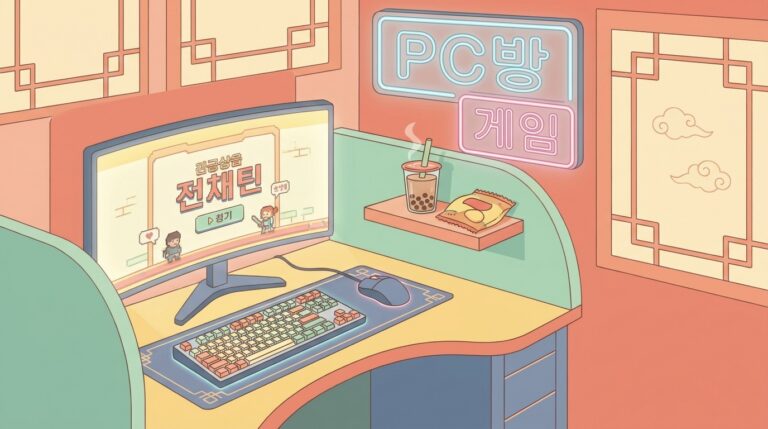
Imagine walking down the neon-drenched streets of Hongdae on a crisp evening. You catch the irresistible aroma of spicy ramyeon and caramelized tteokbokki wafting from a doorway. Following the soft hum of high-end graphics cards and the rhythmic clatter of mechanical keyboards, you step into an iconic Korean PC bang (PC방). Your heart races with excitement: you want to experience the legendary ultra-fast internet, relax in a cloud-like leather gaming chair, and maybe watch your favorite K-pop live stream on a giant 32-inch curved monitor.
Then, you face the first hurdle: a glowing kiosk flashing Korean menus, or a busy counter clerk looking up at you. The screen asks: 회원 (Member) or 비회원 (Non-member)? How many hours do you want? What button do you tap to load your time? If you have ever felt frozen in place, wondering whether you might accidentally lock yourself out or delete someone’s session, take a deep breath. You are definitely not alone! Over the years, countless Daily Hangul students have confessed that entering a Korean PC bang felt more intimidating than going through airport customs.
Do not worry—loading hourly time is actually as simple as ordering coffee once you know the secret pattern. In this beginner guide, we break down real A1-level expressions with zero textbook fluff, so you can walk in, charge your gaming time with total confidence, and start enjoying the ultimate Korean PC bang culture!
Phase 2: 핵심 표현 3선 심층 분석 (Top 3 Core Expressions)
1. 시간 충전할게요 (Sigan chungjeonhalgeyo)
- Pronunciation: [Si-gan chung-jeon-hal-ge-yo] (Think: “See-gahn choong-jeon-hahl-geh-yo” — like ‘charge-on’ with a soft ‘ch’)
- Meaning: Literal: “I will recharge time.” / Real nuance: “I’d like to load some hours onto my computer, please.”
- K-Culture Moment: In slice-of-life K-dramas, university students pop into a PC bang after midterms, hand over a card, and announce this exact phrase before ordering bowls of instant noodles.
- Editor’s Insight: In Korea, time at a PC bang or mobile data is treated like a battery that you “recharge” (충전). Saying this sentence at the front desk instantly marks you as someone who understands how Korean leisure hubs work.
- Situation Spectrum: Casual ⚠️ | Semi-formal ✅ | Formal ✅
- 🤔 Think About It: In English, we say “buy time” or “add hours.” Why do you think Korean uses the word “recharge” (충전), which is identical to charging a phone battery?
2. 비회원으로 할게요 (Bihoewoneuro halgeyo)
- Pronunciation: [Bi-hoe-wo-neu-ro hal-ge-yo] (Think: “Bee-hweh-won-ew-roh hahl-geh-yo” — smooth ‘won’ like Korean currency)
- Meaning: Literal: “I will do it as a non-member.” / Real nuance: “I don’t have an account; I’ll pay as a guest.”
- K-Culture Moment: When visiting idols or travel vloggers drop by a local neighborhood gaming center without a resident registration number, they click the guest button or say this line to get a temporary receipt ticket.
- Editor’s Insight: Most kiosks require a Korean national ID or local phone number to register as a member (회원). As a foreign visitor, choosing “non-member” (비회원) saves you from verification headaches!
- Situation Spectrum: Casual ⚠️ | Semi-formal ✅ | Formal ✅
- 🤔 Think About It: How does your home country handle guest access at internet cafes compared to Korea’s dual member/non-member system?
3. 두 시간 주세요 (Du sigan juseyo)
- Pronunciation: [Du si-gan ju-se-yo] (Think: “Doo see-gahn joo-seh-yoh” — like ‘do’ in English)
- Meaning: Literal: “Two hours, please.” / Real nuance: “Please add two hours to my ticket/seat.”
- K-Culture Moment: The staple phrase used by gamers everywhere in Korea when they want a quick, hassle-free session before dinner.
- Editor’s Insight: At the A1 beginner level, combining a native Korean number (하나, 둘 -> 한, 두) with “시간 주세요” is your universal key for time-based entertainment, including karaoke (노래방)!
- Situation Spectrum: Casual ⚠️ | Semi-formal ✅ | Formal ✅
- 🤔 Think About It: Notice how polite and efficient “주세요” (please give) is in daily Korean. Does asking directly for time feel different than in your mother tongue?
Phase 3: 교과서 한국어 vs 진짜 한국어 (Textbook vs. Real Korean)
Situation 1: Telling the counter staff how long you want to play
- 📖 교과서 한국어: 컴퓨터 사용 시간을 두 시간 연장하고 싶습니다. (Keompyuteo sayong siganeul du sigan yeonjanghago sipseumnida. / I wish to extend my computer usage time by two hours.)
- 🗣️ 진짜 한국어: 두 시간 충전할게요! (Du sigan chungjeonhalgeyo! / I’ll charge two hours!)
- 💡 왜 다를까? Textbook Korean sounds like an official business memo. Real Koreans keep it snappy and practical by combining the duration directly with the verb 충전하다 (to charge).
Situation 2: Informing the clerk that you do not have an account
- 📖 교과서 한국어: 저는 회원 가입이 되어 있지 않습니다. (Jeoneun hoewon gaeibi doe-eo itji anseumnida. / I am not currently registered as an enrolled member.)
- 🗣️ 진짜 한국어: 비회원으로 할게요. (Bihoewoneuro halgeyo. / Non-member, please.)
- 💡 왜 다를까? In fast-paced spaces like internet cafes, staff prefer swift statements of intent rather than background explanations of your membership status.
Phase 4: K-Culture 딥다이브 & 비언어적 매너 (Deep Dive & Manners)
4-1. 눈치 (Nunchi) & Essential Gestures
When using the touch-screen kiosk (무인 충전기), follow the golden rule of Korean counter etiquette:
* Two-Handed Payment: If paying with a physical travel card or cash at the desk, hand it over using both hands, or support your right forearm gently with your left hand. It conveys instant respect.
* Seat Receipt Discipline: When you pay as a 비회원 (non-member), the kiosk prints a small paper receipt containing a temporary PIN or card number (비회원 번호). Keep this slip! You cannot log into your terminal without typing that specific number into the login box on your desk monitor.
* Headset Etiquette: PC bangs are lively, but shouting into open microphones without headphones is considered poor manners. Slip on the plush headset hung beside your screen before opening games or YouTube.
4-2. Culture Code: The “PC-staurant” Phenomenon
Modern Korean PC bangs are no longer dark basements for hardcore gamers; they are gourmet food destinations nicknamed “PC-tourants” (PC방 + 레스토랑). Through a desktop pop-up menu on your screen, you can click to order steaming Shin Ramyun with melted cheese, crispy spam rice bowls, iced Americano, and deep-fried dumplings delivered directly to your desk while you surf. Charging your time is simply the admission ticket to one of the coziest, most affordable food experiences in Seoul!
Phase 5: 실전 롤플레이 시나리오 (Real-World Roleplay)
- Location: A brightly lit, cyber-themed PC bang near Sinchon Station.
- Characters: You (first-time visitor) & Min-jun (friendly part-time staff wearing a black apron).
- You: 🎭 Approaching the front desk after staring nervously at the kiosk screen
안녕하세요! (Annyeonghaseyo! / Hello!) - Min-jun: 🎭 Bowing slightly with a welcoming smile
안녕하세요! 회원 카드로 하세요? (Annyeonghaseyo! Hoewon kadeuro haseyo? / Hello! Are you using a member card?) - You: 🎭 Politely waving hands slightly
아니요, 비회원으로 할게요. (Aniyo, bihoewoneuro halgeyo. / No, I will do it as a non-member.) - Min-jun: 🎭 Nods and gestures to the screen screen selection
네, 몇 시간 충전해 드릴까요? (Ne, myeot sigan chungjeonhae deurilkkayo? / Sure, how many hours should I charge for you?) - You: 🎭 Holding up two fingers with a warm smile
두 시간 충전할게요. (Du sigan chungjeonhalgeyo. / I’ll charge two hours.) - Min-jun: 🎭 Taps the register monitor
삼천 원입니다. 카드 꽂아주세요. (Samcheon-wonimnida. Kadeu kkojajuseyo. / That is 3,000 won. Please insert your card.) - You: 🎭 Inserting card with both hands into the reader
여기요. 감사합니다! (Yeogiyo. Gamsahamnida! / Here you go. Thank you!) - Min-jun: 🎭 Hands over the printed receipt with the login code
영수증에 적힌 번호로 빈자리에 로그인하시면 돼요! (Yeongsujeunge jeokhin beonhoro binjarie rogeu-inhashimyeon dwaeyo! / Just log into any empty seat using the number on this receipt!)
🔀 Interactive Decision Point
Min-jun points to an empty seat with a blinking monitor. What do you do next?
* Choice A (Best): Sit down, look at the screen prompt, type in the guest number from your receipt, and start browsing.
* Feedback (Best): Perfect! You are fully logged in, your time is ticking down smoothly, and the snack-ordering app is right on your desktop.
* Choice B (Risk): Walk over to the clerk and ask: “회원 가입 서류 어디 있어요?” (Where are member registration forms?)
* Feedback (Risk): You might confuse the clerk! Foreign visitors without a Korean Alien Registration Card (ARC) or domestic phone number usually cannot complete formal online registration. Sticking to non-member tickets is much faster.
* Choice C (Bad): Sit down at an occupied terminal that already has a jacket on the chair and try typing your code.
* Feedback (Bad): In Korea, personal belongings on a chair or desk mean the gamer is temporarily away in the restroom or fetching a drink. Always look for a cleared desk with the default blue login wallpaper!
Phase 6: 10초 감정 섀도잉 드릴 (10-Second Emotional Shadowing)
Practice these core lines out loud! Follow the pause markers (/) and embody the emotion tag:
[😊 Friendly & Confident]
안녕하세요! / 비회원으로 / 할게요.
(Annyeonghaseyo! / Bihoewoneuro / halgeyo.)-
[🎯 Clear & Polite]
두 시간 / 충전할게요!
(Du sigan / chungjeonhalgeyo!) -
[🙏 Grateful & Inquisitive]
카드 결제 / 돼요? / 감사합니다.
(Kadeu gyeolje / dwaeyo? / Gamsahamnida.)
Phase 7: K-Culture 미니 사전 (Mini Dictionary)
- PC방 (PC bang): Internet gaming cafe. Beyond computer stations, it acts as a cultural community hub, social venue, and digital diner for locals of all ages.
- 충전 (Chungjeon): Recharge / top-up. Used broadly for battery power, transit T-Money cards, prepaid SIMs, and PC bang hours.
- 비회원 (Bihoewon): Non-member / Guest. The lifesaver category for international travelers navigating Korean self-service kiosks without local phone verification.
- 빈자리 (Binjari): Vacant seat. When entering, you look for a “binjari” with a blank monitor background to sit and enter your access code.
Phase 8: 여행자를 위한 생존 키트 (Traveler’s Survival Kit)
Top 3 Survival Phrases
- 카드 돼요? (Kadeu dwaeyo?) — “Can I pay by card?”
- Pro Tip: Over 99% of modern PC bang kiosks accept international Visa and Mastercard, as well as local tourist cards like WOWPASS.
- 자리 있어요? (Jari isseoyo?) — “Are there open seats?”
- Pro Tip: Use this on Friday and Saturday evenings when trendy branches near universities are packed to capacity.
- 영수증 버려주세요 (Yeongsujeung beoryeojuseyo) — “Please throw away the receipt.”
- Pro Tip: Wait! Do not use this at the PC bang until you have entered your guest PIN into the computer, or you won’t be able to log in!
Editor’s Travel Note
- Navigation Guide: When looking for high-rated spots with English-friendly kiosks, open the Naver Map app navigation and search “PC방” to check interior photos and operating hours.
- Luggage Tip: Traveling with a backpack? Most PC bangs have wide under-desk foot spaces or coat hangers attached behind the seat row.
Phase 9: “한 발 더 깊이” (Deep Cultural Reflection)
In modern Korean cities that never sleep, the term 충전 (Chungjeon – recharging) reflects more than just electronic batteries and computer minutes. For busy high schoolers and exhausted office workers, sinking into a comfortable PC bang booth for two hours is a vital mental recharge. It offers private, air-conditioned sanctuary where one can be entirely alone yet connected to a thrilling collective world.
When you load two hours onto that screen, you are sharing the same rejuvenating ritual that generations of Koreans have cherished after stressful days.
💬 Your Turn: Have you ever visited an internet cafe in your country? How does the idea of eating hot ramyeon while playing games in a PC bang compare to gaming at home? Share your thoughts in the comments below!
Phase 10: FAQ & 오해 방지 (FAQ & Common Mistakes)
Q: Can foreigners sign up for a member discount without a Korean phone number?
A: In most automated systems, a member account requires identity verification through a domestic mobile carrier (본인인증). It is much faster and hassle-free to simply select the 비회원 (Non-member) option. The hourly rate is only a couple of hundred won higher!
Q: What happens if my loaded time runs out while I am playing?
A: A warning box usually pops up on your screen at the 10-minute and 5-minute marks. You can add more time directly from your seat using an electronic payment method, or step back to the kiosk/counter to add more hours to your existing guest number.
Q: Is food included in the hourly rate?
A: No, the hourly fee covers computer access and seat usage. Food and drinks are ordered separately through the on-screen desktop ordering application and paid either online or upon delivery to your desk.
🚨 Common Mistakes Warning Board
- ❌ Mistake 1: Tossing the kiosk receipt into the trash can immediately.
- Correct Action: Keep the paper slip! Your temporary login ID and password are printed on it.
- ❌ Mistake 2: Trying to register an account with an international phone number on the kiosk.
- Correct Action: Tap the big gray or blue 비회원 (Guest/Non-member) button directly to bypass verification.
- ❌ Mistake 3: Leaving the terminal running when you finish your session.
- Correct Action: Click the 사용 종료 (End Session) button on the top right corner of your screen so your remaining time pauses or completes cleanly.
Phase 11: 액션 미션 & 참여 유도 (Action Missions)
- 🥉 Bronze Mission (Solo Practice): Stand in front of a mirror and say: “두 시간 충전할게요!” (Du sigan chungjeonhalgeyo!) three times with a confident smile.
- 🥈 Silver Mission (Social Connection): Share this guide with a gaming buddy or K-culture friend and discuss which PC-staurant dish you would order first (Ramyeon vs. Kimchi Fried Rice).
- 🥇 Gold Mission (Real Life Action): Visit a PC bang during your next trip to Korea, choose 비회원 at the kiosk, load two hours, and snap a proud photo of your login screen!
- 🎮 K-Culture Mission: Watch a clip from a Korean variety show (like Hangout with Yoo or an idol vlog) where cast members visit a PC bang, and spot the moment they order food to their screens!
Phase 12: 인터랙티브 퀴즈 챌린지 (Interactive Quiz)
Test your new skills with these quick checks!
1. Situational Judgment:
You are standing in front of a busy PC bang kiosk. You do not possess a Korean resident card or Korean mobile phone. Which button should you press?
* A) 회원 가입 (Member Registration)
* B) 비회원 충전 (Non-member Recharge)
* C) 관리자 모드 (Admin Mode)
2. Fill-in-the-Blank:
To politely ask the counter clerk for 2 hours, fill in the missing word:
“___ 시간 충전할게요.” (Two hours, please.)
3. True or False:
If you lose your printed kiosk receipt before logging into your computer desk, you can still easily log in with just your first name.
* [True / False]
👉 Click to reveal answer and explanations!
- Answer: B) 비회원 충전 (Non-member Recharge)
- Explanation: As a traveler, selecting non-member lets you pay and play immediately without domestic digital ID verification.
- Answer: 두 (Du)
- Explanation: When counting hours (시간), we use native Korean numbers: 한 시간 (1 hour), 두 시간 (2 hours), 세 시간 (3 hours).
- Answer: False
- Explanation: Non-member logins require the specific temporary digits printed on your receipt slip. Keep that receipt close until you are logged in!
- Explanation: Non-member logins require the specific temporary digits printed on your receipt slip. Keep that receipt close until you are logged in!
🎬 Watch Our Daily Videos! (Daily Hangul Official Instagram)
Review the expressions you learned in this article with our fun daily short videos! Check out native pronunciation and real-life nuances in action.
- Instagram @dailyhangul_en







