

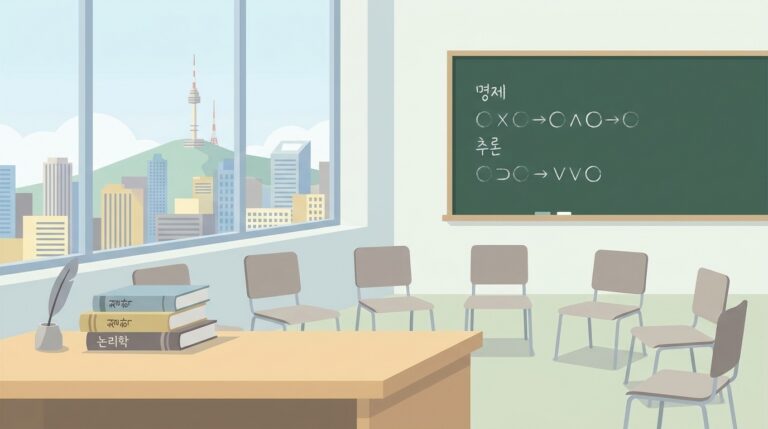
C2 Korean Masterclass: Dissecting Epistemology and Popperian Demarcation
Phase 1: 공감 (Immersive Story Opening)
안녕하세요! 매일한글 에디터입니다.
Imagine this: You are seated in a sunlit seminar room at Seoul National University or having a late-night debate over craft makgeolli in an intellectual lounge in Hyehwa with Korean researchers and scholars. The conversation shifts from AI advancements to what fundamentally separates empirical knowledge from mere speculative illusion. Someone vigorously defends an obscure pop-psychology thesis or an ungrounded wellness theory with dazzling rhetoric. You want to intervene with the razor-sharp precision of Karl Popper: “No matter how plausible that claim sounds, if it provides zero empirical conditions under which it could be refuted, it belongs to dogma or pseudoscience, not science.”
Yet, your tongue hesitates. In English, asserting demarcation between science and dogma is second nature; in Korean, navigating the delicate equilibrium between uncompromising philosophical rigor and diplomatic sociolinguistic tact (ye-ui) feels like walking an intellectual tightrope. Many C2 learners find that while they can talk about everyday life or news headlines effortlessly, framing a high-order epistemological critique in Korean often sounds either awkwardly translated from Western syntax or uncomfortably blunt. This guide is crafted directly from field feedback in Korean academic circles to help you claim intellectual authority with native-level elegance.
Phase 2: 핵심 표현 3선 심층 분석 (Top 3 Expressions)
1. 반박 가능한 경험적 조건을 제시하지 못한다면 과학이 아닙니다 (Banbak ganeunghan gyeongheomjeok jogeon-eul jesihaji mothandamyeon gwahag-i animnida)
- Pronunciation: [Ban-bak ga-neung-han gyeong-heom-jeok jo-geon-eul je-si-ha-ji mot-tan-da-myeon gwa-ha-gi a-nim-ni-da] (Think of ‘Ban-bak’ snapping crisply like a gavel, and ‘gyeong-heom’ flowing smoothly like empirical observation.)
- Meaning: “If it fails to propose empirical conditions under which it can be refuted, it is not science.”
- K-Culture Moment: Heard in investigative reporting programs like SBS Unanswered Questions (그것이 알고 싶다) or during academic symposium debates in medical K-dramas when confronting untested remedies.
- Editor’s Insight: The phrase
경험적 조건(empirical conditions) combined with반박 가능하다(falsifiable) represents the golden standard of Popperian epistemology in Korean academic prose. Ending with-다면 ~에 불과합니다elevates this from an ordinary dispute into a principled philosophical demarcation. - Situation Spectrum:
- Casual: 🚫
- Semi-formal: ⚠️
- Formal: ✅
- 🤔 Think About It: Does Korean debate style privilege social consensus (consensus-building) over analytical confrontation, and how does using passive or conditional constructions soften the critique without diluting truth?
2. 반증 가능성이 결여된 주장은 도그마에 불과합니다 (Banjeung ganeungseong-i gyeol-yeodoen jujang-eun dogeuma-e bulgwahamnida)
- Pronunciation: [Ban-jeung ga-neung-seong-i gyeol-yeo-doen ju-jang-eun do-geu-ma-e bul-gwa-ham-ni-da] (Pronounce ‘gyeol-yeo’ with a fluid liaison like ‘gyul-yeo’.)
- Meaning: “A claim that lacks falsifiability is nothing more than dogma.”
- K-Culture Moment: Frequently utilized in intellectual podcast panels such as Bimil Dokseodan or prestigious university lectures when deconstructing historical ideologies.
- Editor’s Insight:
결여되다(to be deficient/lacking) is far more formal and analytical than simply saying없다(to not have). Pair it with~에 불과하다(nothing more than) to decisively dismiss unfalsifiable positions. - Situation Spectrum:
- Casual: 🚫
- Semi-formal: ⚠️
- Formal: ✅
- 🤔 Think About It: How does utilizing loanwords like 도그마 (dogma) vs. Sino-Korean terms like 독단 (dokdan) alter the emotional distance of your argument in Korean academic circles?
3. 패러다임 전환을 이끌 실증적 균열이 전혀 보이지 않아요 (Paereodaim jeonhwan-eul ikkeul siljeungjeok gyun-yeor-i jeonhyeo bo-iji anayo)
- Pronunciation: [Pae-reo-da-im jeon-hwan-eul ik-keul sil-jeung-jeok gyun-yeo-ri jeon-hyeo bo-i-ji a-na-yo] (Crisp ‘sil-jeung’ followed by a soft, inquisitive cadence on ‘bo-iji anayo’.)
- Meaning: “I see no empirical fissure whatsoever that could precipitate a paradigm shift.”
- K-Culture Moment: Typical phrase in modern tech seminars in Pangyo or Hongdae startup roundtables when analyzing disruptive technological breakthroughs versus superficial trends.
- Editor’s Insight: By weaving Thomas Kuhn’s
패러다임 전환(paradigm shift) with실증적 균열(empirical crack/anomaly), you signal that extraordinary claims require revolutionary empirical anomalies to dislodge the reigning paradigm. - Situation Spectrum:
- Casual: ⚠️
- Semi-formal: ✅
- Formal: ✅
- 🤔 Think About It: In your mother tongue, do you describe shifts in thought organically (like cracks/fissures) or mechanistically?
Phase 3: 교과서 한국어 vs 진짜 한국어 (Textbook vs. Real-world Korean)
Situation 1: Calling out unfalsifiable pseudo-science in a debate
- 📖 교과서 한국어: “그 이론은 반증될 수 없기 때문에 비과학적입니다.” (Geu iron-eun banjeungdoel su eopgi ttaemune bigwahakjeogimnida. – “Because that theory cannot be disproven, it is unscientific.”)
- 🗣️ 진짜 한국어: “어떤 반증 시도에도 빠져나갈 구멍만 마련해 둔 닫힌 체계는 과학이 아니라 유사과학이죠.” (Eotteon banjeung sidodo ppajyeonagal gumeongman maryeonhae dun dachin chegyeneun gwahag-i anira yusagwahag-ijyo. – “A closed system that merely prepares escape hatches against every refutation attempt is pseudoscience, not science.”)
- 💡 왜 다를까? Textbook Korean relies on simple grammatical causal markers (
-기 때문에), whereas sophisticated native discourse prefers evocative imagery like빠져나갈 구멍(escape hatch / loophole) and systemic descriptors like닫힌 체계(closed system).
Situation 2: Critiquing an absolute assertion that ignores counter-evidence
- 📖 교과서 한국어: “당신의 주장은 틀릴 가능성이 전혀 없어서 문제입니다.” (Dangsin-ui jujang-eun teullil ganeungseong-i jeonhyeo eopseoseo munje-imnida. – “Your argument is problematic because it has zero possibility of being wrong.”)
- 🗣️ 진짜 한국어: “반례의 가능성 자체를 원천 차단해 버리면, 그건 학문적 가설이 아니라 맹목적 신념 아닐까요?” (Ballye-ui ganeungseong jache-reul woncheon chadanhae beorimyeon, geugeon hangmunjeok gaseor-i anira maengmokjeok sinnyeom anilkkayo? – “If you preemptively block the very possibility of counter-examples at the source, wouldn’t that be blind faith rather than an academic hypothesis?”)
- 💡 왜 다를까? C2-level Korean uses
원천 차단(blocking at source) and indirect rhetorical questioning (-아닐까요?) to deliver devastating intellectual critiques while honoring scholarly decorum.
Phase 4: K-Culture 딥다이브 & 비언어적 매너 (Deep Dive & Non-Verbal Manners)
4-1. 눈치(Nunchi) & Intellectual Body Language
When engaging in high-level intellectual refutation in Korea, aggressive finger-pointing or sharp vocal escalation will immediately cause your peers to shut down emotionally.
* The Tilt and Pause (고개 갸웃거림): Before delivering an epistemological counter-strike, tilt your head slightly (approx. 5 degrees) as if pondering the opponent’s premise deeply. This non-verbally telegraphs, “I am carefully evaluating your logic, not attacking your person.”
* Open Palm Gesture (손바닥 제스처): Keep your hands open at chest level, palms turned slightly upward or inward, tracing logical premises in the air rather than chopping downwards.
* Softening Terminations: Anchor potent analytical terms (경험적 반증, 도그마) to cushioned sentence-enders like -지 않나 싶습니다 (I wonder if it isn’t…) or -라고 볼 여지가 있습니다 (There is room to view it as…).
4-2. 문화 코드 분석: The Dynamics of K-Debate Culture
In Korean academia and elite media (think of JTBC’s famous Ssulzun or debate panels on public television), public discourse is a performance of dialectical poise. The concept of Chaemyeon (체면, social face) means that stripping someone’s theory down to “dogma” must be accompanied by linguistic devices that attribute the flaw to the theoretical structure, never the opponent’s personal intellect. By using Popper’s and Kuhn’s scientific philosophies, you depersonalize the critique: it is not that your interlocutor is deceitful; it is that their framework has structurally failed the falsification criterion.
Phase 5: 실전 롤플레이 시나리오 (Real-World Roleplay)
- Background: A high-level colloquium on artificial intelligence ethics and ontology at an academic center in Seoul.
- NPC: Professor Kang (강민우 교수) – a rigorous, analytical philosopher of science who admires intellectual courage but despises dogmatism.
대화 (Dialogue):
Turn 1
* 강 교수: 인공지능이 궁극적으로 인간의 직관을 뛰어넘는 초월적 의식을 가질 것이라는 주장은 매우 매력적입니다. 반박할 수 없는 필연적인 미래 같지 않습니까?
(Ingonjineung-i gunggeukjeog-euro in-gan-ui jikgwan-eul ttwieoneomneun chowoljeok uisig-eul gajil geos-iraneun jujang-eun maeu maeryeokjeogimnida. Banbakhal su eomneun pir-yeonjeogin mirae gatji anseumnikka?)
“The argument that AI will ultimately possess a transcendent consciousness beyond human intuition is mesmerizing. Doesn’t it seem like an irrefutable inevitability?”
* 🎭 행동 지문: 안경을 고쳐 쓰며 흥미롭다는 듯 청중을 둘러본다. (Adjusts his glasses and scans the audience with curiosity.)
Turn 2
* 나 (Learner): 교수님 말씀도 일리가 있습니다만, 그 주장은 어떤 반증 조건도 허용하지 않는 면이 있습니다.
(Gyosunim malsseumdo illiga itseumnidaman, geu jujang-eun eotteon banjeung jogeondo heoyonghaji anneun myeon-i itseumnida.)
“Your point certainly has merit, Professor; however, that claim seems to disallow any conditions for empirical falsification.”
* 🎭 행동 지문: 고개를 가볍게 끄덕이며 차분하게 미소를 띤다. (Nods gently with a composed smile.)
Turn 3
* 강 교수: 허용하지 않는다니요? 의식의 발현은 너무나 복합적인 현상이라 기존 잣대로 재단할 수 없을 뿐입니다.
(Heoyonghaji anneundaniyo? Uisik-ui balhyeon-eun neomuna bokhapjeogin hyeonsang-ira gijon jatdaero jaedanhal su eopseul ppunimnida.)
“Disallowing them? The emergence of consciousness is simply too complex to be circumscribed by existing benchmarks.”
* 🎭 행동 지문: 한쪽 눈썹을 치켜세우며 논리적 도전을 환영한다. (Raises an eyebrow, welcoming the dialectical challenge.)
Turn 4
* 나 (Learner): 아무리 그럴듯해 보여도 관찰 가능한 반례나 경험적 검증 조건을 제시하지 못한다면, 그건 과학적 가설이라기보다 일종의 도그마 아닐까요?
(Amuri geureoldeuthae boyeodo gwanchal ganeunghan ballyena gyeongheomjeok geomjeung jogeon-eul jesihaji mothandamyeon, geugeon gwahakjeok gaseor-iragiboda iljong-ui dogeuma anilkkayo?)
“No matter how plausible it sounds, if it fails to offer observable counter-examples or empirical testing conditions, isn’t it more of a dogma than a scientific hypothesis?”
* 🎭 행동 지문: 두 손을 모아 가슴 높이에 두고 차분하게 어조를 낮춘다. (Brings hands together at chest level, lowering tone calmly.)
Turn 5
* 강 교수: 하하, 포퍼의 반증주의를 들고 나오시는군요. 하지만 쿤의 관점에서 보면 이것도 새로운 패러다임의 태동기일 수 있지 않습니까?
(Haha, Popeo-ui banjeungjuui-reul deulgo naosineungunyo. Hajiman Kun-ui gwanjeom-eseo bomyeon igeotdo saeroun paereodaim-ui taedonggi-il su itji anseumnikka?)
“Haha, bringing up Popper’s falsificationism, I see! But from Kuhn’s vantage point, couldn’t this also be the gestation period of a brand new paradigm?”
* 🎭 행동 지문: 책상을 가볍게 두드리며 지적 흥분을 드러낸다. (Lightly taps the desk, showing intellectual excitement.)
Turn 6
* 나 (Learner): 새로운 패러다임 역시 기존 정상과학의 변칙 사례와 실증적 균열을 설명해 낼 때 비로소 설득력을 얻는다고 봅니다.
(Saeroun paereodaim yeoksi gijon jeongsanggwahak-ui byeonchik saryewa siljeungjeok gyun-yeor-eul seolmyeonghae nael ttae biroso seoldeungnyeog-eul eonnendago bomnida.)
“A new paradigm also gains persuasive force only when it successfully accounts for empirical anomalies and cracks within the existing normal science.”
* 🎭 행동 지문: 눈을 똑바로 응시하며 흔들림 없는 단호함을 보인다. (Maintains steady eye contact with unshakeable resolve.)
Turn 7
* 강 교수: 정확한 지적입니다. 반박을 원천 차단하는 순간 학문은 사이비 과학으로 퇴행하고 말죠. 아주 예리한 통찰이었습니다.
(Jeonghwakhan jijeogimnida. Banbag-eul woncheon chadanhaneun sun-gan hangmun-eun saibi gwahag-euro toehaenghago maljyo. Aju yerihan tongchar-ieotseumnida.)
“A precise critique. The moment an inquiry bars refutation at its roots, it regresses into pseudoscience. Very sharp insight.”
* 🎭 행동 지문: 고개를 크게 끄덕이며 펜으로 메모를 적는다. (Nods emphatically and jots down a note with his pen.)
Turn 8
* 나 (Learner): 좋게 평가해 주셔서 감사합니다, 교수님. 이론의 개방성이야말로 진정한 과학적 진보의 출발점이라고 생각합니다.
(Joke pyeong-gahae jusyeoseo gamsahamnida, gyosunim. Iron-ui gaebangseong-iyamallo jinjeonghan gwahakjeok jinbo-ui chulbaljeom-irago saenggakhamnida.)
“Thank you for your generous assessment, Professor. I believe theoretical openness is the genuine departure point of scientific progress.”
* 🎭 행동 지문: 정중하게 고개를 숙여 예를 표한다. (Bows courteously in scholarly gratitude.)
🔀 인터랙티브 분기점 (Branching Decision at Turn 4)
What if you had phrased your response differently at Turn 4?
- Option A (Best): “아무리 그럴듯해 보여도 경험적 반증 조건을 제시하지 못한다면 과학이라기보다는 유사과학이나 도그마에 가깝지 않을까요?”
- Feedback: Perfect C2 balance. Uses the conditional
-다면and softens the verdict with-에 가깝지 않을까요?while retaining maximum conceptual sharpness.
- Feedback: Perfect C2 balance. Uses the conditional
- Option B (Bad – Aggressive & Rigid): “틀렸습니다. 그건 그냥 사이비 종교 같은 도그마일 뿐 과학이 아닙니다.”
- Feedback: Dangerous. Accusing an academic hypothesis of being a “cult-like dogma” causes severe loss of face (Chaemyeon) and terminates fruitful dialectic.
- Option C (Risk – Overly Timid): “음… 제 생각에는 조금 이상한 것 같은데 과학이 아닐 수도 있지 않을까요?”
- Feedback: Fails C2 expectations. Completely loses theoretical precision; misses the chance to invoke epistemological criteria.
Phase 6: 10초 감정 섀도잉 드릴 (Emotional Shadowing Drill)
Practice these with specific pause points (/) and emotional coloring:
[🧐 차분하고 분석적으로 - Calm & Analytical]
“어떤 주장이 아무리 그럴듯해 보여도 / 반박할 수 있는 경험적 조건을 제시하지 못한다면 / 그것은 학문적 가설이 아닙니다.”
(Eotteon jujang-i amuri geureoldeuthae boyeodo / banbakhal su inneun gyeongheomjeok jogeon-eul jesihaji mothandamyeon / geugeos-eun hangmunjeok gaseor-i animnida.)-
[⚖️ 단호하면서도 품격 있게 - Firm yet Dignified]
“모든 반증 시도로부터 안전하게 면역된 이론은 / 과학적 발견이 아니라 / 독단적 신념 체계에 불과하죠.”
(Modeun banjeung sidorobuteo anjeonhage myeon-yeokdoen iron-eun / gwahakjeok balgyeon-i anira / dokdanjeok sinnyeom chegye-e bulgwahajyo.) -
[💡 지적인 호기심을 담아 - Intellectually Curious]
“기존 정상과학의 균열을 설명하지 못하는 가설을 / 우리는 과연 / 새로운 패러다임의 전환이라고 부를 수 있을까요?”
(Gijon jeongsanggwahak-ui gyun-yeor-eul seolmyeonghaji mothaneun gaseor-eul / urineun gwayeon / saeroun paereodaim-ui jeonhwan-irago bureul su isseulkkayo?)
Phase 7: K-Culture 미니 사전 (Mini-Dictionary)
- 반증 가능성 (Banjeung ganeungseong) | Falsifiability
- Essential academic term denoting whether an empirical proposition can be proved false. Essential for research defenses, symposiums, and scientific critiques.
- 패러다임 전환 (Paereodaim jeonhwan) | Paradigm shift
- Widely adopted across both Korean philosophy and the tech/business sphere. Frequently used in venture capital pitches and tech publications in Korea.
- 유사과학 (Yusa gwahak) | Pseudoscience
- The formal term for claims masquerading as science. Distinguishable from the colloquial slur
사이비(charlatanry/cultish).
- The formal term for claims masquerading as science. Distinguishable from the colloquial slur
- 정상과학 (Jeongsanggwahak) | Normal science
- The Kuhnian term for routine scientific research based on an established consensus framework. Highly respected in graduate-level discourse.
Phase 8: 여행자를 위한 생존 키트 (Scholar & Traveler Survival Kit)
High-Level Survival Phrases TOP 3
- 학술적 근거가 무엇인지 구체적으로 여쭤봐도 될까요?
(Haksuljeok geon-geoga mueos-inji guchejeog-euro yeojjwobwado doelkkayo?)- Pro Tip: Use this to politely demand empirical verification during lectures without offending the speaker.
- 그 가설의 경험적 반례는 어떻게 설명될 수 있습니까?
(Geu gaseor-ui gyeongheomjeok ballyeneun eotteoke seolmyeongdoel su itseumnikka?)- Pro Tip: The definitive question to test if a Korean researcher’s thesis is immune to falsification.
- 상호 검증(Peer Review) 과정을 거친 데이터인지 궁금합니다.
(Sangho geomjeung gwajeong-eul geochin de-iteoinji gunggeumhamnida.)- Pro Tip: Highly effective when evaluating health, cosmetics, or tech claims in professional exhibitions in Seoul.
Editor’s Travel Note
If you are visiting Seoul for intellectual and academic exploration, don’t miss the flagship bookstore branches. Check the basement philosophy section at 교보문고 광화문점 서적 검색 서비스 (Kyobo Bookstore Gwanghwamun Book Search) to browse translated monographs of Karl Popper, Thomas Kuhn, and contemporary Korean philosophers. Also, download 네이버 지도 앱 (Naver Map Navigation) to locate historic scholarly salons and university seminar cafes around Daehangno (Hyehwa) and Sinchon.
Phase 9: “한 발 더 깊이” (Cultural Epistemology Essay)
Korean communicative ethos has traditionally prized harmonious consensus (Hwa, 和) and collective face (Chaemyeon). In traditional agrarian and Confucian community life, proposing outright counter-examples was often misconstrued as an interpersonal breach rather than a search for truth. However, modern South Korea boasts one of the most technologically hyper-competitive, analytically rigorous societies on Earth. The contemporary Korean intellectual landscape negotiates this tension through sophisticated grammatical modalization: embedding fierce Popperian refutation inside layers of honorific deference. True mastery of C2 Korean lies not in knowing how to attack an idea, but in using Korean’s refined modal endings to dismantle a dogma while leaving the human dignity of your partner impeccably intact.
💬 Your Turn: Have you ever observed a Korean debate where an argument seemed unfalsifiable? What linguistic strategies did you observe? Share your reflections below!
Phase 10: FAQ & 오해 방지 (FAQ Schema)
Q: Can I use the word ‘사이비’ (Sa-i-bi) instead of ‘유사과학’ (Yu-sa-gwa-hak)?
A: Only in casual contexts. 사이비 carries strong connotations of religious charlatanism or outright fraudulent cults. In an academic or professional debate, always use 유사과학 (pseudoscience) to maintain analytical objectivity.
Q: Is Karl Popper’s falsificationism well-known in Korea?
A: Extremely well-known. Karl Popper’s The Open Society and Its Enemies (열린 사회와 그 적들) and his concept of 반증 가능성 (falsifiability) are staples of the Korean university entrance essay exam (Nonsul) and undergraduate humanities curricula.
Q: How do I express “escape hatch” or ad-hoc hypothesis in sophisticated Korean?
A: Use 임시방편적 가설 (ad-hoc hypothesis) or metaphorically 논리적 퇴로/빠져나갈 구멍 (logical retreat route/escape loophole).
🚨 Common Mistakes Alert
- Mistake: Saying
당신은 틀렸어요(You are wrong).- Correct Action: Attribute the error to the premise:
그 전제에는 논리적 비약이 있는 것으로 보입니다(There appears to be a logical leap in that premise).
- Correct Action: Attribute the error to the premise:
- Mistake: Confusing
반증(falsification/disproof) with방증(circumstantial corroboration).- Correct Action: Ensure you write and pronounce
반증 (反證)when refuting, and방증 (傍證)when referring to indirect supporting evidence.
- Correct Action: Ensure you write and pronounce
- Mistake: Overusing direct negatives like
~아닙니다when critiquing an intellectual superior.- Correct Action: Use indirect epistemic hedging:
~라고 단정 짓기는 어렵지 않을까 합니다(I believe it might be difficult to conclude that definitively).
- Correct Action: Use indirect epistemic hedging:
Phase 11: 액션 미션 & 참여 유도 (Action Missions)
- 🥉 Bronze Mission (Solo): Read the Phase 6 Shadowing Drill out loud 3 times, paying close attention to the pause markers (
/) and capturing the analytical vocal tone. - 🥈 Silver Mission (Interactive): Write a 2-sentence comment using
반증 가능성and-에 불과합니다to critique a superstitious belief (e.g., blood types determining personality). - 🥇 Gold Mission (Real-World): In your next intellectual discussion or language exchange, use the phrase:
그 주장은 어떤 반증 조건도 제시하지 못하고 있어요. - 🎮 K-Culture Mission: Watch a debate scene from a Korean legal/academic drama (e.g., Law School or Stranger) and identify instances where speakers challenge the empirical basis of a hypothesis.
Phase 12: 인터랙티브 퀴즈 챌린지 (Quiz Challenge)
Question 1: Situational Judgment
During a scientific panel, someone states that a new health device operates on an undetectable “cosmic quantum resonance.” What is the most refined C2 response?
* A) “그건 사기꾼이나 하는 소리예요.”
* B) “관찰 가능한 경험적 반증 조건을 제시하지 못한다면, 그것은 과학적 이론이라기보다 유사과학적 도그마에 가깝습니다.”
* C) “당신 주장은 너무 재미있지만 교과서에는 나오지 않습니다.”
Question 2: Fill-in-the-Blank
칼 포퍼에 따르면, 이론이 진정으로 과학적이기 위해서는 스스로가 틀렸음을 입증할 수 있는 ( )을(를) 갖추어야 한다.
Question 3: True / False
In Korean intellectual debate, using the loanword ‘도그마’ (dogma) is strictly forbidden and considered uneducated. (True / False)
👉 정답 및 해설 확인하기 (Click to reveal answers)
- Q1 Answer: B (It articulates the epistemological criterion with immaculate C2 academic poise).
- Q2 Answer: 반증 가능성 (Banjeung ganeungseong – Falsifiability).
- Q3 Answer: False (도그마 is universally accepted and frequently employed in Korean philosophical and sociological writing).
🎬 Watch Our Daily Videos! (Daily Hangul Official Instagram)
Review the expressions you learned in this article with our fun daily short videos! Check out native pronunciation and real-life nuances in action.
- Instagram @dailyhangul_en






