

Phase 1: 공감 (Story Immersion Opening)
안녕하세요! 매일한글 에디터입니다. (Hello! It’s your Daily Hangul editor!)
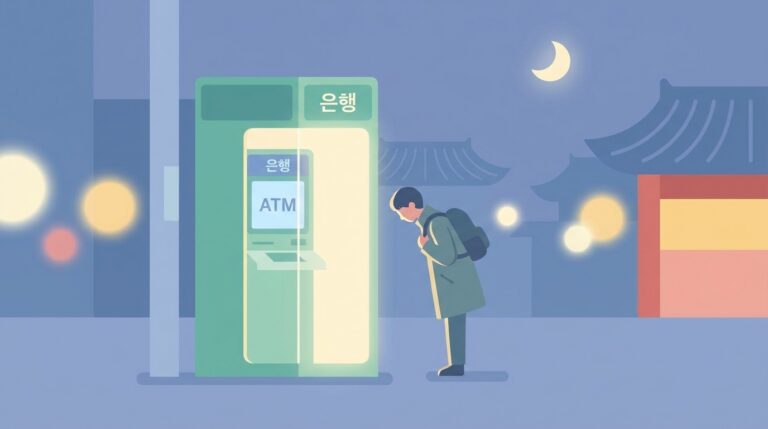
Picture this: You are having the most incredible evening in Hongdae. Neon signs are flashing, the aroma of spicy tteokbokki fills the crisp night air, and you decide to stop by a street-side ATM booth to grab some cash for a cozy pojangmacha (street tent bar). You slide your international travel debit card into the slot, select your withdrawal amount, and hear the satisfying whir of crisp Korean Won bills counting down. You happily take your cash… but then, silence. The ATM screen beeps twice, displays a cryptic flashing message, and your card stays trapped inside. The motorized slot clicks shut. Panic rushes in: Did the machine just swallow my only travel card? What do I do?
If your heart just skipped a beat reading that, don’t worry—you are not alone! Over the past ten years of coaching travelers and expats living in Korea, ATM card capture is hands-down one of the most common panic-inducing moments foreigners face. But here is the good news: Korean ATMs are among the safest and most efficiently monitored in the world. With just a few simple, polite A2-level Korean phrases in your linguistic back pocket, you can resolve this situation calmly and effectively within minutes. Let’s make sure you never feel helpless in front of a Korean ATM again!
Phase 2: 핵심 표현 3선 심층 분석 (Core Expressions)
Here are the three must-know expressions to handle this situation like a seasoned local.
1. 카드가 안 나와요 (Kadeuga an nawayo)
- Pronunciation: [Kadeuga an nawayo] (Pronounce like: Kah-deu-gah ahn nah-wah-yo)
- Meaning:
- Literal: “Card does not come out.”
- Actual Nuance: “My card is stuck” or “My card won’t come out.”
- K-Culture Moment: You will hear characters in slice-of-life K-dramas (like Fight for My Way) use this exact phrase at vending machines or subway ticket kiosks when something jams. It is short, factual, and crystal clear.
- Editor’s Insight: The negative marker 안 (an) directly precedes the verb 나와요 (nawayo – comes out). At the A2 level, saying 안 나와요 is the easiest and most natural way to signal a mechanical jam without needing complicated technical terms.
- Situation Spectrum: Casual: ⚠️ (Use 안 나와 only with close friends) | Semi-formal (Polite): ✅ (카드가 안 나와요) | Formal: ✅ (카드가 나오지 않습니다)
- 🤔 Think About It: In English, we often say “The machine ate my card” or “It won’t give my card back,” assigning intention to the machine. In Korean, simply stating the observable result—the card isn’t emerging—is the most immediate and polite way to explain the issue.
2. 기계가 카드를 먹었어요 (Gigyega kadeureul meogeosseoyo)
- Pronunciation: [Gigyega kadeureul meogeosseoyo] (Pronounce like: Gee-gyeh-gah kah-deu-reul muh-guh-ssuh-yo)
- Meaning:
- Literal: “The machine ate the card.”
- Actual Nuance: “The ATM swallowed my card!”
- K-Culture Moment: A classic, relatable Korean idiom! You will frequently hear YouTube vloggers and comic variety show hosts say this when an automated device swallows money, tickets, or cards unexpectedly.
- Editor’s Insight: Yes, Koreans use the verb 먹다 (meokda – to eat) for machines swallowing cards, just like in English! While it is slightly colloquial, it is completely acceptable when talking to a bank guard or convenience store clerk because it clearly and humorously highlights your predicament.
- Situation Spectrum: Casual: ✅ | Semi-formal (Polite): ✅ (기계가 카드를 먹었어요) | Formal: 🚫 (Avoid in official written banking forms)
- 🤔 Think About It: Isn’t it fascinating how both English and Korean metaphorically describe machines as “eating” items when they trap them? It shows how playful language can be even during minor emergencies!
3. 어떻게 해야 돼요? (Eotteoke haeya dwaeyo?)
- Pronunciation: [Eotteoke haeya dwaeyo] (Pronounce like: Uh-ttuh-keh heh-yah dweh-yo)
- Meaning:
- Literal: “How must [I] do?”
- Actual Nuance: “What should I do? / What are the next steps?”
- K-Culture Moment: If you watch K-dramas, you hear this phrase in almost every crisis scene! The protagonist turns to their trusted friend with wide eyes: “어떻게 해야 돼요?”
- Editor’s Insight: This combines 어떻게 (eotteoke – how) with the obligation grammar ~해야 돼요 (-haeya dwaeyo – must do). It politely asks the listener for practical guidance, showing humility and eagerness to follow local protocol.
- Situation Spectrum: Casual: ⚠️ (Use 어떻게 해야 돼? for peers) | Semi-formal (Polite): ✅ | Formal: ✅ (어떻게 해야 합니까?)
- 🤔 Think About It: Rather than demanding “Help me fix this,” Korean problem-solving often begins with asking for procedure. This shows respect for the other person’s expertise.
Phase 3: 교과서 한국어 vs 진짜 한국어 (Textbook vs. Real Korean)
Let’s compare stiff classroom phrases with what locals actually say when an ATM traps their card:
Situation A: Explaining that the card was retained
- 📖 교과서 한국어 (Textbook): 현금자동입출금기에서 카드가 회수되었습니다. (Hyeongeum-jadong-ipchulgeumgi-eseo kadeuga hoesudoeeotseumnida. – The card has been retrieved inside the automated teller machine.)
- 🗣️ 진짜 한국어 (Real-World): 저기요, 카드가 안 나와요. (Jeogiyo, kadeuga an nawayo. – Excuse me, my card won’t come out.)
- 💡 왜 다를까? (Why the difference?): Nobody says the full formal word for ATM (현금자동입출금기) in an urgent conversation. Calling out a polite 저기요 followed by 카드가 안 나와요 gets instant help without confusing anyone.
Situation B: Asking a nearby clerk or guard for assistance
- 📖 교과서 한국어 (Textbook): 관리 책임자를 호출해 주시겠습니까? (Gwanli chaegimjareul hochulhae jusigesseumnikka? – Could you please summon the designated administrative manager?)
- 🗣️ 진짜 한국어 (Real-World): 여기 인터폰 눌러야 돼요? (Yeogi inteopon nulleoya dwaeyo? – Should I press the interphone button here?)
- 💡 왜 다를까? (Why the difference?): Most ATM booths in Korea connect directly to a remote 24/7 security control center via an emergency phone on the wall. Pointing to the phone and asking simply is what locals actually do.
Phase 4: K-Culture 딥다이브 & 비언어적 매너 (Deep Dive & Manners)
4-1. 눈치 (Nunchi) & ATM Body Language
- Stay right in front of the machine: If your card gets captured, do not walk away immediately. In Korea, ATMs display an error slip or an ATM serial number (기기 번호). Standing by the booth signals to anyone waiting behind you that the booth is temporarily out of order.
- The Two-Handed Gesture: When asking a store clerk or bank security guard for help, point toward the ATM with your open palm facing upward rather than pointing a single index finger. In Korean culture, single-finger pointing can appear aggressive or accusatory.
- Locate the 인터폰 (Interphone): Look right beside or above the ATM screen. You will see a small telephone handset or a prominent red/blue button labeled 호출 (Call) or 인터폰 (Interphone). When you pick it up, it automatically connects to the bank’s security dispatch center without dialing!
4-2. Cultural Code: The 30-Second Security Rule
Why did the machine keep your card? In Korea, fraud prevention is extraordinarily strict. If you take your cash but do not pull your card within 30 seconds, the ATM automatically swallows the card to protect it from being stolen by the next person in line! Koreans refer to this safety mechanism as card capture (카드 회수). It is not a malfunction—it is actually an intentional security feature designed to safeguard your money!
Phase 5: 실전 롤플레이 시나리오 (Real-World Roleplay)
Setting: It is 10:30 PM inside a 24-hour convenience store bank corner near Sinchon Station. Mark (an exchange student) has just withdrawn 50,000 won, but his card didn’t eject. He approaches Mr. Park (박 씨), the friendly store manager who is restocking the milk shelves.
- Mark: 저기요, 죄송한데요… (Jeogiyo, joesonghandeyo…)
🎭 Walks up politely with hands loosely folded in front, speaking with a hesitant smile.
“Excuse me, I am sorry to bother you…” -
Mr. Park: 네, 무슨 일이세요? (Ne, museun iriseyo?)
🎭 Turns around holding a carton of banana milk, listening attentively.
“Yes, what’s the matter?” -
Mark: ATM 기계에서 카드가 안 나와요. (ATM gigye-eseo kadeuga an nawayo.)
🎭 Gently gestures toward the ATM corner with an open hand.
“My card won’t come out of the ATM machine.” -
Mr. Park: 아, 돈은 나왔는데 카드가 안 나왔어요? (A, doneun nawanneunde kadeuga an nawasseoyo?)
🎭 Walks over to the ATM to check the screen.
“Ah, did the cash come out, but not the card?” -
Mark: 네, 맞아요. 기계가 카드를 먹었어요. (Ne, majayo. Gigyega kadeureul meogeosseoyo.)
🎭 Points slightly to the flashing red light on the card slot with a sheepish grin.
“Yes, exactly. The machine swallowed my card.” -
Mr. Park: 시간이 지나서 회수됐나 보네요. 여기 인터폰 보이시죠? (Sigani jinaseo hoesudwaenna boneyo. Yeogi inteopon boisijyo?)
🎭 Taps the red emergency phone mounted on the partition beside the screen.
“It seems it got recalled because time ran out. See this interphone here?” -
Mark: 네, 보여요. 이거 들면 바로 연결돼요? (Ne, boyeoyo. Igeo deulmyeon baro yeongyeoldwaeyo?)
🎭 Looks at the receiver and tilts head inquiringly.
“Yes, I see it. If I pick this up, does it connect right away?” -
Mr. Park: 네, 들고 카드가 안 나온다고 말씀하시면 돼요. 기기 번호 알려주시고요! (Ne, deulgo kadeuga an naondago malsseumhasimyeon dwaeyo. Gigi beonho allyeojusigoyo!)
🎭 Gives a reassuring nod and points to the 4-digit machine number sticker.
“Yes, pick it up and say your card didn’t come out. Make sure to give them this machine number!”
🔀 Interactive Choice Point
You pick up the interphone receiver and hear an automated agent say: “고객센터입니다. 무엇을 도와드릴까요? (Customer service. How may I help you?)” How do you respond?
- Choice A: “야! 내 카드 내놔!” (Ya! Nae kadeu naenwa! – Hey! Give me my card back!)
- ❌ Bad: Extremely rude and aggressive panmal (informal speech). You might shock the operator and cause unnecessary friction.
- Choice B: “카드가 기계 안에 있어요. 기기 번호 1234예요.” (Kadeuga gigye ane isseoyo. Gigi beonho il-i-sam-sa-yeyo. – My card is inside the machine. The machine number is 1234.)
- 🏆 Best! Calm, precise, polite, and provides the essential information immediately. The operator can dispatch a technician or lock the card safely.
- Choice C: Just hang up and walk away to figure it out tomorrow morning.
- ⚠️ Risk: If the machine resets or someone tampers with it, your card could be compromised. Always make the call first to ensure it is locked or held securely.
Phase 6: 10초 감정 섀도잉 드릴 (Shadowing Drill)
Practice reading these out loud with rhythm and the indicated emotional nuance! The slashes (/) represent natural micro-pauses.
[😱 Panic & Urgency]
저기요! / 카드가 / 기계에서 안 나와요!
(Jeogiyo! / Kadeuga / gigye-eseo an nawayo!)
“Excuse me! / My card / isn’t coming out of the machine!”-
[🥺 Humble & Worried]
돈은 나왔는데, / 카드를 먹었어요… / 어떻게 해야 돼요?
(Doneun nawanneunde, / kadeureul meogeosseoyo… / Eotteoke haeya dwaeyo?)
“The cash came out, / but it ate my card… / What should I do?” -
[🙏 Polite & Clear]
여기 / 기기 번호 / 불러드리면 될까요?
(Yeogi / gigi beonho / bulleodeurimyeon doelkkayo?)
“Should I / read out / the machine number here?”
Phase 7: K-Culture 미니 사전 (Mini Dictionary)
-
현금인출기 (Hyeongeum-inchulgi) | ATM / Cash Dispenser
While Koreans often use the English acronym “ATM”, official signs in subway stations and convenience stores read 현금인출기 or CD기. Look for these characters on neon signs! -
호출 버튼 (Hochul beoteon) | Call / Intercom Button
The dedicated assistance button on the machine panel. Pressing this connects you immediately to an operator without having to type phone numbers on your personal phone. -
카드 분실 (Kadeu bunsil) | Card Loss / Lost Card
If you need to report your card lost or canceled, this is the official legal term used in Korean banking applications and telephone voice menus. -
기기 번호 (Gigi beonho) | Machine / Terminal Number
Every standalone ATM in Korea has a unique 4- to 6-digit identification sticker affixed near the screen. Giving this number over the phone tells security personnel your exact GPS location instantly.
Phase 8: 여행자를 위한 생존 키트 (Traveler’s Survival Kit)
Top 3 Survival Phrases
- 1. 카드 분실 신고해 주세요. (Kadeu bunsil singo-hae juseyo.)
Pro Tip: Use this on the phone if your card is swallowed after bank hours and you want to ensure no unauthorized transactions happen. - 2. 영수증이 안 나왔어요. (Yeongsujeungi an nawasseoyo.)
Pro Tip: If the machine keeps your card and fails to print your transaction receipt, use this phrase with the interphone agent. - 3. 영어 가능한 분 계신가요? (Yeongeo ganeunghan bun gyesingayo?)
Pro Tip: Feeling overwhelmed by rapid Korean on the intercom? Ask this politely. Major Korean bank call centers (like Shinhan, KB, and Hana) have dedicated English-speaking representatives.
Editor’s Travel Note
- Emergency Call Tip: If you cannot speak Korean well enough for the intercom, dial the universal tourist helpline by calling the Korea Travel Helpline 1330 (free three-way interpretation service). They will stay on speakerphone and translate between you and the bank security staff!
- Digital Maps: Save your nearest branch using the Naver Map app download to find manned bank branches open during standard banking hours (09:00 to 16:00 on weekdays).
Phase 9: “한 발 더 깊이” (Cultural Essay & Reflection)
Korea is internationally celebrated for its lightning-fast ppalli-ppalli (빨리빨리 – hurry, hurry!) culture. Yet ironically, it is this very dedication to speed and ultra-tight efficiency that catches foreign travelers off guard. Korean banking systems operate under the assumption that a customer takes their cash, takes their card, and steps aside within seconds. When an international visitor pauses to count bills, check their wallet, or review the exchange rate on their smartphone, the ATM assumes the user has walked away and abandoned their card. Rather than an error, the machine’s “greediness” is an automated shield protecting your financial identity from opportunistic theft.
💬 Your Turn: Have you ever experienced an automated machine “eating” your card or ticket while traveling abroad? How did you solve it? Share your story in the comments below!
Phase 10: FAQ & 흔한 실수 (FAQ Schema & Common Mistakes)
Q: Can the convenience store clerk open the ATM and hand my card back to me?
A: No, convenience store staff do not have keys or access to the ATM vault. These machines are managed by third-party armored courier security companies (such as NICE, KIS, or bank security teams). The clerk can only help you locate the interphone.
Q: Will I get my international card back on the spot if a technician arrives?
A: If a technician is dispatched, they will require your passport to verify your identity before opening the capture bin. However, for foreign-issued cards without your printed name matching official ID, bank policy often dictates shredding captured cards for security. It is best to freeze the card on your mobile banking app immediately.
Q: What should I write down before leaving the ATM booth?
A: Always take a photo of the ATM screen, note the 기기 번호 (Machine Number), record the exact time of the transaction, and snap the convenience store or street address.
🚨 Common Mistakes Alert
- Mistake: Yanking or banging on the motorized card slot when it closes.
Correct Action: Never force the slot! It will trigger a loud tamper alarm and can damage your card’s magnetic strip or chip. - Mistake: Walking away without pressing the cancellation button.
Correct Action: Press the bright red 취소 (Cancel) button twice to verify if the session has completely terminated. - Mistake: Forgetting to lock your card via your home bank’s mobile app.
Correct Action: Even though Korean ATMs retain cards securely, open your mobile banking app and toggle your travel card to “Locked/Frozen” as an immediate precaution.
Phase 11: 액션 미션 & 참여 유도 (Action Missions)
- 🥉 Bronze Mission (Solo Shadowing): Stand in front of your bathroom mirror and practice saying: “저기요, 카드가 안 나와요. 도와주세요!” three times with a calm, polite tone.
- 🥈 Silver Mission (Social Challenge): Share your favorite Korean survival phrase from today’s lesson on your Instagram story or Twitter with the hashtag
#DailyHangulEmergencyand tag your study buddy! - 🥇 Gold Mission (Real-World Detection): The next time you walk past an ATM in Korea (or spot one in a K-drama), look for the word 호출 (Call) or 취소 (Cancel) and identify the machine ID number location.
- 🎮 K-Culture Mission: Watch an episode of a modern city K-drama (like Hospital Playlist or Business Proposal) and listen for when characters say “어떻게 해야 돼요?” when faced with an unexpected dilemma!
Phase 12: 인터랙티브 퀴즈 챌린지 (Interactive Quiz)
Test your knowledge with these three practical questions!
1. Situational Judgment
You withdraw cash at an ATM in Seoul, but your card gets trapped. A friendly stranger offers to help. Which phrase should you say to explain the situation clearly?
* A) 카드가 맛있어요. (Kadeuga masisseoyo.)
* B) 카드가 안 나와요. (Kadeuga an nawayo.)
* C) 카드가 비싸요. (Kadeuga bissayo.)
2. Fill in the Blank
Complete the sentence to ask the store clerk what to do next:
“돈은 나왔는데 카드를 먹었어요. ________ 해야 돼요?”
* A) 어디서 (Eodiseo)
* B) 누구 (Nugu)
* C) 어떻게 (Eotteoke)
3. True or False Cultural Quiz
Statement: Korean ATMs will swallow your card if you leave it untouched in the slot for more than 30 seconds after cash withdrawal.
* A) True
* B) False
👉 Click here for answers and explanations!
- Answer: B (카드가 안 나와요)
Explanation: “카드가 안 나와요” means “My card won’t come out.” Option A means “The card is delicious,” and Option C means “The card is expensive!” -
Answer: C (어떻게)
Explanation: “어떻게 해야 돼요?” means “What should I do?” 어디서 means “where,” and 누구 means “who.” -
Answer: A (True)
Explanation: Yes! Korean ATMs automatically retract forgotten cards after approximately 30 seconds as an intentional anti-theft safeguard.
🎬 Watch Our Daily Videos! (Daily Hangul Official Instagram)
Review the expressions you learned in this article with our fun daily short videos! Check out native pronunciation and real-life nuances in action.
- Instagram @dailyhangul_en







