

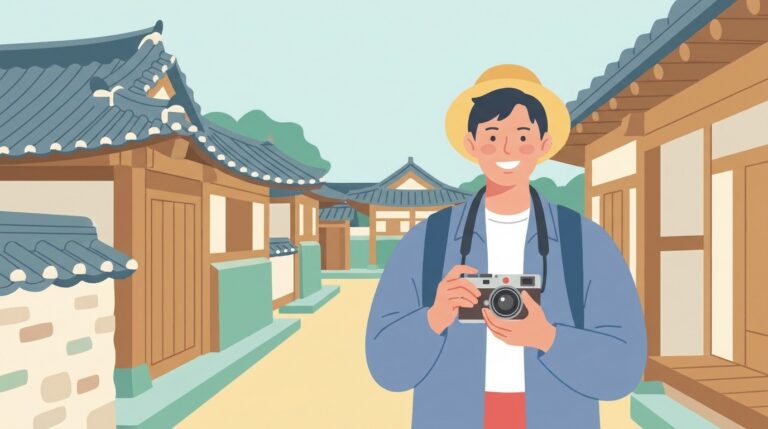
Master the Korean Aspirated Consonant ㅋ with 카메라 (Camera)
Phase 1: 공감 (Story Immersion Opening)
안녕하세요! 매일한글 에디터입니다. (Hello! I’m your Daily Hangul editor.)
Imagine this: You’re standing in front of the stunning autumn foliage at Gyeongbokgung Palace or inside a trendy pastel photobooth in Hongdae. You want to ask someone to take a picture of you, or point to your camera lens, but when you try to say 카메라 (kamera), it sounds flat, like gamera. The person tilts their head, slightly puzzled. You wonder, “Did I say a monster’s name, or did I say camera?”
Don’t worry! This is the single most common stumbling block for beginner Korean learners stepping into 거센소리 (aspirated consonants). In Korean, the difference between the soft ㄱ (g/k) and the strong, bursting ㅋ (k) is all about air pressure. When you master ㅋ, not only will you pronounce words like 카메라 (kamera – camera) and 커피 (keopi – coffee) with absolute confidence, but you will also unlock the joyful world of Korean photo culture. Based on ten years of helping absolute beginners (A1) conquer Hangul sounds, I’ve designed this step-by-step roadmap to make your Korean crisp, natural, and instantly understood.
Phase 2: Core Expressions Deep Dive
1. 카메라 (Kamera)
- Pronunciation: [ka-me-ra] (Hold a tissue in front of your mouth: the initial ‘Ka’ must burst with enough breath to make the tissue fly forward!)
- Meaning: Camera (Loanword from English, referring to both digital cameras and smartphone cameras).
- K-Culture Moment: You hear this constantly at photo spots, K-pop music shows, and self-photo studios: “카메라 보세요!” (Kamera boseyo! – Please look at the camera!)
- Editor’s Insight: In English, you emphasize the first syllable: CA-me-ra. In Korean, keep every syllable even and rhythmic: Ka-me-ra. Don’t drag out the vowels!
- Situation Spectrum: Casual ✅ | Semi-formal ✅ | Formal ✅
- 🤔 Think About It: Why do you think Korean absorbs foreign words like “camera” into its phonetic system rather than inventing a completely separate traditional term?
2. 찰칵 (Chalkak)
- Pronunciation: [chal-kak] (Imagine the crisp, mechanical snap of a shutter closing: chal-kak!)
- Meaning: Click! / Snap! (Onomatopoeia for taking a photo).
- K-Culture Moment: When your Korean friends snap an impromptu photo while you’re eating street food, they’ll laugh and say, “찰칵!” (Chalkak!)
- Editor’s Insight: Both syllables end with stop consonants (ㄹ and ㄱ). Cut the sound off sharply at the end to mimic a real camera shutter.
- Situation Spectrum: Casual ✅ | Semi-formal ⚠️ | Formal 🚫
- 🤔 Think About It: In English, we often say “Say cheese!” while Koreans mimic the shutter sound 찰칵 or say 김치 (Kimchi). How does focusing on sound effects change the mood of taking a photo?
3. 찍어 주세요 (Jjigeo juseyo)
- Pronunciation: [jji-geo ju-se-yo] (Start with a tense ‘jj’ sound like the ‘zz’ in ‘pizza’, followed by a soft and polite ‘juseyo’)
- Meaning: Please take a photo (for me).
- K-Culture Moment: The golden phrase you use when asking someone in Seoul to take your photo at iconic spots like N Seoul Tower.
- Editor’s Insight: The base verb is 찍다 (jjikda), which means “to stamp, prick, or shoot a photo.” Adding ~어 주세요 (~eo juseyo) transforms it into a warm, polite request.
- Situation Spectrum: Casual ⚠️ | Semi-formal ✅ | Formal ✅
- 🤔 Think About It: In many cultures, asking strangers to take your photo feels like an inconvenience. Why are Koreans so uniquely enthusiastic about taking photos for travelers?
Phase 3: 교과서 한국어 vs 진짜 한국어 (Textbook vs. Real Korean)
Situation 1: Asking a passerby to take your picture
- 📖 교과서 한국어: 사진을 찍어 주실 수 있습니까? (Sajineul jjigeo jusil su isseumnikka?) — “Could you possibly take a photograph for me?”
- 🗣️ 진짜 한국어: 사진 한 장만 찍어 주세요! (Sajin han jangman jjigeo juseyo!) — “Could you take just one photo for me, please?”
- 💡 왜 다를까?: The textbook version sounds like a formal diplomatic interview! Adding 한 장만 (han jangman – just one sheet/shot) softens your request immediately, making you sound friendly, considerate, and natural.
Situation 2: Directing a friend’s attention to the lens
- 📖 교과서 한국어: 카메라 렌즈를 응시하십시오. (Kamera renjeureul eungsihasipsio.) — “Please fix your gaze upon the camera lens.”
- 🗣️ 진짜 한국어: 여기 카메라 봐봐! (Yeogi kamera bwabwa!) — “Look at the camera right here!”
- 💡 왜 다를까?: In everyday moments, native speakers keep things short and sweet. 봐봐 (bwabwa) is a casual, warm invitation to look.
Phase 4: K-Culture 딥다이브 & 비언어적 매너 (Culture Deep Dive)
4-1. 눈치 (Nunchi) & Hand Gestures
When handing your phone or camera to a Korean local:
1. The Two-Handed Hand-off: Always hold your phone with both hands or support your right wrist with your left hand. This non-verbal gesture shows immense respect.
2. The Reciprocal Smile: After they take your photo, immediately offer to take theirs. Asking “찍어 드릴까요?” (Jjigeo deurilkkayo? – Shall I take one for you?) is peak Korean social manners (눈치 – nunchi).
4-2. The “Life Shot” (인생샷) Culture
In South Korea, photography is practically an art form of friendship. You will frequently hear the term 인생샷 (Insaeng-syat), which literally translates to “Life Shot” (the single best photo of your entire life). Don’t be surprised if the local you ask crouches all the way down to the pavement or tests multiple angles—they aren’t being silly; they genuinely want to gift you an 인생샷!
Phase 5: 실전 롤플레이 시나리오 (Real-Life Roleplay)
Setting: Bukchon Hanok Village. You are holding your camera, looking for the best angle near a traditional tile-roofed wall. Min-woo, a friendly local carrying an iced Americano, notices you.
- Min-woo: 저기요, 사진 찍어 드릴까요? (Jeogiyo, sajin jjigeo deurilkkayo?) — Excuse me, shall I take a photo for you?
🎭[Smiling warmly, gesturing gently toward your camera] - You: 네! 카메라로 찍어 주세요. (Ne! Kameraro jjigeo juseyo.) — Yes! Please take it with my camera.
🎭[Handing over the camera using both hands with a slight head bow] - Min-woo: 와, 카메라 멋지네요! 어디에 서실래요? (Wa, kamera meotjineyo! Eodie seosillaeyo?) — Wow, cool camera! Where would you like to stand?
🎭[Inspecting the camera frame and looking around] - You: 저기 기와집 앞에서요. (Jeogi giwajip ap-eseoyo.) — Over there in front of the tile-roofed house.
🎭[Politely pointing with an open hand toward the spot] - Min-woo: 좋아요. 하나, 둘, 셋! 찰칵! (Joh-ayo. Hana, dul, set! Chalkak!) — Great. One, two, three! Click!
🎭[Bending his knees to capture an elongated angle] - You: 잘 나왔어요? (Jal nawasseoyo?) — Did it come out well?
🎭[Walking back with an eager, appreciative smile] - Min-woo: 네, 완전 인생샷이에요! 확인해 보세요. (Ne, wanjeon insaengsyat-ieyo! Hwaginhae boseyo.) — Yes, total photo of a lifetime! Please check it out.
🎭[Handing the camera back carefully using both hands] - You: 정말 감사해요! 제가 찍어 드릴까요? (Jeongmal gamsahaeyo! Jega jjigeo deurilkkayo?) — Thank you so much! Shall I take a photo for you?
🎭[Bowing 15 degrees and pointing back to Min-woo with a bright grin]
🔀 Interactive Decision Point
How do you respond after checking your photo?
- Option A: Say nothing, inspect the photo for 3 minutes, then walk away.
- Feedback (Bad): 🚫 This breaks Korean etiquette! A silent exit makes the person feel unappreciated after helping you.
- Option B: Bow slightly, say “정말 감사해요! 제가 찍어 드릴까요?”, and offer to take their picture.
- Feedback (Best): ✅ Perfect! Offering a return photo shows excellent manners and instantly creates warm camaraderie.
- Option C: Ask: “더 찍어 줘!” (Take 50 more photos for me!)
- Feedback (Risk): ⚠️ Using informal speech (반말 – banmal) with a stranger and making excessive demands can cause discomfort.
Phase 6: 10초 감정 섀도잉 드릴 (10-Second Shadowing Drill)
Practice these lines aloud with the emotional cues and pauses (/) marked below:
- [😊 Bright & Friendly]
카메라 / 여기 봐봐! / 찰칵!
(Kamera / yeogi bwabwa! / Chalkak!)
“Look at the camera right here! Click!” -
[🥺 Polite & Modest Request]
사진 / 한 장만 / 찍어 주세요~
(Sajin / han jangman / jjigeo juseyo~)
“Could you please take just one photo for me?” -
[🤩 Delighted & Impressed]
와, / 완전 / 인생샷이에요!
(Wa, / wanjeon / insaengsyat-ieyo!)
“Wow, this is totally the photo of a lifetime!”
Phase 7: K-Culture 미니 사전 (Mini Dictionary)
- 인생샷 (Insaeng-syat) | Photo of a Lifetime
Used when a picture turns out remarkably flattering, capturing ideal lighting and atmosphere. - 포토존 (Poto-jon) | Photo Zone
Designated, well-lit spaces inside Korean cafes, tourist streets, and pop-up stores specifically styled for social media photography. - 브이 (Beu-i) | V-Sign / Peace Sign Pose
The timeless, universal hand pose used by Koreans of all ages as soon as a camera appears. - 인생네컷 (Insaeng-ne-keot) | Life Four Cuts
The iconic self-service 4-frame photo booths found on virtually every bustling street corner in Seoul.
Phase 8: 여행자를 위한 생존 키트 (Traveler’s Survival Kit)
Top 3 Survival Phrases
- 한 장만 찍어 주세요. (Han jangman jjigeo juseyo.) — Please take just one picture for me.
Pro Tip: Tap your camera screen where your face is so the exposure is already set before handing it over! - 여기서 찍어도 돼요? (Yeogiseo jjigeodo dwaeyo?) — Can I take photos here?
Pro Tip: Essential when visiting private cafes, museum exhibits, or traditional markets. - 하나, 둘, 셋! (Hana, dul, set!) — One, two, three!
Pro Tip: Say this count clearly so everyone knows the exact shutter moment!
Editor’s Travel Note
Before roaming around the trendiest photo streets in Seongsu-dong or Ikseon-dong, be sure to complete your 네이버 지도 앱 다운로드 to search for nearby 인생네컷 booths and scenic hidden rooftop cafes. Keep in mind that certain traditional palace buildings and Buddhist temple sanctuaries post signs stating 촬영 금지 (Chwaryeong geumji – No Photography); always look out for this sign before lifting your camera lens!
Phase 9: “한 발 더 깊이” (Deeper Cultural Insight)
In Korea, taking a photograph for someone is an act of 정 (Jeong)—a uniquely Korean concept of heartfelt empathy, bonding, and collective care. When an elderly grandfather or a college student stops on the sidewalk to take your photo, they will often shift their body, verify the lighting, and take five backup shots so you look your absolute best. It reflects a collective mindset where your happy memory becomes part of their personal responsibility in that brief shared moment.
💬 Your Turn: Does your home culture have a special unspoken rule or hand gesture when taking photos with friends? Share your story in the comments below!
Phase 10: FAQ & 흔한 실수 (FAQ Schema)
Q: What is the physical difference between pronouncing ㄱ and ㅋ?
A: The consonant ㄱ (giyeok) has minimal breath release. In contrast, ㅋ (kieuk) is an aspirated sound. To make ㅋ, release a sharp, sudden puff of air from the back of your throat. If you hold your palm 2 inches from your lips, you should feel a distinct burst of warm air when saying 카 (ka), but almost none when saying 가 (ga).
Q: Can I use the English word “Photographer” instead of Korean terms?
A: Yes! While the traditional word is 사진작가 (sajin-jakga), young Koreans frequently use 포토그래퍼 (poteogeuraepeo). However, when talking about personal equipment, always use 카메라 (kamera).
Q: Is it considered rude to ask someone on the street in Korea to take your photo?
A: Not at all! As long as you use polite language (찍어 주세요 – jjigeo juseyo) and offer a two-handed bow, most Koreans will gladly take your photo with enthusiasm.
🚨 Common Mistakes Alert
- Under-aspirating the ㅋ: Pronouncing 카메라 (kamera) as 가메라 (gamera). Remember the candle trick: puff enough air to blow out a flame!
- Using Banmal (Informal Speech): Saying “사진 찍어 줘” (Sajin jjigeo jwo) to a stranger. Always add ~세요 (~seyo) for polite respect.
- One-Handed Phone Passing: Handing your expensive device over with one hand looks dismissive. Always use two hands to convey trust and respect.
Phase 11: 액션 미션 & 참여 유도 (Action Missions)
- 🥉 Bronze Mission: Place a light sheet of tissue paper in front of your mouth. Say 카 (Ka) 5 times until the paper flutters vigorously on every single repetition!
- 🥈 Silver Mission: Open your smartphone camera, look into the lens, and record a 5-second video saying: “하나, 둘, 셋, 찰칵!”
- 🥇 Gold Mission: Visit a Korean photo booth or cafe, and use the phrase “사진 한 장만 찍어 주세요!” with a native speaker or fellow learner.
- 🎮 K-Culture Mission: Watch an episode of a Korean variety show (like Running Man) and listen for the sound effect 찰칵 (Chalkak) whenever the cast takes a group photo!
Phase 12: 인터랙티브 퀴즈 챌린지 (Interactive Quiz)
1. Situation Judgment
You are at Namsan Seoul Tower and want a friendly traveler to take your photo. What should you say?
* A) 사진 찍어! (Sajin jjigeo!)
* B) 사진 한 장만 찍어 주세요. (Sajin han jangman jjigeo juseyo.)
* C) 카메라 보세요. (Kamera boseyo.)
2. Fill-in-the-Blank
Complete the word for ‘camera’:
[ __ ] 메 라
* Hint: It starts with the aspirated burst consonant that makes a tissue fly!
3. True or False
In Korean culture, offering to take a photo in return after someone snaps your picture is considered good manners (눈치 – nunchi).
* (True / False)
🔍 Click here to reveal the answers and explanations!
- Answer: B — 사진 한 장만 찍어 주세요 is polite, natural, and friendly. Option A is rude informal speech to a stranger, and Option C means “Please look at the camera.”
- Answer: 카 (Ka) — The complete word is 카메라 (Kamera). It uses the aspirated consonant ㅋ.
- Answer: True — Offering a reciprocal photo (“제가 찍어 드릴까요?”) is quintessential Korean etiquette!






