

Escape the Cold: How to Enjoy a Korean Jjimjilbang Like a Local
Phase 1: 공감 (Story-Driven Opening)
안녕하세요! 매일한글 에디터입니다.
Imagine this: It is a freezing November afternoon in Seoul. Freezing drizzle is soaking through your sneakers, the wind is biting your cheeks, and every cafe in Hongdae is packed with shivering crowds. You and your friends desperately need a place to escape, unwind, and stay warm for hours without spending a fortune.
Then, you spot the glowing neon sign: 찜질방 (Jjimjilbang – Korean Dry Sauna & Bathhouse).
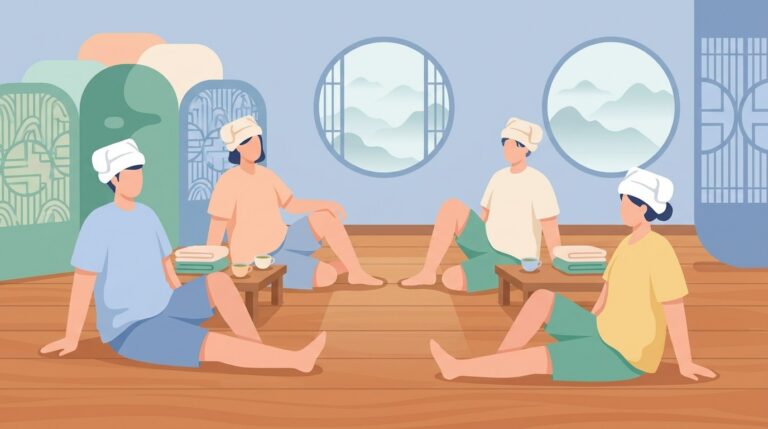
Stepping inside, the aroma of mugwort, roasted barley tea, and warm cypress wood greets you. But suddenly, your heart skips a beat. You are handed an oversized pair of cotton shorts and a t-shirt (찜질복 – jjimjilbok), two hand towels, and an electronic wristband. Your mind races: “Wait, do I take off my shoes right here? Where do I change? What do I say to order that iconic cold rice punch I saw on K-Dramas? And how on earth do I fold that cute sheep-head towel?”
Don’t worry at all! Every foreigner visiting Korea for the first time experiences that exact moment of hesitation. A jjimjilbang is not just a spa; it is Korea’s ultimate indoor playground, community sanctuary, and winter haven all rolled into one. Drawing from over a decade of guiding international travelers and real learner feedback, I’ve created this fail-safe A2-level Korean guide. By the end of this post, you will comfortably walk in, order signature snacks, chat with friends, and make a whole rainy day fly by just like a Seoulite!
Phase 2: 핵심 표현 3선 심층 분석 (Deep Dive into 3 Core Expressions)
Here are the three must-know expressions to navigate any jjimjilbang with confidence.
1. 따뜻해서 너무 좋아요 (한글)
- Pronunciation: [Ttatteuthaeseo neomu joayo] (Sounds like: Tah-teut-hae-seo nuh-moo jo-ah-yo. The double ‘tt’ has a tight, crisp pop like the ‘t’ in ‘stop’.)
- Meaning: Literally “Because it is warm, it is very good.” -> “It’s so warm and cozy, I love it!”
- K-Culture Moment: You will hear this in almost every winter travel variety show (like 2 Days & 1 Night) the second members enter a heated ondol floor room or hot charcoal kiln.
- Editor’s Insight: Koreans use the word 좋아요 (joayo) not just for “I like it,” but to express physical comfort and emotional satisfaction. Adding 따뜻해서 (because it’s warm) makes you sound instantly warm-hearted and natural.
- Situation Spectrum:
- Casual (to friends): 따뜻해서 너무 좋아 (Ttatteuthaeseo neomu joa) ✅
- Semi-formal (to staff / elders): 따뜻해서 너무 좋아요 (Ttatteuthaeseo neomu joayo) ✅
- Formal (business setting): ⚠️ (Too personal for boardrooms, but fine during casual team dinners)
- 🤔 Think About It: In English, we often evaluate the room (“The temperature is nice”), whereas Koreans express how the environment makes them feel inside (“I feel good because it’s warm”). How does your native language express physical coziness?
2. 식혜랑 구운 계란 주세요 (한글)
- Pronunciation: [Sikhyerang guun gyeran juseyo] (Sounds like: Sheek-hye-rahng goo-oon gyeh-ran joo-seh-yo. Blend “Sikhye” smoothly like “seek-yeah”.)
- Meaning: Literally “Sikhye and roasted eggs, please.” -> “Can I get sweet rice punch and baked eggs, please?”
- K-Culture Moment: The quintessential K-Drama snack counter scene! Whether in Crash Landing on You or Legend of the Blue Sea, characters sit cross-legged on the heated floor sipping sweet sikhye from a plastic cup with a bendy straw.
- Editor’s Insight: The particle ~랑 (~rang) is the friendly, conversational way to say “and” when connecting nouns (used when the preceding word ends in a vowel, or ~이랑 after a consonant). It feels much more relaxed and natural at snack bars than the textbook ~와/과 (~wa/gwa).
- Situation Spectrum:
- Casual (between close peers): 식혜랑 계란 줘 (Sikhyerang gyeran jwo) ✅
- Semi-formal (ordering at counter): 식혜랑 구운 계란 주세요 (Sikhyerang guun gyeran juseyo) ✅
- Formal: 식혜와 구운 계란을 부탁드립니다 🚫 (Overly stiff for a cozy snack bar!)
- 🤔 Think About It: Why are baked brown eggs and sweet malt drink the universal food pairing of Korean saunas? It restores hydration and lost minerals after sweating!
3. 하루가 금방 가요 (한글)
- Pronunciation: [Haruga geumbang gayo] (Sounds like: Hah-roo-gah geom-bahng gah-yo. Notice how ‘geumbang’ sounds swift and light.)
- Meaning: Literally “A day goes by quickly.” -> “The whole day just flies by!”
- K-Culture Moment: Used whenever friends realize they arrived at noon, took naps in jade rooms, played arcade games, ate ramen, and suddenly it’s 9:00 PM outside.
- Editor’s Insight: 금방 (geumbang) describes how time feels unexpectedly fast in retrospect or how soon something will happen. When hanging out on a miserable rainy day, this expression is the ultimate compliment to the venue and your company.
- Situation Spectrum:
- Casual: 하루가 금방 가네 (Haruga geumbang gane) ✅
- Semi-formal: 하루가 금방 가요 (Haruga geumbang gayo) ✅
- Formal: 시간이 빠르게 지나갑니다 (Sigani ppareuge jinagamnida) ✅
- 🤔 Think About It: Time “flies” in English like a bird, but in Korean, time “goes quickly” (금방 가요). Notice how Korean often personifies units of time like days (하루) and years (한 해) taking a journey!
Phase 3: 교과서 한국어 vs 진짜 한국어 (Textbook vs. Real-Life Korean)
Situation 1: Ordering drinks at the snack counter (매점)
- 📖 교과서 한국어: 음료수를 마시고 싶습니다. (Eumnyosureul masigo sipseumnida.) – “I wish to consume a beverage.”
- 🗣️ 진짜 한국어: 시원한 식혜 하나 주세요! (Siwonhan sikhye hana juseyo!) – “One cold sweet rice punch, please!”
- 💡 왜 다를까? Koreans rarely say “I want to drink a beverage” in real life. Name the specific item and temperature (시원한 = refreshing/cold), and keep the sentence breezy with “~하나 주세요”.
Situation 2: Reacting to how hot the sauna kiln is
- 📖 교과서 한국어: 이 방의 온도가 매우 높습니다. (I bang-ui ondoga maeu nopseumnida.) – “The temperature of this chamber is exceptionally elevated.”
- 🗣️ 진짜 한국어: 우와, 여기 진짜 뜨끈뜨끈해요! (Uwa, yeogi jinjja tteukkeun-tteukkeunhaeyo!) – “Whoa, it is so pleasantly piping hot in here!”
- 💡 왜 다를까? Native speakers love expressive sensory words like 뜨끈뜨끈하다 (tteukkeun-tteukkeunhada), which conveys deep, soothing, bone-warming heat rather than mere high numerical temperature.
Phase 4: K-Culture 딥다이브 & 비언어적 매너 (Deep Dive & Non-Verbal Manners)
4-1. 눈치 (Nunchi) & Jjimjilbang Etiquette
- The Shoe Locker Rule: The moment you cross the main entrance mat, shoes come off. Place them in the designated shoe locker (신발장), lock it, and keep that wristband key. The same key number often corresponds to your clothing locker inside!
- Gender Zones vs. Common Plaza: Bath zones (목욕탕) are strictly gender-segregated and fully nude. But the huge heating lounge (찜질실 / 공용 거실) is unisex, and everyone wears the provided matching cotton pajamas (찜질복).
- Making the Sheep-Head Towel (양머리): Take your small provided hand towel, fold it lengthwise into three equal folds (like a business letter), and then roll both ends outward like rolling up your shirt sleeves until it fits snugly over your skull. It keeps your hair from overheating and looks adorably iconic for photos!
4-2. Cultural Code Analysis: Why Koreans Love Jjimjilbang on Dreary Days
In Korean culture, communal rest on an 온돌 (ondol – traditional underfloor heating) is deeply therapeutic. In modern apartment life, people rarely spread out flat on warm floors together. A jjimjilbang offers an expansive heated floor where friends lie side-by-side on bamboo mats, chat with zero social pressure, crack roasted eggs against each other’s foreheads, and escape chilly Korean winters.
Phase 5: 실전 롤플레이 시나리오 (Real-Life Roleplay Scenario)
Characters & Setting: You and your Korean classmate Minji just ran inside a cozy neighborhood Jjimjilbang near Sinchon to escape a freezing sleet storm. You are both dressed in your matching mustard-colored jjimjilbok and wearing yangmeori towel hats, walking up to the snack kiosk (maejeom).
- Turn 1 (Minji):
비 맞아서 너무 추웠는데, 여기 들어오니까 살 것 같다!
(Bi majaseo neomu chuwonneunde, yeogi deureoonikka sal geot gatda!)
“I was freezing from the rain, but stepping in here feels like heaven!”
🎭 Shivers slightly, rubbing her arms with a happy grin. -
Turn 2 (You):
맞아요, 바닥이 따뜻해서 너무 좋아요!
(Majayo, badagi ttatteuthaeseo neomu joayo!)
“Totally, the floor is so warm and cozy, I love it!”
🎭 Wiggling your toes on the warm wooden floorboards. -
Turn 3 (Snack Bar Auntie / 이모님):
학생들, 귀엽게 양머리도 했네! 뭐 줄까?
(Haksaengdeul, gwiyeopge yangmeorido haenne! Mwo julkka?)
“You kids even made cute sheep horns! What can I get for you?”
🎭 Smiling warmly while wiping down the counter with a cloth. -
Turn 4 (You):
이모님, 식혜 두 개랑 구운 계란 주세요.
(Imonim, sikhye du gaerang guun gyeran juseyo.)
“Auntie, two cold sikhye drinks and baked eggs, please.”
🎭 Holding up two fingers politely with a bright smile. -
Turn 5 (Auntie):
계란은 세 개에 삼천 원이야. 키 여기 대줘~
(Gyeraneun se gaee samcheon woniya. Ki yeogi daejwo~)
“Eggs are three for 3,000 won. Tap your wristband key right here~”
🎭 Pointing to the digital sensor on the card terminal. -
Turn 6 (You):
네, 결제했어요! 감사합니다.
(Ne, gyeoljehaesseoyo! Gamsahamnida.)
“Yes, I tapped it! Thank you.”
🎭 Tapping your electronic wristband until it goes beep. -
Turn 7 (Minji):
자, 계란은 머리로 깨야 제맛인 거 알지? 딱!
(Ja, gyeraneun meoriro kkaeya jemas-in geo alji? Ttak!)
“Now, you know eggs taste best when cracked on a forehead, right? Crack!”
🎭 Playfully tapping the egg against her own forehead and laughing. -
Turn 8 (You):
하하, 진짜요? 여기서 노니까 하루가 금방 가요!
(Haha, jinjjayo? Yeogiseo nonikka haruga geumbang gayo!)
“Haha, really? Hanging out here makes the whole day fly by!”
🎭 Cracking your egg open and peeling off the warm brown shell.
🔀 인터랙티브 분기점 (Interactive Choice)
The Auntie hands you a steaming basket of baked eggs and says: “소금 필요해? (Do you need salt?)” How do you reply?
- Option A: “아니요, 소금을 거절합니다.” (Aniyo, sogeumeul geojeolhamnida.)
- Feedback (Bad): Too rigid! “I reject the salt” sounds like a diplomatic sanction. Koreans don’t use ‘거절합니다’ at snack bars.
- Option B: “네, 소금 조금만 주세요!” (Ne, sogeum jogeumman juseyo!)
- Feedback (Best): Perfect! Natural, polite, and uses 조금만 (just a little), which native speakers use constantly.
- Option C: “소금 없어.” (Sogeum eopseo.)
- Feedback (Risk): Dangerously informal 반말 (banmal)! Saying this to an elder auntie might make her frown instantly.
Phase 6: 10초 감정 섀도잉 드릴 (10-Second Emotion Shadowing Drill)
Practice reading these out loud, observing the pause marks (/) and emotional cues:
[😊 기쁘고 감탄하며 - Delighted & Warm]
와~ / 바닥이 따뜻해서 / 너무 좋아요!
(Wa~ / badagi ttatteuthaeseo / neomu joayo!)-
[🤤 시원하고 당당하게 - Thirsty & Anticipating]
이모님! / 시원한 식혜랑 / 구운 계란 주세요!
(Imonim! / siwonhan sikhyerang / guun gyeran juseyo!) -
[😌 편안하고 여유롭게 - Cozy & Content]
친구들이랑 쉬니까 / 하루가 / 진짜 금방 가요.
(Chingudeurirang swinikka / haruga / jinjja geumbang gayo.)
Phase 7: K-Culture 미니 사전 (Mini Dictionary)
- 찜질복 (Jjimjilbok) | Sauna Pajama Uniform
- The loose cotton shorts and shirt given upon entry. Everyone wears them in communal relaxation spaces.
- 양머리 (Yangmeori) | Sheep-Head Towel Hat
- The two-knob rolled towel style invented in Korean saunas. It holds your hair together and keeps your head comfortably insulated.
- 식혜 (Sikhye) | Sweet Fermented Rice Punch
- A chilled traditional drink containing grains of cooked rice. Its subtle sweetness and malt enzymes revive your energy after sweating.
- 온돌 (Ondol) | Underfloor Radiant Heating
- The genius Korean heating architecture where heat radiates from beneath floor stones or water pipes. It is the cornerstone of Korean sitting culture.
Phase 8: 여행자를 위한 생존 키트 (Traveler’s Survival Kit)
서바이벌 표현 TOP 3 (Top 3 Survival Expressions)
- 수건 한 장 더 주세요 (Su-geon han jang deo ju-se-yo)
- Meaning: “Could I have one more towel, please?”
- Pro Tip: Usually women receive 2 small towels at reception while men find towels stacked inside the locker room. If you need an extra one, ask the front desk nicely with this phrase.
- 키로 결제할게요 (Ki-ro gyeol-je-hal-ge-yo)
- Meaning: “I will pay with my locker wristband key.”
- Pro Tip: You never need cash or a credit card inside the sauna. You tap your wristband at snack bars, massage chairs, and arcades, then settle the bill at checkout.
- 얼음방 어디예요? (Eor-eum-bang eo-di-ye-yo?)
- Meaning: “Where is the Ice Room?”
- Pro Tip: When you get too hot in the 80°C pine sauna, immediately ask someone for the ice room to cool down your body temperature!
Editor’s Travel Note
- Navigation: Download the 네이버 지도 앱 다운로드 to search for reputable 24-hour saunas nearby (search for “찜질방”).
- Overnight Stays: Many jjimjilbangs allow you to sleep overnight for just 15,000–20,000 KRW! Look for the quiet sleeping hall (수면실 – sumyeonsil) with separate male/female rooms.
Phase 9: “한 발 더 깊이” (A Step Deeper)
In Western cultures, public spaces are typically meant for transit or active dining. In contrast, the Korean jjimjilbang reflects Korea’s unique concept of 바닥 문화 (badak munhwa – floor culture) and collective bonding. When Koreans lie down on a heated communal floor together wearing identical oversized clothes with zero makeup and silly sheep towels, all social masks, job titles, and hierarchies disappear. It is an egalitarian space of pure restorative comfort.
💬 Your Turn: Does your country have a communal place where people lie down, relax, and hang out all day in comfortable clothes? Leave a comment below and share your thoughts!
Phase 10: FAQ & 오해 방지 (FAQ & Common Mistakes)
Q: Do I have to be completely naked in the whole Jjimjilbang?
A: No! The nude section is only the bathhouse area (목욕탕), which is strictly separated by gender. Once you change into the dry sauna uniform (찜질복), you enter the unisex lounge where everyone is fully clothed.
Q: Can I wear my outdoor shoes inside the bathhouse?
A: Absolutely not! You must take off outdoor shoes at the entrance shoe lockers. Inside the bath area, you walk barefoot or use the wet plastic bath slippers provided in wash zones.
Q: How do I fold the towel into sheep horns (양머리)?
A: Lay the towel flat horizontally. Fold the bottom third up, then the top third down. Then roll both the left and right openings outward 3-4 times. Pull the center open and wear it like a cap!
🚨 흔한 실수 (Common Mistakes) 경고판
- ❌ Mistake 1: Jumping into the hot bath tubs without showering first.
- 👉 Correct Action: Always wash your entire body with soap at the shower stalls before stepping into any communal hot tub.
- ❌ Mistake 2: Bringing outside drinks or alcoholic beverages into the lounge.
- 👉 Correct Action: Outside food is prohibited in almost all spas. Buy fresh snacks at the snack bar using your wrist key!
- ❌ Mistake 3: Talking loudly in the designated sleeping rooms (수면실).
- 👉 Correct Action: Keep conversations to a whisper or enjoy chatting in the main central lobby.
Phase 11: 액션 미션 & 참여 유도 (Action Missions)
- 🥉 Bronze Mission (Solo): Grab any hand towel in your bathroom, practice rolling the sheep-head (yangmeori), put it on, and say “따뜻해서 너무 좋아요!” in front of your mirror.
- 🥈 Silver Mission (Social): Snap a selfie wearing your towel sheep hat and share it on Instagram or TikTok with the caption: “식혜랑 구운 계란 주세요! 🥚🥤 #DailyHangul #Jjimjilbang”.
- 🥇 Gold Mission (Real Life): Visit a real Korean Jjimjilbang in Seoul (or a Korean spa in your local city), order sikhye with your wristband key using only Korean, and spend at least 3 blissful hours relaxing.
- 🎮 K-Culture Mission: Watch an episode of a Korean variety show or drama featuring a jjimjilbang scene, spot how they crack the baked egg, and notice how many times they say “시원하다” or “따뜻하다”!
Phase 12: 인터랙티브 퀴즈 챌린지 (Interactive Quiz Challenge)
Test your knowledge before packing your towel!
- Situational Judgment: You are ordering at the Jjimjilbang counter and want to get two sweet rice drinks and three eggs. What is the most natural sentence?
- (A) 식혜 두 개랑 계란 세 개 주세요.
- (B) 음료수 둘 그리고 알 셋을 마시겠습니다.
- (C) 식혜와 계란을 거절하지 않겠습니다.
- Fill-in-the-Blank: 비 오는 날 친구들이랑 찜질방에서 쉬니까 하루가 ________ 가요! (fly by / quickly)
- Hint: Sounds like “geom-bang”
- True or False: You should wear your sauna uniform (찜질복) inside the hot bath tubs.
- (True / False)
👉 Click here to reveal the answers and explanations!
- Answer: (A)
- Explanation: 식혜 두 개랑 계란 세 개 주세요 (Sikhye du gaerang gyeran se gae juseyo) is the textbook-perfect, everyday natural phrasing.
- Answer: 금방 (geumbang)
- Explanation: 하루가 금방 가요 means “The whole day goes by so fast!”
- Answer: False
- Explanation: Hot bath tubs (탕) are strictly entered naked after showering. The uniform is only worn in the dry sauna lounging halls!
- Explanation: Hot bath tubs (탕) are strictly entered naked after showering. The uniform is only worn in the dry sauna lounging halls!







