

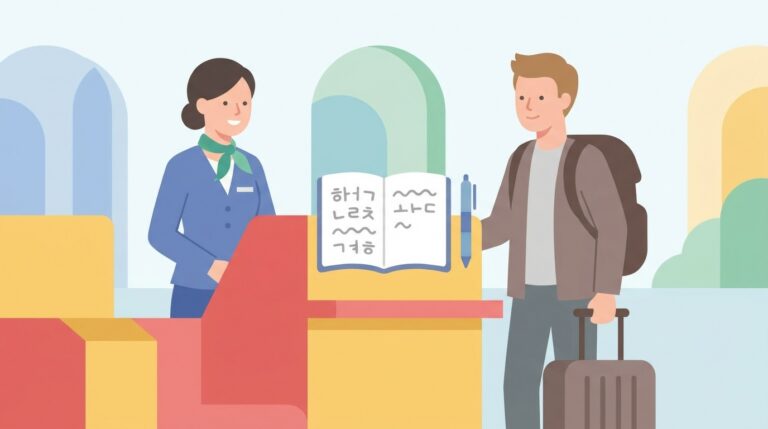
Showing Your Baggage Tag to Report Missing Bags at the Airport
Phase 1: 공감 (Story-driven Opening)
안녕하세요! 매일한글 에디터입니다.
Imagine this: After a long 14-hour flight with a tight layover in Tokyo or Hong Kong, you finally land at Incheon International Airport. Your heart flutters with excitement to dive into late-night K-BBQ and stroll through Hongdae. You stand beside the luggage carousel as K-pop hits hum softly in the terminal background. Bags slide down the belt one by one—a chic metallic suitcase, a cute Kakao Friends trunk… until the belt stops. The crowd disperses, and you are left standing alone in an empty baggage hall.
Panic sets in. Where is your bag? Luckily, you spot the airline’s baggage assistance counter (수하물 분실 서비스 카운터). You clutch the tiny sticker receipt slapped onto your passport boarding pass during check-in. But how do you explain your situation in Korean without freezing up? Today’s guide is designed precisely for this heart-dropping moment. Drawing from real experiences shared by our Daily Hangul learners who survived transit turbulence, we will equip you with natural, courteous, and effective B1-level expressions to show your baggage claim tag, confirm if your bag missed its transfer flight, and request safe delivery to your hotel. Let’s make sure language barriers never keep you from your suitcase!
Phase 2: 핵심 표현 3선 심층 분석
1. 수하물 태그 스티커 여기 있어요. (Suhamul taegeu seutikeo yeogi isseoyo.)
- Pronunciation: [Su-ha-mul tae-geu seu-ti-keo yeo-gi i-sseo-yo] (Think of su-ha-mul sounding like ‘sue-ha-mool’, with a crisp yeogi like ‘yaw-gi’.)
- Meaning: Literal: “Baggage tag sticker is here.” | Nuance: “Here is the baggage claim tag sticker I received at check-in.”
- K-Culture Moment: In travel K-Dramas, whenever an adventurous main character arrives stranded at an airport counter, they pull out their wrinkled ticket showing this sticker to kick off the storyline.
- Editor’s Insight: In Korea, airport staff value efficiency. Handing over the baggage tag (수하물 표 / 태그) immediately saves minutes of searching by name or flight number.
- Situation Spectrum: Casual: 🚫 | Semi-formal: ✅ | Formal: ✅
- 🤔 Think About It: In English, we often say “Can you look up my tag?” In Korean, simply presenting the object with
여기 있어요(Here it is) is polite, efficient, and immediately prompts the agent into problem-solving mode.2. 환승 공항에서 짐이 안 실린 것 같아요. (Hwanseung gonghang-eseo jimi an sillin geot gatayo.)
- Pronunciation: [Hwan-seung gong-hang-e-seo ji-mi an sil-lin geot ga-ta-yo] (Flow hwan-seung smoothly like ‘hwan-seung’ and soften gatayo like ‘gah-tah-yo’.)
- Meaning: Literal: “It seems the baggage was not loaded at the transfer airport.” | Nuance: “I suspect my luggage got left behind during the layover/transit.”
- K-Culture Moment: Used by characters when returning home from study abroad trips, expressing unfortunate transit mishaps without placing direct blame.
- Editor’s Insight: Notice the grammar
-(으)ㄴ 것 같아요(it seems like). Rather than bluntly asserting “You lost my bag!”, Korean speakers soften claims to avoid confrontational blame while stating the facts.- Situation Spectrum: Casual: ⚠️ | Semi-formal: ✅ | Formal: ✅
- 🤔 Think About It: Why do Koreans soften factual statements using “it seems like”? How does this indirectness reflect harmony in customer service encounters?
3. 짐을 찾으면 호텔로 배송해 주실 수 있나요? (Jimeul chajeumyeon hotello baesonghae jusil su innayo?)
- Pronunciation: [Ji-meul cha-jeu-myeon ho-tel-lo bae-song-hae ju-sil su in-na-yo] (Chajeumyeon sounds like ‘chah-jeu-myun’, and baesong echoes ‘bay-song’.)
- Meaning: Literal: “If you find the bag, can you deliver it to my hotel?” | Nuance: “Once my luggage arrives, could you courier it directly to my accommodation?”
- K-Culture Moment: Typical of busy Seoul business executives in dramas who must rush directly to a boardroom from the airport without their suits.
- Editor’s Insight: Korea has one of the world’s most sophisticated door-to-door courier systems (택배 / 퀵서비스). Airlines frequently send delayed transit luggage straight to your accommodation free of charge.
- Situation Spectrum: Casual: 🚫 | Semi-formal: ✅ | Formal: ✅
- 🤔 Think About It: Contrast requesting delivery in your home country versus Korea. In Korea, this service is customary for airline transit delays.
Phase 3: 교과서 한국어 vs 진짜 한국어
- Situation 1: Explaining your missing luggage
- 📖 교과서 한국어: 제 수하물을 분실했습니다. (Je suhamureul bunsilhaesseumnida. / “I have lost my baggage.”)
- 🗣️ 진짜 한국어: 짐이 아직 안 나와서 확인해 보려고요. (Jimi ajik an nawaseo hwaginhae boryeogoyo. / “My bag hasn’t come out yet, so I’d like to check on it.”)
- 💡 왜 다를까? “분실했습니다” implies you personally dropped or misplaced the item. At the carousel, the bag simply “hasn’t come out” (
안 나왔어요), so real native speakers express the status rather than claiming personal loss.
- Situation 2: Asking for status updates
- 📖 교과서 한국어: 어디에 있는지 조사해 주십시오. (Eodie inneunji josahae jusipsio. / “Please investigate where it is.”)
- 🗣️ 진짜 한국어: 위치 조회가 가능할까요? (Wichi johoega ganeunghalkkayo? / “Would it be possible to track its location?”)
- 💡 왜 다를까?
조사하다sounds like a police interrogation or legal audit. In customer service contexts,위치 조회(location tracking/lookup) paired with polite inquiry is standard and polished.
Phase 4: K-Culture 딥다이브 & 비언어적 매너
4-1. 눈치(Nunchi) & 제스처 (Airport Counter Etiquette)
When approaching the baggage desk (수하물 서비스 데스크), avoid waving the baggage tag in the air or slapping it onto the counter. In Korea, hand small physical documents—such as passport sleeves and baggage claim slips—using two hands (두 손) with a slight forward bow of your torso. Maintain calm eye contact without an aggressive stare. When the staff member receives your tag, they will typically inspect it while typing furiously on their terminal. Practicing patience during this keyboard blitz is prime Nunchi (reading the atmosphere); they are checking real-time global airline baggage databases (WorldTracer) on your behalf.
4-2. Cultural Code: ‘택배 강국’ (The Delivery Nation) and Hotel Reception Etiquette
If your luggage was left behind at the transfer airport, the airline will arrange ground transport directly to your hotel once it arrives on the next available flight. In Korean culture, this process is seamless because hotels and guesthouses are well-accustomed to receiving luggage deliveries for guests. Make sure you obtain a Property Irregularity Report (PIR / 분실신고서) with your claim reference number before leaving the airport, and simply inform your hotel front desk with: “항공사에서 제 짐을 배송해 주기로 했어요” (The airline agreed to deliver my bag).
Phase 5: 실전 롤플레이 시나리오
Setting: Incheon Airport Terminal 1, Baggage Claim Service Desk near Carousel 18.
Characters:
* Alex (알렉스): Arrived from Paris via Frankfurt transfer; his suitcase is missing.
* Agent Park Min-ji (박민지 직원): Efficient, courteous baggage claims specialist.
- 알렉스: 안녕하세요, 비행기에서 짐이 안 나와서 문의드리려고요.
(Annyeonghaseyo, bihaenggi-eseo jimi an nawaseo mun-yideuriryeogoyo.)
“Hello, my baggage hasn’t arrived from the plane, so I’d like to make an inquiry.”
🎭 Hands over boarding pass with both hands politely. -
박민지 직원: 아, 그러세요? 탑승권 뒤에 부착된 수하물 태그 스티커 확인해 드릴게요.
(A, geureoseyo? Tapseunggwon dwie buchakdoen suhamul taegeu seutikeo hwaginhae deurilgeyo.)
“Oh, really? Let me check the baggage tag sticker attached to the back of your boarding pass.”
🎭 Takes the pass with both hands and scans the barcode. -
알렉스: 여기 있어요. 프랑크푸르트에서 환승했는데 시간이 좀 촉박했어요.
(Yeogi isseoyo. Peurangkeupureuteu-eseo hwanseunghaenneunde sigani jom chokbakhaesseoyo.)
“Here it is. I transferred in Frankfurt, and the layover time was quite tight.” -
박민지 직원: 전산 확인해 보니, 고객님 짐이 환승 공항에서 누락된 것으로 확인됩니다.
(Jeonsan hwaginhae boni, gogaengnim jimi hwanseung gonghang-eseo nurakdoen geoseuro hwagindoemnida.)
“Checking our system, it is confirmed that your luggage was left behind at the transfer airport.” -
알렉스: 아, 그렇군요. 혹시 다음 비행기로 도착하면 호텔로 배송받을 수 있나요?
(A, geureokgunyo. Hoksi daeum bihaenggi-ro dochakhamyeon hotello baesongbadeul su innayo?)
“Ah, I see. By any chance, when it arrives on the next flight, can it be delivered to my hotel?”
🎭 Shows worried expression while pulling out hotel address on phone. -
박민지 직원: 네, 가능합니다. 오늘 저녁 편으로 도착해서 내일 오전 중 호텔 프런트로 배송될 예정입니다.
(Ne, ganeunghamnida. Oneul jeonyeok pyeoneuro dochakhaeseo naeil ojeon jung hotel peureonteuro baesongdoel yejeong-imnida.)
“Yes, that is possible. It will arrive on this evening’s flight and will be delivered to your hotel front desk tomorrow morning.” -
알렉스: 다행이네요. 분실 신고서 작성하고 접수 번호 받을 수 있을까요?
(Dahaeng-ineyoyo. Bunsil singoseo jakseonghago jeopsu beonho badeul su isseulkkayo?)
“What a relief. May I fill out the irregularity report and receive a reference number?” -
박민지 직원: 네, 여기에 연락처와 호텔 주소를 적어 주시면 바로 서류 발급해 드리겠습니다.
(Ne, yeogie yeollakcheowa hotel jusoreul jeogeo jusimyeon baro seoryu balgeuphae deurigesseumnida.)
“Yes, please write your contact details and hotel address here, and I will issue the document right away.”
🔀 인터랙티브 분기점 (Interactive Choice)
The agent says your bag won’t arrive until tomorrow night, and you need urgent toiletry items today. What do you say?
- Option A: “지금 당장 제 짐 찾아내세요!” (Find my bag right this second!)
- Option B: “지연 보상이나 비상용 생필품 키트(Amenity Kit)를 받을 수 있을까요?” (Could I receive delay compensation or an emergency amenity kit?)
- Option C: “그냥 갈게요, 상관없어요.” (I’ll just leave, it doesn’t matter.)
-
Feedback:
- Option A (Bad): Aggressive confrontation will stall assistance and violates Korean service etiquette.
- Option B (Best!): Professional and respectful. Most international carriers at Incheon offer emergency toiletry kits or small delay stipends upon request.
- Option C (Risk): Leaving without a claim report makes claiming compensation later nearly impossible.
Phase 6: 10초 감정 섀도잉 드릴 (Shadowing Drill)
- Drill 1 [😰 걱정스럽고 정중하게 – Worried & Courteous]
환승 공항에서 / 짐이 안 실린 것 같아요. / 확인 부탁드립니다.
(Hwanseung gonghang-eseo / jimi an sillin geot gatayo. / Hwagin butakdeurimnida.) -
Drill 2 [🙏 간절하고 차분하게 – Earnest & Calm]
수하물 태그 스티커 여기 있어요. / 호텔로 배송 가능한가요?
(Suhamul taegeu seutikeo yeogi isseoyo. / Hotello baesong ganeunghangayo?) -
Drill 3 [📝 명확하고 당당하게 – Clear & Assured]
수하물 지연 신고서 작성하고 / 접수증 받고 싶어요.
(Suhamul jiyeon singoseo jakseonghago / jeopsujeung batgo sipeoyo.)
Phase 7: K-Culture 미니 사전 (핵심 키워드 4선)
- 수하물 태그 (Suhamul taegeu) | Baggage Claim Tag
The barcode sticker provided at check-in counter desks matching your luggage barcode. Always keep this intact until you unpack in your room. - 누락 (Nurak) | Left Behind / Omission
Often used by airline logistics (짐이 누락되었습니다) meaning the bag failed to board the aircraft during transit. - 환승 공항 / 경유지 (Hwanseung gonghang / Gyeong-yuji) | Transfer Airport / Layover City
Crucial vocabulary when explaining multi-leg flights where bags commonly get delayed during short connections. - 지연 보상 (Jiyeon bosang) | Delay Compensation
Airline policies providing reimbursement for essential toiletries and clothing when luggage is delayed past 24 hours.
Phase 8: 여행자를 위한 생존 키트 (Traveler’s Survival Kit)
-
Top 3 Survival Expressions:
- 짐 도착하면 전화나 문자로 알려주시겠어요? (Could you notify me by phone or text when the bag arrives?)
Jim dochakhamyeon jeonhwana munjaro allyeojusigesseoyo?
Pro Tip: Korean staff will send text messages via SMS or KakaoTalk alerting you to courier dispatches. - 호텔 주소 여기 적어 둘게요. (I will write down my hotel address right here.)
Hotel juso yeogi jeogeo dulgeyo.
Pro Tip: Keep your hotel’s Korean address (한국어 도로명 주소) saved on your phone notepad for accurate courier routing. - 보상 관련 규정을 안내받고 싶습니다. (I would like information regarding baggage delay compensation policies.)
Bosang gwallyeon gyujeong-eul annaebatgo sipseumnida.
Pro Tip: Keep all purchase receipts for emergency clothes and toothbrushes purchased in Seoul.
- 짐 도착하면 전화나 문자로 알려주시겠어요? (Could you notify me by phone or text when the bag arrives?)
- Editor’s Travel Note:
Bookmark the official 인천국제공항 수하물 안내 가이드 before departing. If you have an unlocked phone, purchase an eSIM with a local 010 mobile number at the arrival terminal. Couriers (택배 기사님) rely heavily on domestic contact numbers to confirm delivery times at your hotel or Airbnb.
Phase 9: “한 발 더 깊이” (Reflective Cultural Prompt)
In Western customer service cultures, asserting individual rights with firm demands (“Your system failed, fix this immediately”) is standard practice. However, in Korean communication, using humble and collective framing—such as acknowledging that transit delays happen (시간이 촉박해서 누락된 것 같아요)—actually yields faster, more empathetic cooperation from counter staff. By framing the missing luggage as a mutual puzzle to solve rather than an aggressive blame game, staff will gladly go out of their way to track down the luggage and arrange express dispatch.
💬 Your Turn: Have you ever lost your luggage during an international transit? How would you describe the situation in Korean using -(으)ㄴ 것 같아요? Share your sentence in the comments below!
Phase 10: FAQ & 오해 방지 (FAQ Schema)
Q: 수하물 태그 스티커를 잃어버렸으면 어떻게 해야 하나요?
A: If you lost the physical claim sticker, immediately provide your passport and boarding pass to the airline staff. They can cross-reference your passenger reservation record (PNR) and electronic baggage number stored in their database.
Q: 호텔 대신 에어비앤비(Airbnb) 숙소로 배송받을 수 있나요?
A: Yes, but Airbnbs usually lack a reception desk. You must provide the exact building entrance passcode (공동현관 비밀번호) and your active Korean phone number so the courier driver can reach you.
Q: 파손된 짐은 언제까지 신고해야 보상을 받을 수 있나요?
A: Under international aviation agreements (Montreal Convention) adhered to in Korea, damaged luggage must be reported within 7 days of receipt, while delayed baggage claims must be submitted within 21 days.
🚨 흔한 실수 (Common Mistakes) 경고판
- ❌ Mistake 1: Tossing away your paper boarding pass upon leaving the plane gate.
Correct Action: Your baggage barcode is pasted onto that ticket! Keep it safe until your suitcase is physically in your hands. - ❌ Mistake 2: Using the word “도둑맞았어요” (My bag was stolen) when the bag simply didn’t appear on the carousel.
Correct Action: Use “짐이 아직 안 나왔어요” (My luggage hasn’t come out yet) to avoid causing false criminal alarms. - ❌ Mistake 3: Leaving the airport without the official PIR case reference slip.
Correct Action: Always ensure you receive a printout of the baggage inquiry report with a file tracking number before exiting customs.
Phase 11: 액션 미션 & 참여 유도
- 🥉 Bronze Mission (Solo): Practice saying “환승 공항에서 짐이 안 실린 것 같아요” 5 times aloud using the audio pauses from Phase 6.
- 🥈 Silver Mission (Interactive): Write down your accommodation’s Korean address and draft a mock baggage report memo in your Korean notebook.
- 🥇 Gold Mission (Real Application): Next time you fly, identify the baggage claim tag sticker and explain its details in Korean to a study buddy or language partner.
- 🎮 K-Culture Mission: Watch an episode of a travel variety show like Europe Outside Your Tent (텐트 밖은 유럽) or an airport drama scene and spot how cast members handle boarding tickets and luggage.
Phase 12: 인터랙티브 퀴즈 챌린지
1. Situational Judgment:
Your baggage is missing at Incheon Airport after transferring at Dallas. Which phrase is the most natural and polite way to address the counter staff?
(A) 짐 내놓으세요!
(B) 환승 공항에서 짐이 누락된 것 같은데 확인해 주실 수 있나요?
(C) 왜 내 짐을 버렸어요?
2. Fill-in-the-Blank:
탑승권 뒤에 부착된 수하물 ________ 스티커를 보여 주시면 조회해 드리겠습니다. (Hint: Tag)
3. True or False:
In Korea, you must stay waiting at the airport terminal until your missing transit luggage arrives, even if it takes 24 hours. (True / False)
🔍 Click to reveal answers & explanations!
- Answer: (B)
Explanation: (B) uses the polite indirect structure-(으)ㄴ 것 같은데 확인해 주실 수 있나요?to inquire without rude confrontation. (A) and (C) are aggressive and unnatural. - Answer: 태그 (또는 표)
Explanation: 수하물 태그 (baggage tag) or 수하물 표 is the exact term for the baggage receipt barcode. - Answer: False
Explanation: Once you fill out the irregularity report with your address, the airline will deliver the luggage directly to your hotel or residence via door-to-door courier service.







