

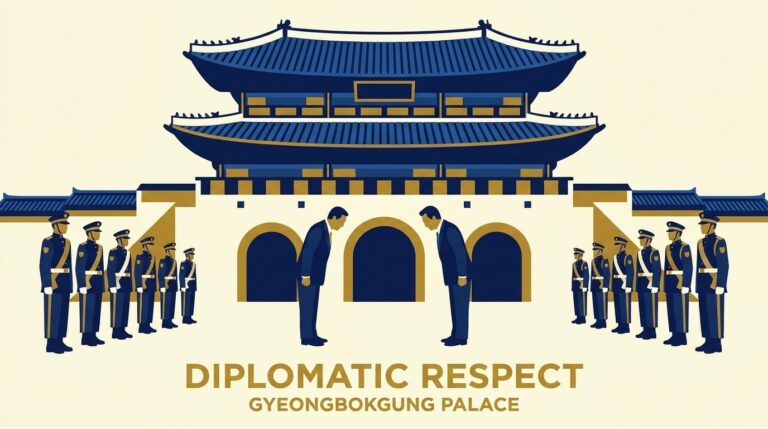
The Silent Grammar of Sovereignty: Mastering State Visits, Precedence, and Banquet Protocol in Korean
안녕하세요! 매일한글 에디터입니다. Have you ever tuned into an international summit broadcast or a high-stakes diplomatic K-drama like Designated Survivor: 60 Days and felt captivated by the sheer precision of the ceremonies? From the thunderous 21-gun salute echoing across the palace grounds to the calculated placement of name cards at a state banquet, every movement feels like an elaborate dance. Yet, for advanced learners reaching for CEFR C2 proficiency, navigating this rarefied sphere of the Korean language often feels like hitting a fortified wall. You might understand common formal honorifics, but when confronted with the esoteric terminology of international protocol—where a single misplaced syllable can inadvertently imply diplomatic subservience or breach national decorum—it is easy to feel intimidated.
Diplomatic protocol is far from mere pomp and hollow pageant. It is the visible grammar of sovereign equality and mutual respect, articulated without raising one’s voice. Having guided foreign diplomats, trade attachés, and corporate executives in Seoul for over a decade, I have seen brilliant Korean speakers stumble simply because they treated protocol as bureaucratic jargon rather than an art form. Today, we will elevate your Korean beyond textbook correctness into the highest echelon of statecraft. Let us unlock the silent language of Korean diplomacy together.
Phase 2: Core Expressions Deep Dive
1. 국빈 예우에 만전을 기하다 (Gukbin ye-ue manjeoneul gihada)
- Pronunciation: [Guk-bin ye-u-e man-jeon-eul gi-ha-da] (Think of guk like ‘cook’ with a soft g, bin like ‘bean’, and manjeon rolling off the tongue like a resolute martial vow).
- Meaning: Literally “To direct one’s entire effort toward the courtesies owed to a State Guest.” In practice, it signifies executing absolute, flawless state-level hospitality without the slightest diplomatic oversight.
- K-Culture Moment: You will hear this phrase uttered by the Chief Presidential Secretary or Director of Protocol in political dramas right before Air Force One touches down at Seoul Air Base.
- Editor’s Insight: The word 만전 (萬全, manjeon) embodies total completeness where zero risk is tolerated. Pairing it with 기하다 (gihada, to commit/aim) shows institutional dedication. Using this in high-stakes corporate hosting demonstrates supreme executive polish.
- Situation Spectrum: Casual 🚫 | Semi-formal ⚠️ | Formal ✅
- 🤔 Think About It: Does your native language view hospitality as an emotional warmth or as a calibrated duty of sovereign parity? In Korean, 국빈 예우 reflects historical statecraft where respect signifies mutual power.
2. 의전 서열을 엄격히 준수하다 (Uijeon seoyoreul eomgyeokhi junsuhada)
- Pronunciation: [Ui-jeon seo-yeo-reul eom-gyeok-hi jun-su-ha-da] (Glide through ui-jeon like ‘wee-jeon’, with a crisp stop at eom-gyeok).
- Meaning: Literally “To strictly adhere to the order of protocol precedence.” It means observing established hierarchical rankings among dignitaries to prevent diplomatic slights.
- K-Culture Moment: Seen in news coverage of state banquets at Yeongbingwan (the State Guest House), where seating charts determine the exact distance of ministers and ambassadors from the heads of state.
- Editor’s Insight: In diplomatic Korean, 서열 (seoyeol) is not about personal ego; it reflects the constitutional weight of the office a person represents. Saying you strictly observe it reassures foreign delegates that their nation is being honored proportionally.
- Situation Spectrum: Casual 🚫 | Semi-formal ⚠️ | Formal ✅
- 🤔 Think About It: How does your home culture handle precedence at official dinners? Is seating determined by chronological age, institutional rank, or alternating gender?
3. 화기애애한 분위기 속에서 건배를 제의하다 (Hwagiaeaehan bunwigi sogeseo geonbaereul je-yihada)
- Pronunciation: [Hwa-gi-ae-ae-han bun-wi-gi sok-e-seo geon-bae-reul je-ui-ha-da] (Pronounce hwa-gi-ae-ae smoothly, echoing the harmony it describes).
- Meaning: Literally “To propose a toast within a harmonious and cordial atmosphere.” It denotes shifting a rigid formal summit into warm, productive bilateral camaraderie.
- K-Culture Moment: Featured prominently in official press releases following bilateral bilateral dinners, summarizing the rapport between state leaders.
- Editor’s Insight: 화기애애 (和氣靄靄) paints an image of peaceful, warm energy filling the room like gentle spring mist. When paired with the honorific verb 제의하다 (je-yihada, to propose), it strikes the perfect balance between ceremonial gravity and genuine goodwill.
- Situation Spectrum: Casual ⚠️ | Semi-formal ✅ | Formal ✅
- 🤔 Think About It: Notice how Korean diplomatic communiqués consistently highlight atmospheric harmony (분위기) alongside formal agreements. Why is ambient harmony so central to East Asian diplomacy?
Phase 3: Textbook Korean vs. Native Diplomatic Korean
Scenario 1: Describing the Bilateral Dialogue
- 📖 Textbook Korean: 대통령들이 만나서 좋은 대화를 나누었습니다. (Daetongryeongdeuri mannaseo joeun daehwareul nanueotseumnida. / The presidents met and had a good conversation.)
- 🗣️ Native Diplomatic Korean: 양국 정상은 시종 화기애애한 분위기 속에서 친교를 다지고 상호 관심사에 대해 심도 있는 의견을 교환했습니다. (Yang-guk jeongsang-eun sijong hwagiaeaehan bunwigi sogeseo chin-gyoreul dajigo sangho gwansimsa-e daehae simdo inneun uigyeoneul gyohwanhaetseumnida. / The leaders of both nations cultivated fellowship throughout in a cordial atmosphere and exchanged in-depth views on mutual interests.)
- 💡 Why the Difference? At a professional C2 level, vague words like ‘좋은’ (good) or ‘대화’ (conversation) are replaced with specific diplomatic idioms such as ‘친교를 다지다’ (strengthen fraternal ties) and ‘의견을 교환하다’ (exchange views), honoring institutional weight.
Scenario 2: Directing Guests to Banquet Seating
- 📖 Textbook Korean: 지정된 자리에 앉아 주시기 바랍니다. (Jijeongdoen jarie anja jusigi baramnida. / Please sit in your designated seat.)
- 🗣️ Native Diplomatic Korean: 사전에 조율된 의전 서열에 입각하여 좌석을 정중히 영접해 드리겠습니다. (Sajeone joyuldoen uijeon seoyore ipgakayeo jwaseog-eul jeongjunghi yeongjeopae deurigetseumnida. / We will courteously guide you to your seat in accordance with the pre-coordinated order of precedence.)
- 💡 Why the Difference? ‘앉아 주시기 바랍니다’ sounds like a transit announcement. In high-level protocol, one ‘receives and ushers’ (영접하다) according to verified diplomatic agreements (조율된 의전 서열).
Phase 4: K-Culture Deep Dive & Non-Verbal Manners
4-1. Nunchi & Spatial Decorum in Diplomatic Protocol
In the theater of international protocol, your body speaks before your mouth opens. When foreign dignitaries arrive, eye contact is measured: neither submissively dropped nor aggressively fixed. A subtle nod from the neck, accompanied by a light clasp of both hands below the waist (공수, gongsu), projects profound poise.
During a state toast (건배), pay acute attention to the rim of your glass. In traditional Korean social settings, juniors lower their glass rim beneath that of seniors. However, in diplomatic protocol, sovereign equality dictates that heads of state and official envoys clink glasses at the exact same level, symbolizing that neither nation stands subordinate to the other. Yet, notice the host’s supporting left hand gently touching the base of their own glass or right forearm—a non-verbal nod of traditional Korean respect melded into modern multilateral equality.
4-2. Cultural Code: The Symbolism of the 21-Gun Salute and Royal Guard
When a head of state arrives for an official State Visit (국빈 방문), they are greeted by a 21-gun salute (예포 21발) and an inspection of the Traditional Guard of Honor (전통 의장대 사열). In Korea, the 21-gun salute originates from the British maritime custom of emptying weapons to show peaceful intentions, but when combined with the colorful traditional garb of the Joseon Chwi-ta-dae (royal marching band), it communicates that modern South Korea welcomes its guest with the prestige of a five-thousand-year heritage.
Furthermore, state banquet menus are rarely random. When dishes like Sinseollo (신선로, Royal Hot Pot) appear, they do not just showcase Korean gastronomy; the harmonious arrangement of five cardinal colors (obangsaek) represents global balance and shared prosperity between the two visiting nations.
Phase 5: Real-World Diplomatic Roleplay Scenario
Setting: Bilateral Protocol Operations Room at the Ministry of Foreign Affairs (MOFA), Seoul. Final briefing minutes before the State Dinner.
Characters: Chief Protocol Officer Min (민 국장, experienced, exacting, impeccably courteous) and Protocol Officer Alex (사무관 알렉스, sharp C2 learner assigned to bilateral seating coordination).
- 민 국장: 알렉스 사무관, 오늘 저녁 국빈 만찬의 좌석 배치는 완벽히 마무리되었습니까? (Alex samugwan, oneul jeonyeok gukbin manchan-ui jwaseok baechineun wanbyeokhi mamurideueotseumnikka? / Protocol Officer Alex, has the seating arrangement for tonight’s State Dinner been finalized flawlessly?)
- 알렉스: 🎭 Taking a crisp standing posture with a dossier held in both hands 네, 국장님. 주빈과 동반 수행원의 의전 서열을 한 치의 오차도 없이 반영했습니다. (Ne, gukjangnim. Jubin-gwa dongban suhaengwon-ui uijeon seoyoreul han chi-ui ochado eopsi banyeonghaetseumnida. / Yes, Director. We have reflected the precedence of the principal guest and accompanying delegation without a millimeter of error.)
- 민 국장: 다행입니다. 상대국 측 대사관과의 사전 조율에서 특이사항은 없었나요? (Dahaeng-imnida. Sangdaeguk cheuk daesagwan-gwa-ui sajeon joyureseo teugisahang-eun eopseonnayo? / That is a relief. Were there any anomalies during the pre-coordination with the guest nation’s embassy?)
- 알렉스: 🎭 Handing over the protocol memo smoothly with both hands 문화적 특성을 고려하여 만찬 메뉴에서 특정 육류를 배제하고, 할랄 대체 코스를 만전의 기를 다해 준비했습니다. (Munhwajeok teukseong-eul goryeohayeo manchan menyueseo teukjeong yungnyureul baejehago, hallal daeche koseureul manjeon-ui gireul dahae junbihaetseumnida. / Considering cultural factors, we excluded specific meats from the dinner menu and prepared a halal alternative course with utmost care.)
- 민 국장: 훌륭한 대처군요. 예포 21발 발사 및 의장대 사열 동선은 경호처와 최종 확인했습니까? (Hullyunghan daecheogunyo. Yepo isip-il-bal balsa mit uijangdae sayeol dongseon-eun gyeonghocheowa choejong hwaginhaetseumnikka? / Excellent handling. Have you conducted the final check with the Presidential Security Service regarding the 21-gun salute and Guard of Honor inspection routes?)
- 알렉스: 네, 정각 18시 영빈관 도착에 맞춰 양국 정상의 동선이 겹치지 않도록 리허설을 마쳤습니다. (Ne, jeong-gak sip-pal-si yeongbingwan dochag-e matchwo yang-guk jeongsang-ui dongseon-i gyeopchiji antorok riheoseoreul macheotseumnida. / Yes, we finished rehearsals to ensure the routes of both leaders do not conflict, timed precisely for their 18:00 arrival at the State Guest House.)
- 민 국장: 완벽합니다. 주권국가 간의 예우는 사소한 디테일에서 결정되는 법이지요. (Wanbyeokhamnida. Jugweon-gukga gan-ui ye-uneun sasohan diteireseo gyeoljeongdoeneun beobijiyo. / Perfect. Courtesy between sovereign nations is decided by the smallest details.)
- 알렉스: 명심하겠습니다. 국빈 예우에 빈틈이 없도록 끝까지 긴장을 늦추지 않겠습니다. (Myeongsimhagetseumnida. Gukbin ye-u-e binteum-i eoptorok kkeutkkaji ginjang-eul neutchuji anketseumnida. / I will keep that in mind. I will remain vigilant until the end to ensure not a single flaw occurs in our state honors.)
🔀 Interactive Decision Point
During the pre-banquet cocktail, a high-ranking foreign delegate accidentally walks toward the head of state’s private waiting room. How do you intervene?
- Option A: “저기요, 거기는 VIP 전용 구역이라 들어가시면 안 됩니다!” (Jeogiyo, geogineun VIP jeonyong guyeogira deureogasimyeon an doemnida! / Hey, that is a VIP-only area, you cannot enter!)
- Option B: “귀빈 여러분, 잠시 후 만찬장으로 안내해 드릴 예정이오니 이쪽 영빈 라운지에서 잠시 담소를 나누어 주시겠습니까?” (Gwibin yeoreobun, jamsi hu manchanjang-euro annaehae deuril yejeong-ioni ijjok yeongbin raunjieseo jamsi damsoreul nanueo jusigetseumnikka? / Distinguished guests, we will guide you to the banquet hall momentarily; may I invite you to converse in the Reception Lounge here?)
- Option C: Say nothing and quickly alert the armed presidential security guards to physically block the path.
[Feedback Analysis]
- Option A (Bad): Using casual '저기요' and blunt prohibition creates a diplomatic incident and embarrasses a foreign dignitary.
- Option B (Best): Masterful protocol intervention. It gently redirects movement without uttering a negative word, preserving the delegate's dignity while maintaining strict security perimeter control.
- Option C (Risk): Excessive reaction. Introducing visible physical security enforcement into an ambient diplomatic reception creates unnecessary geopolitical tension.
Phase 6: 10-Second Emotion Shadowing Drill
Practice these lines aloud, honoring the pause marks (/) and capturing the solemn authority of diplomatic Korean.
- [🏛️ 중후하고 절제된 어조로 – Solemn and restrained tone]
대한민국 정부는 / 국빈의 방한을 진심으로 환영하며 / 최고의 예우를 다할 것을 약속드립니다.
(Daehanminguk jeongbuneun / gukbin-ui banghan-eul jinsim-euro hwanyeonghamyeo / choego-ui ye-ureul dahal geoseul yaksokdeurimnida.)
“The Government of the Republic of Korea / sincerely welcomes the state visit of our honored guest / and pledges the highest courtesies of state.” -
[🤝 상호 존중과 결의를 담아 – With mutual respect and resolute clarity]
양국 간의 유구한 우호 협력 관계를 바탕으로 / 번영의 미래를 향해 / 함께 나아가길 희망합니다.
(Yang-guk gan-ui yugu-han uho hyeopnyeok gwan-gyereul batangg-euro / beon-yeong-ui miraereul hyanghae / hamkke na-agagil huimanghamnida.)
“Based upon the longstanding ties of friendship and cooperation between our two nations / toward a future of prosperity / we aspire to advance forward together.” -
[🥂 정중하고 품격 있는 건배 제의 – Refined and dignified toast delivery]
양국의 영원한 우정과 / 양국 정상의 건승을 기원하며 / 건배를 제의합니다.
(Yang-guk-ui yeong-wonhan ujeong-gwa / yang-guk jeongsang-ui geonseung-eul giwonhamyeo / geonbaereul je-yihamnida.)
“Wishing for eternal friendship between our nations / and the continued health of both leaders / I propose a toast.”
Phase 7: K-Culture Mini Dictionary
-
예포 21발 (Ye-po i-sip-il-bal) | 21-Gun Salute
The highest military honor rendered to foreign heads of state during official arrivals, signaling the absence of hostility and sovereign parity. -
의장대 사열 (Ui-jang-dae sa-yeol) | Inspection of the Guard of Honor
A solemn ceremony where visiting state leaders walk along the ranks of honor guards, symbolically inspecting defensive readiness and mutual alliance strength. -
환담 (Hwan-dam) | Cordial Tête-à-tête
A warm, informal preliminary dialogue held between heads of state or high-level delegates before formal plenary sessions, establishing emotional rapport. -
공동성명 (Gong-dong-seong-myeong) | Joint Communiqué / Declaration
The official consensus document issued mutually at the conclusion of a summit, detailing bilateral treaties, agreements, and shared diplomatic stances.
Phase 8: Traveler’s Protocol Survival Kit
When attending high-level diplomatic, NGO, or bilateral trade functions in Seoul, keep these three survival phrases ready:
- Top 1: 귀빈을 정중히 모시겠습니다. (Gwibin-eul jeongjunghi mosigetseumnida.)
Pro Tip: Use this when ushering VIP guests. It replaces the basic “이쪽으로 오세요” with aristocratic poise. - Top 2: 의전 계획에 의거하여 순서대로 진행하겠습니다. (Uijeon gyehoege uigeohayeo sunseodaero jinhaenghagetseumnida.)
Pro Tip: The ideal response to soothe an anxious organizer asking why an event segment is delayed. - Top 3: 양국의 번영과 상호 우호를 위해 잔을 들겠습니다. (Yang-guk-ui beon-yeong-gwa sangho uhoreul wihae jan-eul deulgetseumnida.)
Pro Tip: The quintessential formal banquet toast opening for foreign trade reps and researchers alike.
Editor’s Travel Note: Navigating Seoul’s Diplomatic Enclave
If your travels take you to official meetings near Gwanghwamun or the Yongsan Government Complex, punctuality is absolute. For smooth transit, check transport updates directly via the 네이버 지도 앱 다운로드 to anticipate traffic holds caused by diplomatic motorcades (의전 차량 행렬). For formal dress codes, state functions in Korea strictly observe dark lounge suits (평복 정장) or traditional national costume (hanbok or your own home country’s formal attire).
Phase 9: “One Step Deeper” (Thinking Reflection)
In Western diplomacy, protocol is deeply rooted in Westphalian sovereignty: legal equality among states regardless of geographic size or economic wealth. In East Asia, historical international relations operated through the Confucian concept of Ye (禮, propriety/decorum), where moral conduct and proper forms maintained regional harmony. Modern Korean diplomatic protocol beautifully synthesizes these two philosophical strands. While adhering strictly to the Vienna Convention on Diplomatic Relations, the Korean State still weaves in the ancient concept of Jeong (정) and deep-rooted respect for human relationships. Protocol here is not cold choreography; it is an ethical pledge that you recognize your guest’s nation as your equal partner under heaven.
💬 Your Turn: How does your native language balance legal equality with hospitality when welcoming foreign dignitaries? Does your culture favor rigid ceremony or relaxed informality at top-level state meetings? Share your thoughts below!
Phase 10: FAQ & Common Pitfalls
Q: Can I use “당신” (Dangsin) to address a foreign ambassador or diplomat?
A: Never. While dangsin can mean ‘you’ in songs or between spouses, in formal diplomatic Korean it borders on an insult. Always address officials by their exact institutional title with the honorific suffix: e.g., 대사님 (Daesanim, Your Excellency Ambassador) or 장관님 (Janggwannim, Honorable Minister).
Q: How do I propose a toast at a formal diplomatic dinner without sounding overly stiff?
A: Use the formula: [Purpose of the event] + 을/를 기원하며, 건배를 제의합니다. For example: “양국의 무궁한 번영을 기원하며, 건배를 제의합니다.” (Wishing for the boundless prosperity of both nations, I propose a toast.) This strikes the golden mean of elegance.
Q: Why do Korean protocol officers use passive or humble verb constructions constantly?
A: In high-register Korean, suppressing direct agency lowers the speaker’s ego and highlights the institutional process. Instead of saying “내가 결정했다” (I decided), officers say “합의된 의전 원칙에 따라 진행됩니다” (It proceeds in accordance with agreed protocol principles).
🚨 Common Mistakes Alert
- Mistake: Saying “건배합시다!” (Geonbaehapsida!) at a state or corporate banquet.
Correct Action: Use “건배를 제의하고자 합니다” (I would like to propose a toast). Saying ‘합시다’ sounds demanding and abrupt to senior dignitaries. - Mistake: Confusing 의전 서열 (Precedence) with 나이 순서 (Age hierarchy).
Correct Action: At international events, institutional rank and bilateral accreditation dates take precedence over chronological age. - Mistake: Clinking glasses aggressively above a senior official’s glass.
Correct Action: Hold your glass level to honor sovereign equality, but steady the base of your glass with your left hand to reflect Korean cultural deference.
Phase 11: Action Mission & Engagement
- 🥉 Bronze Level: Stand before a mirror and practice delivering the Phase 6 Toast Shadowing Drill without glancing down at your notes.
- 🥈 Silver Level: Write a 2-sentence formal toast in Korean for your country’s national day and post it on your study social media or in our comments section.
- 🥇 Gold Level: Watch a Korean news briefing covering a recent state visit (국빈 방문) and extract three diplomatic nouns used by the spokesperson (e.g., 예우, 정상회담, 친선도모).
🎮 K-Culture Mission: Tune into an episode of a political K-drama (such as Chief of Staff or The Whirlwind) and spot the exact moment protocol seating or motorcade order becomes a plot point!
Phase 12: Interactive Protocol Quiz Challenge
Test your diplomatic mastery below! (Click each toggle to verify your answers.)
1. Situational Judgment
At a bilateral trade summit dinner, you must announce the seating of the foreign delegation head. Which phrasing is most appropriate?
* A) 여기 명당자리에 앉으시면 됩니다. (Yeogi myeongdangjarie anjeusimyeon doemnida.)
* B) 사전에 협의된 의전 서열에 따라 좌석으로 정중히 안내해 드리겠습니다. (Sajeone hyeobuidoen uijeon seoyore ttara jwaseog-euro jeongjunghi annaehae deurigetseumnida.)
* C) 아무 데나 편한 자리에 착석하십시오. (Amu dena pyeonhan jarie chakseokhasipsio.)
View Answer & Explanation
Correct Answer: B
Explanation: Option B incorporates key C2 protocol terms: ‘사전에 협의된’ (mutually agreed beforehand), ‘의전 서열’ (protocol precedence), and ‘정중히 안내해 드리겠습니다’ (courteously guide). Option A uses casual colloquialisms (명당자리), and Option C is an unacceptable diplomatic breach.
2. Fill-in-the-Blank
국빈 방문 시 주권국가 간의 평등과 최고의 존중을 표하기 위해 발사하는 대포 의례를 ( )라 부른다.
(Hint: 21 rounds)
View Answer & Explanation
Correct Answer: 예포 21발 (Ye-po i-sip-il-bal)
Explanation: The 21-gun salute is the international benchmark of highest state honors reserved exclusively for heads of state.
3. Cultural True or False
Statement: In Korean diplomatic protocol, because sovereign nations are strictly equal, you must never use two hands when raising your glass to toast a foreign leader.
View Answer & Explanation
Correct Answer: False
Explanation: While glasses clink at an equal horizontal level to represent sovereign parity, supporting the base or forearm with the other hand expresses refined Korean etiquette and cordiality without compromising diplomatic equality.







