

Phase 1: Empathy & Storytelling Opening
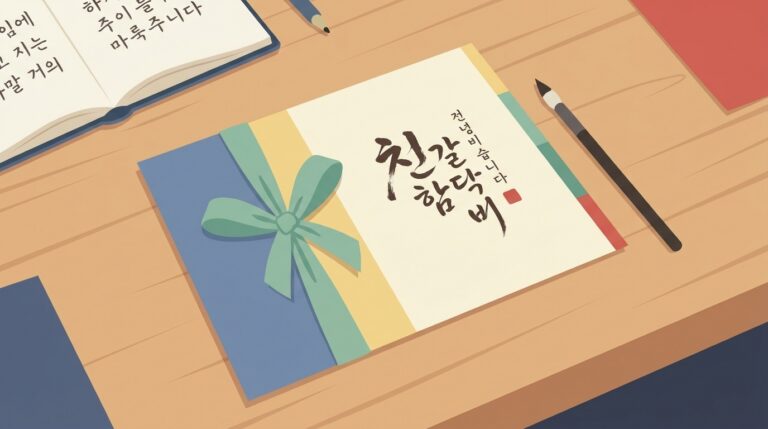
안녕하세요! 매일한글 에디터입니다. Welcome back to our language lounge! Have you ever watched a high-stakes K-Drama like Queen of Tears or Reborn Rich and noticed those breathtaking scenes where an invitation arrives? It isn’t an informal Slack message or a quick email ping; it is an embossed Hanji card wrapped in silk norigae, bearing words so poetic and stately that the recipient immediately pauses in reverent contemplation.
Now imagine this: your Korean company or academic institution tasks you with drafting the official invitation for an upcoming global summit or VIP gala. You want to say, “Please come if you have time, it will be fun,” but translated directly into Korean, that sounds embarrassingly casual—or worse, dismissive of your esteemed guests. Many advanced learners hit an invisible wall here: you know fluent daily Korean, but when stepping into the realm of high-level protocol (의전, Uijeon), ordinary politeness simply isn’t enough. Today, we bridge that gap. Based on ten years of coaching corporate executives and diplomats, this guide breaks down the gold standard of formal invitation protocol: ‘바쁘신 일정 중에도 부디 왕림하시어 자리를 빛내 주시기 바랍니다’ (Bappeusin iljeong jung-edo budi wangnimhasi-eo jarireul binnae jusigi baramnida). Let’s master the linguistic elegance that turns an ordinary event into an unmissable royal summons.
Phase 2: Core Expressions Deep Dive
1. 바쁘신 일정 중에도 부디 참석하시어 자리를 빛내 주시기 바랍니다 (Bappeusin iljeong jung-edo budi chamseokhasi-eo jarireul binnae jusigi baramnida)
- Pronunciation: [Bah-ppeu-shin il-jeong joong-eh-doh boo-dee cham-seok-hah-shi-uh jah-ree-reul been-neh joo-shee-gee bah-rahm-nee-dah] (Flow smoothly: connect 참석하시어 without hard stops, sounding like cham-seok-ha-syeo in natural cadence).
- Meaning: “Despite your busy schedule, we earnestly hope you will attend and grace our gathering with your luminous presence.”
- K-Culture Moment: You will hear this phrase uttered at VIP red-carpet movie premieres in Chungmuro, annual chaebol foundation anniversaries, or high-profile diplomatic receptions.
- Editor’s Insight: The phrase ‘자리를 빛내다’ literally means ‘to illuminate the seat’. In high Korean etiquette, the host humbly implies that their event venue is just an empty, dim shell until the distinguished guest arrives and makes it radiant.
- Situation Spectrum: Casual 🚫 | Semi-formal ⚠️ | Formal ✅
- 🤔 Think About It: Notice how the host takes zero credit for the event’s prestige, attributing 100% of the glory to the guest. Does your native culture frame invitation politeness through personal flattery or communal humility?
2. 부디 왕림하시어 자리를 함께해 주시기를 청하옵니다 (Budi wangnimhasi-eo jarireul hamkkehae jusigireul cheonghaomnida)
- Pronunciation: [Boo-dee wahng-neem-hah-shee-uh jah-ree-reul hahm-kkeh-heh joo-shee-gee-reul cheong-hah-ohm-nee-dah] (왕림 sounds like wang-neem due to nasalization).
- Meaning: “We respectfully petition you to honor us with your august visit and share this occasion.”
- K-Culture Moment: Seen in classical period dramas (사극) or on traditional wedding invitations (청첩장) delivered to venerable elders and mentors.
- Editor’s Insight: 왕림 (往臨) contains the Chinese character 臨 (to descend from above to oversee). It historically denoted a monarch’s arrival. Using it treats the guest as royalty. The ending -청하옵니다 is an archaically ultra-polite petition.
- Situation Spectrum: Casual 🚫 | Semi-formal 🚫 | Formal ✅
- 🤔 Think About It: In English, “your royal visit” sounds sarcastic unless addressing a literal monarch. In Korean formal protocol, why is historic royal vocabulary still cherished in elite business contexts?
3. 공사다망하신 중에도 (Gongsadamanghasin jung-edo)
- Pronunciation: [Gong-sah-dah-mahng-hah-sheen joong-eh-doh] (Emphasize the rhythm of each Sino-Korean syllable evenly).
- Meaning: “Even amidst being overwhelmingly occupied with both official duties and personal matters.”
- K-Culture Moment: The opening line of every official congratulatory letter (축전) sent between university presidents, politicians, and CEOs during New Year or national galas.
- Editor’s Insight: This four-character idiom (사자성어) combines 공 (公, public), 사 (私, private), 다 (多, many), and 망 (忙, busy). It expresses profound consideration (배려) by recognizing that the recipient carries heavy public duties while managing private life.
- Situation Spectrum: Casual 🚫 | Semi-formal ⚠️ | Formal ✅
- 🤔 Think About It: Acknowledging that someone has a private life outside work is considered ultimate tact in Korean protocol, contrasting with Western corporate letters that focus strictly on professional schedules.
Phase 3: Textbook Korean vs. Real Protocol Korean
Situation 1: Inviting an Honorary Guest to an Annual Corporate Gala
- 📖 교과서 한국어 (Textbook): 우리 회사 행사에 꼭 와 주시면 좋겠습니다. (Uri hoesa haengsa-e kkok wa jusimyeon jokessseumnida. – “It would be great if you definitely come to our company event.”)
- 🗣️ 진짜 한국어 (Real Protocol): 뜻깊은 자리에 부디 참석하시어 자리를 빛내 주시기 바랍니다. (Tteutgipeun jari-e budi chamseokhasi-eo jarireul binnae jusigi baramnida. – “We earnestly hope you will grace this meaningful occasion with your honored presence.”)
- 💡 왜 다를까? (Why the Difference?): Textbook phrasing relies on “와 주세요” (please come), which sounds like an informal request between peers. Protocol Korean elevates the event from a mere “행사” (event) to a “뜻깊은 자리” (meaningful occasion) and honors the attendee as the light of the venue.
Situation 2: Following Up on an Unanswered VIP Invitation
- 📖 교과서 한국어 (Textbook): 아직 안 오실 건지 결정 안 하셨나요? 답장 주세요. (Ajik an osil geonji gyeoljeong an hasyeonnayo? Dapjang juseyo. – “Haven’t you decided if you aren’t coming yet? Please reply.”)
- 🗣️ 진짜 한국어 (Real Protocol): 공사다망하신 줄 아오나, 참석 여부를 회신해 주시면 행사진행에 큰 도움이 되겠습니다. (Gongsadamanghasin jul a-ona, chamseok yeobureul hoesinhae jusimyeon haengsajinhaeng-e keun do-umi doegessseumnida. – “We know how heavily occupied you are with both public and private matters, yet your kind RSVP would greatly aid our event preparations.”)
- 💡 왜 다를까? (Why the Difference?): Demanding an answer directly violates the cardinal rule of Korean Che-myeon (face saving). Blaming their delay on their immense importance (공사다망) gives them a face-saving exit while still obtaining the RSVP.
Phase 4: K-Culture Deep Dive & Non-Verbal Manners
4-1. 눈치 (Nunchi) & Protocol Etiquette
When delivering a formal physical invitation in Korea, how you physically present the paper envelope matters as much as the calligraphy inside.
* The Two-Handed Angle: Never hand an invitation card with one hand. Hold the envelope with both hands, thumbs positioned along the top edge without covering the guest’s printed name. The typography must face the recipient so they can read their name immediately without rotating the card.
* The Modest Bow: Accompany the presentation with a 30-degree respectful bow (인사). Keep your gaze dropped momentarily toward the envelope before making soft, deferential eye contact. Avoid sharp, unblinking gazes, which signify defiance rather than sincerity.
4-2. The Cultural Symbolism of the ‘Chungcheopjang’ Envelope
In modern Korea, formal corporate letters and high-end wedding invitations (청첩장) are tactile power symbols. High-ranking dignitaries evaluate an organization’s protocol competence (의전 격식) based on whether the stationery uses mother-of-pearl (자개) motifs, traditional Korean mulberry paper (한지), and correct honorific suffixing like 귀하 (Gwiha – Esteemed Sir/Madam) or 좌하 (Jwaha – Venerable Elder). A single spelling mistake or an excessively casual tone in an invitation will result in executive attendees declining due to perceived protocol disrespect.
Phase 5: Real-World Roleplay Scenario
Setting: Elena (Global Communications Director) is reviewing a bilingual gala invitation card with Team Leader Kang (Protocol Advisor) at a Grand Hyatt conference room in Seoul.
- Elena: 팀장님, 이번 한-글로벌 바이오 포럼 VIP 초청장 문안을 작성해 보았습니다. (Timjangnim, ibeon han-geullobeol ba-io poreum VIP chocheongjang munan-eul jakseonghae boassseumnida. / “Team Leader, I have drafted the VIP invitation copy for the Korea-Global Bio Forum.”)
- 🎭 행동 지문: Elena hands over the silk-embossed proof using both hands.
- Team Leader Kang: 어디 한번 볼까요? 흠, 전반적으로 정갈하지만 마지막 맺음말이 조금 캐주얼하네요. (Eodi hanbeon bolkkayo? Heum, jeonbanjeog-euro jeonggalhajiman majimak maejeummari jogeum kaejueolhaneyo. / “Let me see. Hmm, overall it is neat, but the concluding sentence is slightly too casual.”)
- Elena: 아, ‘시간 되시면 꼭 오셔서 축하해 주세요’라고 썼는데, 격식이 부족한가요? (A, ‘sigan doesimyeon kkok osyeoseo chukhahae juseyo’rago sseonneunde, gyeoksigi bujokhangayo? / “Ah, I wrote ‘If you have time, please definitely come and congratulate us.’ Is it lacking in formal etiquette?”)
- Team Leader Kang: 장관님들과 해외 석학들이 오시는 의전 자리입니다. 이럴 때는 관용적 의전 표현을 구사해야 행사의 품격이 올라갑니다. (Janggwannimdeulgwa hae-oe seokhag-i osineun uijeon jari-imnida. Ireol ttaeneun gwanyongjeok uijeon pyohyeon-eul gusahaeya haengsaui pumgyeogi ollagamnida. / “Ministers and international scholars are attending this protocol event. In times like this, using established protocol idioms elevates the stature of our gathering.”)
- Elena: 그렇다면 문장을 어떻게 다듬는 것이 좋을까요? (Geureotamyeon munjang-eul eotteoke dadeumneun geosi joeulkkayo? / “How should I refine the phrasing then?”)
- Team Leader Kang: 게스트의 귀한 발걸음을 칭송하는 표현을 넣어 보세요. (Geseutu-ui gwihan balgeor-eum-eul chingsonghaneun pyohyeon-eul neoeo boseyo. / “Incorporate expressions that praise the guest’s precious steps.”)
🔀 Interactive Decision Point
How should Elena rewrite the final sentence for the VIP invitation card?
- Option A: “바쁘시겠지만 꼭 와서 자리를 빛내 주세요!” (Bappeusigessjiman kkok waseo jarireul binnae juseyo!)
- Option B: “바쁘신 일정 중에도 부디 왕림하시어 자리를 빛내 주시기 바랍니다.” (Bappeusin iljeong jung-edo budi wangnimhasi-eo jarireul binnae jusigi baramnida.)
- Option C: “시간이 허락되시면 우리 행사에 참석해 주십시오.” (Sigani heorakdoesimyeon uri haengsa-e chamseokhae jusipsio.)
Feedback:
* Option A (Risk): While ‘자리를 빛내다’ is present, ‘와서 … 주세요’ is an informal polite ending. Using this with state ministers or foreign diplomats borders on insolence.
* Option B (Best!): Flawless protocol execution. It pairs ‘바쁘신 일정 중에도’ (humble consideration) with ‘부디 왕림하시어’ (reverent elevation) and ‘자리를 빛내 주시기 바랍니다’ (classic closing honorific).
* Option C (Bad): Functional, but cold and sterile. “시간이 허락되시면” sounds like an administrative reminder rather than a warm, prestigious protocol summons.
Phase 6: 10-Second Emotion Shadowing Drill
Drill your muscle memory with these exact cadence pauses (/):
- [👔 Courteous & Dignified Dignitary Tone]
- 바쁘신 / 일정 중에도 / 부디 왕림하시어 / 자리를 빛내 주시기 바랍니다.
- (Bappeusin / iljeong jung-edo / budi wangnimhasi-eo / jarireul binnae jusigi baramnida.)
- “Despite your busy schedule… / please grace us with your arrival… / and illuminate our gathering.”
- [🙏 Profoundly Grateful & Reverent Cadence]
- 공사다망하신 줄 아오나 / 부디 귀한 발걸음 하시어 / 뜻깊은 시간을 함께해 주십시오.
- (Gongsadamanghasin jul a-ona / budi gwihan balgeor-eum hasi-eo / tteutgipeun sigan-eul hamkkehae jusipsio.)
- “Fully acknowledging your public and private commitments… / we pray you make this precious journey… / and share this meaningful occasion with us.”
Phase 7: K-Culture Mini Dictionary
- 왕림 (往臨, Wangnim): Noun. An honored or august visit. Composed of ‘go’ (往) and ‘descend/arrive’ (臨). Used strictly when referring to a revered guest coming to the speaker’s event; never use it to describe your own visits.
- 혜량 (惠諒, Hyeryang): Noun. Gracious understanding, generous magnanimity. Often combined as 혜량하여 주시기 바랍니다 (We ask for your kind understanding) when an event has limited seating or changes.
- 귀한 발걸음 (Gwihan Balgeoreum): Idiomatic phrase. Literally “precious steps.” Used in verbal and written protocols to thank people for taking the time and effort to physically walk into your venue.
- 배상 (拜上, Baesang): Formal suffix. “Respectfully submitted with a deep bow.” Placed after the host’s name at the very end of invitations or letters (e.g., 홍길동 배상).
Phase 8: Traveler & Expat Protocol Survival Kit
Survival Expressions Top 3
- 귀한 걸음 해 주셔서 진심으로 감사드립니다. (Gwihan georeum hae jusyeoseo jinsimeuro gamsadeurimnida.)
- Pro Tip: Say this at the reception desk the second a VIP guest walks through the door.
- 일정 편하실 때 회신 부탁드리겠습니다. (Iljeong pyeonhasil ttae hoesin butakdeurigessseumnida.)
- Pro Tip: A diplomatic way to request an RSVP without sounding pushy.
- 부디 참석하시어 자리를 빛내 주시면 더없는 영광이겠습니다. (Budi chamseokhasi-eo jarireul binnae jusimyeon deoeomneun yeonggwang-igessseumnida.)
- Pro Tip: Use this in written invitations to express that their attendance is the highest conceivable honor.
Editor’s Travel & Protocol Note
If you ever need to produce bespoke VIP invitations while in Seoul, skip standard copy shops. Head to the historic print masters in Euljiro or Chungmuro. Search for artisan letterpress and traditional Hanji embossing services via the 네이버 지도 앱 다운로드 platform by querying “을지로 인쇄골목 청첩장/초대장”. Always deliver high-level invitations at least three to four weeks prior, packaged in an unstamped envelope if delivered by hand.
Phase 9: “One Step Deeper” (Humanities Essay)
In contemporary Western professional settings, brevity is the supreme form of respect: “Join us if your schedule permits” is valued for not wasting time. However, traditional Korean protocol operates on an entirely distinct cultural frequency governed by relational aesthetics (인간관계의 미학).
When a host writes “자리를 빛내 주시기 바랍니다” (Please illuminate our seat), they are enacting the philosophical concept of Gyeom-yang (겸양, humble self-effacement). The host deliberately frames the physical space as lifeless and dim, granting the guest full creative agency to endow the venue with honor and warmth. Formal Korean protocol does not merely convey logistics; it weaves a ceremonial fabric of mutual debt and reciprocal elevation that cements long-term social trust (정, Jung).
💬 Your Turn: Have you ever received an invitation in your culture that made you feel like an absolute VIP? How does that compare to the concept of “illuminating a room” in Korean? Share your thoughts below!
Phase 10: FAQ & Avoiding Misunderstandings (FAQ Schema)
Q: Can I use ‘왕림’ (Wangnim) in an everyday email to my university professor or manager?
A: Be careful! ‘왕림’ is an ultra-formal term reserved for grand occasions like weddings, milestone anniversaries (환갑/칠순), academic symposiums, and corporate gala galas. For regular seminars or office meetings, use the polished yet modern ‘참석’ (Chamseok): ‘바쁘신 중에도 참석해 주시면 감사하겠습니다.’
Q: What is the difference between writing ‘귀하’ (Gwiha) and ‘배상’ (Baesang)?
A: ‘귀하’ is an honorific title attached to the recipient’s name on the front envelope (e.g., 김철수 교수님 귀하). ‘배상’ means “respectfully submitted” and attaches to the sender’s name at the conclusion of the letter (e.g., 박민수 배상).
Q: Can I say “제가 왕림하겠습니다” if I am enthusiastically confirming my attendance?
A: Absolutely not! This is a catastrophic protocol blunder. ‘왕림’ honors the movement of others descending upon your space. Applying it to yourself implies you view yourself as an emperor blessing commoners. When attending, say: ‘기쁜 마음으로 참석하겠습니다’ (I will gladly attend).
🚨 Common Mistakes Warning Board
- The Self-Elevating Trap: Saying 제가 왕림하겠습니다 (I will make my royal visit) instead of 제가 참석하겠습니다 (I will attend).
- The Passive Imperative Error: Writing 참석해 주세요 on printed formal invitations instead of the stately 참석하시어 자리를 빛내 주시기 바랍니다.
- The Confusing Sender/Receiver Suffix: Writing 배상 (respectfully submitted) after the recipient’s name instead of your own.
Phase 11: Action Missions
- 🥉 Bronze Mission (Solo Shadowing): Read the Phase 6 shadowing drills out loud 5 times using your deepest, most poised corporate voice.
- 🥈 Silver Mission (Social Application): Leave a comment under this blog creating a mock one-sentence formal invitation to your dream dinner party using ‘자리를 빛내 주시기 바랍니다’.
- 🥇 Gold Mission (Real World): The next time you draft an email to a Korean senior partner, professor, or client, replace a basic “와 주세요” with “뜻깊은 자리에 부디 참석하시어 자리를 빛내 주시기 바랍니다.”
- 🎮 K-Culture Mission: Watch Episode 1 of any business/chaebol drama (like Reborn Rich or The Heirs) and listen for formal protocol vocabulary used during family banquets or shareholder inaugurations.
Phase 12: Interactive Quiz Challenge
Test your mastery of Korean VIP protocol:
- Situational Decision: You are writing an invitation card for the opening of an international art exhibition attended by government officials. Which sentence is the most appropriate closing?
- A) 시간 나실 때 꼭 놀러 와서 구경하세요.
- B) 바쁘신 일정 중에도 부디 왕림하시어 자리를 빛내 주시기 바랍니다.
- C) 바쁘시더라도 우리 전시회에 들러 주시기 바랍니다.
- Fill-in-the-Blank: Complete the traditional four-character idiom recognizing the guest’s busy life:
- (________)하신 중에도 귀한 걸음 해 주셔서 감사합니다.
- True or False: You can write “김영희 배상” on the envelope when writing the name of the VIP recipient.
👉 Click to reveal answers & detailed explanations!
- Answer: B
- Explanation: Option A is everyday street banter. Option C is semi-formal but flat. Option B encapsulates the complete protocol formula (바쁘신 일정 중에도 + 부디 왕림하시어 + 자리를 빛내 주시기 바랍니다).
- Answer: 공사다망 (Gongsadamang)
- Explanation: It represents being overwhelmingly occupied with public and private duties (公私多忙).
- Answer: False
- Explanation: ‘배상’ (拜上) means ‘respectfully submitted by’ and must always follow the sender’s name, never the recipient. The recipient should take ‘귀하’ (貴下) or ‘좌하’ (座下).
- Explanation: ‘배상’ (拜上) means ‘respectfully submitted by’ and must always follow the sender’s name, never the recipient. The recipient should take ‘귀하’ (貴下) or ‘좌하’ (座下).







