

Phase 1: Empathy (스토리 몰입형 오프닝)
안녕하세요! 매일한글 에디터입니다.
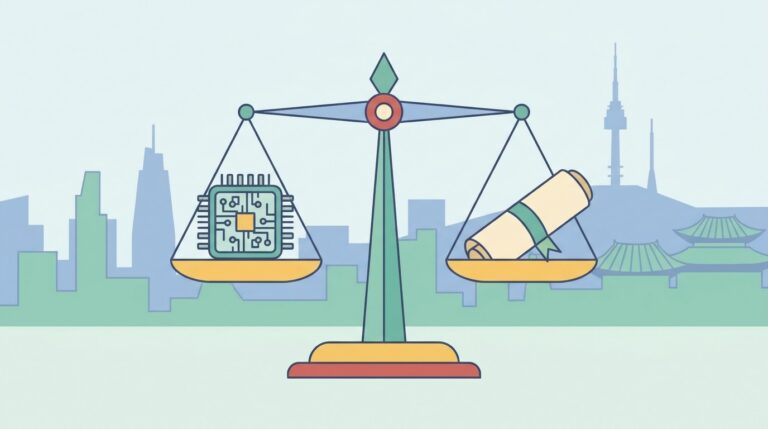
Have you ever watched that gripping courtroom scene in a high-stakes K-drama like Start-Up or Extraordinary Attorney Woo, where two rival tech giants face off over a micro-engineered semiconductor sensor? The defendant claims, “We swapped out one non-essential catalytic element, so it is a brand-new invention!” while the plaintiff’s fiery patent attorney slams the desk, retorting, “That is a blatant evasion under the doctrine of equivalents!”
At the C2 level, delving into Korean intellectual property jurisprudence (지식재산권법) is not merely about memorizing statutory jargon—it is an intricate philosophical dance. How does legal Korean articulate that delicate balance: “창작과 혁신의 정당한 과실을 보호하면서도 후속 연구자들의 기술 개선 자유를 숨 막히지 않게 하는 균형이 지재권법의 예술이에요” (Balancing strong incentives for pioneers with room for follow-on innovation is the art of IP jurisprudence)?
Many advanced learners tell us they hit a brick wall when trying to sound authoritative in Korean boardroom negotiations or patent tribunals. Literal translations of Western legal terms sound mechanical, while conversational Korean fails to convey institutional gravitas. This masterclass bridges that gap with nuanced idioms, judicial rhetoric, and contextual strategies curated from seasoned Seoul patent attorneys.
Phase 2: 핵심 표현 3선 심층 분석
1. 균등의 범주에 포섭되다 (Gyun-deung-ui beom-ju-e po-seop-doe-da)
- Pronunciation: [Gyun-deung-ui beom-ju-e po-seop-dwe-da] (Think: gyun like “tune” with a soft g, po-seop like “pose-up”)
- Meaning: Literally “to be subsumed within the category of equivalence”; in practice, it asserts that an alleged infringement falls squarely within the scope of protection under the Doctrine of Equivalents.
- K-Culture Moment: In corporate legal thrillers, counsel for a pioneering bio-venture confronts a copycat chaebol, arguing that mere minor component substitutions cannot bypass the patent claim.
- Editor’s Insight: The verb ‘포섭하다’ (to subsume/encompass) carries significant philosophical weight. It signals that despite physical or chemical alterations, the core technological spirit remains within the original claim’s rightful orbit.
- Situation Spectrum: Casual 🚫 | Semi-formal ⚠️ | Formal ✅
- 🤔 Think About It: Does your native legal language treat equivalence as an “extension” of a boundary, or as an “umbrella” that pulls variations inward?
2. 진보성을 부정하기 어렵다 (Jin-bo-seong-eul bu-jeong-ha-gi eo-ryeop-da)
- Pronunciation: [Jin-bo-seong-eul bu-jeong-ha-gi eo-ryeop-da] (Think: jin-bo like “gene-bo”, seong like “sung”)
- Meaning: Literally “it is difficult to deny its inventive step / non-obviousness”; practically means “the invention clearly possesses inventive merit.”
- K-Culture Moment: A patent examiner or appellate judge delivering a pivotal ruling affirming that a subsequent startup’s leap in efficiency was non-obvious to a person skilled in the art (통상의 기술자).
- Editor’s Insight: Korean legal rhetoric heavily relies on double negatives (부정하기 어렵다) to convey objective neutrality and judicial modesty, rather than shouting an emphatic affirmative.
- Situation Spectrum: Casual 🚫 | Semi-formal ⚠️ | Formal ✅
- 🤔 Think About It: Why does Korean professional discourse favor litotes (understatement via double negation) when issuing authoritative declarations?
3. 공공 영역을 질식시키다 (Gong-gong yeong-yeok-eul jil-sik-si-ki-da)
- Pronunciation: [Gong-gong yeong-yeo-geul jil-sik-ssi-ki-da] (Think: gong-gong like two soft bronze gongs, jil-sik like “chill-seek”)
- Meaning: Literally “to suffocate the public domain”; metaphorically warns against excessive patent monopolies that stifle broader scientific progress.
- K-Culture Moment: An open-source tech advocate testifying at the National Assembly against patent trolls choking off entry-level software developers.
- Editor’s Insight: The visceral verb ‘질식시키다’ (to choke/suffocate) transforms an abstract economic concept into a tangible moral imperative for societal balance.
- Situation Spectrum: Casual 🚫 | Semi-formal ✅ | Formal ✅
- 🤔 Think About It: When does vigorous enforcement of property rights cross the line into monopolistic gatekeeping in your society?
Phase 3: 교과서 한국어 vs 진짜 한국어
Situation 1: Arguing that a competitor’s tweak is merely cosmetic
- 📖 교과서 한국어: 그 회사의 기술은 우리 특허와 구성이 거의 비슷합니다. (Geu hoe-sa-ui gi-sul-eun u-ri teuk-heo-wa gu-seong-i geo-ui bi-sut-ham-ni-da. / That company’s technology is almost similar in composition to our patent.)
- 🗣️ 진짜 한국어: 구성요소의 치환에 불과하여 과제 해결원리가 동일하므로 균등 침해를 면할 수 없습니다. (Gu-seong-yo-so-ui chi-hwan-e bul-gwa-ha-yeo gwa-je hae-gyeol-won-ri-ga dong-il-ha-meu-ro gyun-deung chim-hae-reul myeon-hal su eop-seum-ni-da. / It is a mere substitution of elements with an identical problem-solving principle; thus, they cannot evade doctrine of equivalents infringement.)
- 💡 왜 다를까?: In real-world IP litigation, vague words like ‘비슷하다’ sound amateurish. C2 precision requires invoking the tripartite test: 치환가능성 (interchangeability) and 과제 해결원리의 동일성 (identity of problem-solving principle).
Situation 2: Cautioning against over-broad claim construction
- 📖 교과서 한국어: 권리를 너무 넓게 인정하면 다른 사람들이 연구하기 힘들어요. (Gwon-ri-reul neo-mu neolp-ge in-jeong-ha-myeon da-reun sa-ram-deul-i yeon-gu-ha-gi him-deul-eo-yo. / If rights are recognized too broadly, other people will have a hard time researching.)
- 🗣️ 진짜 한국어: 특허권의 과도한 확장은 후속 개량발명의 숨통을 죄어 산업 발전을 저해할 우려가 큽니다. (Teuk-heo-gwon-ui gwa-do-han hwak-jang-eun hu-sok gae-ryang-bal-myeong-ui sum-tong-eul joe-eo san-eop bal-jeon-eul jeo-hae-hal u-ryeo-ga keum-ni-da. / Undue expansion of patent exclusivity risks strangling follow-on improvement inventions and impeding industrial progress.)
- 💡 왜 다를까?: Senior legal strategists elevate the conversation by framing follow-on research as ‘후속 개량발명’ and using vivid metaphorical expressions like ‘숨통을 죄다’ (to choke the windpipe) to emphasize macro-economic impact.
Phase 4: K-Culture 딥다이브 & 비언어적 매너
4-1. 눈치 (Nunchi) & Courtroom Demeanor
When addressing a panel of judges at the Patent Court of Korea (특허법원) or leading an adversarial IP arbitration session in Seoul:
* The Modulated Cadence: Never raise your voice in anger; high-status Korean legal professionals demonstrate authority through steady, baritone restraint. Rapid-fire speech signals panic.
* Bowing Angles and Gaze: When submitting supplementary briefs (준비서면), bow at precisely 15 degrees, presenting physical dossiers with both hands.
* Deference to Judicial Inquiry: When a judge interrogates your claim, begin with: “재판장님의 석명권 행사에 따른 취지를 깊이 헤아려…” (Fully appreciating the intent behind the presiding judge’s request for clarification…).
4-2. Cultural Code: The Tech Corridor of Pangyo (판교 테크노밸리)
Korea’s rapid transition from a fast-follower manufacturing nation to a hyper-innovative IP powerhouse created a distinct cultural dichotomy. On one side are the legacy conglomerates (대기업) safeguarding vast defensive patent portfolios; on the other are agile startups in Pangyo pushing disruptive AI and biotech solutions. The legal tension around 진보성 (inventive step) and 균등론 mirrors this generational shift—respecting foundational engineering while defending the creative oxygen of newcomers.
Phase 5: 실전 롤플레이 시나리오
Setting: A conference room at a premier IP law firm in Gangnam overlooking Teheran-ro. Senior Korean Patent Attorney Park (박 변리사) is advising Alex, Chief Legal Officer of a global medical tech enterprise, on filing an infringement suit against a Korean competitor.
- 박 변리사: 상대측이 핵심 센서의 합금 소재를 미세하게 변경하여 문언 침해를 회피하려 하고 있습니다. (Sang-dae-cheuk-i haek-sim sen-seo-ui hap-geum so-jae-reul mi-se-ha-ge byeon-gyeong-ha-yeo mun-eon chim-hae-reul hoe-pi-ha-ryeo ha-go it-seum-ni-da. / 🎭 Pointing calmly with a silver pen to a metallurgical diagram / The opposing party has subtly altered the alloy material of the core sensor to evade literal infringement.)
- Alex: 문언상 불일치는 인정하지만, 균등론을 적용하면 승산이 있지 않겠습니까? (Mun-eon-sang bul-il-chi-neun in-jeong-ha-ji-man, gyun-deung-ron-eul jeok-yong-ha-myeon seung-san-i it-ji an-kket-seum-ni-kkwa? / 🎭 Leaning forward, eyebrows furrowed intently / While I concede literal divergence, don’t we have strong prospects if we apply the doctrine of equivalents?)
- 박 변리사: 물론입니다. 치환된 구성 역시 통상의 기술자가 용이하게 도출할 수 있으며 기술적 사상이 실질적으로 동일합니다. (Mul-ron-im-ni-da. Chi-hwan-doen gu-seong yeok-si tong-sang-ui gi-sul-ja-ga yong-i-ha-ge do-chul-hal su it-seu-myeo gi-sul-jeok sa-sang-i sil-jil-jeok-eu-ro dong-il-ham-ni-da. / 🎭 Nodding measuredly, turning a page of the brief / Indeed. The substituted element is also easily derivable by a person skilled in the art, and the technical essence is substantially identical.)
- Alex: 다만 상대측이 우리 특허의 진보성 결여를 사유로 무효심판을 청구할 가능성은 어떻습니까? (Da-man sang-dae-cheuk-i u-ri teuk-heo-ui jin-bo-seong gyeol-yeo-reul sa-yu-ro mu-hyo-sim-pan-eul cheong-gu-hal ga-neung-seong-eun eo-tteot-seum-ni-kkwa? / 🎭 Crossing arms thoughtfully / However, what are the odds of them filing an invalidation trial citing lack of inventive step in our patent?)
- 박 변리사: 선행기술과의 차별적 임계치가 명확하여 진보성을 부정하기는 극히 어렵다고 봅니다. (Seon-haeng-gi-sul-gwa-ui cha-byeol-jeok im-gye-chi-ga myeong-hwak-ha-yeo jin-bo-seong-eul bu-jeong-ha-gi-neun geuk-hi eo-ryeop-da-go bom-ni-da. / 🎭 Smiling with quiet assurance / Given that our distinct critical threshold over the prior art is unambiguous, denying inventive step will be extremely difficult.)
- Alex: 그렇다면 권리범위확인심판과 본안 소송을 병행하는 것이 주효하겠군요. (Geu-reot-da-myeon gwon-ri-beom-wi-hwak-in-sim-pan-gwa bon-an so-song-eul byeong-haeng-ha-neun geos-i ju-hyo-ha-get-gun-yo. / 🎭 Taking notes carefully / Then pursuing an action for the scope of rights alongside the lawsuit on the merits would be the most effective strategy.)
- 박 변리사: 정확하십니다. 다만 균등의 외연 확장이 후속 혁신을 억압한다는 법원의 잠재적 우려를 불식시켜야 합니다. (Jeong-hwak-ha-sim-ni-da. Da-man gyun-deung-ui oe-yeon hwak-jang-i hu-sok hyeok-sin-eul eok-ap-han-da-neun beop-won-ui jam-jae-jeok u-ryeo-reul bul-sik-si-kyeo-ya ham-ni-da. / 🎭 Lowering voice to a confidential, serious register / Exactly. However, we must dispel any underlying judicial concern that expanding the envelope of equivalence might stifle follow-on innovation.)
- Alex: 창작의 결실을 지키되 공공영역과의 조화를 입증하는 변론 논리를 구성합시다. (Chang-jak-ui gyeol-sil-eul ji-ki-doe gong-gong-yeong-yeok-gwa-ui jo-hwa-reul ip-jeung-ha-neun byeon-ron non-ri-reul gu-seong-hap-si-da. / 🎭 Extending a handshake with resolve / Let us build a line of argument that protects the fruits of creation while demonstrating harmony with the public domain.)
🔀 인터랙티브 분기점 (Branching Decision)
At this juncture, if Alex wants to push the offensive against the competitor, what is his best tactical statement?
- Option A: “상대방은 무조건 사기꾼이니 특허청에 강력한 처벌을 요구합시다.” (Sang-dae-bang-eun mu-jo-geon sa-gi-kkun-i-ni teuk-heo-cheong-e gang-ryeok-han cheo-beol-eul yo-gu-hap-si-da. / They are swindlers, let’s demand harsh punishment from KIPO.)
- Feedback: [Bad] Confuses civil/administrative IP determination with emotional criminal accusations. Completely unbefitting C2 legal etiquette.
- Option B: “공지기술 배제의 원칙을 선제적으로 검토하여 균등의 범주를 견고히 확정하시죠.” (Gong-ji-gi-sul bae-je-ui won-chik-eul seon-je-jeok-eu-ro geom-to-ha-yeo gyun-deung-ui beom-ju-reul gyeon-go-hi hwak-jeong-ha-si-jyo. / Let us proactively review the principle of prior art exclusion to solidly establish our boundary of equivalence.)
- Feedback: [Best] Demonstrates consummate mastery of patent law doctrines, preventing the opponent’s strongest defense before trial.
- Option C: “침해 문제는 복잡하니 그냥 우리 특허 청구범위를 자진해서 포기합시다.” (Chim-hae mun-je-neun bok-jap-ha-ni geu-nyang u-ri teuk-heo cheong-gu-beom-wi-reul ja-jin-hae-seo po-gi-hap-si-da. / Infringement is complex, so let’s voluntarily abandon our patent claim.)
- Feedback: [Risk] Catastrophic surrender of valuable proprietary rights without testing judicial remedies.
Phase 6: 10초 감정 섀도잉 드릴
Master the rhythmic pauses (/) and authoritative cadence expected in executive legal advocacy:
[⚖️ 진중하고 단호하게 / With gravitas and resolve]
“구성의 단순한 치환만으로는 / 특허권의 실질적 가치를 / 훼손할 수 없습니다.”
(Gu-seong-ui dan-sun-han chi-hwan-man-eu-ro-neun / teuk-heo-gwon-ui sil-jil-jeok ga-chi-reul / hwe-son-hal su eop-seum-ni-da.)-
[🏛️ 법리적 논리 정연함 / Analytical and measured]
“진보성 판단에 있어서 / 사후적 고찰은 / 철저히 배제되어야 마땅합니다.”
(Jin-bo-seong pan-dan-e it-seo-seo / sa-hu-jeok go-chal-eun / cheol-jeo-hi bae-je-doe-eo-ya ma-ttang-ham-ni-da.) -
[💡 균형 잡힌 통찰 / Philosophical and visionary]
“선도자의 과실 보호와 / 후속 연구의 숨통 사이에서 / 지재권법의 조화가 완성됩니다.”
(Seon-do-ja-ui gwa-sil bo-ho-wa / hu-sok yeon-gu-ui sum-tong sa-i-e-seo / ji-jae-gwon-beop-ui jo-hwa-ga wan-seong-doem-ni-da.)
Phase 7: K-Culture 미니 사전
- 진보성 (Jin-bo-seong) | Non-obviousness / Inventive Step | The critical patentability benchmark evaluating whether a technician in the relevant field could have easily deduced the invention from prior art.
- 균등론 (Gyun-deung-ron) | Doctrine of Equivalents | The legal rule holding that an accused product infringes a patent if it performs substantially the same function in substantially the same way to achieve the same result.
- 치환가능성 (Chi-hwan-ga-neung-seong) | Interchangeability | The legal test determining whether substituting an element of a patent with another feature yields essentially identical effects without novel creative endeavor.
- 공공영역 (Gong-gong-yeong-yeok) | Public Domain | The sphere of knowledge, discoveries, and culture free from intellectual property monopolies, accessible to all follow-on researchers.
Phase 8: 여행자를 위한 생존 키트
Legal & Business Visitor Essentials TOP 3
- 특허법원 판례를 참고하여 준비서면을 보강해 주십시오.
(Teuk-heo-beop-won pan-rye-reul cham-go-ha-yeo jun-bi-seo-myeon-eul bo-gang-hae ju-sip-si-o.)
Pro Tip: Use this formal imperative with co-counsel when requesting that briefs be reinforced with Patent Court precedents. - 당해 발명이 통상의 기술자에게 자명한지 여부가 쟁점입니다.
(Dang-hae bal-myeong-i tong-sang-ui gi-sul-ja-e-ge ja-myeong-han-ji yeo-bu-ga jaeng-jeom-im-ni-da.)
Pro Tip: Use this to instantly refocus distracted arbitration talks onto the core issue of inventive step. - 공지기술과의 차이점을 명확히 대비해 주시기 바랍니다.
(Gong-ji-gi-sul-gwa-ui cha-i-jeom-eul myeong-hwak-hi dae-bi-hae ju-si-gi ba-ram-ni-da.)
Pro Tip: Indispensable during technical meetings with Korean R&D engineers to map prior art disparities.
Editor’s Travel Note: Navigating Legal Seoul
If your mission takes you to patent hearings in Seoul, remember that the high-density legal hub is situated around Seocho Station (서초역) and Yeoksam Station (역삼역). When searching prior patents on the go, avoid commercial search engines; install the official mobile database via the KIPRIS Korean Intellectual Property Search Service to verify patent claims and registration statuses directly from your smartphone.
Phase 9: “한 발 더 깊이” (생각 질문)
In Korean jurisprudence, the concept of Gong-ik (공익 / the public interest) is never treated as a mere peripheral after-thought to Sa-ik (사익 / private right). Intellectual property law in Korea fundamentally conceptualizes patents as a grand social bargain: the state grants a 20-year monopoly precisely so that technical knowledge is publicly disclosed, thereby enriching the common reservoir of human ingenuity. Thus, judicial restraint in interpreting the doctrine of equivalents is not hostility toward creators, but a communal commitment to ensuring the technological ecosystem does not wither.
💬 Your Turn: In your home jurisdiction, does the legal system lean more toward absolute patentee exclusivity, or does it actively protect the breathing room for follow-on inventors? Share your perspective in the comments!
Phase 10: FAQ & 오해 방지 (FAQ Schema)
Q: Does the Korean Patent Court apply the Doctrine of Equivalents as generously as the US courts?
A: Not necessarily. Korean courts apply a rigorous five-part test: (1) replacement of non-essential elements, (2) identity of operational principle, (3) interchangeability easily conceived by a person skilled in the art, (4) absence of prior art identity, and (5) no intentional exclusion during file wrapper prosecution. All five prongs must be methodically established.
Q: How do you address a Korean patent attorney without sounding overly informal?
A: Address them by their full professional title: 변리사님 (Byeon-ri-sa-nim). Never use casual terms like “선생님” or “매니저님” in formal patent prosecution discussions.
Q: What is the difference between ‘신규성’ and ‘진보성’ in Korean patent disputes?
A: ‘신규성’ (Sin-gyu-seong) means novelty (whether the technology has literally appeared in prior public documents anywhere in the world), while ‘진보성’ (Jin-bo-seong) means inventive step/non-obviousness (whether the improvement was obvious to an artisan in that field).
🚨 흔한 실수 (Common Mistakes) 경고판
- Mistake: Using “비슷하다” (to be similar) in patent claims analysis.
Correct Action: Use formal technical terms such as “실질적 동일성” (substantial identity) or “균등 관계” (relationship of equivalence). - Mistake: Confusing an attorney-at-law (변호사) with a patent attorney (변리사).
Correct Action: Ensure you address specialized patent practitioners as 변리사님 (Patent Attorney) to acknowledge their specialized scientific and IP certification. - Mistake: Translating “prior art” as “이전 기술”.
Correct Action: Always employ the statutory term 선행기술 (Seon-haeng-gi-sul) or 공지기술 (Gong-ji-gi-sul).
Phase 11: 액션 미션 & 참여 유도
- 🥉 Bronze Mission (Solo Shadowing): Read aloud Phase 6’s three emotional shadowing drills 5 times, focusing on pausing sharply at the
/marks. - 🥈 Silver Mission (Social Application): Post a short reflection on LinkedIn or your language journal summarizing today’s key phrase: “창작의 결실과 후속 연구의 자유 사이의 조화” (Harmony between the fruits of creation and the freedom of follow-on research).
- 🥇 Gold Mission (Real-world Synthesis): Search a real Korean patent dispute on KIPRIS and write a 3-sentence summary in C2-level Korean analyzing whether the accused item fell under 균등의 범주 (category of equivalence).
- 🎮 K-Culture Mission: Watch an episode of a legal K-drama dealing with corporate lawsuits, and spot whether the attorneys invoke administrative agencies like 특허심판원 (Intellectual Property Trial and Appeal Board)!
Phase 12: 인터랙티브 퀴즈 챌린지
Test your mastery of advanced Korean patent jurisprudence!
- 상황 판단 (Contextual Assessment): A junior counsel remarks in court: “피고의 제품은 우리 특허와 그냥 판박이처럼 닮았습니다.” Why should you intervene to refine this phrase?
- 빈칸 채우기 (Fill in the Blank): 후속 연구자들의 창작 의지를 꺾지 않고 공공 영역이 ( _______ )되지 않도록 특허권의 과도한 확장을 경계해야 합니다.
- True / False 문화 퀴즈: Under Korean patent law, if an element was intentionally excluded from the claims during prosecution to overcome a prior art rejection, it can still be recaptured later under the Doctrine of Equivalents. (T/F)
🔍 정답 및 심층 해설 확인하기 (Click to reveal answers & explanations)
- 정답: ‘판박이처럼 닮았다’ is an informal, colloquial idiom unsuitable for judicial argument. It should be rephrased as: “피고 제품은 본원 발명의 특허청구범위 구성요소를 균등하게 치환한 것에 해당합니다.”
- 정답: 질식 (Jil-sik – suffocated/choked). The phrase ‘공공 영역이 질식되지 않도록’ metaphorically protects the breathing room for communal innovation.
- 정답: False (F). Under Korean patent law (as with Prosecution History Estoppel/의식적 제외의 법리), elements consciously surrendered or excluded during examination cannot be recaptured under the doctrine of equivalents.







