

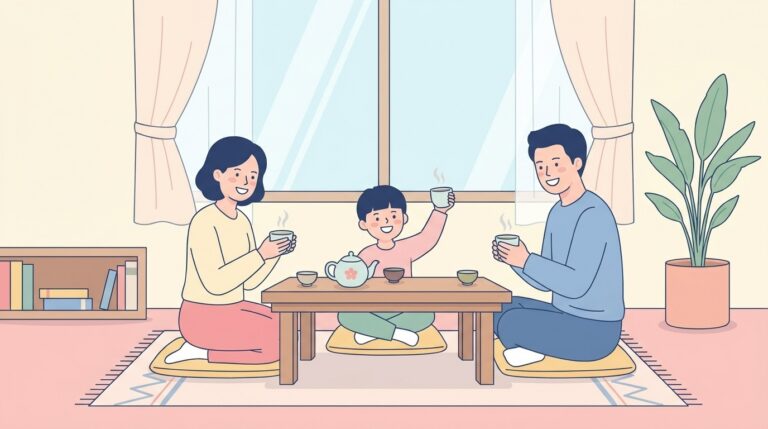
Master Family Introductions in Korean: Living with Parents with Confidence
Phase 1: Empathy (Story-Immersive Opening)
안녕하세요! 매일한글 에디터입니다.
Have you ever been binge-watching a warm slice-of-life K-drama like Reply 1988 or Crash Landing on You, and noticed how grown adults in their late twenties or thirties happily live under the same roof with their parents? In many Western cultures, moving out right at eighteen is framed as the ultimate badge of independence. When someone asks you who you live with, saying “I live with my parents” might occasionally trigger an awkward pause or a need to explain yourself.
In Korea, that script is completely flipped! Sharing a home with your parents as an adult is not only standard, it is deeply celebrated as filial, loving, and economically savvy. Yet, when beginner Korean learners want to introduce their loved ones or describe their living situation, anxiety often strikes: Should I say “nae” or “uri”? Is “eomma” too childish? How do I say “with” without sounding robotic?
Take a deep breath! After guiding hundreds of international learners through their first Korean conversations at Daily Hangul, I have distilled the exact phrases, cultural nuances, and gestures you need. By the end of this guide, you will talk about your family and home life with the natural charm of a local friend.
Phase 2: Core Expressions Deep Dive
1. 부모님과 같이 살아요 (Bumonim-gwa gachi sarayo)
- Pronunciation: Bumonim-gwa gachi sarayo (Boo-mo-neem-gwa gah-chee sah-rah-yo. Pro sound tip: pronounce gachi just like “got cheese” without the ‘s’ sound!)
- Meaning: Literal: “Parents-with together I live” | Nuance: “I live with my parents (warmly and respectfully).”
- K-Culture Moment: When your university senior or coworker asks where your apartment is during lunch, and you share that you live comfortably in the family nest.
- Editor’s Insight: Notice the polite honorific suffix -님 (-nim) attached to 부모 (bumo). It adds instant respect to your parents without making your sentence sound stiff or distant.
- Situation Spectrum:
- Casual (close friends): ⚠️ (Better to say: 엄마 아빠랑 살아)
- Semi-formal (polite everyday): ✅ (Perfect and widely used!)
- Formal (job interview): ⚠️ (Better to say: 부모님과 함께 거주하고 있습니다)
- 🤔 Think About It: In English, “living with parents” can subtly imply dependence. In Korean, does adding the word 같이 (gachi – together) make it feel like a shared, cooperative bond rather than a dependency?
2. 저희 가족은 네 명이에요 (Jeohui gajog-eun ne myeong-ieyo)
- Pronunciation: Jeohui gajog-eun ne myeong-ieyo (Juh-hee gah-joh-geun neh myuhng-ee-eh-yo. Rhyme myeong with English “young”, starting with a smooth my- sound.)
- Meaning: Literal: “Our humble family topic-marker four persons is” | Nuance: “There are four people in my family.”
- K-Culture Moment: The quintessential icebreaker during an introductory Korean class or a welcoming team dinner (hoesik).
- Editor’s Insight: Koreans use the humble pronoun 저희 (jeohui) instead of the proud 우리 (uri) when presenting their group to someone outside. It signals modesty and politeness toward your listener!
- Situation Spectrum:
- Casual: ⚠️ (Better: 우리 가족은 네 명이야)
- Semi-formal: ✅ (Standard friendly polite!)
- Formal: ✅ (Works very well in polite company)
- 🤔 Think About It: Why does Korean prioritize using “our/we” (jeohui/uri) over “my” (nae) when talking about your own household?
3. 우리 엄마, 아빠예요 (Uri eomma, appayeyo)
- Pronunciation: Uri eomma, appayeyo (Oo-ree um-mah, ah-pah-yeh-yo. Short, cheerful cadence.)
- Meaning: Literal: “Our mom, dad it is” | Nuance: “This is my mom and dad.”
- K-Culture Moment: Swiping through your phone gallery over coffee to show your Korean friend snapshots from your hometown.
- Editor’s Insight: Even though they are strictly your biological parents, saying 내 엄마 (nae eomma – my mom) sounds startlingly cold and detached to Korean ears. Always embrace the collective 우리 (uri)!
- Situation Spectrum:
- Casual: ✅ (Just drop the polite ending: 우리 엄마, 아빠야)
- Semi-formal: ✅ (Warm and natural)
- Formal: 🚫 (Elevate to: 저희 어머니, 아버지이십니다)
- 🤔 Think About It: Imagine if English speakers introduced their mother as “our mother” to complete strangers. How does language shape our sense of community?
Phase 3: Textbook Korean vs. Real Korean
Situation 1: Explaining that you live at home
- 📖 교과서 한국어: 저는 부모님과 함께 거주합니다. (Jeoneun bumonimgwa hamkke geojuhamnida. – “I reside together with my parents.”)
- 🗣️ 진짜 한국어: 저 부모님이랑 같이 살아요. (Jeo bumonim-irang gachi sarayo. – “I live with my parents.”)
- 💡 왜 다를까?: The conversational particle ~(이)랑 (-irang) sounds far warmer in daily speech than the bookish 과/와 (gwa/wa), and 거주하다 (geojuhada – to reside) belongs on official lease paperwork, not in cozy conversations!
Situation 2: Stating how many people are in your family
- 📖 교과서 한국어: 저의 가족 구성원은 네 명입니다. (Jeoui gajok guseong-woneun ne myeong-imnida. – “My family members consist of four people.”)
- 🗣️ 진짜 한국어: 저희 가족은 다 합쳐서 네 명이에요. (Jeohui gajogeun da hapchyeoseo ne myeong-ieyo. – “Our family is four people all together.”)
- 💡 왜 다를까?: Real people rarely talk like sociological surveys! Dropping clinical vocabulary like 구성원 (guseong-won – member units) and using 다 합쳐서 (all together) sounds effortless and friendly.
Phase 4: K-Culture Deep Dive & Non-Verbal Manners
4-1. 눈치 (Nunchi) & Gestures
- Two-Hand Phone Hold: When showing family photos on your smartphone, rest your holding wrist on your opposite hand or support your phone gently with both hands. It shows sincere respect for the people in the picture.
- No Pointing Fingers: Never point directly at elders or photos of your parents with a single index finger. Gesture toward them with an open, upward-facing palm and a subtle, polite head nod.
4-2. Cultural Code: The Warmth of “Bonga” (본가)
In Korea, adult children living at home is practically the default until marriage. The family residence is known affectionately as the 본가 (bonga – root family home). Rather than viewing this as a delay of adult responsibilities, Korean society sees it as an emotional anchor: mom packs containers of hearty side dishes (banchan), parents and adult children look out for each other, and young professionals can save money for housing.
Phase 5: Real-World Roleplay Scenario
Setting: A sunlit café in Hongdae. You are chatting over iced Americanos with Minji (민지), your Korean language exchange partner who loves learning about your roots.
- Turn 1 (Minji): 민지: OO 씨는 지금 혼자 살아요, 아니면 룸메이트 있어요? (OO ssi-neun jigeum honja sarayo, animyeon rum-me-i-teu isseoyo? – “Do you live alone, or do you have a roommate?”) [🎭 Leaning forward with open curiosity]
- Turn 2 (You): 나: 아, 저는 부모님과 같이 살아요. (A, jeoneun bumonim-gwa gachi sarayo. – “Ah, I live with my parents.”) [🎭 Smiling gently and holding your hands neatly together]
- Turn 3 (Minji): 민지: 우와, 정말요? 집밥 매일 드시겠어요! 가족이 몇 명이에요? (Uwa, jeongmalyo? Jipbap maeil deusigesseoyo! Gajogi myeot myeong-ieyo? – “Wow, really? You must get to eat home-cooked meals every day! How many are in your family?”) [🎭 Clapping hands lightly with delight]
- Turn 4 (You): 나: 저희 가족은 네 명이에요. 부모님이랑 여동생이 있어요. (Jeohui gajogeun ne myeong-ieyo. Bumonim-irang yeodongsaeng-i isseoyo. – “There are four of us. My parents and a younger sister.”) [🎭 Counting fingers gently with a warm expression]
- Turn 5 (Minji): 민지: 여동생이랑 사이좋아요? 혹시 사진 있어요? (Yeodongsaeng-irang sa-i-joayo? Hoksi sajin isseoyo? – “Are you close with your sister? Do you happen to have a photo?”) [🎭 Tilting her head playfully]
- Turn 6 (You): 나: 네, 사이좋아요! 여기 우리 가족사진이에요. (Ne, sa-i-joayo! Yeogi uri gajoksajin-ieyo. – “Yes, we are close! Here is our family photo.”) [🎭 Unlocking your phone and showing the screen using both hands]
- Turn 7 (Minji): 민지: 어머, 부모님이 인상이 너무 좋으세요! 여동생도 닮았네요! (Eomeo, bumonim-i insang-i neomu joeuseyo! Yeodongsaeng-do dalman-neyo! – “Oh my, your parents have such warm, kind impressions! Your sister looks like you too!”) [🎭 Looking attentively with an appreciative smile]
- Turn 8 (You): 나: 감사해요! 부모님이 정말 다정하세요. (Gamsahaeyo! Bumonim-i jeongmal dajeonghaseyo. – “Thank you! My parents are truly caring.”) [🎭 Nodding with a proud, thankful grin]
🔀 Interactive Branch Point
When Minji asks if you live alone, what will you say?
* Choice A: 부모님이랑 같이 살아요. 집밥이 최고예요! (Bumonim-irang gachi sarayo. Jipbap-i choegoyeyo! – “I live with my parents. Home-cooked food is the best!”)
* Choice B: 내 엄마 아빠 집에 얹혀살아요. (Nae eomma appa jibe eonhyeosarayo. – “I freeload at my mom and dad’s house.”)
* Choice C: 나 혼자 안 살아. (Na honja an sara. – “I don’t live alone.”)
Feedback:
* Choice A (Best): Spot on! Friendly, polite A1 grammar, and mentioning 집밥 (home food) builds instant rapport with Koreans!
* Choice B (Risk): 얹혀살다 means “freeloading/sponging off”. While meant humorously, using 내 instead of 우리 makes it awkward and overly self-critical.
* Choice C (Bad): This is informal speech (banmal). Speaking casually to someone who isn’t a long-time close friend sounds abrasive and rude.
Phase 6: 10-Second Emotion Shadowing Drill
Read each phrase aloud, following the emotional markers and breathing pauses (/):
[😊 Warm and proud]저 / 부모님이랑 / 같이 살아요. (Jeo / bumonim-irang / gachi sarayo. – “I / live with / my parents.”)[✨ Bright and friendly]저희 가족은 / 네 명이에요! (Jeohui gajog-eun / ne myeong-ieyo! – “In our family / there are four of us!”)[🥰 Affectionate and sweet]우리 엄마, / 아빠예요. (Uri eomma, / appayeyo. – “This is my / mom and dad.”)
Phase 7: K-Culture Mini Dictionary
- 본가 (Bonga): The parental family home. Young Koreans living solo often declare on Friday nights: “이번 주말에 본가 가요! (I’m heading to my family home this weekend!)”
- 자취 (Jachwi): Living independently in a small studio or flat, cooking your own meals. Widely referenced by university students and newcomers to Seoul.
- 집밥 (Jipbap): Home-cooked meals. A cultural emblem of motherly love, featuring piping-hot steamed rice, hearty stews, and abundant side dishes.
- 외동 (Oedong): An only child. You will frequently hear 외동딸 (oedongttal – only daughter) or 외동아들 (oedong-adeul – only son).
Phase 8: Traveler’s Survival Kit
Top 3 Survival Phrases
- 부모님 선물이에요. (Bumonim seonmul-ieyo. – “This is a gift for my parents.”)
- Pro Tip: Souvenir merchants and traditional market shopkeepers love hearing this and will frequently hand you extra free gifts (service)!
- 가족이랑 같이 왔어요. (Gajog-irang gachi wasseoyo. – “I came with my family.”)
- Pro Tip: Great when booking tickets, organizing tours, or arranging seating at busy venues.
- 세 명이에요 / 네 명이에요. (Se myeong-ieyo / Ne myeong-ieyo. – “Table for three / four people.”)
- Pro Tip: The number-one phrase you will utter at restaurant doors throughout Korea.
Editor’s Travel Note
When venturing out for family-style dining with larger tables or cozy floor seating, skip generic search engines and use the [Naver Map app download for Korea navigation]. Need immediate assistance translating restaurant notices or photo menus for your folks? Rely on the [Papago translation guide for instant photo and voice interpretation] for the most accurate Korean context.
Phase 9: One Step Deeper (Reflective Insight)
Have you ever wondered why Korean speakers naturally utter 우리 엄마 (our mom) or 우리 집 (our house) even when they are an only child speaking to a stranger? In the Korean linguistic universe, individual identity is cradled inside the collective “we”. To say 내 엄마 (my mom) erects a barrier, separating you from the listener. By saying 우리, you invite your listener into an extended circle of warm kinship.
💬 Your Turn: In your home country, is living with parents as an adult common, or is moving out early the golden rule? Share your thoughts below in English or try writing your family size in Korean!
Phase 10: FAQ & Common Pitfalls
Q: Is it considered rude to say ‘엄마 (Eomma)’ and ‘아빠 (Appa)’ when introducing parents?
A: Not at all for beginner learners! In friendly, everyday conversations, 우리 엄마, 아빠예요 sounds endearing and relatable. When you speak in formal business or job interview settings, you can elevate your vocabulary to 어머니 (eomeoni) and 아버지 (abeoji).
Q: What is the difference between ‘-랑/이랑’, ‘-하고’, and ‘-와/과’?
A: All three mean “with” or “and”! 과/와 is preferred in written literature or news. 하고 is neutral and universally reliable. (이)랑 is the most spontaneous and natural for daily spoken conversations. For A1 spoken mastery, 부모님이랑 is your best friend!
Q: Can I count my family using the counter ‘개 (gae)’?
A: Never! The counter 개 (gae) is strictly reserved for inanimate objects like apples or pencils. For human beings, always use 명 (myeong), or the honorific 분 (bun).
🚨 Common Mistakes Alert
- Mistake 1: Calling your mother 내 엄마 (nae eomma). -> Correct Action: Always say 우리 엄마 (uri eomma).
- Mistake 2: Leaving the verb un-conjugated: 부모님과 살다. -> Correct Action: Add the polite present-tense ending: 부모님과 살아요 (sarayo).
- Mistake 3: Counting people with 사람 (saram) like 네 사람이에요. -> Correct Action: Pair native Korean numbers with the proper counter: 네 명이에요 (ne myeong-ieyo).
Phase 11: Action Missions
- 🥉 Bronze Mission (Solo): Look into your mirror and proudly repeat three times: “저 부모님이랑 같이 살아요!”
- 🥈 Silver Mission (Social): Snap a photo of a family meal or your pet, post it on social media or a study log, and caption it: “저희 가족이에요! (This is our family!)”
- 🥇 Gold Mission (Real-World): In your next language exchange session, ask your Korean friend: “가족이 몇 명이에요? (How many people are in your family?)” and respond with your own household setup.
- 🎮 K-Culture Mission: Tune in to the first episode of a family K-drama (like Hospital Playlist or Once Again) and spot the moment someone mentions their 본가 (bonga) or announces they are going home to eat 집밥 (jipbap)!
Phase 12: Interactive Quiz Challenge
1. Situation Judgment: You are talking to a friendly Korean coworker at lunch. How do you naturally explain that you live with your parents?
* (A) 부모님과 함께 거주하고 있습니다.
* (B) 저 부모님이랑 같이 살아요.
* (C) 나 엄마 아빠랑 산다.
2. Fill-in-the-Blank: Complete the sentence with the correct particle meaning “with”:
* 저희 가족은 부모님____ 여동생이 있어요. (Options: 이랑 / 개 / 로)
3. True or False: In Korea, adults living with their parents until marriage is generally perceived as warm, common, and financially responsible.
Click here to reveal answers and explanations!
- 1. Answer: (B) — Choice (B) is the most natural, polite conversational form (부모님이랑 같이 살아요). Choice (A) is overly stiff written language, and (C) is informal banmal.
- 2. Answer: 이랑 — 부모님이랑 correctly attaches the spoken particle “and/with” to a noun ending in a consonant (ㅁ).
- 3. Answer: True — Sharing a home with family (본가) is completely normal and widely respected in Korean culture!







