

Crack the Code of Korean Tech Meetings: Talk App UX and A/B Testing Like a Pro
Phase 1: Empathy (Story-driven Opening)
안녕하세요! 매일한글 에디터입니다. (Hello! I’m the Daily Hangul editor.)
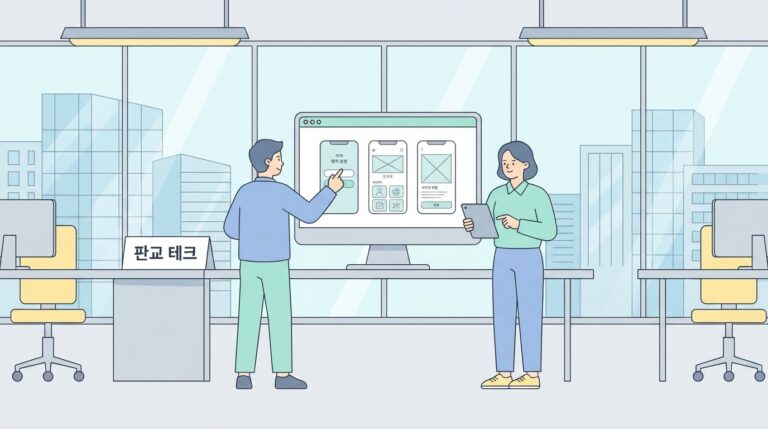
Picture this: You are sitting in an ultra-modern glass conference room in Pangyo Techno Valley—South Korea’s vibrant Silicon Valley. Your team is wrapping up the final usability test for a hot new mobile lifestyle app. On the shared monitor, two bold variations of a call-to-action button are glowing: Option A reads “지금 시작하기” (Start Now), while Option B nudges “3초 만에 가입하기” (Sign up in 3 seconds).
Everyone looks at you. The lead product designer turns her head, sips her iced Americano, and asks what the next game plan is. You know exactly what strategy to use in English: “We built an A/B test to determine which copy drives a higher CTR.” But your tongue freezes. How do you say “CTR” without sounding like an automated translation bot? How do you smoothly propose an “A/B test” using natural Korean workplace cadence instead of stiff textbook grammar?
If you’ve watched K-dramas like Start-Up (스타트업), you’ve seen characters like Dal-mi and Do-san debate product wireframes late into the night over convenience store snacks. The Korean tech and startup scene moves at breakneck speed, driven by the famous ppalli-ppalli (빨리빨리, fast-paced) culture. In this environment, communicating usability feedback concisely and diplomatically is a superpower. Today, we’re unpacking real insider phrases straight from Pangyo and Seongsu-dong tech squads. By the end of this guide, you’ll present UX hypotheses, compare microcopies, and deliver constructive usability feedback with total confidence!
Phase 2: Core Expressions Deep Dive
1. A안과 B안 중 어떤 문구가 클릭률이 더 높은지 확인하기 위해 A/B 테스트를 설계했어요
(A-an-gwa B-an jung eotteon mungu-ga keul-ling-nyur-i deo nopeunji hwag-inhagi wihae A/B teseuteu-reul seolgye-haesseoyo)
* Pronunciation: Ah-ahn-gwa Bee-ahn joong uh-tteon moon-goo-gah keul-ling-nyoo-ree duh noh-peun-jee hwahg-een-hah-gee wee-hae ey-bee teh-seu-teu-reul sul-gyeh-hae-ssuh-yo. (Tip: Think of seolgye as similar to the first syllable of ‘sulky’ followed by ‘yeah’.)
* Meaning:
* Literal: “In order to check which phrase between Option A and Option B has a higher click rate, we designed an A/B test.”
* Real Nuance: “We set up an A/B test to see whether Copy A or Copy B yields a stronger CTR.”
* K-Culture Moment: In K-drama tech pitch scenes, you will often hear project leads present data using the pattern ~안 (Option/Plan). Instead of saying “Option 1 and 2,” Korean tech teams nearly always use A안 (Plan A) and B안 (Plan B).
* Editor’s Insight: Notice the combination of ~는지 확인하기 위해 (in order to check/verify whether). This is an essential B1 intermediate grammatical pattern used constantly in product management, QA, and data analysis.
* Situation Spectrum:
* Casual: ⚠️ (A bit formal for casual coffee talk with friends)
* Semi-formal (Team Slack / Standup): ✅
* Formal (Board Presentation): ✅
* 🤔 Think About It: In English, we often use passive framing (“An A/B test was created to measure…”). Korean tech discourse favors active intent (“We designed this to check…”) because team accountability and collaborative initiative are highly valued.
2. 사용자 이탈을 줄이려면 버튼 문구를 더 직관적으로 바꿔야 해요
(Sayongja itareul juriryeomyeon beoteun mungureul deo jik-gwanjeog-euro bakkwoya haeyo)
* Pronunciation: Sah-yong-jah ee-tahl-eul joo-ree-ryuh-myun buh-teun moon-goo-reul duh jeek-gwahn-juhg-eu-roh bah-kkwuh-yah hae-yo. (Sounds like: Jeek-gwahn as in ‘seek’ with a soft J + ‘gwan’.)
* Meaning:
* Literal: “If we want to reduce user drop-off, we must change the button copy more intuitively.”
* Real Nuance: “To prevent drop-offs, we need our button microcopy to be clearer and more intuitive.”
* K-Culture Moment: Korean mobile apps (like Toss or Baemin) are legendary for their clean, zero-friction microcopy. Tech teams obsess over eliminating user hesitation on payment and signup screens.
* Editor’s Insight: 이탈 (churn/drop-off) and 직관적 (intuitive) are must-know B1 vocabulary words if you discuss design, marketing, or digital services in Korea.
* Situation Spectrum:
* Casual: ⚠️
* Semi-formal (Sprint planning): ✅
* Formal (Client presentation): ✅
* 🤔 Think About It: Why does Korean UX emphasize 직관적 (intuitive) so much? Korean users expect instant feedback and seamless navigation; any momentary confusion usually results in immediate uninstallation!
3. 피드백을 반영해서 다음 스프린트에 개선안을 적용해 볼게요
(Pideubaeg-eul banyeonghaeseo daeum seupeurinteu-e gaeseon-aneul jeog-yonghae bolgeyo)
* Pronunciation: Pee-deu-baek-eul bahn-yuhng-hae-suh dah-eum seu-peu-reen-teu-eh gae-sun-ahn-eul juhg-yong-hae bohl-geh-yo. (Tip: The English word ‘sprint’ becomes four syllables in Korean: seu-peu-reen-teu.)
* Meaning:
* Literal: “Reflecting the feedback, we will try applying the improvement plan in the next sprint.”
* Real Nuance: “We’ll take this feedback on board and push the improvements into our next sprint.”
* K-Culture Moment: The agile methodology is standard across Korean unicorns. Phrases like 피드백 반영 (incorporating feedback) signal professional flexibility and proactive teamwork.
* Editor’s Insight: Using ~해 볼게요 (I/we will try doing…) softens the statement. Instead of making a rigid declaration, it expresses a collaborative commitment to experiment and optimize.
* Situation Spectrum:
* Casual: ⚠️
* Semi-formal (Team sync / Retrospective): ✅
* Formal: ✅ (Use 적용해 보겠습니다 for higher formality)
* 🤔 Think About It: Notice the polite modesty of ~해 보다 (to try doing). In Korean workplace communication, asserting an absolute outcome before testing can sound arrogant; framing it as an iterative attempt displays the right balance of humility and competence.
Phase 3: Textbook Korean vs Real Korean
Scenario 1: Proposing an experiment during sprint review
- 📖 교과서 한국어 (Textbook):
“A안과 B안의 성과를 비교 분석하기 위한 실험을 수행하겠습니다.”
(A-ang-gwa B-an-ui seong-gwa-reul bigyo bun-seok-hagi wihan sil-heom-eul su-haeng-hagesseumnida. – “I shall execute an experiment to comparatively analyze the outcomes of Option A and Option B.”) - 🗣️ 진짜 한국어 (Real-life Korean):
“A안이랑 B안으로 A/B 테스트 돌려보고 데이터 확인해 봐요.”
(A-an-irang B-an-euro A/B teseuteu dollyeobogo de-i-teo hwag-inhae bwayo. – “Let’s run an A/B test with Plan A and B and check the numbers.”) - 💡 왜 다를까? (Why is it different?):
Textbook phrases use heavy Sino-Korean verbs like수행하다(execute) and비교 분석하다(comparatively analyze). In modern agile offices, native speakers naturally say테스트 돌리다(to run/spin a test) and use the casual connector~이랑/랑instead of the rigid~과/와.
Scenario 2: Asking for qualitative test feedback
- 📖 교과서 한국어 (Textbook):
“피시험자들의 사용성 만족도 평가를 수집하도록 합시다.”
(Pi-si-heom-ja-deur-ui sayong-seong man-jok-do pyeong-ga-reul su-jip-hadorok hapsida. – “Let us collect the usability satisfaction evaluation of test subjects.”) - 🗣️ 진짜 한국어 (Real-life Korean):
“유저 반응 어떤지 정성 피드백 위주로 먼저 살펴볼까요?”
(Yujeo ban-eung eotteonji jeong-seong pideubaek wiju-ro meonjeo salpyeobolkkayo? – “Shall we check user reactions first, focusing on qualitative feedback?”) - 💡 왜 다를까? (Why is it different?):
Modern Korean tech teams use loanwords like유저(user) and industry terms like정성 피드백(qualitative feedback). Ending suggestions with~볼까요?(Shall we take a look?) sounds collaborative rather than authoritarian.
Phase 4: K-Culture Deep Dive & Non-verbal Manners
4-1. 눈치 (Nunchi) & Workplace Body Language
When discussing UI/UX usability test results in a Korean company, technical accuracy is only half the battle—the other half is Nunchi (reading the room’s unstated atmosphere and social hierarchy).
- The Cushioning Head Tilt: When challenging a senior colleague’s design copy, never blurt out “B안이 틀렸어요” (Option B is wrong). Instead, lean slightly forward, nod thoughtfully, and start with:
- “제 생각에는…” (In my opinion…)
- “데이터를 보니까…” (Looking at the data…)
- Open-Hand Pointing: Never point at a screen or a mock-up slide with a single index finger—especially if an executive is looking. Extend an open palm facing upward to indicate the wireframe component. This subtle gesture conveys refinement and respect.
- Active Listening Markers (Chuimsae): While a designer explains their rationale, softly interject with polite listening cues: “아, 네네” (Ah, yes yes), “맞아요” (That’s right), or “일리가 있네요” (That makes sense). Staying completely silent while staring at your laptop screen can be interpreted as disinterest or passive resistance.
4-2. Cultural Code: The Pangyo Startup Ecosystem
In traditional Korean conglomerates (Chaebol), communication historically followed strict hierarchical top-down structures. However, modern Korean IT hubs—specifically Pangyo Techno Valley in Gyeonggi-do and Seongsu-dong in Seoul—have revolutionized this dynamic.
Inspired by Silicon Valley, many Korean tech companies adopt flat titles (calling each other by English names like “Chris-nim” or “Sarah-nim” instead of corporate ranks like Bujang-nim). Yet, the underlying culture still values harmony (Hwahap). When presenting test hypotheses, framing findings around user metrics rather than personal critique ensures constructive, ego-free collaboration.
Phase 5: Real-life Roleplay Scenario
Setting: A sunlit open-plan meeting booth at a fintech startup in Pangyo.
Characters:
* Sujin (수진): Senior Product Designer, detail-oriented and passionate about clean visual hierarchy.
* You (학습자): Growth Product Manager, eager to boost signup conversions using solid testing data.
Turn 1 (Sujin):
“이번 온보딩 화면 테스트 결과 나왔나요? 버튼 카피 때문에 고민이 많았거든요.”
(Ibeon onboding hwamyeon teseuteu gyeolgwa nawannayo? Beoteun kapi ttaemune gomiri manatgeodeunyo.)
🎭 Adjusts her glasses while leaning toward the tablet screen with an inquisitive look.
“Did the onboarding screen test results come out? I was really agonizing over the button copy.”
Turn 2 (You):
“네, 수진 님! A안과 B안 중 어떤 문구가 클릭률이 더 높은지 확인하기 위해 A/B 테스트를 설계했어요.”
(Ne, Sujin-nim! A-an-gwa B-an jung eotteon mungu-ga keul-ling-nyur-i deo nopeunji hwag-inhagi wihae A/B teseuteu-reul seolgye-haesseoyo.)
🎭 Smiling warmly, opening the analytics dashboard with a polite two-handed gesture.
“Yes, Sujin! We designed an A/B test to see which copy between Option A and Option B gets a higher click-through rate.”
Turn 3 (Sujin):
“오, 빠르네요! 데이터는 어떻게 나왔어요?”
(O, ppareuneyo! De-i-teo-neun eotteoke nawasseoyo?)
🎭 Eyes lighting up with curiosity as she points gently toward the conversion chart.
“Oh, that was fast! How did the numbers turn out?”
Turn 4 (You):
“‘지금 시작하기’인 A안보다 ‘3초 만에 계좌 만들기’인 B안이 전환율이 18% 더 높았어요.”
(‘Jigeum sijakhagi’in A-an-boda ‘sam-cho mane gyejwa mandeulgi’in B-an-i jeonhwanyur-i sip-pal-peosenteu deo nopatseoyo.)
🎭 Highlighting the conversion graph with the cursor while speaking clearly.
“Option B, ‘Open an account in 3 seconds,’ had an 18% higher conversion rate than Option A, ‘Start now.'”
Turn 5 (Sujin):
“사용자들은 역시 구체적인 혜택이 적힌 문구에 더 반응하네요. 혹시 이탈률은 어땠나요?”
(Sayongjadeureun yeoksi guchejeogin hyetaegi jeokhin mungue deo baneunghaneyo. Hoksi itallyureun eottaennayo?)
🎭 Nodding thoughtfully, noting the insight down in her design system logbook.
“As expected, users respond much better to copy that states concrete benefits. How was the bounce rate?”
Turn 6 (You):
“B안에서 첫 화면 이탈률도 눈에 띄게 줄었어요. 직관적인 문구가 효과적이었던 것 같아요.”
(B-aneseo cheot hwamyeon itallyur-do nune ttwige jureosseoyo. Jik-gwanjeogin mungu-ga hyogwajeog-ieotdeon geot gatayo.)
🎭 Speaking with grounded confidence while matching her calm, collaborative tone.
“The bounce rate on the initial screen also dropped noticeably with Option B. I think clear, intuitive copy did the trick.”
Turn 7 (Sujin):
“좋은 인사이트네요! 그럼 이 문구로 확정하고 메인 배너에도 적용해 볼까요?”
(Joeun insaiteuneyo! Geureom i munguro hwakjeonghago mein baeneoe-do jeog-yonghae bolkkayo?)
🎭 Clapping hands together once lightly with a satisfied smile.
“Great insight! Shall we finalize this copy and apply it to our main banners as well?”
Turn 8 (You):
“좋습니다! 이번 피드백을 반영해서 다음 스프린트에 개선안을 바로 배포해 볼게요.”
(Jotsumnida! Ibeon pideubaeg-eul banyeonghaeseo daeum seupeurinteu-e gaeseon-aneul baro baepohae bolgeyo.)
🎭 Closing the meeting with a clean nod and an enthusiastic smile.
“Sounds great! We’ll incorporate this feedback and deploy the improvements right away in the next sprint.”
🔀 Interactive Decision Point
Sujin asks: “그런데 C안으로 아예 버튼 색상도 바꿔보는 건 어떨까요?” (By the way, what if we also change the button color completely with an Option C?)
- Option A: “안 돼요. 이미 테스트 끝났으니까 그냥 B안으로 가시죠.”
(No. The test is already over, so let’s just go with Option B.) - Option B: “흥미로운 아이디어네요! 다만 변수가 섞이면 안 되니까, 이번 배포 후에 버튼 컬러만 따로 분리해서 후속 테스트를 돌려보는 건 어떨까요?”
(That’s an interesting idea! However, since we shouldn’t mix variables, how about testing the button color separately in a follow-up test after this release?) - Option C: “네, 수진 님이 디자이너시니까 마음대로 하셔도 돼요.”
(Sure, you’re the designer, so you can do whatever you want.)
Feedback:
* Option A (Bad): Far too blunt and dismissive. In a Korean tech environment, shutting down a teammate’s creative suggestion without acknowledging it destroys rapport.
* Option B (Best!): Perfect data-driven communication! It validates the colleague’s input (흥미로운 아이디어네요), explains the scientific reason for isolating variables (변수가 섞이면 안 되니까), and offers a constructive next step (후속 테스트).
* Option C (Risk): Sounds indifferent and uninvested. While it seems agreeable, it abdicates your responsibility as an active collaborator.
Phase 6: 10-Second Emotion Shadowing Drill
Practice speaking these phrases with real emotional cadence! The slash (/) marks a natural breath pause.
- [😊 자신감 넘치고 명쾌하게 – Confident & Crisp]
“A안과 B안 중 / 어떤 문구가 클릭률이 더 높은지 확인하기 위해 / A/B 테스트를 설계했어요.”
(A-an-gwa B-an jung / eotteon mungu-ga keul-ling-nyur-i deo nopeunji hwag-inhagi wihae / A/B teseuteu-reul seolgye-haesseoyo.) -
[🤔 진지하게 문제점을 짚으며 – Analytical & Thoughtful]
“사용자 이탈을 줄이려면 / 온보딩 화면의 버튼 문구를 / 훨씬 직관적으로 바꿔야 해요.”
(Sayongja itareul juriryeomyeon / onboding hwamyeon-ui beoteun mungureul / hwolssin jik-gwanjeog-euro bakkwoya haeyo.) -
[🤝 파트너십을 다지며 긍정적으로 – Collaborative & Enthusiastic]
“오늘 논의된 피드백을 반영해서 / 다음 스프린트에 개선안을 / 바로 적용해 볼게요!”
(Oneul noni-doen pideubaeg-eul banyeonghaeseo / daeum seupeurinteu-e gaeseon-aneul / baro jeog-yonghae bolgeyo!)
Phase 7: K-Culture Mini Dictionary
- 전환율 (Jeon-hwan-yul) | Conversion Rate (CVR)
- Usage: Essential metric in Korean product marketing and e-commerce. You will often hear: “카피 하나 바꿨는데 전환율이 5% 올랐어요!” (Just changing one line of copy increased our conversion rate by 5%!).
- 마이크로카피 (Ma-i-keu-ro-ka-pi) | Microcopy / UI Text
- Usage: Refers to tiny instructional words on buttons, error messages, and tooltips. Tech squads frequently debate whether a text feels too stiff (딱딱하다) or warm and friendly (친근하다).
- 배포 (Bae-po) | Deployment / Release
- Usage: Originally meaning broad distribution, in tech it refers to code deployment. Everyday expression: “오늘 저녁 8시에 핫픽스 배포 예정입니다.” (We are scheduled to deploy a hotfix tonight at 8 PM).
- 이탈률 (I-tal-ryul) | Bounce Rate / Drop-off Rate
- Usage: Refers to the percentage of users leaving a specific funnel step. Teams work obsessively to “이탈을 방어하다” (defend against drop-offs).
Phase 8: Survival Kit for Tech Expats & Digital Nomads
Survival Tech Phrases TOP 3
- “화면 공유 좀 부탁드려도 될까요?”
(Hwamyeon gong-yu jom butak-deuryeodo doelkkayo?)- Meaning: “Could you please share your screen?”
- Pro Tip: Use this politely at the start of remote Zoom or Google Meet sprint meetings.
- “이 버튼 클릭했을 때 반응 속도가 좀 느려요.”
(I beoteun keullik-haesseul ttae ban-eung sokdoga jom neuryeoyo.)- Meaning: “The response latency is a bit sluggish when clicking this button.”
- Pro Tip: A gentle way to flag frontend latency issues during a QA or usability run.
- “피그마 코멘트로 피드백 남겨둘게요.”
(Pigeuma komenteu-ro pideubaek namgyeodulgeyo.)- Meaning: “I will leave feedback in the Figma comments.”
- Pro Tip: The golden phrase for asynchronous design communication across Korean cross-functional teams.
Editor’s Travel Note: Living in Korea’s Hyper-Digital Ecosystem
When traveling or working remotely in South Korea, you are living inside an ultra-smooth UX testing ground. From paying for street food to navigating complex subway lines, everything runs on high-speed mobile apps.
Before landing in Incheon, make sure to install 네이버 지도 앱 다운로드 (Naver Map app) rather than relying on Google Maps, which lacks walking directions due to local map data regulations. For frictionless peer-to-peer payments and seamless split-bills at team dinners, check out 토스 앱 다운로드. Experiencing these Korean consumer apps firsthand will teach you more about seamless microcopy and high-conversion UX than any textbook!
Phase 9: “한 발 더 깊이” (Thinking Questions)
In Korean corporate communication, expressing disagreement requires sophisticated emotional intelligence (Gong-gam). When data shows that a senior designer’s favorite copy underperformed in an A/B test, directly declaring “Your idea failed” destroys psychological safety. Instead, Korean professionals spotlight the user’s voice through metrics—saying “데이터를 통해 새로운 유저 패턴을 발견했어요” (We discovered a new user pattern through the data). By redirecting the focus from personal competence to objective learning, the entire team grows together without loss of face.
💬 Your Turn: Have you ever experienced a workplace culture where constructive criticism required careful reframing? How do you usually balance diplomatic politeness with hard statistical test results? Share your thoughts below!
Phase 10: FAQ & Avoiding Misunderstandings
Q: Can I just say “CTR” in English during Korean meetings?
A: Absolutely! In Korean tech companies, industry acronyms like CTR (클릭률), CVR (전환율), DAU (일간 활성 사용자), and ROI are universally recognized. However, when writing formal stakeholder reports, pairing the acronym with the Korean equivalent (e.g., 클릭률(CTR)) shows professional polish.
Q: How do I distinguish between A안 and 플랜 A?
A: A안 (A-an) is almost exclusively used for design drafts, copy variations, and UI proposals. 플랜 A (Plan A) refers to high-level strategic contingency planning (e.g., Plan A vs. Plan B if an event gets canceled). In UI/UX sprint sessions, stick to A안/B안.
Q: What is the polite way to disagree with feedback in a sprint review?
A: Avoid starting with “아닌데요” (That’s not right). Instead, use the collaborative softening phrase: “좋은 지적이십니다. 다만, 이번 타깃 유저 성향을 고려했을 때 이런 방향도 가능할 것 같아요.” (That is a great point. However, considering our target user persona, this direction might also be viable.)
🚨 Common Mistakes Alert
- Mistake: Saying “A/B 테스트를 만들었어요” (I made an A/B test).
- Correct Action: In Korean professional contexts, experiments and architectures are designed or executed. Use
설계했어요(designed) or진행했어요 / 돌렸어요(conducted/ran).
- Correct Action: In Korean professional contexts, experiments and architectures are designed or executed. Use
- Mistake: Using “너” or “당신” when asking a colleague for UI feedback.
- Correct Action: Never use Neo or Dangsin at work. Address them by Name + Nim (e.g., 지민 님, 민수 님) or by their role (디자이너님, 팀장님).
- Mistake: Confusing
문구(mungu) with문장(munjang).- Correct Action:
문장means a complete grammatical sentence.문구refers specifically to phrases, slogans, or microcopy on buttons and banners.
- Correct Action:
Phase 11: Action Missions & Engagement
Ready to put your tech Korean into practice? Take on our 3-tiered sprint challenge:
- 🥉 Bronze Mission (Solo Shadowing): Read Phase 6’s three emotion shadowing drills out loud three times. Pay special attention to pausing cleanly at the slash marks.
- 🥈 Silver Mission (Social / Community): Open your favorite Korean app (like KakaoTalk, Coupang, or Webtoon). Find a button or banner microcopy you love, take a screenshot, and write one sentence explaining it: “이 문구가 참 직관적이네요!” (This copy is really intuitive!).
- 🥇 Gold Mission (Real-world Execution): In your next language exchange or tech study session, pretend you are presenting a UX test result. Say the entire core sentence: “A안과 B안 중 어떤 문구가 클릭률이 더 높은지 확인하기 위해 A/B 테스트를 설계했어요.” without glancing at the notes!
🎮 K-Culture Mission: Watch an episode of the drama Start-Up or Search: WWW. Keep your ears open for how product managers and developers address each other during pitch meetings. Notice how many times the word 안 (Plan/Draft) pops up!
Phase 12: Interactive Quiz Challenge
Test your mastery of Korean UI/UX communication! Can you score a perfect 3 out of 3?
1. Context Judgment
You want to propose running an experiment on two different banner microcopies during sprint planning. Which phrase is the most natural and polite?
* (A) 야, 카피 둘 다 별로니까 새로 쓰자.
* (B) A안과 B안 중 어떤 문구가 클릭률이 더 높은지 확인하기 위해 A/B 테스트를 돌려보는 건 어떨까요?
* (C) 클릭률 조사를 위해 실험을 반드시 명령하겠습니다.
2. Fill-in-the-Blank
Fill in the missing connective particle meaning “in order to check”:
“어떤 버튼 카피의 전환율이 더 높은지 ________ (확인하다) A/B 테스트를 진행했어요.”
3. Cultural True or False
Statement: In modern Korean tech companies located in Pangyo or Seongsu, addressing your product lead by their English name followed by “-님” (e.g., Alex-nim) is considered rude and unprofessional.
* (True / False)
👉 Click here for answers and explanations!
- Answer: (B)
- Explanation: Option B strikes the ideal balance of polite business phrasing (
~어떨까요?) and standard industry jargon (A안과 B안,A/B 테스트를 돌려보다). Option A is impolitely blunt, and Option C sounds like an autocratic royal decree!
- Explanation: Option B strikes the ideal balance of polite business phrasing (
- Answer: 확인하기 위해
- Explanation: The grammar pattern
Verb stem + -기 위해expresses purpose (“in order to [verb]”). Coupled with인지(whether),확인하기 위해means “in order to check/verify whether.”
- Explanation: The grammar pattern
- Answer: False
- Explanation: It is completely false! Modern Korean tech startups actively encourage using English names paired with the polite suffix
-님(e.g., Steve-nim, Sujin-nim) to break down traditional hierarchy while maintaining courteous respect.
- Explanation: It is completely false! Modern Korean tech startups actively encourage using English names paired with the polite suffix







