

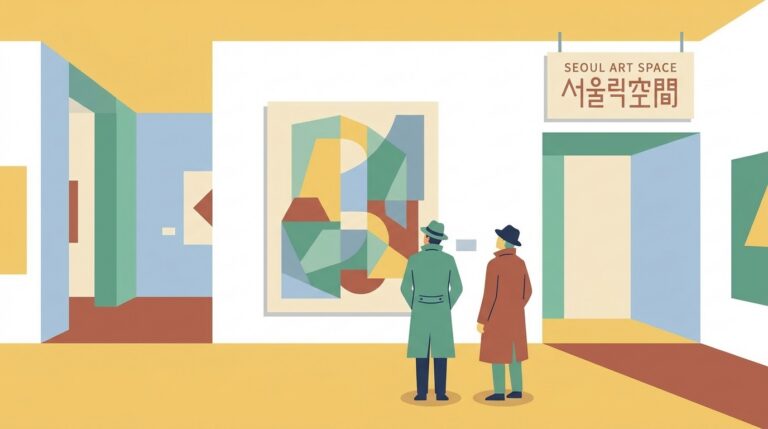
Phase 1: Empathy & Immersion
안녕하세요! 매일한글 에디터입니다. (Hello! This is your Daily Hangul editor.)
Have you ever walked out of an avant-garde exhibition at the MMCA (National Museum of Modern and Contemporary Art) in Samcheong-dong, or stepped into the cool twilight after a thought-provoking indie play in Daehangno, bursting with deep impressions—yet finding your Korean suddenly reduced to a timid “진짜 좋았어요” (It was really good) or an awkward “조금 난해했어요” (It was a bit difficult)? Worse, when you want to offer nuanced analysis or point out a disjointed motif, do you freeze out of fear that your critique will sound like harsh personal attack or petty fault-finding (흠집 내기)?
In Korean cultural spaces, expressing an intellectual opinion requires walking a delicate tightrope. You do not want to sound dismissive, but neither do you want to offer hollow compliments. Many of our advanced C1 learners share this exact frustration: “I want to participate in art seminars and discourse, but I lack the vocabulary to articulate constructive critique without offending people.” Real critical discourse in Korean is not about tearing an artwork down; it is about illuminating its latent network of meaning (잠재적 의미망을 발굴하다) and building a vibrant bridge between the creator and the audience (대중과 예술가 사이에 다리를 놓다). This comprehensive C1 guide draws from real curatorial talks and university cultural debate circles to give you the exact vocabulary, tonal elegance, and rhetorical tools to critique Korean art, architecture, and performance with sophistication and genuine empathy.
Phase 2: Core Expressions Deep Dive
Here are three indispensable C1-level expressions used by top Korean curators, cultural columnists, and critics.
1. 흠집 내기가 아니라 잠재적 의미망을 발굴하다
- Pronunciation: [Heum-jip nae-gi-ga a-ni-ra jam-jae-jeok ui-mi-mang-eul bal-gul-ha-da] (Think of ‘heum-jip’ like a small blemish on pottery, and ‘bal-gul’ like an archaeologist carefully unearthing relics).
- Meaning: “It’s not about finding faults or nitpicking; it’s about excavating the latent web of meaning.”
- K-Culture Moment: Heard frequently on cultural talk shows such as Bang-guseok 1-yeol (Movie Room Row 1) or art panel discussions at the Seoul Biennale of Architecture and Urbanism when a critic clarifies their motive before challenging an experimental project.
- Editor’s Insight: 흠집 means a scratch or nick on a surface. Adding 내기 (making/inflicting) describes destructive, petty criticism that targets trivial weaknesses. Counterbalancing it with 발굴하다 (excavate) frames your critique as a generous intellectual contribution that uncovers what the artist planted beneath the surface.
- Situation Spectrum: Casual: ⚠️ | Semi-formal: ✅ | Formal: ✅
- 🤔 Think About It: In your native culture, is critique seen primarily as an objective dissection, or does it carry an interpersonal burden? How does framing critique as ‘archaeological discovery’ change the listener’s receptivity?
2. 대중과 예술가 사이에 다리를 놓다
- Pronunciation: [Dae-jung-gwa ye-sul-ga sa-i-e da-ri-reul no-ta] (Pronounce ‘dari-reul nota’ smoothly like laying planks across a gentle stream).
- Meaning: “To build a bridge between the general public and the artist.”
- K-Culture Moment: Used by docents and art reviewers introducing complex installation works—like the kinetic sculptures of Choe U-Ram—helping casual gallery visitors grasp heavy existential themes without feeling alienated.
- Editor’s Insight: This phrase rescues critique from being ivory-tower jargon (탁상공론). In Korea, where art appreciation has surged across young demographics (the “Art-tech” and “Exhibition Hopping” trends), framing criticism as a bridge (다리) positions the speaker as an empathetic cultural mediator rather than an elitist gatekeeper.
- Situation Spectrum: Casual: ✅ | Semi-formal: ✅ | Formal: ✅
- 🤔 Think About It: Why does Korean criticism place such high value on ‘mediating with the public’ compared to isolated auteurism?
3. 비판적 거리를 유지하며 맥락화하다
- Pronunciation: [Bi-pan-jeok geo-ri-reul yu-ji-ha-myeo maeng-nak-hwa-ha-da] (Crisp and measured cadence, emphasizing ‘maeng-nak-hwa’ as placing puzzle pieces into a larger picture).
- Meaning: “To contextualize while maintaining critical distance.”
- K-Culture Moment: Quoted in architectural journals analyzing repurposed industrial spaces in Seongsu-dong, evaluating whether a converted warehouse honors historical labor memory or merely exploits retro aesthetics.
- Editor’s Insight: C1 speakers stand out by using 맥락화하다 (contextualize) instead of simply saying 설명하다 (explain). Paired with 비판적 거리 (critical distance), it signals that you neither blindly romanticize nor unfairly dismiss the work; you examine its historical and social ecosystem with poise.
- Situation Spectrum: Casual: 🚫 | Semi-formal: ✅ | Formal: ✅
- 🤔 Think About It: How does maintaining ‘distance’ in Korean differ from cold emotional detachment, especially when discussing emotionally resonant works like post-war photography?
Phase 3: Textbook Korean vs. Real Korean
Let us compare stiff classroom formulations with authentic, high-level natural critique.
Situation 1: Offering constructive critique on an ambiguous contemporary installation
- 📖 교과서 한국어 (Textbook):
이 미술 작품은 조금 이해하기 어렵고 부족한 점이 있지만 좋은 메시지를 가지고 있습니다.
(I misul jakpumeun jogeum ihaehagi eoryeopgo bujokhan jeomi itjiman joeun mesijireul gajigo itseumnida.)
“This art piece is a bit hard to understand and has deficiencies, but it carries a good message.” - 🗣️ 진짜 한국어 (Authentic C1):
완성도 면에서 약간의 아쉬움은 남지만, 담론을 촉발하는 파격적인 시도 자체만으로도 충분히 유의미해요.
(Wanseongdo myeoneseo yakganui aswiumeun namjiman, damnoneul chokbalhaneun pageokjeogin sido jachemaneurodo chungbunhi yu-uimihaeyo.)
“While there is a slight sense of regret regarding its technical polish, the audacious attempt to trigger public discourse is itself profoundly meaningful.” - 💡 왜 다를까? (Cultural Nuance):
Calling an artist’s work 부족하다 (deficient) can sound blunt and personal. Native critics soften the blow by using 아쉬움이 남다 (a longing/regret remains) while uplifting the piece’s conceptual initiative through terms like 담론을 촉발하다 (provoke discourse) and 파격적인 시도 (unconventional leap).
Situation 2: Defending the necessity of rigorous critical reviews
- 📖 교과서 한국어 (Textbook):
작품을 나쁘게 말하는 것은 나쁜 것이 아닙니다. 예술 발전에 필요합니다.
(Jakpumeul nappeuge malhaneun geoseun nappeun geosi animnida. Yesul baljeone piryohamnida.)
“Speaking badly of an artwork is not a bad thing. It is needed for art’s development.” - 🗣️ 진짜 한국어 (Authentic C1):
덮어놓고 깎아내리려는 게 아니에요. 다각적인 시선으로 맥락을 짚어줄 때 비로소 예술 생태계가 건강해지거든요.
(Deopeonotgo kkak-anaeriryeoneun ge anieyo. Dagakjeogin siseoneuro maengnageul jipeojul ttae biroso yesul saengtaegyega geonganghaejigeodeunyo.)
“It’s not about thoughtlessly belittling it. Only when we trace the context through multifaceted perspectives does the artistic ecosystem truly flourish.” - 💡 왜 다를까? (Cultural Nuance):
Colloquial mastery at C1 pairs the visceral idiom 덮어놓고 깎아내리다 (blindly chop down/belittle) with ecological metaphors like 예술 생태계 (art ecosystem) and the essential conditional marker ~ㄹ 때 비로소 (only then).
Phase 4: K-Culture Deep Dive & Non-Verbal Manners
4-1. Nunchi & Physical Poise in Critical Discourse
In Korean critical circles (art roundtables, Q&A sessions at the Jeonju International Film Festival, or architectural critique panels), how you deliver critique matters just as much as your theoretical thesis.
* The Tilt & Nod: Never deliver sharp analytical critique with an unblinking, upright stare. Tilt your head slightly, nod slowly to validate the artist’s labor (노고), and use open-palm gestures rather than pointing index fingers when referencing specific motifs.
* The Softening Buffer: Begin with 조심스러운 의견이지만… (If I may offer a humble, tentative view…) or 보는 시각에 따라 다를 수 있겠으나… (Depending on one’s visual perspective…). This verbal Nunchi demonstrates respect for collective harmony (정) without diluting your intellectual edge.
4-2. Cultural Code: The “Exhibition Run” (전시 투어) Culture
From the transformation of old steel mills in Mullae-dong into alternative art labs to public installations at Dongdaemun Design Plaza (DDP), Korea’s cultural landscape thrives on the tension between lightning-fast hyper-modernity and preservation of memory (기억의 보존). When Koreans critique architecture or exhibitions, they pay special attention to 장소성 (placeness) and 공공성 (public accessibility). An installation is rarely critiqued as an isolated aesthetic object; it is evaluated based on how gracefully it converses with its local neighborhood and everyday citizens.
Phase 5: Real-World Roleplay Scenario
Setting: A quiet café inside the Arko Art Center near Marronnier Park, Daehangno. You are sipping tea with Min-seo, a passionate independent curator, after attending an experimental mixed-media exhibition examining urban redevelopment.
- 민서 (Min-seo): 오늘 전시 어떻게 보셨어요? 작가가 재개발 구역의 잔해를 그대로 가져와서 설치했잖아요. 호불호가 꽤 갈리더라고요.
(Oneul jeonsi eotteoke bosyeosseoyo? Jakgaga jaegaebal guyeogui janhaereul geudaero gajyeowaseo seolchihaetjanh-ayo. Hobulho-ga kkwae gallideoragoyo.)
“How did you find today’s exhibition? The artist brought actual debris from the redevelopment zone and installed it as is. Reactions seem quite polarized.” - 나 (You): 🎭 (차분하게 찻잔을 내려놓으며 / Calming putting down your teacup)
단순한 시각적 충격을 넘어, 관람객에게 도시의 상흔을 직면하게 만드는 힘이 있었어요.
(Dansunhan sigakjeok chunggyeogeul neomeo, gwanramgaegege dosiui sangheuneul jingmyeonhage mandeuneun himi isseosseoyo.)
“Beyond simple visual shock, it possessed a strength that forced visitors to confront the scars of the city.” - 민서 (Min-seo): 맞아요. 하지만 일각에서는 지나치게 스펙터클에만 치중해서 거주민들의 실제 고통을 대상화했다는 비판도 나오거든요.
(Majayo. Hajiman ilgageseoneun jinachige seupekteokeulleman chijunghaeseo geojumindeurui silje gotongeul daesanghwahaetdaneun bipando naogodeunyo.)
“True. Yet from some corners, there’s critique that it focused excessively on spectacle, objectifying the actual suffering of displaced residents.” - 나 (You): 🎭 (고개를 끄덕이며 공감하되 생각을 덧붙이며 / Nodding empathetically while adding your thought)
충분히 제기될 수 있는 지적이에요. 하지만 날카로운 비평은 단순한 흠집 내기가 아니어야 하잖아요.
(Chungbunhi jegidoel su inneun jijeogieyo. Hajiman nalkaroun bipyeongeun dansunhan heumjip naegiga anieoya hajanh-ayo.)
“That is a critique worth raising. However, sharp criticism should never be mere fault-finding.” - 민서 (Min-seo): 그렇다면 이 작업의 진짜 가치는 어디에서 찾아야 할까요?
(Geureotamyeon i jag-eobui jinjja gachineun eodieseo chajaya halkkayo?)
“In that case, where should we seek the true value of this piece?” - 나 (You): 🎭 (진지하고 따뜻한 시선으로 / With an earnest, warm expression)
작품이 남긴 공백 속에서 잠재적 의미망을 발굴해 대중과 예술가 사이에 다리를 놓아주는 게 우리 비평의 역할 아닐까요?
(Jakpumi namgin gongbaek sogeseo jamjaejeok uimimangeul balgulhae daejunggwa yesulga saie darireul noajuneun ge uri bipyeongui yeokhal anilkkayo?)
“Isn’t it our critical duty to unearth the latent web of meaning from the void left by the artwork and build a bridge between the artist and the public?” - 민서 (Min-seo): 와, 그 표현 정말 와닿네요! 단순히 좋고 나쁨을 따지는 걸 넘어서는 통찰이에요.
(Wa, geu pyohyeon jeongmal wadanne-yo! Dansunhi jotgo nappeumeul ttajineun geol neomeoseoneun tongcharieyo.)
“Wow, that expression genuinely resonates with me! That is insight that transcends merely judging whether something is good or bad.” - 나 (You): 🎭 (미소를 지으며 / Smiling humbly)
비판적 거리를 유지할 때 비로소 그 파격이 지닌 미학적 질문이 선명해지니까요.
(Bipanjeok georireul yujihal ttae biroso geu pageogi jinin mihakjeok jilmuni seonmyeonghaejinikkayo.)
“Because only when we maintain critical distance do the aesthetic questions posed by such boldness become crystal clear.”
🔀 Interactive Decision Point
Suppose Min-seo asks: “그렇다면 이 전시의 도록(catalog) 비평글을 쓴다면 한마디로 뭐라고 규정하시겠어요?” (Then if you were to write a one-line critique for the exhibition catalog, how would you define it?)
- Option A (Best Choice): “재개발의 폭력성을 박제하는 데 그치지 않고, 도시의 상실을 공론장으로 끌어올린 용기 있는 시도입니다.” (It is a courageous attempt that refuses to merely taxidermy the violence of redevelopment, instead pulling urban loss into the public forum.)
- Feedback: Perfect C1 choice! It captures nuances, balances sharp assessment, and uses high-register terms like 공론장 (public sphere/forum) and 박제하다 (taxidermy/stagnate).
- Option B (Bad Choice – Excessively Combative): “솔직히 주민들의 슬픔을 팔아서 만든 실패작이고, 비판받아 마땅하다고 봅니다.” (Honestly, it’s a failed work made by selling the residents’ sorrow, and it thoroughly deserves condemnation.)
- Feedback: Destructive critique (흠집 내기). It shuts down further dialogue and alienates curators who seek constructive synthesis.
- Option C (Risk Choice – Over-Flattery / Superficial): “그냥 작가님이 워낙 유명하시니까 다 깊은 뜻이 있을 거라고 생각해요. 너무 멋졌어요!” (Well, since the artist is so famous, I’m sure everything has deep meaning. It was just so cool!)
- Feedback: Weak and passive. C1 discourse requires independent analytical judgment rather than appealing to authority.
Phase 6: 10-Second Emotional Shadowing Drill
Practice these sentences with the exact pauses (/) and emotional pitch markers.
- [🧐 지적이고 통찰력 있게 / Intellectually & Insightfully]
날카로운 비평은 / 흠집 내기가 아니라, / 작품의 잠재적 의미망을 발굴하는 일이에요.
(Nalkaroun bipyeongeun / heumjip naegiga anira, / jakpumui jamjaejeok uimimangeul balgulhaneun irieyo.) -
[🤝 설득력 있고 따뜻하게 / Persuasively & Warmly]
난해한 현대 예술일수록 / 대중과 작가 사이에 / 친절한 다리를 놓아줄 비평이 절실해요.
(Nanhaehan hyeondae yesurilsurok / daejunggwa jakga saie / chinjeolhan darireul noajul bipyeongi jeolsilhaeyo.) -
[⚖️ 균형 잡히고 차분하게 / Balanced & Composed]
작품의 미학적 성취와 한계를 / 비판적 거리를 두고 / 균형 있게 짚어봐야 합니다.
(Jakpumui mihakjeok seongchwiwa hangyereul / bipanjeok georireul dugo / gyunhyeong itge jipeobwaya hamnida.)
Phase 7: K-Culture Mini Dictionary
- 담론 (Dam-non) | Discourse / Dialogue
- Context: Refers to structured intellectual conversation around art or society. Highly used in phrases like 담론을 형성하다 (form discourse) or 담론을 촉발하다 (provoke discourse).
- 맥락화 (Maeng-nak-hwa) | Contextualization
- Context: The act of viewing a scene, installation, or building inside its historical, sociopolitical, or generational frame rather than as a vacuum.
- 파격 (Pa-gyeok) | Unconventionality / Rule-breaking
- Context: Combining 깨뜨릴 파 (破) and 격식 격 (格), it describes an avant-garde artistic move that tears down formal conventions with intentional daring.
- 미학적 울림 (Mi-hak-jeok ul-lim) | Aesthetic Resonance
- Context: Describes an echo of meaning that lingers long after leaving the theater or gallery hall, surpassing momentary sensory entertainment.
Phase 8: Cultural Explorer Survival Kit
Top 3 Discourse Survival Phrases
- 호불호가 갈릴 수 있겠으나 시도 자체는 신선해요.
(Hobulho-ga gallil su itgeseuna sido jacheneun sinseonhaeyo.)
“Reactions might be polarized, but the attempt itself is refreshing.”- Pro Tip: Use this when stepping out of a controversial K-movie or indie performance with Korean acquaintances to keep discussion constructive.
- 어떤 맥락에서 이런 조형 언어를 썼는지 궁금해지네요.
(Eotteon maengnageseo ireon johyeong eoneoreul sseotneunji gunggeumhaejineyo.)
“It makes me curious in what context they employed this visual/formative language.”- Pro Tip: Perfect question to pose to gallery docents or artists during Q&A sessions.
- 직관적인 감상과 비판적 독해 사이의 균형이 돋보입니다.
(Jikgwanjeogin gamsanggwa bipanjeok dokhae sai-ui gyunhyeongi dotboimnida.)
“The balance between intuitive appreciation and critical reading is truly striking.”- Pro Tip: High-register praise to write in an exhibition visitor log (방명록).
Editor’s Travel Note
If you want to experience authentic cultural discourse in Seoul, check out the specialized public talk programs and docent schedules on the 국립현대미술관 공식 전시 예약 플랫폼 (MMCA official exhibition reservation platform). Many contemporary galleries in Bukchon, Samcheong-dong, and Euljiro offer bilingual critique pamphlets (리플릿). Always download the audio docent apps provided on-site—listening to how professional Korean curators formulate their sentences will accelerate your C1 fluency tenfold!
Phase 9: A Step Deeper (한 발 더 깊이)
In traditional Korean aesthetics, there is a concept called 여백의 미 (the beauty of empty space). This idea extends directly into modern criticism. Critique in the West can sometimes feel like an adversarial contest where rhetoric is sharpened to win debates. However, within sophisticated Korean cultural circles, an artwork is viewed as an incomplete dialogue until it meets the spectator. When you point out the tensions or ambiguities in a work, you are not inflicting a flaw (흠집); you are stepping into that deliberate “empty space” and weaving meaning together with the artist.
This is why genuine critique in Korea is recognized as an act of solidarity—building a living bridge (다리) between creators striving to articulate the unspeakable and citizens walking the hurried streets outside.
💬 Your Turn: What piece of Korean art, film, or architecture made you want to look past the surface and unearth its hidden layers? Share your critique in the comments below using today’s phrases!
Phase 10: FAQ & Common Pitfalls
Q: Can I use the word ‘비판’ (bipan) and ‘비평’ (bipyeong) interchangeably?
A: Not quite. 비판 (criticism/critique) leans toward philosophical questioning or identifying ideological contradictions and flaws. 비평 (criticism/review) is broader and predominantly used in artistic and cultural contexts (e.g., 문학 비평 – literary criticism, 영화 비평 – film critique). 비평 encompasses appreciation, interpretation, and historical positioning, whereas 비판 is the analytical faculty applied within that review.
Q: Does calling an artwork ‘난해하다’ sound rude to a Korean artist?
A: Not at all! 난해하다 (esoteric/complex/difficult to interpret) is widely recognized in contemporary art discourse. In fact, calling an artwork simply 어렵다 (difficult) sounds like personal incomprehension, whereas 난해하다 acknowledges that the artwork intentionally holds multi-layered, cryptic conceptual puzzles.
Q: How do I express disagreement with a senior scholar or curator’s interpretation?
A: Always begin by validating their premise using concession markers: “선생님께서 짚어주신 역사적 맥락에 깊이 공감하면서도, 동시대적 관점에서는 또 다른 잠재적 의미망을 발견할 수 있지 않을까 조심스럽게 생각해 봅니다.” This maintains total cultural courtesy (예의) while boldly presenting your original thesis.
🚨 Common Mistakes Alert
- Mistake: Using 지적질하다 (jijeokjilhada) when describing critique.
- Why it’s bad: 지적질 is a derogatory slang term meaning “bossy, condescending finger-pointing.”
- Correct Action: Use 건설적인 비평을 제시하다 (offer constructive critique) or 맥락을 짚다 (highlight context).
- Mistake: Overusing 별로예요 (It’s not good / Meh) in public artistic settings.
- Why it’s bad: It reduces complex aesthetic endeavor to juvenile personal taste.
- Correct Action: Say 다소 아쉬움이 남습니다 (It leaves a bit of longing/regret) or 보완의 여지가 있어 보입니다 (There seems to be room for complementation).
- Mistake: Confusing 흠집 내기 with 문제의식 (problem consciousness).
- Why it’s bad: Calling an artist’s sharp societal challenge a “flaw” misinterprets critical art.
- Correct Action: Commend the artist’s 날카로운 문제의식 (keen critical awareness).
Phase 11: Action Missions
- 🥉 Bronze Mission (Solo Shadowing):
Record your voice reading the Phase 6 shadowing drill 3 times. Focus on softening your final verb endings (~ㄹ 일이에요, ~절실해요). - 🥈 Silver Mission (Community Review):
Visit a museum or open an art article. Write a 2-sentence mini-critique on Instagram or Naver Blog using the expression 대중과 예술가 사이에 다리를 놓다. Tag our Daily Hangul community! - 🥇 Gold Mission (Live Discourse):
Attend an artist talk, theater Q&A, or cinema screening talk (GV – Guest Visit) in Korea. Ask a question or leave a visitor-book comment beginning with “작품의 잠재적 의미망을 발굴한다는 관점에서…” - 🎮 K-Culture Mission:
Watch a classic Korean cinephile program (like 방구석 1열) or an episode of an architectural documentary (like EBS 건축탐구 집). Spot when the speakers balance a critique with the phrase 아쉬움 instead of direct negativity!
Phase 12: Interactive Quiz Challenge
Test your mastery of C1 cultural critique discourse!
1. Context Judgment
Which sentence is the most appropriate and sophisticated comment to leave in an exhibition guestbook where the installation was radical and experimental?
* (A) 솔직히 너무 난잡해서 무슨 소린지 하나도 모르겠고 시간 낭비였어요.
* (B) 형식의 파격을 통해 현대 사회의 균열을 날카롭게 짚어낸 문제의식이 돋보입니다.
* (C) 비평가들이 다 칭찬하니까 저도 그냥 대단하다고 생각하겠습니다.
👉 Click to reveal Answer & Explanation
Answer: (B)
* Explanation: (B) demonstrates advanced C1 vocabulary (형식의 파격 – formal subversion, 균열을 날카롭게 짚어내다 – sharply trace fractures, 문제의식 – critical consciousness). (A) is raw 흠집 내기 emotional venting, and (C) abandons critical engagement.
2. Fill in the Blank
비평의 진정한 역할은 단순히 결점을 찾아내는 ( [ 1 ] )가 아니라, 작품 이면에 숨겨진 ( [ 2 ] )을 발굴하는 데 있습니다.
👉 Click to reveal Answer & Explanation
Answer: [ 1 ] 흠집 내기 (Heumjip naegi) | [ 2 ] 잠재적 의미망 (Jamjaejeok uimimang)
* Explanation: Constructive critique moves from finding petty flaws (흠집 내기) to excavating the latent web of meaning (잠재적 의미망).
3. True / False Cultural Check
- Statement: In Korean contemporary art discussions, softening one’s tone with expressions like ~아쉬움이 남다 indicates that the speaker lacks confidence in their critical opinion. (True / False)
👉 Click to reveal Answer & Explanation
Answer: False
* Explanation: Far from showing insecurity, using strategic buffers is an advanced rhetorical marker of high Nunchi and intellectual maturity in Korea, inviting reciprocal dialogue while keeping the critique focused on aesthetics rather than ego.
Keep refining your critical gaze, cultural navigators! With these tools, your conversations about art will build enduring bridges wherever you go.







