

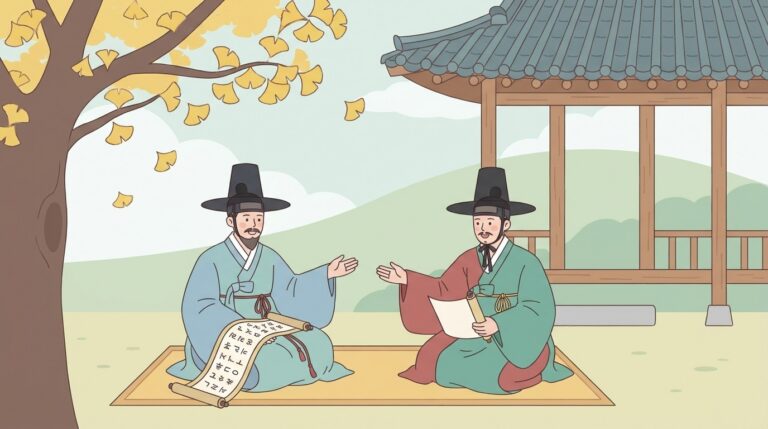
The Art of Respectful Defiance: Joseon’s Greatest Debate
Phase 1: Empathy & Context
안녕하세요! 매일한글 에디터입니다.
Picture this: You are sitting in an ultra-prestigious academic symposium or a high-stakes executive boardroom in central Seoul. Across from you sits an industry legend—a mentor whose books you devoured in university, thirty years your senior. They present an elegant, binary framework that everyone else in the room nods along with out of sheer deference. Yet, your analytical intuition catches a fatal flaw: human emotion and reality cannot be neatly cleaved into tidy philosophical bins. Your heart pounds. In Korean culture, where age and institutional hierarchy carry immense gravitational pull, how do you challenge a master without sounding insolent, aggressive, or culturally tone-deaf?
This precise dilemma occurred in the autumn of 1558. A 32-year-old newly minted scholar named Gobong Ki Dae-seung (고봉 기대승) dared to pen a letter to 58-year-old Toegye Yi Hwang (퇴계 이황)—the intellectual sun of the Joseon Dynasty. Toegye had proposed a dualistic view where the morally pure “Four Beginnings” (Sadan) stem from Principle (Li, 이), while ordinary human “Seven Emotions” (Chiljeong) stem from Material Force (Ki, 기). Gobong respectfully pushed back with razor-sharp rigor: in theoretical contemplation, Principle and Material Force may be conceptually distinct, but in the living, breathing manifestation of human emotion, they are fundamentally inseparable (이와 기는 개념상 구분될 뿐 실제 감정에서는 분리될 수 없다).
Many C2 learners tell us that mastering everyday fluency is one thing, but navigating the elite linguistic tightrope of sophisticated dissent—speaking with razor-sharp logic wrapped in profound epistolary humility—feels almost impossible. Today, based on actual feedback from our advanced learners preparing for academic defenses and executive debates in Korea, we break down the rhetorical genius of Gobong’s famous counter-argument. By mastering this discourse, you will gain the linguistic tools to articulate complex philosophical dialectics in polished, C2-level Korean.
Phase 2: Core Expressions Deep Dive
1. 개념상으로는 구분될지언정 실제로는 떼려야 뗄 수 없습니다
- Pronunciation: [Gaenyeomsang-eoroneun gubundoeljeonjeong siljjeroneun tteryeoya ttel su eopseumnida] (Analogy: Gae-nyeom-sang-eo-ro-nun goo-boon-dwel-jeon-jeong, flowing like “though concept-wise separated, in reality cannot be unclasped”)
- Meaning: “Though they may be conceptually distinguished, in reality they cannot be torn apart.”
- K-Culture Moment: Evoking iconic debate scenes in historical dramas (사극) like The Red Sleeve or legal thrillers like Stranger (비밀의 숲), where a brilliant junior strategist dismantles a simplistic premise before the court.
- Editor’s Insight: The grammatical ending
-ㄹ지언정concedes a conceptual point with grace, while떼려야 뗄 수 없다emphasizes an unbreakable organic unity. This mirrors the Neo-Confucian principle of I-gi bul-sang-ri (理氣不相離). - Situation Spectrum:
- Casual: 🚫
- Semi-formal: ⚠️
- Formal: ✅
- 🤔 Think About It: In Western philosophy, Cartesian dualism separates mind and matter sharply. How does Gobong’s holistic balance between Li and Ki challenge binary thinking in your native language?
2. 외람되오나 감히 재론의 여지를 여쭙고자 합니다
- Pronunciation: [Oeramdoeona gamhi jaeron-ui yeojireul yeojjupgoja hamnida] (Soft, reverent cadence: Oe-ram-doe-o-na gam-hee jae-ron-eui…)
- Meaning: Literal: “Though it is presumptuous, I dare inquire about the possibility of re-discussion.” / Real Nuance: “With utmost respect, I venture to propose a counterargument.”
- K-Culture Moment: Used by elite advisors in palace council chambers or boardrooms in dramas like Queen of Tears when addressing an executive chairman with unwavering conviction.
- Editor’s Insight:
외람되오나(“though beyond my station”) acts as an immediate linguistic shield. It signals that your dissent is driven by intellectual pursuit, not personal disrespect. - Situation Spectrum:
- Casual: 🚫
- Semi-formal: ⚠️
- Formal: ✅
- 🤔 Think About It: Why does Korean culture preserve specialized humble verbs like
여쭙다even when the underlying intellectual point is radically subversive?
3. 사안의 본질을 어찌 단편적으로만 재단할 수 있겠습니까
- Pronunciation: [Sa-an-ui bonjireul eojji danpyeonjeog-euroman jaedanhal su itgesseumnikka] (Analogy: Sharp and deliberate rhetorical rhythm: Sa-an-eui bon-jee-reul eot-ji…)
- Meaning: Literal: “How could one tailor the essence of the matter merely unilaterally?” / Real Nuance: “We cannot afford to judge such a multifaceted issue through a simplistic, one-dimensional lens.”
- K-Culture Moment: Intellectual panel discourse programs such as 썰전 or deep-dive podcasts where critics dismantle reductionist theories.
- Editor’s Insight: The verb
재단하다(to cut cloth according to a pattern) carries a sharp critique: you are accusing the opposing view of forcing dynamic reality into an artificial mold. - Situation Spectrum:
- Casual: 🚫
- Semi-formal: ✅
- Formal: ✅
- 🤔 Think About It: Rhetorical questions (설의법) in formal Korean create dramatic tension while inviting the listener to reach the same logical conclusion themselves.
Phase 3: Textbook Korean vs. Real Korean
Scenario 1: Objecting to an established theoretical paradigm
- 📖 교과서 한국어: 제 생각에는 선생님의 주장에 논리적 오류가 있습니다. (Je saenggagenun seonsaengnim-ui jujange nollijeok oryuga itseumnida. / “In my opinion, there is a logical error in your argument, Sir.”)
- 🗣️ 진짜 한국어: 기존 학설의 맹점을 보완하고자 또 다른 시각을 개진해 봅니다. (Gijon hakseorui maengjeomeul bowanhagoja tto dareun sigageul gaejinhae bomnida. / “To complement the blind spots of the prevailing doctrine, I venture to present an alternative perspective.”)
- 💡 왜 다를까?: Stating directly that an authority figure has a “logical error” (논리적 오류) violates Confucian conversational grace. Polished C2 Korean reframes refutation as “supplementing blind spots” (맹점 보완), honoring the mentor while dismantling the flaw.
Scenario 2: Explaining that two intertwined realities cannot be separated
- 📖 교과서 한국어: A와 B는 연결되어 있어서 따로 나눌 수 없다고 생각해요. (A-wa B-neun yeongyeoldoeeo isseoseo ttaro nanul su eopdago saenggakhaeyo. / “I think A and B are connected so they cannot be divided separately.”)
- 🗣️ 진짜 한국어: 양자는 동전의 양면과 같아 분리하여 논할 성질의 것이 아닙니다. (Yangjaneun dongjeon-ui yangmyeongwa gata bullihayeo nonhal seongjirui geosi animnida. / “The two are like two sides of the same coin, defying segregated debate.”)
- 💡 왜 다를까?: Basic textbooks use connective clauses like
-어서and colloquial verbs like나누다. Advanced intellectual discourse uses metaphorical parallelism (동전의 양면) and formal nominalization (논할 성질의 것).
Phase 4: K-Culture Deep Dive & Non-verbal Manners
4-1. Nunchi & Physical Deportment during Intellectual Dissent
When challenging a mentor or superior in a Korean formal context, non-verbal cues carry fifty percent of your message. Ki Dae-seung accomplished his historic debate through letters (서간문), utilizing profound honorific calligraphy to balance his fierce critique.
In face-to-face academic settings:
* Hand Posture (공수, Gongsu): Keep your hands clasped together comfortably at the lower chest or resting softly on your notes; avoid sweeping finger-pointing gestures.
* Gaze Management: Direct, unblinking eye contact during critique can be perceived as confrontational defiance. Soften your gaze toward the mid-bridge of the nose or collar area, nodding slowly while listening to prove your dissent comes from profound attentiveness.
* Tone Modulation: Lower your pitch and slow your cadence slightly when delivering the crux of your counterpoint. The calmer your tone, the sharper your philosophical insight appears.
4-2. Culture Code: The Beauty of Sincere Debate (토론과 쟁명)
In popular historical dramas (사극), we often see courtiers screaming factional insults. But historical reality reveals that the Joseon intellectual world held deep debates in the highest esteem. Toegye Yi Hwang—despite being the supreme sage of his era—did not silence the 32-year-old junior scholar. Instead, he exchanged letters with Gobong for thirteen straight years, even revising his own treatises based on Gobong’s critiques. This shows that Korean deference is not blind subservience; when logic is underpinned by genuine respect for truth (구도, seeking the Way), intellectual defiance becomes the highest form of filial and scholarly honor.
Phase 5: Real-Life Roleplay Scenario
- Setting: An international Neo-Confucian colloquium at the historic Myeongnyundang lecture hall inside Sungkyunkwan. Sunlight filters through ancient ginkgo trees.
- Characters:
- Professor Min (민 교수): A venerated scholar of Joseon philosophy advocating Toegye’s early dualistic framework.
- Alex (알렉스 / You): A doctoral candidate presenting a thesis on Ki Dae-seung’s integrated Li-Ki synthesis.
Turn 1
* 민 교수: 퇴계 선생께서는 사단은 이가 발하여 기가 따르고, 칠정은 기가 발하여 이가 탄다고 보셨네. 이 엄격한 도덕적 분별이야말로 우리 학맥의 근간이지. (Toegye seonsaengkkeseoneun sadaneun iga balhayeo giga ttareugo, chiljeongeun giga balhayeo iga tandago bosyeonne. I eomgyeokhan dodeokjeok bunbyeoriyamallo uri hangmaegui geunganiji. / “Master Toegye held that the Four Beginnings emerge from Li followed by Ki, while the Seven Emotions emerge from Ki ridden by Li. This rigorous moral distinction is the bedrock of our academic lineage.”)
* 🎭 [안경을 고쳐 쓰며 묵직한 목소리로 청중을 둘러본다]
Turn 2
* 알렉스: 교수님의 고견에 깊이 감복하면서도, 당시 고봉 기대승의 서한을 다시금 반추해 보게 됩니다. (Gyosunim-ui gogyeone gipi gambokhansamyeonseodo, dangsi Gobong Ki Dae-seung-ui seohaneul dasigeum banchuhae boge doemnida. / “While deeply impressed by your profound insight, Professor, I find myself reconsidering Gobong Ki Dae-seung’s letters from that time.”)
* 🎭 [단정한 자세로 목례를 올린 뒤, 발표 자료의 한 구절을 조용히 가리킨다]
Turn 3
* 민 교수: 자네 뜻은 삼십이 세의 신진 학자가 제기한 의문이 퇴계의 원숙한 학설을 뒤흔들 수 있었다는 말인가? (Jane tteuseun samsib-i se-ui sinjin hakjaga jegihan uimuni Toegye-ui wonsukhan hakseoreul dwiheundeul su isseotdaneun maringa? / “Do you imply that the questioning raised by a 32-year-old novice scholar could overturn Toegye’s mature doctrine?”)
* 🎭 [눈썹을 살짝 치켜올리며 찻잔을 내려놓는다]
Turn 4
* 알렉스: 외람되오나 감히 재론의 여지를 여쭙고자 합니다. 사단과 칠정을 이와 기로 각각 배속시키는 것은 감정의 유기적 실체를 간과할 위험이 있지 않겠습니까? (Oeramdoeona gamhi jaeron-ui yeojireul yeojjupgoja hamnida. Sadangwa chiljeongeul i-wa gi-ro gakgak baesoksikineun geoseun gamjeong-ui yugijeok silchereul gangwahal wiheomi itji anketseumnikka? / “Excuse my presumption, but I venture to propose grounds for re-examination. Might allocating the Four and Seven separately to Li and Ki run the risk of overlooking the organic reality of emotion?”)
* 🎭 [차분하고 흔들림 없는 시선으로 교수의 안색을 살핀다]
Turn 5
* 민 교수: 음, 그렇다면 자네는 순선(純善)한 도덕적 본성과 가변적인 정념이 근원부터 뒤섞여 있다고 주장하는 겐가? (Eum, geureotdamyeon janeneun sunseonhan dodeokjeok bonseonggwa gabyeonjeogin jeongnyeomi geunwonbuteo dwiseokkyeo itdago jujanghaneun genga? / “Hmm, then are you asserting that purely good moral nature and variable human passions are intermingled from their very origin?”)
* 🎭 [팔짱을 낀 채 흥미로운 표정으로 경청한다]
Turn 6
* 알렉스: 결코 혼동하자는 뜻이 아닙니다. 개념상으로는 구분될지언정 실제 감정의 발현에서는 떼려야 뗄 수 없는 관계임을 고봉은 역설했던 것입니다. (Gyeolko hondonghajaneun tteusi animnida. Gaenyeomsang-eoroneun gubundoeljeonjeong siljje gamjeong-ui balhyeon-eseoneun tteryeoya ttel su eopneun gwangye-imeul Gobongeun yeokseolhaetdeon geosimnida. / “By no means do I suggest confusing them. Gobong stressed that though they are conceptually distinct, in the actual manifestation of human emotion, they are inextricably united.”)
* 🎭 [미소를 띤 채 양손을 모으며 부드럽게 방점을 찍는다]
Turn 7
* 민 교수: 허허, 이와 기가 서로 떨어질 수 없다는 ‘이기불상리’의 묘미를 정면으로 파고드는구먼. 자네의 고봉 해석에 상당한 설득력이 있어. (Heoheo, i-wa giga seoro tteoreojil su eopdaneun ‘igi-bulsang-ri’-ui myomireul jeongmyeon-euro pagodeuneoguman. Jane-ui Gobong haeseoge sangdanghan seoldeuknyeogi isseo. / “Aha! You strike directly at the core of ‘inseparability of Li and Ki.’ Your interpretation of Gobong holds formidable persuasive weight.”)
* 🎭 [너털웃음을 터뜨리며 고개를 끄덕인다]
Turn 8
* 알렉스: 가르침을 주셔서 대단히 감사드립니다, 교수님. (Gareuchimeul jusyeoseo daedanhi gamsadeurimnida, gyosunim. / “Thank you deeply for your guidance, Professor.”)
* 🎭 [정중하게 고개 숙여 예를 표한다]
🔀 Interactive Decision Point
Suppose Professor Min challenges you again: “그렇다면 일상에서 도덕적 실패를 겪는 원인은 기(氣)의 탓입니까, 이(理)의 한계입니까?” How will you respond?
- Option A: “그건 교수님께서 성리학을 너무 흑백논리로 보셔서 생기는 의문입니다.” (Geugeon gyosunimkkeseo seongnihageul neomu heukbaengnolli-ro bosyeoseo saenggineun uimunimnida.)
- Feedback: 🛑 Bad. Accusing a professor of “black-and-white thinking” (흑백논리) shatters academic harmony instantly and will alienate your Korean peers.
- Option B: “외람되오나, 기가 탁하여 이가 온전히 드러나지 못할 뿐, 양자를 분리하여 책임을 물을 수는 없다고 사료됩니다.” (Oeramdoeona, giga takhayeo iga onjeonhi deureonaji mothal ppun, yangjareul bullihayeo chaegimeul mureul suneun eopdago saryodoemnida.)
- Feedback: 🏆 Best! Flawlessly deploys humble prefaces, acknowledges the Joseon conceptual model of Ki‘s turbidity, and maintains Gobong’s holistic framework with academic poise.
- Option C: “잘 모르겠습니다. 그냥 옛날 책에 그렇게 적혀 있으니 맞지 않을까요?” (Jal moreugesseumnida. Geunyang yennal chaege geureoke jeokhyeo isseuni matji aneulkkayo?)
- Feedback: ⚠️ Risk. Total retreat undermines your C2 credibility. Scholarly deference should never collapse into intellectual apathy.
Phase 6: 10-Second Emotion Shadowing Drill
Practice these lines aloud, paying attention to breath marks (/) and emotional tone!
Line 1
* [🧐 차분하고 정중하게 논리적 전제를 깔며]
* 개념상으로는 / 구분될지언정 / 실제 발현에서는 / 떼려야 뗄 수 없습니다.
* Gaenyeomsang-eoroneun / gubundoeljeonjeong / siljje balhyeon-eseoneun / tteryeoya ttel su eopseumnida.
Line 2
* [🙏 깊은 존경심을 담아 조심스럽게 그러나 명확하게]
* 외람되오나 / 감히 / 학설의 재론의 여지를 / 여쭙고자 합니다.
* Oeramdoeona / gamhi / hakseorui jaeron-ui yeojireul / yeojjupgoja hamnida.
Line 3
* [🔥 학구적인 단호함으로 본질을 짚으며]
* 인간 감정의 총체를 / 어찌 단편적인 이분법으로만 / 재단할 수 있겠습니까?
* Ingan gamjeong-ui chongchereul / eojji danpyeonjeogin ibunbeop-euroman / jaedanhal su itgetseumnikka?
Phase 7: K-Culture Mini Dictionary
- 사단칠정 (Sadan-chiljeong): The Four Beginnings and Seven Emotions. In contemporary intellectual usage, it symbolizes the fundamental human struggle between moral integrity (사단) and raw instinctual passions (칠정).
- 이기불상리 (I-gi bul-sang-ri): Principle and Material Force cannot be separated. Modern Korean executives and academics cite this idiom when insisting that abstract values (ethics, mission) and practical execution (budget, reality) must work in tandem.
- 문답법 (Mundapbeop): Dialectical Question-and-Answer Method. Describes high-level collaborative inquiry, reminiscent of Toegye and Gobong’s epistolary discourse.
- 온고지신 (Ongojisin): Reviewing the old to discover the new. Frequently used in Korean business and cultural innovation to describe modernizing traditional philosophies for cutting-edge solutions.
Phase 8: Traveler’s Cultural Survival Kit
If you visit South Korea’s iconic Confucian academies (서원), such as Dosan Seowon in Andong or Wolbong Seowon in Gwangju (dedicated to Ki Dae-seung), keep these high-register expressions handy:
- Top 3 Expressions:
- 퇴계 선생과 고봉 선생의 왕복 서한 자료를 열람할 수 있습니까? (Toegye seonsaenggwa Gobong seonsaeng-ui wangbok seohan jaryoreul yeollamhal su itseumnikka?)
- Pro Tip: Use
열람하다(to inspect/view documents) rather than보다when speaking to archivists.- 이 서원의 배향 인물과 학문적 내력에 대해 해설을 청해도 되겠습니까? (I seowon-ui baehyang inmulgwa hangmunjeok naeryeoge daehae haeseoreul cheonghaedo doegesseumnikka?)
- Pro Tip:
배향 인물refers to the honored historical figures enshrined at the academy.- 당시 사단칠정 논쟁의 전개 과정을 다룬 도록이 구비되어 있나요? (Dangsi sadanchiljeong nonjaeng-ui jeongae gwajeongeul darun dorogi gubidoeeo innayo?)
- Pro Tip: Use
도록(exhibition catalogue) to purchase specialized academic material on-site.
- Editor’s Travel Note: To explore the historical setting of these debates, travel down to Andong. We strongly recommend booking train tickets directly via the [KORAIL Talk official app installation guide] rather than third-party resellers. Many ancestral halls (종택) in Andong prefer cash donations or direct bank transfers for tea ceremonies, so having the KakaoPay app or local cash ready is essential.
Phase 9: “One Step Deeper” (Thought Essay)
In modern corporate Korea, foreign observers frequently mistake strict hierarchy for intellectual stagnation. Yet the Four-Seven Debate between Toegye and Gobong shatters this stereotype. At 58, Toegye was the supreme chancellor of Sungkyunkwan; Gobong was merely a newly passed civil servant. Yet Toegye listened, engaged, and adjusted his life’s philosophical work across a thirteen-year epistolary dialogue because truth (도, the Way) reigned supreme above mortal status. This dynamic tension—where linguistic reverence elevates rather than dilutes intellectual critique—is the foundational engine of modern Korean debate culture. When you learn how to argue in Korean with impeccable honorific modesty, your words gain monumental moral power.
💬 Your Turn: Have you ever had to critique a mentor or senior colleague in your culture? How did your language help—or hinder—your goal? Share your thoughts below!
Phase 10: FAQ & Common Mistakes
Q: Why didn’t Toegye punish or reprimand Ki Dae-seung for questioning his theory?
A: In Neo-Confucian governance, scholarly critique undertaken with proper epistolary decorum (예법) was considered the supreme duty of a Confucian gentleman (군자). Toegye was renowned for his extraordinary humility (경, Gyeong) and welcomed Gobong’s incisive mind as a gift toward refining philosophical truth.
Q: How can I use these expressions in a modern Korean business meeting?
A: When proposing an alternative strategy against a senior executive’s project, replace the philosophical jargon with modern business terminology while preserving the rhetorical frame: “부장님 고견에 감사드리며, 외람되오나 현장 실행력 차원에서 재론의 여지를 여쭙고자 합니다.”
Q: What is the primary difference between Toegye’s and Gobong’s stances?
A: Toegye emphasized dual origin (focusing on the moral purity of Li versus the volatility of Ki), while Gobong asserted that in actual human experience, Li cannot exist independently of Ki, making moral virtue an embodied balance rather than a separate metaphysical entity.
🚨 Common Mistakes Alert
- Mistake: Using 반박하다 (to refute/retort) to describe your own objection to a senior.
- Correct Action: Use
재고를 여쭙다(ask for reconsideration) or이견을 조심스럽게 개진하다(carefully unfold a differing opinion).
- Correct Action: Use
- Mistake: Ending an argumentative objection with direct negation like 틀렸습니다 (It is wrong).
- Correct Action: Frame it through dialectical tension:
~라는 점에서 보완의 여지가 있다고 사료됩니다(It is considered that there is room for supplementation in terms of…).
- Correct Action: Frame it through dialectical tension:
- Mistake: Speaking in a hurried, elevated pitch when nervous.
- Correct Action: Take a deliberate breath, anchor your hands, and drop your vocal register into a resonant, calm chest voice.
Phase 11: Action Missions
- 🥉 Bronze Mission: Stand in front of a mirror and recite Expression #1 three times using the shadowing cadence marks.
- 🥈 Silver Mission: Write a 3-sentence respectful counterargument in Korean on a cultural or professional topic using
외람되오나and post it in the comments below. - 🥇 Gold Mission: Use
개념상으로는 구분될지언정in your next formal discussion, Korean language exchange, or academic paper. - 🎮 K-Culture Mission: Watch an episode of a Joseon palace drama (e.g., Under the Queen’s Umbrella or Tree With Deep Roots) and listen for how ministers frame polite dissent using
외람되오나.
Phase 12: Interactive Quiz Challenge
1. Situation Judgment
You are presenting an alternative marketing strategy to your Korean team director, who favors a purely theoretical campaign model. Which sentence expresses Gobong’s philosophy of inseparable reality best?
* (A) 팀장님의 모델은 현장을 전혀 모르는 탁상공론입니다.
* (B) 개념상으로는 이상적일지언정 실제 고객 접점에서는 분리하여 적용하기 어렵습니다.
* (C) 제 생각에는 다른 회사 모델을 베끼는 것이 훨씬 낫습니다.
2. Fill in the Blank
“[ ] 감히 교수님의 학설에 대해 재론의 여지를 여쭙고자 서한을 올립니다.”
3. True or False
In Joseon Neo-Confucianism, junior scholars were strictly forbidden by law and cultural custom from debating philosophical doctrine with older masters.
👉 Click to reveal answers & explanations!
- Answer: (B)
- Explanation: Option B uses sophisticated C2 phrasing (
개념상으로는 ~일지언정 실제로는...) to point out practical limitations without resorting to aggressive insult like Option A.
- Explanation: Option B uses sophisticated C2 phrasing (
- Answer: 외람되오나
- Explanation: The gold-standard deferential intro phrase meaning “Though it is beyond my humble station.”
- Answer: False
- Explanation: While rigid respect was required, intellectual debates (강론 and 서간 논쟁) were actively practiced, as evidenced by the legendary 13-year debate between Toegye and Gobong.
- Explanation: While rigid respect was required, intellectual debates (강론 and 서간 논쟁) were actively practiced, as evidenced by the legendary 13-year debate between Toegye and Gobong.







