

Phase 1: Empathy (Immersive Storytelling Opening)
안녕하세요! 매일한글 에디터입니다.
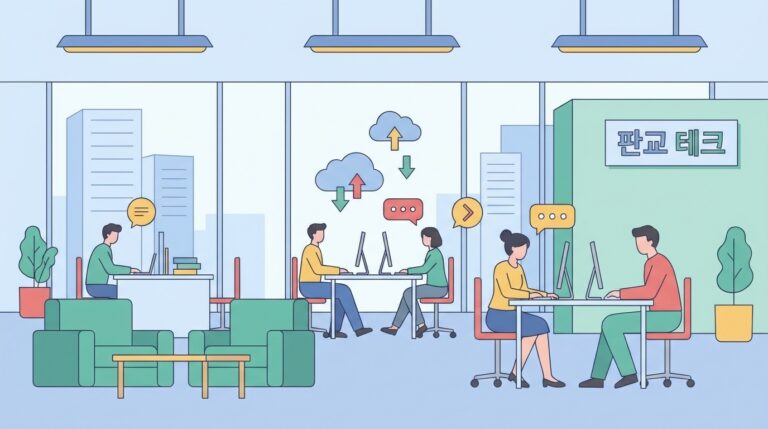
Imagine this: You are sitting at a sleek cafe in Pangyo Techno Valley—South Korea’s Silicon Valley—sipping an Iced Americano. Around you, product owners and legal tech advisors are engaged in heated discussions over open laptops. You hear someone sigh deeply while looking at their smartphone: “카카오 생태계에서 벗어나는 건 이제 불가능에 가까워요 (Kakao saengtae-gye-eseo beoseonaneun geon ije bulganeung-e gakkawoyo – It’s practically impossible to escape the Kakao ecosystem).” From hailing a taxi on Kakao T, paying with Kakao Pay, chatting on KakaoTalk, to gifting birthday coupons, your entire digital footprint is woven into a single Korean super-app.
For advanced learners navigating professional or academic discussions in Korea, the debate over big tech platform monopolies vs. innovation is no longer abstract theory. When you want to discuss market competition, consumer rights, and how guaranteeing ‘데이터 이동권’ (Data Portability) breaks user lock-in, basic textbook Korean falls short. You need the precision, vocabulary, and cultural tact of an insider.
Based on feedback from hundreds of advanced expatriates and global professionals working in Korean tech firms, this guide bridges the gap between mechanical dictionary definitions and the nuanced boardroom rhetoric of Seoul. By mastering these expressions, you will not only articulate complex tech policy debates fluently but also understand the subtle social tensions between hyper-convenience and digital sovereignty in contemporary Korea.
Phase 2: Deep Dive into 3 Core Expressions
1. 락인 효과를 깨다 (Rakin hyogwa-reul kkaeda)
- Pronunciation: [Rakin hyogwareul kkaeda] (Sounds like rock-in hyo-gwa-reul kkay-da with a crisp, decisive ‘kk’ sound as in ‘sky’).
- Meaning: Literally “to shatter the lock-in effect”; idiomatically used to describe breaking consumer dependency on a single ecosystem.
- K-Culture Moment: Commonly heard in startup boardroom dramas like tvN’s Start-Up when pitching disruptive services against dominant conglomerates.
- Editor’s Insight: While ‘락인 효과를 극복하다’ (overcoming lock-in) is textbook-formal, using the active verb ‘깨다’ (to shatter/break) injects dynamic agency into business strategy proposals.
- Situation Spectrum:
- Casual: ⚠️ (Can sound overly technical for everyday banter)
- Semi-formal: ✅ (Perfect for team meetings and tech meetups)
- Formal: ✅ (Standard in policy papers, op-eds, and investor pitches)
- 🤔 Think About It: In English, we often say “break free from lock-in” (consumer focus). Why does Korean often frame it actively as “shattering the barrier” (깨다)? Reflect on how this highlights proactive regulatory or business intervention.
2. 데이터 이동권을 보장하다 (De-i-teo i-dong-gwon-eul bo-jang-ha-da)
- Pronunciation: [Deiteo idonggwoneul bojanghada] (Pronounce day-ee-tuh ee-dong-gwon-eul bo-jahng-ha-da, rolling the ‘d’ and ‘g’ smoothly).
- Meaning: Literally and legally “to guarantee the right to data portability.”
- K-Culture Moment: Frequently headlined on Korean financial news (e.g., SBS Biz, Hankyung) discussing Korea’s landmark ‘MyData’ (마이데이터) initiative in fintech.
- Editor’s Insight: ‘이동권’ (right to mobility/portability) combines ‘이동’ (movement) and ‘권’ (right/권리). In Korea’s legal discourse, framing data access as an individual citizen’s fundamental ‘권’ (right) elevates consumer data sovereignty over corporate ownership.
- Situation Spectrum:
- Casual: 🚫 (Too formal for casual chatting)
- Semi-formal: ✅ (Appropriate in tech/finance workplace contexts)
- Formal: ✅ (Mandatory term in legal, regulatory, and policy debates)
- 🤔 Think About It: Notice how Korean legal terminology embeds individual rights into technical jargon. Does your home country treat data portability as a consumer benefit or a fundamental legal right?
3. 전환 장벽을 낮추다 (Jeon-hwan jang-byeok-eul nat-chu-da)
- Pronunciation: [Jeonhwan jangbyeogeul natchuda] (Pronounce jun-hwan jahng-byuk-eul naht-choo-da).
- Meaning: Literally “to lower switching barriers”; idiomatically refers to reducing the cost, friction, or psychological effort required for a user to switch platforms.
- K-Culture Moment: Used by venture capitalists and app developers on YouTube tech channels like EO (태용) when explaining growth hacks against legacy market leaders.
- Editor’s Insight: ‘전환 비용’ (switching costs) and ‘전환 장벽’ (switching barriers) are sister terms. Using ‘장벽’ (barrier/wall) provides a more visual, structural metaphor than abstract ‘비용’ (costs).
- Situation Spectrum:
- Casual: ⚠️ (Only among startup founders or tech enthusiasts)
- Semi-formal: ✅ (Widely used in business reviews and marketing strategy)
- Formal: ✅ (Academic conferences, antitrust hearings)
- 🤔 Think About It: How does the physical metaphor of a ‘장벽’ (barrier wall) being ‘낮추다’ (lowered) reflect the Korean architectural and historical consciousness of fortresses and gates?
Phase 3: Textbook Korean vs. Real Korean
Scenario 1: Warning someone about becoming overly reliant on a dominant app
- 📖 교과서 한국어: 독점 플랫폼을 사용하면 다른 서비스를 이용하기 어려워집니다. (Dokjeom peullaetpomeul sayonghamyeon dareun seobiseureul iyonghagi eoryeowojimnida. – If you use a monopolistic platform, using other services becomes difficult.)
- 🗣️ 진짜 한국어: 특정 플랫폼에 완전히 종속되면 나중에 갈아타기 진짜 힘들어요. (Teukjeong peullaetpome wanjeonhi jongsongdoemyeon najung-e garatagi jinjja himdeureoyo. – If you become completely subordinate to one platform, jumping ship later is brutally hard.)
- 💡 왜 다를까?: Native speakers replace formal phrases like “서비스를 전환하다” with the colloquial yet universally understood transit metaphor “갈아타다” (to transfer buses/subways, meaning to switch services).
Scenario 2: Expressing the intent to switch services due to better data freedom
- 📖 교과서 한국어: 데이터 이동권이 보장되면 저는 다른 플랫폼으로 이전할 것입니다. (Deiteo idonggwoni bojangdoemyeon jeoneun dareun peullaetpomeuro ijeonhal geosimnida. – If data portability is guaranteed, I will transfer to another platform.)
- 🗣️ 진짜 한국어: 내 데이터 그대로 옮겨올 수만 있으면, 혜택 좋은 데로 바로 갈아타죠. (Nae deiteo geudaero omgyeool suman isseumyeon, hyetaek joeun dero baro garatajyo. – As long as I can bring my data over as-is, I’d jump straight to whatever platform offers better perks.)
- 💡 왜 다를까?: In real Korean corporate and personal discussions, conversational conditionals like “~수만 있으면” paired with confident enders like “~바로 갈아타죠” convey practical pragmatism over academic rigidity.
Phase 4: K-Culture Deep Dive & Non-Verbal Manners
4-1. 눈치 (Nunchi) & Tech Meeting Etiquette
When debating regulatory frameworks or platform monopolies in a Korean corporate setting (such as in Yeouido finance or Pangyo IT), direct confrontation is considered unrefined (부담스럽다). Even at a C1 level, asserting opinions requires mastering cushion words (쿠션어).
* Body Language: Maintain relaxed yet attentive eye contact. When disagreeing with a senior colleague’s view on platform regulations, tilt your head slightly (about 15 degrees) and give a slow, thoughtful nod before speaking.
* The Verbal Buffer: Never start with “아닌데요” (That’s not right). Instead, validate first: “팀장님 말씀처럼 혁신이 위축될 수 있다는 우려도 일리가 있습니다. 다만…” (As you pointed out, Team Leader, concerns about stifling innovation are certainly valid. However…).
4-2. Cultural Code: The ‘Super-App’ Syndrome & MyData in Korea
Korea is one of the few global markets where local platforms successfully resisted Silicon Valley dominance. Naver beat Google in search for decades; Kakao dominated messaging over WhatsApp; Coupang outpaced Amazon.
However, this triumph birthed the “Super-App Syndrome.” Everything is connected: logging into public government services with your Kakao or Naver certificate, hailing taxis, banking, and shopping. Because Korean consumers prioritize seamless convenience (편리미엄, ‘convenience premium’), breaking user lock-in through legal mechanisms like ‘데이터 이동권’ (Data Portability via the Personal Information Protection Act / MyData) has become a major socio-political milestone. Discussing this shows you truly understand modern Korean digital sociology.
Phase 5: Real-World Roleplay Scenario
Setting: A glass-walled meeting room overlooking Pangyo Valley.
Characters:
* Min-woo (민우): A senior product strategy lead who worries that strict regulations might stifle platform innovation.
* You (학습자): A digital policy consultant advocating for consumer data portability to lower entry barriers.
Turn 1
민우: 솔직히 거대 플랫폼 규제가 강화되면, 스타트업들의 혁신 동력까지 꺾이지 않을까 걱정돼요.
(Soljikhi geodae peullaetpom gyujega ganghwadoemyeon, seutateueopdeurui hyeoksin dongnyeokkkaji kkeokk-iji aneulkka geokjeongdwaeyo.)
“Honestly, if regulations on big tech platforms tighten, I worry it might dampen the innovation engine even for startups.”
🎭 미간을 살짝 찌푸리며 태블릿 화면을 넘긴다.
Turn 2
You: 물론 과도한 규제는 경계해야 하겠지만, 락인 효과가 심화되면 오히려 신규 진입자의 기회가 차단되지 않을까요?
(Mullon gwadohan gyujeneun gyeonggyehaeya hagetjiman, rakin hyogwaga simhwadoemyeon o려 sin-gyu jin-ipjaui gihoega chadan-doeji aneulkkayo?)
“Of course we must beware of excessive regulation, but if the lock-in effect intensifies, wouldn’t it shut out opportunities for new market entrants?”
🎭 온화하게 고개를 끄덕이며 펜을 가볍게 쥔다.
Turn 3
민우: 맞는 말씀이지만, 소비자들이 편의성 때문에 자발적으로 생태계에 머무는 측면도 크잖아요.
(Maneun malsseum-ijiman, sobijadeuri pyeon-uiseong ttaemune jabaljeog-euro saengtaegye-e meomuneun cheukmyeondo keujanayo.)
“True, but there is also a significant aspect where consumers voluntarily stay within the ecosystem due to pure convenience.”
🎭 커피를 한 모금 마시며 반론을 펼친다.
Turn 4
You: 바로 그 지점에서 데이터 이동권 보장이 핵심 열쇠가 될 수 있습니다.
(Baro geu jijeom-eseo deiteo idonggwon bojang-i haeksim yeolswega doel su itseumnida.)
“It is precisely at that point where guaranteeing data portability becomes the master key.”
🎭 단호하면서도 차분한 어조로 시선을 맞춘다.
Turn 5
민우: 데이터 이동권이요? 그게 구체적으로 플랫폼 시장에 어떤 변화를 가져오나요?
(Deiteo idonggwon-iyo? Geuge guchejeog-euro peullaetpom sijang-e eotteon byeonhwareul gajyeo-onayo?)
“Data portability? Specifically, what kind of change does that bring to the platform market?”
🎭 상체를 약간 앞으로 기울이며 호기심을 보인다.
Turn 6
You: 소비자가 원할 때 자신의 활동 내역과 데이터를 다른 서비스로 이전할 수 있게 하면, 전환 장벽이 현저히 낮아지거든요.
(Sobijaga wonhal ttae jasin-ui hwaldong naeyeokgwa deiteoreul dareun seobiseuro ijeonhal su itge hamyeon, jeonhwan jangbyeog-i hyeonjeohi najajigeodeunyo.)
“If consumers can transfer their activity logs and data to other services whenever they wish, switching barriers will drop substantially.”
🎭 메모지에 화살표를 그리며 시각적으로 설명한다.
Turn 7
민우: 아, 사용자가 한 플랫폼에 종속되지 않고 언제든 대안을 선택할 수 있는 환경을 만들자는 거군요!
(A, sayongjaga han peullaetpome jongsongdoeji anko eonjedeun daeaneul seontaekhal su inneun hwan-gyeong-eul mandeuljaneun geogunyo!)
“Ah, so you mean creating an environment where users aren’t locked into one platform and can freely choose alternatives at any time!”
🎭 밝은 표정으로 고개를 끄덕이며 공감한다.
Turn 8
You: 네, 맞습니다. 그렇게 되면 플랫폼들도 안주하지 않고 서비스 품질 혁신으로 진검승부를 벌이게 되겠죠.
(Ne, matseumnida. Geureoke doemyeon peullaetpomdeuldo anjuhaji anko seobiseu pumjil hyeoksineuro jin-geomseungbureul beorige doegetjyo.)
“Exactly. When that happens, platforms won’t stay complacent; they will compete through genuine service quality and innovation.”
🎭 확신에 찬 미소를 지으며 회의를 마무리 짓는다.
🔀 Interactive Decision Point
How would you conclude your argument to Min-woo to solidify the win?
- Option A: “어쨌든 독점 기업들은 벌금을 세게 때려 맞아야 정신을 차립니다.” (Anyway, monopolistic companies need to get hit with heavy fines to come to their senses.)
- Option B: “규제 일변도보다는 데이터 주권을 소비자에게 돌려줌으로써 건강한 시장 경쟁을 유도하는 것이 바람직합니다.” (Rather than one-sided regulation, inducing healthy market competition by returning data sovereignty to consumers is desirable.)
- Option C: “혁신이고 뭐고 간에 소비자 피해가 발생하면 무조건 서비스를 강제 분할해야 합니다.” (Innovation or not, if consumer harm occurs, the service must be forcefully split up no matter what.)
Feedback:
* Option A (Risk): Too aggressive and conversational for a business context. “벌금을 세게 때려 맞다” sounds crude and ignores the nuance of balancing innovation.
* Option B (Best): Perfect C1 executive nuance! Words like “규제 일변도” (regulatory one-sidedness) and “데이터 주권” (data sovereignty) demonstrate elevated command of business Korean.
* Option C (Bad): Overly radical and dismissive (“혁신이고 뭐고 간에”), likely to alienate tech industry counterparts.
Phase 6: 10-Second Emotion Shadowing Drill
Read these sentences aloud following the pauses (/) and emotional cues:
[🧐 신중하고 분석적인 톤 / Thoughtful & Analytical]
“플랫폼 생태계의 편의성 이면에 / 락인 효과가 고착화되는 구조적 문제를 / 짚고 넘어가야 합니다.”
(Peullaetpom saengtaegye-ui pyeon-uiseong imyeon-e / rakin hyogwaga gochakhwadoeneun gujojeok munje-reul / jipgo neomeogaya hamnida.)
Behind the convenience of the platform ecosystem / we must examine the structural issue / of entrenched lock-in effects.-
[💡 확신에 찬 설득의 톤 / Confident & Persuasive]
“데이터 이동권이 보장되어야만 / 소비자의 실질적인 전환 장벽을 낮추고 / 진정한 혁신 경쟁이 촉발됩니다.”
(Deiteo idonggwoni bojangdoeeoyaman / sobijaui siljiljeogin jeonhwan jangbyeogeul natchugo / jinjeonghan hyeoksin gyeongjaeng-i chokbaldoemnida.)
Only when data portability is guaranteed / can we lower the actual switching barriers for consumers / and trigger genuine competition in innovation. -
[🤝 경청과 포용의 톤 / Empathetic & Cooperative]
“기업의 혁신 의지를 꺾지 않으면서도 / 플랫폼 종속을 방지할 수 있는 균형점을 / 함께 찾아야 할 때입니다.”
(Gieobui hyeoksin uijireul kkeokji aneumyeonseodo / peullaetpom jongsogeul bangjihal su inneun gyunhyeongjeomeul / hamkke chajaya hal ttae-imnida.)
Without dampening corporate innovation drive / it is time for us to collaboratively seek the balance point / that prevents platform dependency.
Phase 7: K-Culture Mini Dictionary
-
갈아타다 (Garatada)
- Translation: To transfer / To switch platforms
- Usage: Originally used for transit (지하철 갈아타다). In tech and commerce, it refers to switching service providers (e.g., “통신사 갈아타다”, “음원 스트리밍 플랫폼 갈아타다”).
- 마이데이터 (Maideiteo – MyData)
- Translation: Government-backed Financial/Personal Data Portability Scheme
- Usage: Korea’s official regulatory initiative allowing citizens to aggregate and migrate their personal financial data across banking, insurance, and fintech apps with one touch.
- 종속성 (Jongsongseong)
- Translation: Dependency / Subordination
- Usage: Used in business analytics to discuss reliance on single vendors or platforms (e.g., “벤더 종속성 탈피” – breaking away from vendor lock-in).
- 기울어진 운동장 (Giureojin undongjang)
- Translation: An uneven playing field
- Usage: Ubiquitous media idiom in Korean economic news describing unfair market structures where tech conglomerates possess insurmountable data advantages over new startups.
Phase 8: Survival Kit for Travelers & Expats
Top 3 Survival Expressions
- “혹시 기존 계정 데이터 연동되나요?”
(Hoksi gijon gyejeong deiteo yeondongdoenayo?)
“By any chance, can my existing account data be synced/ported?”- Pro Tip: Use this when signing up for secondary Korean services via Naver/Kakao OAuth login to confirm if past data syncs.
- “회원 탈퇴하면 작성했던 리뷰나 구매 내역은 백업 가능한가요?”
(Hoewon taltoehamyeon jakseonghaetdeon ribyuna gumae naeyeogeun baeg-eop ganeunghangayo?)
“If I delete my membership, can I back up my written reviews or purchase history?”- Pro Tip: Essential when leaving platforms like Coupang or Kurly and you don’t want to lose personal logs.
- “다른 서비스로 이전할 때 수수료나 위약금이 발생하나요?”
(Dareun seobiseuro ijeonhal ttae susuryona wiyakgeumi balsaenghanayo?)
“Do fees or cancellation penalties occur when transferring to another service?”- Pro Tip: Crucial for mobile carrier shifts (알뜰폰) or internet service switching.
Editor’s Travel Note
When living or traveling in Korea, avoiding platform lock-in is notoriously tough because local super-apps are unmatched in performance. To maintain your digital flexibility:
* Explore the 토스(Toss) 금융 앱 서비스 안내 to see Korea’s prime example of MyData in action, allowing you to manage multiple Korean bank accounts from one dashboard.
* If hailing cabs, test alternative services using the 타다(TADA) 호출 서비스 가이드 alongside Kakao T to observe how different ride-hailing services compete on ride comfort and vehicle quality.
* Keep your international payment cards integrated into local digital wallets to avoid relying strictly on closed Korean domestic payment schemes.
Phase 9: “One Step Deeper” (Reflective Humanities Essay)
South Korea’s rapid digital infrastructure transformation was largely fueled by a collective cultural yearning for ‘빨리빨리’ (hurry-hurry) and extreme convenience. In a society historically defined by close-knit communities, the digital space mirrored this dynamic through giant platform walled gardens where everyone gathers in a single town square. However, as these digital town squares turned into commercial monopolies, Korean society began confronting the shadow side of hyper-convenience: the loss of agency over personal digital identities. Data portability is not merely a technical policy in Korea; it represents the modern digital manifestation of citizen autonomy—balancing the beloved communal speed with individual freedom.
💬 Your Turn: Does the convenience of having everything in one super-app outweigh the risk of corporate platform dependency? Or should regulations mandate data portability even if it adds friction? Share your thoughts in Korean or English in the comments below!
Phase 10: FAQ & Avoiding Misconceptions
Q: Is ‘데이터 이동권’ the exact equivalent of GDPR’s Data Portability in Korean law?
A: Yes, it is directly anchored in Article 35-2 of South Korea’s amended Personal Information Protection Act (개인정보 보호법), granting individuals the right to demand their personal information be transmitted to themselves or designated third parties in a machine-readable format.
Q: Can I use ‘갈아타다’ in a formal academic presentation?
A: ‘갈아타다’ is excellent for meetings, panel talks, and op-eds, but in a strictly formal dissertation or legal document, replace it with ‘서비스를 전환하다’ (to switch services) or ‘대체재로 이전하다’ (to migrate to a substitute product).
Q: What is the difference between ‘독점’ and ‘독과점’?
A: ‘독점’ (Monopoly) strictly refers to a single dominant seller, whereas ‘독과점’ (Monopoly and Oligopoly) encompasses both pure monopolies and oligopolistic market conditions where a handful of giant tech firms collectively control the market.
🚨 Common Mistakes (흔한 실수)
- Translating “switching costs” as ‘바꾸는 돈’:
- ❌ 바꾸는 돈이 많이 들어요.
- ✅ 전환 비용이 많이 들어요. (Use the proper economic term ‘전환 비용’).
- Confusing ‘종속’ (subordination/lock-in) with ‘접속’ (connection/access):
- ❌ 플랫폼 접속 현상이 심해요. (Wrong word!)
- ✅ 플랫폼 종속 현상이 심해요. (‘종속’ accurately describes user lock-in).
- Overusing passive expressions for policy actions:
- ❌ 데이터 이동권이 보장되어짐을 당해야 합니다. (Grammatically awkward double-passive).
- ✅ 데이터 이동권을 확실히 보장해야 합니다. (Clear, direct active phrasing).
Phase 11: Action Missions
- 🥉 Bronze Mission (Solo Practice): Read the 3 shadowing sentences from Phase 6 aloud 5 times each. Record your voice on your smartphone and check if you paused correctly at
/. - 🥈 Silver Mission (Community Engagement): Write a 2-sentence comment on LinkedIn or Instagram using the phrase “전환 장벽을 낮추다” regarding a tech app you recently used.
- 🥇 Gold Mission (Real-world Challenge): Next time you discuss tech or economics with a Korean colleague or language partner, use the sentence: “데이터 이동권이 보장되면 플랫폼 간 전환 장벽이 많이 낮아질 것 같아요.” Observe their reaction!
- 🎮 K-Culture Mission: Watch an episode of a Korean business documentary or startup reality show (like Unicorn or YouTube’s EO) and listen for words containing ‘플랫폼’ and ‘생태계’. Write down the verbs they pair with them.
Phase 12: Interactive Quiz Challenge
1. Contextual Judgment
Which expression best fits a policy consultant presenting a strategy to foster fair startup competition against mega-platforms?
* (A) 플랫폼들이 돈을 많이 버니까 세금을 왕창 매겨야 합니다.
* (B) 데이터 이동권을 제도화하여 신규 진입 장벽과 사용자 전환 장벽을 동시에 낮춰야 합니다.
* (C) 스타트업들이 알아서 대기업 앱을 카피해 갈아타게 유도합시다.
2. Fill-in-the-Blank
소비자가 특정 기업의 서비스 생태계에 갇혀 다른 대안을 찾지 못하게 되는 현상을 ‘______ 효과’라고 부릅니다. (힌트: 영어 Lock-in에서 유래)
3. Cultural True or False
In Korea, ‘마이데이터(MyData)’ services only apply to mobile telecommunications and cannot be used for banking or asset management. (True / False)
👉 Click to view answers and explanations
- Correct Answer: (B)
- Explanation: (B) uses sophisticated policy Korean (‘제도화하다’, ‘진입 장벽’, ‘전환 장벽’). (A) is too crude in tone (‘왕창 매기다’), and (C) promotes illegal copyright infringement and informal phrasing.
- Correct Answer: 락인 (Lock-in)
- Explanation: The full phrase is ‘락인 효과’ (Lock-in effect), widely recognized across Korean tech, economics, and business media.
- Correct Answer: False
- Explanation: Korea’s MyData initiative was pioneered most aggressively in the fintech and banking sectors, allowing citizens to integrate bank accounts, credit cards, investments, and insurance in apps like Toss, KakaoBank, and Naver Pay.
- Explanation: Korea’s MyData initiative was pioneered most aggressively in the fintech and banking sectors, allowing citizens to integrate bank accounts, credit cards, investments, and insurance in apps like Toss, KakaoBank, and Naver Pay.







