

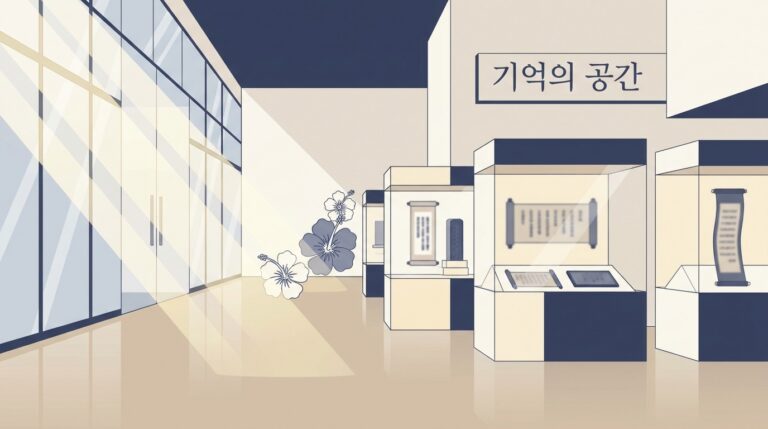
Beyond Vengeance to Universal Solidarity: Navigating Historical Memory in Advanced Korean
Phase 1: Empathy & Immersion (Opening)
안녕하세요! 매일한글 에디터입니다. (Hello! I’m your Daily Hangul editor.)
Have you ever found yourself in a dimly lit Bukchon tea house or an intellectual salon in Seochon, listening to Korean friends passionately debate a historical film like 1987: When the Day Comes or Han Kang’s haunting novel Human Acts? You want to contribute your thoughts on how a nation navigates historical trauma—how collective grief can either calcify into bitter, exclusive nationalism or blossom into a universal struggle for human dignity. But suddenly, your words feel trapped. You know the basic vocabulary for “history” and “sadness,” but when the conversation shifts to the politics of memory, historiography, and transitional justice, elementary phrases fail you.
Discussing historical trauma in Korea requires immense sensitivity and linguistic precision. Many advanced learners confess that they fear sounding either dismissively detached or accidentally echoing aggressive, xenophobic rhetoric. This guide is crafted specifically from hundreds of hours of feedback with C2-level scholars, diplomats, and cultural researchers. By mastering the expressions below, you will gain the power to discuss the deepest layers of Korea’s collective memory with nuance, empathy, and philosophical maturity.
Phase 2: Core Expressions Deep Dive
[1] 과거의 상처를 승화시키다
- Pronunciation: Gwageoui sangcheoreul seunghwasikida (gwah-gaw-eui sang-cheo-reul seung-hwa-shi-ki-da)
- Meaning: Literal: “To sublimate the wounds of the past.” Nuance: Transforming personal or collective historical pain into a higher, constructive ethical virtue or creative purpose.
- K-Culture Moment: Heard frequently during the memorial addresses for the Gwangju May 18 Democratic Uprising or the Jeju April 3 Incident, where civil rights leaders urge the nation to turn mourning into democratic resilience.
- Editor’s Insight: The term 승화 (昇華, sublimation) comes from both chemistry and psychoanalysis. In Korean intellectual discourse, it signifies an alchemy of the soul—refusing to let suffering degrade into bitterness, and instead channeling it into art, institutional reform, or universal peace.
- Situation Spectrum: Casual 🚫 | Semi-formal ⚠️ | Formal ✅
- 🤔 Think About It: Does your native culture emphasize “forgive and forget,” or does it, like Korea, emphasize carrying memory forward through active cultural sublimation?
[2] 배타적 민족주의를 경계하다
- Pronunciation: Baetajeok minjokjuuireul gyeonggyehada (bae-tah-jeok meen-jok-joo-eui-reul gyeong-gye-ha-da)
- Meaning: Literal: “To be vigilant against exclusive nationalism.” Nuance: Actively warning against ethnocentric, xenophobic, or chauvinistic impulses that instrumentalize historical trauma against other groups.
- K-Culture Moment: Editorial columnists and cultural critics use this when reviewing historical period K-dramas (like Mr. Sunshine), cautioning audiences not to fall into simplistic “us versus them” jingoism.
- Editor’s Insight: 경계하다 (境界하다/警戒하다) is a powerful verb meaning to keep guard against a threat. Pairing it with 배타적 민족주의 shows that you distinguish between healthy civic patriotism (애국심) and toxic, exclusionary hyper-nationalism.
- Situation Spectrum: Casual 🚫 | Semi-formal ✅ | Formal ✅
- 🤔 Think About It: How does language distinguish between healthy pride in national identity and exclusionary political populism in your country?
[3] 보편적 인권의 가치로 확장하다
- Pronunciation: Bopyeonjeok ingwonui gachiro hwakjanghada (boh-pyeon-jeok een-gwon-eui gah-chee-roh hwahk-jang-ha-da)
- Meaning: Literal: “To expand into the value of universal human rights.” Nuance: Elevating a localized historical injustice into a global benchmark for human dignity and peace.
- K-Culture Moment: Regularly used in international human rights forums regarding the Japanese military “comfort women” issue, re-framing it not merely as a bilateral diplomatic dispute, but as an enduring crime against women in wartime globally.
- Editor’s Insight: 확장하다 denotes an intentional, outward-reaching expansion. Using this expression signals that you possess a cosmopolitan perspective that bridges national boundaries.
- Situation Spectrum: Casual ⚠️ | Semi-formal ✅ | Formal ✅
- 🤔 Think About It: When past atrocities are discussed in your homeland, are they framed as specific national grievances or connected to global human rights solidarity?
Phase 3: Textbook Korean vs. Real Native Korean
Situation 1: Discussing historical lessons
- 📖 교과서 한국어: 우리는 과거의 역사를 통해 교훈을 얻고 반성해야 합니다. (We must gain lessons and reflect through past history.)
- 🗣️ 진짜 한국어: 과거의 비극을 딛고 보편적 연대로 나아가는 성숙한 태도가 절실해요. (A mature attitude that overcomes past tragedies to move toward universal solidarity is imperative.)
- 💡 왜 다를까? Textbook Korean leans on repetitive moral platitudes like ‘반성하다’ (to reflect). High-level native speakers use dynamic idioms such as ‘비극을 딛고’ (stepping over/overcoming tragedy) and concepts like ‘보편적 연대’ (universal solidarity) to project philosophical depth.
Situation 2: Critiquing populist historical revisionism or hatred
- 📖 교과서 한국어: 다른 나라를 미워하는 것은 나쁩니다. (Hating other countries is bad.)
- 🗣️ 진짜 한국어: 과거의 상처가 또 다른 혐오의 재생산으로 이어지는 악순환은 단호히 끊어내야 합니다. (We must resolutely sever the vicious cycle where historical wounds reproduce yet another layer of hatred.)
- 💡 왜 다를까? C2-level Korean discourse analyzes societal mechanisms rather than personal feelings. Phrasing like ‘혐오의 재생산’ (reproduction of hatred) and ‘악순환을 단호히 끊어내다’ (resolutely sever a vicious cycle) elevates your speech into top-tier academic discourse.
Phase 4: K-Culture Deep Dive & Non-Verbal Manners
4-1. Nunchi & Non-Verbal Gravitas
When discussing historical trauma in Korean society—whether Japanese colonial occupation, the Korean War, or democratization uprisings—your physical demeanor speaks before your words do:
* The Somber Nod (묵직한 끄덕임): Avoid quick, cheerful nods. Tilt your head forward slightly with eyes resting calmly at mid-level. Never display casual smiles or smirk when articulating terms like ‘과거사’ (past history) or ‘비극’ (tragedy).
* Subdued Gestures: Keep your palms open, resting lightly near the table or lap. Pointing fingers or making aggressive chopping hand motions can be interpreted as ideological dogmatism or combative self-righteousness.
4-2. Cultural Code: The Evolution of Han (한) to Yeondae (연대)
Classical K-culture often depicted historical trauma through the prism of Han (恨)—a deep, internalized reservoir of collective sorrow and unresolved grief. However, modern Korean historiography and contemporary cultural movements have radically rewritten this narrative.
From the Gwangju Uprising to the Candlelight Demonstrations, Korean civil society transformed passive sorrow into civic agency. When you watch Korean historical cinema today, look beyond the surface rage; observe how directors contrast individual human dignity against the machinery of state violence. True cultural fluency lies in recognizing that Koreans do not remember past trauma merely to dwell in resentment; they preserve memory as a moral vaccine against future authoritarianism.
Phase 5: Real-World Roleplay Scenario
Setting: A quiet research archive cafe near the National Museum of Korean Contemporary History in Gwanghwamun.
Characters:
* Min-woo (민우): A Korean modern history doctoral researcher, thoughtful and reflective.
* You (학습자): A visiting international scholar participating in a colloquium on memory politics.
— Dialogue —
민우: 이번 특별전 보시면서 어떤 생각이 드셨어요? 아무래도 타국의 시선에서는 역사의 상처를 다루는 방식이 사뭇 다르게 다가왔을 것 같은데요.
(Ibeon teukbyeoljeon bosimyeonseo eotteon saenggagi deusyeosseoyo? Amuraedo tagugui siseoneseoneun yeoksaui sangcheoreul dareuneun bangsigi samut dareuge dagawasseul geot gateundeyo.)
“What were your thoughts while viewing this special exhibition? To someone viewing from outside, the way we handle historical wounds might feel quite different.”
🎭 (민우는 찻잔을 조심스레 내려놓으며 진지하고 탐색하는 눈빛으로 당신을 바라본다.)
You: 단순히 피해의 역사만을 전시하는 데 그치지 않고, 그 고통을 민주주의와 인권의 가치로 승화시킨 궤적이 매우 인상 깊었습니다.
(Dansunhi pihaeui yeoksaman eul jeonsihaneun de geuchiji anko, geu gotongeul minjujuuiwa ingwonui gachiro seunghwasikin gwejeogi maeu insang gipeosseumnida.)
“I was deeply impressed that it did not stop at exhibiting a history of victimhood, but traced the trajectory of sublimating that suffering into the values of democracy and human rights.”
🎭 (고개를 천천히 끄덕이며 진중한 목소리로 공감을 표한다.)
민우: 맞아요. 자칫 과거의 비극에만 매몰되면 편협한 민족주의나 타자에 대한 적대감으로 변질되기 쉬운데, 그 경계를 넘어서는 작업이 참 어렵죠.
(Majayo. Jachit gwageoui bigeugeman maemoldoemyeon pyeonhyeophan minjokjuuina tajae daehan jeokdaegameuro byeonjildeogi swiunde, geu gyeonggyereul neomeoseoneun jageobi cham eoryeopjyo.)
“Exactly. If one becomes buried solely in past tragedies, it is all too easy to degenerate into narrow nationalism or hostility toward the ‘other,’ yet transcending that boundary is extraordinarily difficult.”
🎭 (깊이 공감하며 쓴웃음을 살짝 짓는다.)
You: 그래서일수록 배타적 민족주의를 경계하고 보편적 인권의 관점에서 사관을 재정립하는 노력이 필수적인 것 같아요.
(Geuraeseoilssurok baetajeok minjokjuuireul gyeonggyehago bopyeonjeok ingwonui gwanjeomeseo sagwaneul jaejeongniphaneun noryeogi pilsujeogin geot gatayo.)
“That is precisely why the effort to guard against exclusive nationalism and re-establish a historical perspective from the vantage point of universal human rights is so essential.”
🎭 (차분하면서도 단호한 눈빛으로 시선을 마주한다.)
민우: 정확한 지적이십니다. 기억의 정치가 증오의 재생산 도구로 전락하지 않으려면 결국 과거사 청산이 화해와 평화의 디딤돌이 되어야 하니까요.
(Jeonghwakhan jijeogisimnida. Gieogui jeongchiga jeungo-ui jaesaengsan doguro jeollakhaji aneuryeomyeon gyeolguk gwageosa cheongsani hwahaewa pyeonghwaui didimdori doe-eoya hanikkayo.)
“An astute observation. For memory politics not to degenerate into a tool for reproducing hatred, the reckoning of past history must ultimately serve as a stepping stone toward reconciliation and peace.”
🎭 (안도감과 존중이 담긴 미소를 지으며 가볍게 상체를 숙인다.)
You: 동감합니다. 피해와 가해의 이분법에 갇히지 않을 때 비로소 진정한 역사적 치유와 연대가 가능해진다고 봅니다.
(Donggamhamnida. Pihaewa gahaeui ibunbeobe gathiji aneul ttae biroso jinjeonghan yeoksajeok chiyuwa yeondaega ganeunghaejindago bomnida.)
“I agree. Only when we refuse to remain trapped in the dichotomy of victim versus perpetrator does true historical healing and solidarity become attainable.”
🎭 (손을 가슴 가까이에 모으며 진심 어린 어조로 말한다.)
민우: 오늘 선생님과의 대화 덕분에 저희 역사가 세계 시민사회와 어떻게 호흡해야 하는지 다시금 확신을 얻게 되네요.
(Oneul seonsaengnim-gwaui daehwa deokbune jeohui yeoksaga segye siminsahoewa eotteoke hoheuphaeya haneunji dasigeum hwaksineul eotge doeneyo.)
“Thanks to our conversation today, I have regained conviction in how our history must breathe alongside global civil society.”
🎭 (따뜻한 눈빛으로 고마움을 전한다.)
You: 오히려 제가 더 많이 배웁니다. 역사를 기억하는 성숙한 태도가 무엇인지 한국의 경험이 훌륭한 길잡이가 되어주고 있어요.
(Ohiryeo jega deo mani baeumnida. Yeoksareul gieokhaneun seongsukhan taedoga mueosinji hangugui gyeongheomi hullyunghan giljabiga doe-eojugo isseoyo.)
“Rather, I am learning far more. Korea’s experience serves as a remarkable guiding light for what a mature attitude toward remembering history looks like.”
🎭 (겸손하게 미소 지으며 대화를 마무리한다.)
— Interactive Branching Point —
If Min-woo asks: “그렇다면 피해 당사국 입장에서 가해국의 진정한 사과 없이도 화해를 모색하는 것이 도덕적으로 정당화될 수 있을까요?” (Could seeking reconciliation without a sincere apology from the perpetrating state ever be morally justified from the victim nation’s stance?)
- Choice A: “국익과 경제적 실리를 위해서라면 과거의 잘잘못은 덮고 무조건 타협해야 한다고 봅니다.”
Feedback: Bad. In Korean intellectual spheres, advocating for dismissing historical justice merely for short-term economic utility (실리) ignores genuine transitional justice and sounds morally bankrupt. - Choice B: “진정한 사과가 전제되지 않는 화해는 미봉책에 불과하지만, 그렇다고 대화의 창구마저 닫아버리면 증오의 악순환만 깊어질 위험이 있습니다. 진실 규명과 사죄 촉구를 지속하되 평화의 지평을 함께 열어가는 이중적 접근이 필요하다고 생각해요.”
Feedback: Best! Demonstrates philosophical maturity. It honors the absolute necessity of sincere contrition while balancing the pragmatic imperative to prevent perpetual diplomatic paralysis. - Choice C: “가해자가 사과할 때까지 모든 관계를 완전히 단절하고 대대적인 불매운동을 지속하는 것만이 유일한 정답입니다.”
Feedback: Risk. This falls straight into emotional retributive nationalism, abandoning the very nuances of peace-building and universal human rights that C2 speakers strive to embody.
Phase 6: 10-Second Emotional Shadowing Drill
Read aloud, matching the pause markers (/) and internalizing the psychological state.
[진중하고 사색적인 어조로: With profound, reflective gravity]
과거의 비극을 / 영구적인 원한으로 남겨두기보다는, /
보편적 인권과 평화의 디딤돌로 / 승화시키는 성숙함이 /
우리 시대에 절실합니다.
(Gwageoui bigeugeul / yeonggujeogin wonhaneuro namgyeodugibodaneun, /
bopyeonjeok ingwonwa pyeonghwaui didimdollo / seunghwasikineun seongsukhami /
uri sidaee jeolsilhamnida.)
"Rather than leaving past tragedies as permanent grudges, the maturity to sublimate them into stepping stones for universal human rights and peace is deeply needed in our era."
[단호하면서도 포용적인 어조로: With resolute yet compassionate conviction]
역사를 올바르게 직시하되, / 편협한 배타주의에 갇히지 않는 /
열린 연대의 사관을 / 함께 구축해 나가야 합니다.
(Yeoksareul olbareuge jiksihadae, / pyeonhyeophan baetajuuie gathiji anneun /
yeollin yeondaeui sagwaneul / hamkke guchukhae nagaya hamnida.)
"While looking history straight in the eye, we must construct an open historiography of solidarity that does not remain imprisoned within narrow exclusionism."
Phase 7: K-Culture Mini Dictionary
- 사관 (史觀, Sagwan)
- Definition: Historiographical perspective; the philosophical lens through which one interprets historical phenomena.
- Usage: Used in analytical discussions to compare positivist historiography (실증주의 사관) with constructivist or nationalist frameworks.
- 과거사 청산 (過去事 淸算, Gwageosa Cheongsan)
- Definition: The reckoning and resolution of past historical injustices.
- Usage: A central legal and political term in Korea concerning truth commissions, state violence reparations, and post-colonial rectifications.
- 연대 (連帶, Yeondae)
- Definition: Solidarity; mutual bonding transcending individual, regional, or national limits.
- Usage: Widely used in modern civic society movements to describe collaborative resistance against human rights abuses worldwide.
- 미봉책 (彌縫策, Mibongchaek)
- Definition: A makeshift patch-up; a superficial, stopgap solution that fails to resolve root causes.
- Usage: Commonly invoked in critique of rushed international political settlements that paper over unresolved historical trauma.
Phase 8: Survival Kit for Travelers & Intellectual Explorers
Top 3 Survival Lines for Historic Sites & Memorial Halls
- 이 전시관은 당시 사건을 어떤 사관에 입각하여 조명하고 있나요?
(I jeonsigwaneun dangsi sageoneul eotteon sagwane ipgakhayeo jomyeonghago innayo?)
“Upon what historiographical perspective does this memorial hall illuminate the event of that era?”
Pro Tip: Use this at museum curatorial desks to invite profound curator insights. - 역사적 비극을 평화 교육의 장으로 훌륭하게 승화시켰네요.
(Yeoksajeok bigeugeul pyeonghwa gyoyugui jangeuro hullyunghage seunghwasikyeotneyo.)
“You have magnificently sublimated historical tragedy into a forum for peace education.”
Pro Tip: A deeply respectful compliment to museum docents and memorial researchers. - 단순한 기록을 넘어 보편적 인권의 소중함을 되새기게 합니다.
(Dansunhan girogeul neomeo bopyeonjeok ingwonui sojunghameul daesaegige hamnida.)
“Beyond mere records, it reminds us of the preciousness of universal human rights.”
Editor’s Travel Note
When engaging with Korean memory politics on the ground, visit the Seodaemun Prison History Hall and the National Museum of Korean Contemporary History. To navigate Seoul’s memorial hubs efficiently, use the Naver Map application download to search for localized archives like the Democracy and Human Rights Memorial Hall (former Namyeong-dong anti-communist interrogation lab). Remember that photography inside memorial prayer spaces is strictly regulated; look for signs reading 경건한 참배 공간 (reverent memorial space) and adjust your phone to silent mode.
Phase 9: “One Step Deeper” (Reflective Essay)
In many Western intellectual traditions, history is frequently historicized through empirical distance or dialectical detachment. In Korea, however, history remains visceral—it pulses directly through the veins of modern constitutional democracy. The transformation of historical memory in South Korea demonstrates that remembrance does not need to feed revanchism. When collective grief is met with democratic accountability and open discourse, memory becomes an emancipatory shield safeguarding against future tyranny.
By engaging with Korea’s historical pain through the grammar of cosmopolitan solidarity rather than inward-looking ethnic nationalism, foreign observers and citizens alike achieve true intellectual communion.
💬 Your Turn: How does your home society balance the remembrance of past national trauma with the ethical obligation to cultivate global peace and international friendship? Share your thoughts below in Korean!
Phase 10: FAQ & Avoiding Misconceptions
Q: Can I use the term ‘민족주의’ (nationalism) positively in Korean?
A: Yes, but with precise context. In Western discourse, “nationalism” is almost exclusively pejorative (associated with chauvinism or fascism). In Korea, because minjokjuui was historically the ideological resistance vehicle against foreign colonial obliteration, it often carries an instinctive legitimacy. To specify harmful nationalism, you should explicitly qualify it as 배타적 민족주의 (exclusive nationalism) or 국수주의 (ultra-nationalism).
Q: What is the linguistic difference between ‘사죄’ (sajoe) and ‘사과’ (sagwa)?
A: While both mean apology, 사과 is used for everyday personal apologies or standard civil apologies. 사죄 (謝罪) carries immense legal, historical, and moral gravity—literally meaning “to acknowledge and beg pardon for a criminal or grievous sin.” In the context of war crimes and historical atrocities, activists and legal scholars strictly demand 진정한 사죄 (sincere historical atonement).
Q: Does using the word ‘용서’ (forgiveness) sound dismissive in historical discussions?
A: It can if deployed prematurely. In Korean discourse around transitional justice, forgiveness cannot precede systemic 진상 규명 (uncovering the truth) and 명예 회복 (restoration of honor). Asserting that victims should simply “용서하다” (forgive) without institutional reckoning can sound insensitive to Korean interlocutors.
🚨 Common Mistakes Warning Board
- Mistake: Conflating 애국심 (patriotism) with 국수주의 (ultra-chauvinism).
Correct Action: Use 성숙한 시민의식 (mature civic consciousness) or 열린 애국심 (open-minded patriotism) when describing positive civic attachment. - Mistake: Labeling historical sensitivity as mere 반일 감정 (anti-Japanese sentiment).
Correct Action: Re-frame the issue using structural concepts like 인도주의적 정의 실현 (realization of humanitarian justice) and 보편적 여성 인권 (universal women’s human rights). - Mistake: Using aggressive rhetoric like 원수를 갚다 (to seek revenge against the enemy).
Correct Action: Use high-level intellectual verbs such as 역사의 교훈을 아로새기다 (to engrave the lessons of history into our hearts) or 상처를 평화로 승화하다 (to sublimate wounds into peace).
Phase 11: Action Missions
- 🥉 Bronze Mission (Solo Shadowing): Read the Phase 6 shadowing drill out loud three times, matching the introspective gravity of a cultural documentary narrator.
- 🥈 Silver Mission (Social Exploration): Look up an English-subtitled trailer or commentary of the film 1987 or A Taxi Driver. In the comments or in your journal, write one sentence utilizing:
과거의 비극을 딛고 보편적 연대로 나아가야 합니다. - 🥇 Gold Mission (Real-world Application): The next time you visit a museum or discuss a historical documentary with Korean peers, ask: “이 사건을 보편적 인권의 가치로 승화시키기 위해 우리 사회는 어떤 사관을 지녀야 할까요?”
- 🎮 K-Culture Mission: Watch the acceptance speech or a literary lecture by Korean author Han Kang. Notice how frequently she focuses on the vulnerability of the human body and universal empathy over nationalistic triumph.
Phase 12: Interactive Quiz Challenge
1. Context Judgment
Which of the following responses is the most philosophically mature and linguistically sophisticated at a C2 level when asked how society should handle unresolved historical trauma?
* A) 무조건 잊어버리는 것이 평화를 위한 지름길입니다.
* B) 원한을 대물림하여 상대국을 끝까지 적대시해야 합니다.
* C) 과거의 상처를 기억하되, 편협한 증오를 넘어 보편적 인권과 평화의 연대로 승화시켜야 합니다.
👉 Click to view Answer & Explanation
Correct Answer: C
Explanation: Option C elegantly balances the moral imperative of historical remembrance with the ethical expansion toward universal peace and human rights, encapsulating the highest tier of Korean intellectual expression.
2. Fill-in-the-Blank
Fill in the blank with the appropriate Hanja-derived term:
“우리는 역사적 상처가 또 다른 혐오를 낳지 않도록, 타자를 배제하는 ( ) 민족주의를 경계해야 합니다.”
👉 Click to view Answer & Explanation
Correct Answer: 배타적 (Baetajeok – Exclusive/Exclusionary)
Explanation: ‘배타적’ (排他的) means tending to push away others, making ‘배타적 민족주의’ the standard scholarly colocation for exclusive nationalism.
3. True or False Cultural Quiz
Statement: In contemporary Korean intellectual discourse, the reckoning of past historical trauma (과거사 청산) is viewed solely as an act of diplomatic retaliation against neighboring countries.
👉 Click to view Answer & Explanation
Correct Answer: False
Explanation: Rather than mere retaliation, 과거사 청산 is conceived as an essential democratic prerequisite to restore universal human rights, vindicate the dignity of historical victims, and build enduring global reconciliation.






