

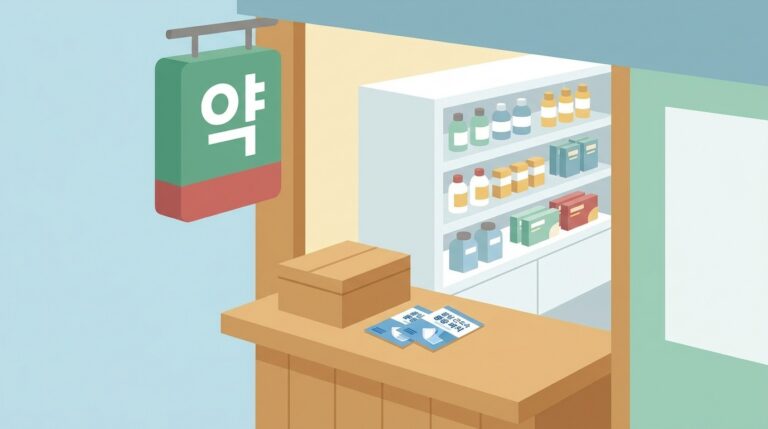
Phase 1: 공감 (Story Opening)
안녕하세요! 매일한글 에디터입니다.
Picture this: You spent an incredible day exploring Seoul. You climbed the steep stone steps of Namsan Seoul Tower, took an energetic two-hour K-pop dance workshop in Hongdae, and powered through 25,000 steps shopping across Myeongdong. But the next morning, your legs feel like lead weights, and your neck can barely turn. You desperately need relief!
You step outside and immediately spot the familiar red and green ‘약’ (Yak – Pharmacy) sign around the street corner. Your hand reaches for the door handle, but panic suddenly sets in. How do I explain muscle pain in Korean? What is the word for those medicated pain relief patches I always see in K-dramas? Will the pharmacist understand my English?
You are definitely not alone. Over 80% of our beginner learners tell us that walking into a local Korean pharmacy feels like entering a high-stakes exam room. But getting relief shouldn’t be stressful! Today, we will master the exact words you need to buy pain patches (파스, paseu) with total confidence. By the time you finish this guide, you will be able to stride into any Korean pharmacy, describe your soreness effortlessly, and walk out with instant comfort.
Phase 2: 핵심 표현 3선 심층 분석 (Top 3 Expressions)
1. 파스 있어요? (Paseu isseoyo?)
- Pronunciation: Paseu isseoyo? (Pronounced like PAH-seu ee-ssuh-yo, matching the rhythm of saying ‘pasta’ without the ‘ta’)
- Meaning: “Do you have pain relief patches?” (Direct: Pain patch exists?)
- K-Culture Moment: In workplace K-dramas like Misaeng, exhausted salarymen keep packs of these patches in their desk drawers to survive overtime culture.
- Editor’s Insight: The term paseu (파스) comes originally from the German word Pflaster (plaster) via historical loanword adaptation. In Korea, it refers specifically to medicated transdermal pain patches rather than regular band-aids.
- Situation Spectrum: Casual: ⚠️ (Use ‘파스 있어?’ only with close friends) | Semi-formal: ✅ (Standard polite for shops and pharmacies) | Formal: ✅ (파스 있습니까?)
- 🤔 Think About It: In many Western countries, pain patches sit in open retail aisles. In Korea, asking the pharmacist directly across the counter is standard. How does this direct pharmacist interaction change how you prepare your sentences?
2. 근육통 약 주세요 (Geunyuktong yak juseyo)
- Pronunciation: Geunyuktong yak juseyo (Pronounced like Goon-yook-tong yahk joo-seh-yo)
- Meaning: “Please give me muscle pain medicine.”
- K-Culture Moment: On Korean travel variety shows, cast members often groan “근육통 왔어!” (Muscle pain has arrived!) after long mountain hikes.
- Editor’s Insight: Korean compound nouns are wonderfully logical: 근육 (geunyuk = muscle) + 통 (tong = pain/ache). Adding 약 (yak = medicine) and 주세요 (juseyo = please give) instantly signals your exact problem to the pharmacist.
- Situation Spectrum: Casual: 🚫 | Semi-formal: ✅ (Most natural and polite) | Formal: ✅
- 🤔 Think About It: Notice how Korean stacks Chinese-root syllables (근육 + 통) to form concise medical terms. How does recognizing root syllables make learning new Korean nouns faster?
3. 여기 아파요 (Yeogi apayo)
- Pronunciation: Yeogi apayo (Sounds like Yuh-gee ah-pah-yo)
- Meaning: “It hurts here.”
- K-Culture Moment: The classic hospital room scene in romantic dramas where the lead points gently to their bandage with a dramatic pout.
- Editor’s Insight: If you forget complex anatomical vocabulary like ‘trapezius’ or ‘lower back’, don’t worry. Simply point to your shoulder, calf, or wrist and say “여기 아파요”. Pharmacists will immediately pinpoint what size and type of patch you need.
- Situation Spectrum: Casual: ⚠️ (여기 아파) | Semi-formal: ✅ | Formal: ✅ (여기가 아픕니다)
- 🤔 Think About It: English speakers often explain detailed injury mechanics (“I pinched a nerve”), whereas Korean communication effectively prioritizes physical gestures combined with short, clear sensory words.
Phase 3: 교과서 한국어 vs 진짜 한국어 (Textbook vs Real Korean)
Situation 1: Asking for pain patches
- 📖 교과서 한국어: “근육통을 완화해 주는 파스가 있습니까?” (Geunyuktong-eul wanhwahae juneun paseuga isseumnikka? / Do you have patches that alleviate muscle pain?)
- 🗣️ 진짜 한국어: “붙이는 파스 하나 주세요.” (Buchineun paseu hana juseyo. / Please give me one adhesive pain patch.)
- 💡 왜 다를까?: Written textbooks rely heavily on formal, clinical verbs like ‘완화하다’ (to alleviate). In real life, native speakers simply ask for ‘붙이는 파스’ (adhesive stick-on patch) or specify the count directly.
Situation 2: Describing physical stiffness
- 📖 교과서 한국어: “제 어깨 근육에 상당한 피로가 누적되었습니다.” (Je eokkae geunyug-e sangdanghan piroga nujeokdoe-eosseumnida. / Significant fatigue has accumulated in my shoulder muscles.)
- 🗣️ 진짜 한국어: “어깨가 너무 뻐근해요.” (Eokkaega neomu bbeogeunhaeyo. / My shoulders feel so stiff and heavy.)
- 💡 왜 다를까?: Native Koreans favor vivid sensory descriptive adjectives like 뻐근하다 (bbeogeunhada = stiff/sore) or 쑤시다 (ssusida = throbbing ache) over stiff academic terms.
Phase 4: K-Culture 딥다이브 & 비언어적 매너 (Culture & Manners)
4-1. 눈치 (Nunchi) & Pharmacy Body Language
- Two-Handed Courtesy: When presenting your payment card or receiving your bag of medicine, always support your right forearm with your left hand, or hold the item with both hands. This shows respect to the healthcare provider.
- The Point-and-Touch Gesture: Korean pharmacists read body language quickly. Lightly tapping your shoulder or lower back while saying your symptoms helps them confirm whether you need a large sheet patch or small spot patches.
4-2. The “Cool vs Hot” Cultural Code
Korean pain patches fall into two major categories: 쿨파스 (Cool Patch) and 핫파스 (Hot Patch).
* 쿨파스 (Kul-paseu): Formulated with menthol for cooling relief. Perfect for acute sprains, fresh swelling, or tired, overheated calves after walking 20,000 steps.
* 핫파스 (Hat-paseu): Formulated with capsaicin or warming agents to stimulate blood circulation. Best for chronic, dull muscle stiffness and stiff backs.
* The Patch of Care: Applying a patch to an elder’s or friend’s back is a beloved everyday gesture of affection (Jeong, 정). It is one of the most tender, homey scenes frequently depicted in Korean domestic media.
Phase 5: 실전 롤플레이 시나리오 (Real-World Roleplay)
Setting: A cozy, organized neighborhood pharmacy near Hongdae. Pharmacist Kim stands warmly behind the glass counter.
- Turn 1 (Pharmacist Kim): “어디가 불편하세요?” (Eodiga bulpyeonhaseyo? / Where feels uncomfortable?) 🎭 [Smiling pleasantly with a warm nod]
- Turn 2 (You): “어제 많이 걸어서 다리가 너무 아파요.” (Eoje mani georeoseo dariga neomu apayo. / I walked a lot yesterday, so my legs hurt so much.) 🎭 [Gently rubbing your calves with an exhausted smile]
- Turn 3 (Pharmacist Kim): “근육통이 심하시군요. 파스 붙여보셨어요?” (Geunyuktongi simhasigunyo. Paseu buchyeobosyeosseoyo? / Ah, you have muscle pain. Have you tried applying patches?) 🎭 [Turning to inspect the organized patch shelves]
- Turn 4 (You): “아직 안 해봤어요. 파스 붙이면 근육통에 좋아요?” (Ajik an haebwasseoyo. Paseu buchimyeon geunyuktong-e joayo? / Not yet. Is applying a pain patch good for muscle pain?) 🎭 [Leaning in with curiosity]
- Turn 5 (Pharmacist Kim): “네, 파스 붙이면 근육통에 정말 좋아요. 시원한 쿨파스로 드릴게요.” (Ne, paseu buchimyeon geunyuktong-e jeongmal joayo. Siwonhan kulpaseuro deurilgeyo. / Yes, applying a patch is really good for muscle pain. I will give you cooling patches.) 🎭 [Placing a pack of menthol patches on the counter]
- Turn 6 (You): “먹는 약도 같이 먹으면 더 효과가 빠른가요?” (Meongneun yakdo gachi meogeumyeon deo hyogwaga bbareungayo? / Is the effect faster if I take oral pills together too?) 🎭 [Looking attentively at the medicine box]
- Turn 7 (Pharmacist Kim): “그럼요. 이 소염진통제랑 같이 드시면 금방 좋아져요.” (Geureomyo. I so-yeomjintongjerang gachi deusimyeon geumbang joajyeoyo. / Certainly. If you take this anti-inflammatory pain reliever together, you will feel better soon.) 🎭 [Setting down a blister pack with clear dosage instructions]
- Turn 8 (You): “감사합니다! 다 같이 주세요.” (Gamsahamnida! Da gachi juseyo. / Thank you! Please give me all of them.) 🎭 [Handing over payment card respectfully using both hands]
🔀 Interactive Decision Branch
What would you say next to complete your purchase smoothly?
* Option A: “파스 하나랑 먹는 약 같이 계산해 주세요.” (Paseu hanarang meongneun yak gachi gyesanhae juseyo. / Please ring up one patch and the oral pills together.)
* Outcome (Best): Perfectly natural, polite, and guarantees quick checkout!
* Option B: “파스 줘!” (Paseu jwo! / Give patch!)
* Outcome (Bad): This is informal 반말 (banmal). Using it with an adult pharmacist sounds rude and jarring.
* Option C: “제 다리를 수술해 주세요.” (Je darireul susulhae juseyo. / Please perform surgery on my leg.)
* Outcome (Risk): Pharmacists sell medicine, they don’t do surgery! You might cause accidental comic confusion.
Phase 6: 10초 감정 섀도잉 드릴 (10-Second Emotional Shadowing)
Practice these lines out loud with the emotional markers and rhythm breaks (/):
[😣 Tired and seeking relief]
“어제 많이 걸어서 / 종아리가 너무 아파요.”
(Eoje mani georeoseo / jong-ariga neomu apayo.)-
[🤔 Curious and engaged]
“파스 붙이면 / 근육통에 정말 좋아요?”
(Paseu buchimyeon / geunyuktong-e jeongmal joayo?) -
[😊 Relieved and polite]
“시원한 쿨파스로 / 두 개 주세요!”
(Siwonhan kulpaseuro / du gae juseyo!)
Phase 7: K-Culture 미니 사전 (Mini Dictionary)
- 파스 (Paseu) | Medicated Pain Patch | The ultimate Korean household remedy for sprains, muscle aches, and desk fatigue.
- 근육통 (Geunyuktong) | Muscle Pain / Myalgia | Used constantly after gym workouts, idol dance rehearsals, or hiking.
- 약국 (Yakguk) | Pharmacy | Found on almost every commercial block in Korea, easily spotted by the single bold red character ‘약’.
- 소염진통제 (So-yeom-jin-tong-je) | Anti-inflammatory Painkiller | Standard over-the-counter tablets prescribed for muscle soreness and swelling.
Phase 8: 여행자를 위한 생존 키트 (Traveler’s Survival Kit)
Top 3 Survival Phrases
- 시원한 파스 주세요. (Siwonhan paseu juseyo.) | “Please give me cool menthol patches.” (Pro Tip: Best for swollen feet after sightseeing).
- 동전 파스 있어요? (Dongjeon paseu isseoyo?) | “Do you have coin patches?” (Pro Tip: Coin patches are mini round patches ideal for precise spots like knuckles, neck joints, and wrists).
- 하루에 몇 번 붙여요? (Harue myeot beon buchyeoyo?) | “How many times a day do I apply it?”
Editor’s Travel Note
- Finding Duty Pharmacies: Most pharmacies close around 7:00 PM or 8:00 PM. If your muscles throb late at night, search for holiday/night duty pharmacies using the Naver Map application on mobile.
- Convenience Store Alternative: If local pharmacies are closed, visit any convenience store (CU, GS25, 7-Eleven) and ask the cashier for 안전상비의약품 (safety emergency medicines). They keep basic pain patches and Tylenol behind the front counter!
Phase 9: 한 발 더 깊이 (A Step Deeper)
In Korean society, physical wellness is viewed through a communal lens of reciprocal care. Inquiring about a companion’s aches isn’t seen as meddling—it is an authentic expression of Jeong (정, warm relational affection). When a friend or homestay host notices you limping and offers to slap a cool patch on your back, they are sharing an everyday ritual of Korean comfort.
💬 Your Turn: Have you ever had to walk into a pharmacy while traveling abroad? What was the hardest part? Share your experience in the comments below!
Phase 10: FAQ & 오해 방지 (FAQ & Common Mistakes)
Q: Can I buy pain relief patches in Korea without a prescription?
A: Yes! Standard pain patches (파스), topical sprays, and basic pain relief pills are over-the-counter products available immediately without a doctor’s prescription.
Q: Should I buy a cool patch (쿨파스) or a hot patch (핫파스)?
A: For fresh muscle strain, swelling, or heat from walking, pick 쿨파스 (Cool Patch). For lingering chronic stiffness or long-standing joint aches, choose 핫파스 (Hot Patch).
Q: What if I have sensitive skin?
A: Tell the pharmacist: “피부가 예민해요” (Pibuga yeminhaeyo – My skin is sensitive). They will give you gentle, thin fabric patches with mild adhesive.
🚨 Common Mistakes Warning Board
- Mistake: Asking for ‘밴드’ (baendeo) when your muscle aches.
Correct Action: ‘밴드’ means a sterile band-aid for cuts. For muscle pain relief, always ask for 파스 (paseu). - Mistake: Leaving strong pain patches on for multiple days.
Correct Action: Korean patches are very medicated and potent. Peel them off after 8 to 12 hours to prevent contact rash. - Mistake: Trying to explain muscle pain only using English medical jargon.
Correct Action: Keep it simple! Point to your body and say: “여기 근육통 있어요” (Yeogi geunyuktong isseoyo).
Phase 11: 액션 미션 & 참여 유도 (Action Missions)
- Bronze Mission: Say “파스 하나 주세요” (Paseu hana juseyo) out loud three times in the mirror until it rolls off your tongue.
- Silver Mission: Next time your neck feels stiff from studying, write “근육통 있어요!” in your study journal or share it in your language study group.
- Gold Mission: Enter a real Korean pharmacy (or an online Korean mart) and order patches exclusively using the Korean phrases learned today!
- 🎮 K-Culture Mission: Watch an episode of an athletic or slice-of-life drama and spot characters applying patches to their shoulders or backs!
Phase 12: 인터랙티브 퀴즈 챌린지 (Quiz Challenge)
1. Situational Judgment: You walked up 400 stairs at Gamcheon Culture Village in Busan and your calves are burning hot and swollen. What is the best request?
* A) 핫파스 주세요 (Hot patch, please)
* B) 쿨파스 주세요 (Cool patch, please)
* C) 대일밴드 주세요 (Band-aid, please)
2. Fill in the Blank: Complete the sentence: “파스 ________ 근육통에 좋아요.” (Applying a patch is good for muscle pain.)
* A) 붙이면 (buchimyeon)
* B) 먹으면 (meogeumyeon)
* C) 마시면 (masimyeon)
3. True or False: You must visit a general hospital and get a prescription to buy basic pain patches in Korea. (True / False)
👉 Click here to reveal answers & explanations!
-
Answer: B (쿨파스 주세요)
Explanation: For acute swelling and burning muscle fatigue from excessive walking, a cooling menthol patch (쿨파스) provides ideal relief. -
Answer: A (붙이면)
Explanation: The verb for applying an adhesive patch is ‘붙이다’ (buchida). Therefore, ‘붙이면’ means ‘if/when you apply’. (‘먹으면’ means if you eat, ‘마시면’ means if you drink). -
Answer: False
Explanation: Pain patches are over-the-counter items available directly from any neighborhood pharmacy or convenience store in Korea.







