

Beyond Seeing to Doing: Master Advanced Korean Idioms on Truth and Action
Phase 1: 공감 (Story-Immersive Opening)
안녕하세요! 매일한글 에디터입니다.
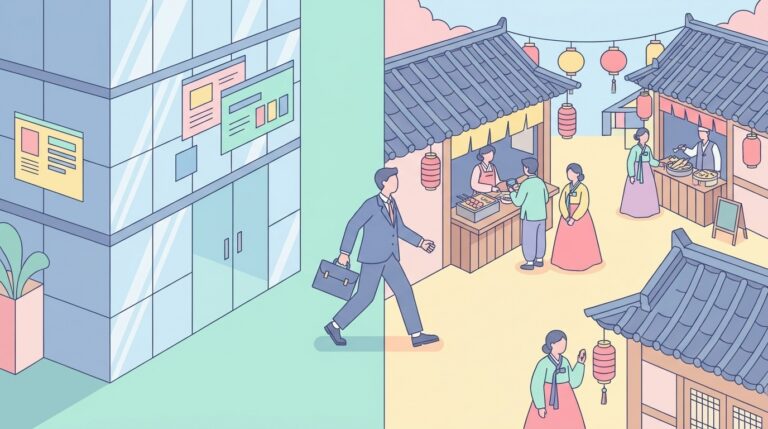
Picture a glass-walled conference room overlooking the neon skyline of Teheran-ro in Gangnam. A junior strategist has just delivered a flawless, eighty-slide deck analyzing street consumer behavior in Seongsu-dong, backed by complex graphs and social listening metrics. The senior executive calmly shuts the laptop and utters a single phrase that shifts the entire room’s gravity: “보고서만 백 번 들여다보면 뭐 합니까? 백견이 불여일행인데, 지금 당장 성수동 골목으로 나갑시다.” (What is the use of staring at reports a hundred times? A hundred seeings cannot match one action; let us head to the alleys of Seongsu right now.)
For C2 learners, mastering Korean transcends grammatical accuracy; it demands fluency in the epistemological skepticism woven into Korean intellectual and corporate culture. While intermediate learners rely on the familiar proverb 백문불여일견 (Baekmunbul-yeoilgyeon), native Korean leaders, seasoned negotiators, and editorial writers frequently push further, invoking 백견불여일행 (Baekgyeonbul-yeoilhaeng) to dismantle armchair theorizing. This guide draws upon real executive coaching sessions with foreign directors working in Seoul, unlocking the profound rhetorical power of empirical verification in high-stakes discourse.
Phase 2: 핵심 표현 3선 심층 분석
1. 백견불여일행 (百見不如一行)
- Pronunciation: [Baek-gyeon-bul-yeo-il-haeng] (Sounds like: Beck-gyun-bool-yuh-eel-heng)
- Meaning: Literally “A hundred seeings do not equal one single action.” It carries the nuanced pragmatic weight of rejecting passive observation in favor of tangible, boots-on-the-ground execution.
- K-Culture Moment: Seen frequently in hardboiled investigative K-Dramas like Stranger (비밀의 숲), where the dogged prosecutor ignores visual surveillance files to interrogate a crime scene manually.
- Editor’s Insight: This is an evolutionary idiom derived from Han Dynasty classicism. In modern executive discourse, dropping this idiom asserts supreme practical leadership. It signals: Stop analyzing; produce an empirical prototype.
- Situation Spectrum: Casual ⚠️ | Semi-formal ✅ | Formal ✅
- 🤔 Think About It: Does your native language view visual evidence as the ultimate proof, or does it demand active intervention to establish empirical truth?
2. 백문불여일견 (百聞不如一見)
- Pronunciation: [Baek-mun-bul-yeo-il-gyeon] (Sounds like: Beck-moon-bool-yuh-eel-gyun)
- Meaning: Literally “A hundred hearings do not equal one seeing.” Pragmatically, it warns against relying on hearsay, gossip, or secondhand briefings.
- K-Culture Moment: In food and travel variety shows like Baek Jong-won’s Alley Restaurant, when mentors urge skeptical owners to taste a competitor’s dish directly rather than listening to market rumors.
- Editor’s Insight: While basic, using it in high-level debates can sound slightly cliché if used alone. Pair it with an assertive tone to slice through unverified corporate gossip.
- Situation Spectrum: Casual ✅ | Semi-formal ✅ | Formal ✅
- 🤔 Think About It: In an age of algorithmic noise, why does direct visual witnessing remain a foundational cultural baseline in Korea?
3. 탁상공론 (卓上空論)
- Pronunciation: [Tak-sang-gong-non] (Sounds like: Tahk-sahng-gohng-nohn)
- Meaning: Literally “Empty discussion around an elevated desk.” Pragmatically: ungrounded ivory-tower theorizing disconnected from real-world variables.
- K-Culture Moment: Delivered with venom by ground engineers toward headquarters executives in corporate thrillers like Agency (대행사).
- Editor’s Insight: This is an offensive weapon in Korean meetings. Accusing a team’s proposal of being a taksanggongnon is a direct intellectual challenge. Use it only when you have field data to back up your claim.
- Situation Spectrum: Casual 🚫 | Semi-formal ⚠️ | Formal ✅
- 🤔 Think About It: Why does Korean corporate culture place such biting shame on deskbound planning that ignores field dynamics?
Phase 3: 교과서 한국어 vs 진짜 한국어
Situation 1: Calling out a proposal that has no grounding in reality
- 📖 교과서 한국어: 그 계획은 현실성이 전혀 없으니 다시 검토해 주십시오. (Geu gyehoegeun hyeonsilseongi jeonhyeo eopseuni dasi geomtohae jusipsio. / “That plan lacks all feasibility, so please re-examine it.”)
- 🗣️ 진짜 한국어: 현장 데이터 없는 탁상공론에 불과합니다. 백견불여일행이니 직접 테스트베드부터 돌려보시죠. (Hyeonjang deiteo eomneun taksanggongnone bulgwahamnida. Baekgyeonbul-yeoilhaeng-ini jikjeop teseuteubedeubuteo dollyeobosijo. / “This is mere deskbound theory without field data. A hundred seeings don’t match one action, so let’s run a live testbed first.”)
- 💡 왜 다를까? C2-level real Korean blends classical idiom with technical terminology (testbed, field data), transforming an abstract rejection into an incisive, operational counter-strategy.
Situation 2: Emphasizing experiential mastery over theoretical expertise
- 📖 교과서 한국어: 직접 해봐야 진정한 의미를 알 수 있습니다. (Jikjeop haebwaya jinjeonghan uimireul al su itseumnida. / “You must do it yourself to understand its true meaning.”)
- 🗣️ 진짜 한국어: 백 번 들어도 직접 발로 뛰지 않으면 뜬구름 잡기입니다. (Baek beon deureodo jikjeop ballo ttwiji aneumyeon tteungureum japgi-imnida. / “Even if you hear it a hundred times, unless you run on your own feet, you’re merely grasping at clouds.”)
- 💡 왜 다를까? Educated Koreans love balancing classical cadence with vivid vernacular idioms like ballo ttwida (running with one’s own feet) and tteungureum japgi (grabbing floating clouds).
Phase 4: K-Culture 딥다이브 & 비언어적 매너
4-1. 눈치 (Nunchi) & Field Manners
When challenging theoretical complacency in Korean business circles, body language dictates whether your assertion is seen as sharp brilliance or insolence:
* The Forward Lean: Never deliver 백견불여일행 leaning back with crossed arms; that signals aloof cynicism. Instead, lean slightly forward, resting your forearms lightly on the desk, matching physical readiness to the ethos of action.
* The Visual Sweep: When identifying 탁상공론, do not point fingers at individual colleagues. Cast your gaze briefly over the documents or screen, then look directly into the senior decision-maker’s eyes, depersonalizing the critique into a shared pursuit of objective truth.
4-2. The Cultural Paradigm: Joseon Silhak to K-Tech
Korea’s relentless obsession with hands-on validation originates historically from the late Joseon Silhak (실학, Practical Learning) movement, which rejected rigid Neo-Confucian dogmatism in favor of Silsagusi (실사구시, seeking truth from facts). Today, this legacy pulses through modern industrial culture—from Samsung’s Hyeonjang-jungsim (field-centric) production philosophies to the lightning-quick turnaround of K-Beauty pop-ups. In Korean boardrooms, words are ephemeral; physical implementation is the only legitimate currency.
Phase 5: 실전 롤플레이 시나리오
Setting: A strategic marketing war-room at a top-tier retail firm in Yeouido.
Characters:
* Director Min (민 상무): A battle-hardened field veteran who built his career on offline logistics.
* Julian (줄리안 팀장): A brilliant, analytical foreign team lead presenting an AI-generated trend forecasting model.
Turn 1
* 줄리안: 상무님, 이번 20대 타깃 팝업스토어는 빅데이터 분석 결과를 토대로 성수동보다는 온라인 가상 공간에 집중해야 합니다. (Sangmunim, ibeon isipdae tagit papeopseuto-eoneun bikdeiteo bunseok gyeolgwateul todaero seongsudongbodaneun onrain gasang gonggane jipjunghaeya hamnida.)
Julian: Executive Director Min, based on big data analytics, our 20s-targeted pop-up should focus on virtual spaces rather than Seongsu-dong.
🎭 Hands clasped neatly over an iPad, speaking with confident precision.
Turn 2
* 민 상무: 줄리안 팀장, 화면 속 수치들이 참 그럴듯하지만, 지난 분기 가상 스토어 전환율 기억 안 납니까? (Julian timjang, hwamyeon sok suchideuri cham geureoldeuthajiman, jinan bungi gasang seoto-eo jeonhwanyul gieok an namnikka?)
Director Min: Team Lead Julian, the metrics on screen look plausible, but don’t you remember last quarter’s virtual store conversion rate?
🎭 Tapping his pen rhythmically against the table, brows furrowed.
Turn 3
* 줄리안: 하지만 이번 알고리즘은 결이 다릅니다. 소비 패턴 시뮬레이션을 이미 백 번 넘게 검증했습니다. (Hajiman ibeon algo-rijeumeun gyeori dareumnida. Sobi paeteon simyulle-isyeoneul imi baek beon neomge geomjeonghaetseumnida.)
Julian: However, this algorithm’s texture is completely different. We have simulated consumption patterns over a hundred times already.
🎭 Leaning forward, clicking smoothly to a multi-variable regression graph.
Turn 4
* 민 상무: 아무리 시뮬레이션을 돌려도 현장에 나가지 않으면 그건 탁상공론에 불과해요. (Amuri simyulle-isyeoneul dollyeodo hyeonjange nagaji aneumyeon geugeon taksanggongnone bulgwahaeyo.)
Director Min: No matter how many simulations you run, if you don’t step into the field, that is nothing more than deskbound rhetoric.
🎭 Pushing the tablet gently aside, fixing an unyielding stare on Julian.
Turn 5
* 줄리안: 백문불여일견이라는 말씀이시군요. 데이터 화면만 들여다보지 말고 현장의 온도를 보라는 뜻으로 이해하겠습니다. (Baekmunbul-yeoilgyeon-iraneun malsseumisigunyo. Deiteo hwamyeonman deuryeodaboji malgo hyeonjangui ondoreul boraneun tteuseuro ihaehaegetseumnida.)
Julian: You mean ‘a hundred hearings do not equal one seeing.’ I understand your point to be observing the temperature of the field rather than looking at data screens.
🎭 Nodding calmly, acknowledging the philosophical foundation of the critique.
Turn 6
* 민 상무: 아니, 백문불여일견을 넘어 백견불여일행이어야지. 눈으로 구경만 하는 게 아니라, 우리가 직접 현장에서 판을 깔고 겪어봐야 진실을 알 수 있소. (Ani, baekmunbul-yeoilgyeoneul neomeo baekgyeonbul-yeoilhaeng-ieoyaji. Nuneuro gugyeongman haneun ge anira, uriga jikjeop hyeonjangeseo paneul kkalgo gyeok-eobwaya jinsireul al su itso.)
Director Min: No, we must go beyond ‘one seeing’ to ‘one action.’ It is not about passively watching; we must set the stage on the ground and experience it directly to understand truth.
🎭 Slapping the mahogany desk with an open palm, resolute.
Turn 7
* 줄리안: 전적으로 동의합니다. 그렇다면 가상 기획을 고집하지 않고, 성수동 현장에 3일짜리 마이크로 팝업을 당장 실행하여 고객 반응을 직접 검증하겠습니다. (Jeonjeogeuro dong-uihamnida. Geureotdamyeon gasang gihoegeul gojiphaji anko, seongsudong hyeonjange sam-iljjari maikeuro papeobeul dangjang silhaenghayeo gogaek ban-eungeul jikjeop geomjeonghaegetseumnida.)
Julian: I wholeheartedly agree. In that case, instead of stubbornly clinging to virtual planning, I will immediately execute a three-day micro-popup in Seongsu to verify consumer reactions firsthand.
🎭 Straightening up, jotting down an actionable pilot test timeline.
Turn 8
* 민 상무: 좋아! 백 마디 말보다 그 한 번의 실행이 우리의 진짜 자산이 될 겁니다. 즉시 진행합시다. (Joa! Baek madi malboda geu han beonui silhaeng-i uriui jinjja jasani doel geomnida. Jeuksi jinhaenghapsida.)
Director Min: Good! That single execution will be our real asset far more than a hundred words. Proceed at once.
🎭 Breaking into an approving smile, nodding firmly.
🔀 인터랙티브 분기점: How should Julian respond at Turn 7?
- Choice A: “상무님, 하지만 데이터 검증 없이 오프라인에 나가는 건 비용 낭비입니다. 보고서를 한 번만 더 읽어주십시오.” (Insisting on the report)
- Feedback (Bad): Dismisses the executive’s philosophical stance; brands Julian as an unyielding academic trapped in taksanggongnon.
- Choice B: “백견불여일행의 가치를 되새겨, 이번 주말 성수동에서 게릴라 파일럿 테스트를 진행한 뒤 실측 데이터를 보고드리겠습니다.” (Proposing a rapid practical trial)
- Feedback (Best): Directly integrates the idiom’s ethos, respects senior judgment, and pivots theoretical research into empirical execution.
- Choice C: “알겠습니다. 그럼 성수동 상권을 눈으로 둘러보고 오겠습니다.” (Merely going to observe)
- Feedback (Risk): Stops at 백문불여일견 (passive looking) and misses the Director’s explicit demand for 백견불여일행 (active, hands-on trial).
Phase 6: 10초 감정 섀도잉 드릴
Read aloud, matching the pause markers (/) and internalizing the specific psychological state:
[🧐 차분하지만 단호하게]
수치에만 매몰된 논의는 / 결국 탁상공론에 그칠 뿐입니다. / 백견불여일행이니, / 현장의 실행 결과를 보고 판단하시죠.
(Suchie-man maemoldoen non-uineun / gyeolguk taksanggongnone geuchil ppun-imnida. / Baekgyeonbul-yeoilhaeng-ini, / hyeonjangui silhaeng gyeolgwateul bogo pandanhansijo.)
Discussion buried only in numbers ends up as armchair theory. Since seeing a hundred times falls short of one action, let us judge by field execution.-
[⚡ 확신에 찬 어조로 카리스마 있게]
수백 번의 회의보다 / 직접 발로 뛰는 한 번의 실천이 / 진실을 밝히는 유일한 열쇠입니다.
(Subaek beonui hoe-uiboda / jikjeop ballo ttwineun han beonui silcheoni / jinsireul balkhineun yu-ilhan yeolsoe-imnida.)
Rather than hundreds of meetings, a single action carried out with one’s own feet is the only key to uncovering truth.
Phase 7: K-Culture 미니 사전 (핵심 키워드 4선)
- 현장주의 (Hyeonjang-juui) | Pragmatic Field-First Doctrine
- The institutional belief in Korean manufacturing and commerce that true insights exist on the factory floor, the restaurant counter, or the retail street, not in executive headquarters.
- 발로 뛰다 (Ballo ttwida) | To pound the pavement; to run on one’s own feet
- Colloquial phrase used to commend journalists, market researchers, or salespeople who gather raw intelligence firsthand.
- 실사구시 (Silsagusi) | Seeking truth from factual reality
- High-level four-character idiom (實事求是) frequently deployed in policy editorials to advocate empirical evidence over dogma.
- 뜬구름 잡다 (Tteungureum japda) | To grasp at floating clouds
- Idiomatic metaphor for vague, unrealistic, and unsubstantiated claims made without empirical verification.
Phase 8: 여행자를 위한 생존 키트
Even when navigating urban Korea as an advanced traveler or professional, applying an empirical mindset changes your operational effectiveness:
- Top 1: “소문만 듣고 왔는데, 백문이 불여일견이네요!” (Somunman deutgo wanneunde, baekmuni bul-yeoilgyeon-ineyyo! / I only heard rumors, but seeing it once beats hearing it a hundred times!)
- Pro Tip: Use this at an artisanal restaurant or neighborhood market to delight elderly Korean craftsmen.
- Top 2: “블로그 정보랑 현장이 많이 다른가요?” (Beullogeu jeongborang hyeonjang-i mani dareungayo? / Is the actual location very different from blog reviews?)
- Pro Tip: Essential when scoping authentic regional travel destinations beyond sponsored social posts.
- Top 3: “직접 발로 뛰어봐야 제대로 된 맛을 알 수 있죠.” (Jikjeop ballo ttwieobwaya jedaero doen maseul al su itjyo. / You have to pound the pavement yourself to know genuine taste.)
- Pro Tip: Perfect icebreaker with local taxi drivers and culinary enthusiasts.
- Editor’s Travel Note: Avoid planning itineraries purely via international search engines. Leverage real-time user verification by installing local location engines: download the 네이버 지도 앱(Naver Map App) to cross-reference verified resident visitor reviews before setting off.
Phase 9: “한 발 더 깊이” (생각 질문)
Korean communicative hierarchy often conceals a sharp epistemological duel between theoretical authority and empirical legitimacy. While high status grants one the floor to speak, undisputed respect is won only when an individual demonstrates hyeonjang-gam (현장감)—an instinct sharpened by tangible, physical labor. Thus, deploying 백견불여일행 is not merely an expression of skepticism toward rhetoric; it is a cultural corrective against intellectual self-indulgence.
💬 Your Turn: Have you ever encountered a situation in your own career or studies where excessive analysis paralyzed genuine progress? How would you articulate the transition from theory to practical action using Korean?
Phase 10: FAQ & 오해 방지
Q: Can ‘백견불여일행’ be used in everyday casual conversation with close friends?
A: While grammatically correct, using a four-character idiom (사자성어) like 백견불여일행 during a casual chat over drinks can sound overly dramatic or professorial. With friends, say: “말만 하지 말고 일단 직접 해보자!” (Don’t just talk, let’s try it ourselves!). Reserve the idiom for project debates, motivational speeches, or reflective essays.
Q: How does ‘백견불여일행’ differ philosophically from ‘백문불여일견’?
A: 백문불여일견 establishes that visual observation disproves verbal hearsay (Passive Verification). 백견불여일행 argues that even observation can deceive or remain inert without tactile execution (Active Empirical Intervention).
Q: Is calling someone’s proposal ‘탁상공론’ considered rude in a workplace?
A: Yes, it is extremely sharp. Calling a colleague’s work 탁상공론 openly invalidates their preparation. In diplomatic corporate environments, soften the blow by stating: “현실과의 괴리를 좁히기 위해 현장 검증이 보완되면 좋겠습니다” (I hope field validation is supplemented to narrow the gap with reality).
🚨 흔한 실수 (Common Mistakes) 경고판
- Using 백문불여일견 for action: Learners often say 백문불여일견 when they mean “let’s take action.” Seeing is not doing. Use 백견불여일행 or 일행 (一行) when execution is required.
- Confusing 탁상공론 with 단순한 실수: 탁상공론 does not mean a minor clerical error; it refers exclusively to an entire theoretical framework detached from real-world feasibility.
- Mispronouncing 탁상공론: Due to nasalization rules, 탁상공론 is pronounced as [탁쌍공논 / Tak-ssang-gong-non], where the final ‘ㄹ’ assimilates into an ‘ㄴ’ sound after the nasal ‘ㅇ’.
Phase 11: 액션 미션 & 참여 유도
- 🥉 Bronze Mission: Pronounce 백견불여일행 and 탁상공론 aloud three times, focusing on the nasalization transition in [탁쌍공논].
- 🥈 Silver Mission: Write a two-sentence diary entry in Korean contrasting an assumption you held about Korea with what you experienced when actually trying it.
- 🥇 Gold Mission: In your next business meeting or advanced language exchange, replace “직접 해봅시다” with “백견불여일행이니 작은 파일럿 테스트부터 직접 부딪쳐 보죠.”
- 🎮 K-Culture Mission: Watch an episode of a workplace K-Drama (such as Misaeng or Hot Stove League) and note down how many times veterans use the word “현장 (field/site)” to overrule headquarters reports.
Phase 12: 인터랙티브 퀴즈 챌린지
1. 상황 판단 (Contextual Fit)
Which idiom best fits this scenario?
A marketing team spends three months analyzing food delivery data inside a conference room, only to realize the dish they designed cannot survive a 15-minute motorcycle delivery.
(A) 백문불여일견
(B) 탁상공론
(C) 동문서답
🔍 정답 및 해설 보기
정답: (B) 탁상공론
해설: Building a theoretical solution that collapses when deployed into real-world operational logistics is the textbook definition of 탁상공론 (armchair empty theory).
2. 빈칸 채우기 (Fill in the Blank)
백 번 보는 것도 훌륭하지만, 직접 현장에서 겪어보는 (________)에 비할 수는 없습니다.
🔍 정답 및 해설 보기
정답: 백견불여일행 (또는 일행 / 직접적인 실천)
해설: The contrast between passive visual observation and active execution points precisely to the ethos of 백견불여일행.
3. True / False Cultural Check
True or False: In contemporary Korean business culture, invoking 백견불여일행 implies that high-level data analysis is useless and should be eliminated completely.
🔍 정답 및 해설 보기
정답: False
해설: 백견불여일행 does not reject data; it warns against data idolatry. It demands that numerical forecasting be corroborated and stress-tested through active physical trials in the field.






