

Phase 1: 공감 (Story-Immersive Opening)
안녕하세요! 매일한글 에디터입니다.
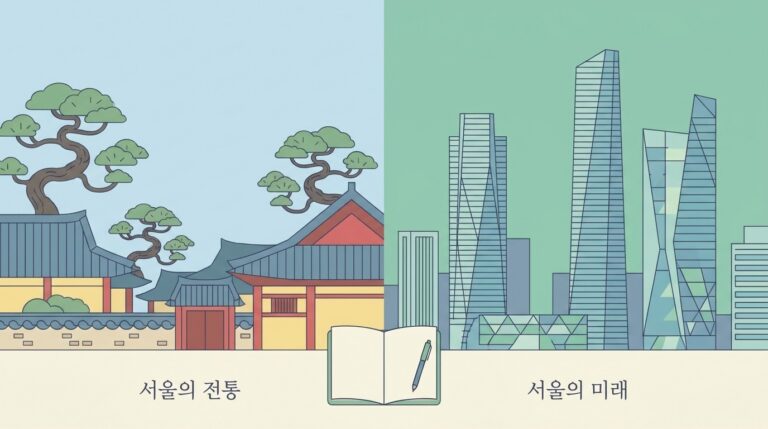
Picture this: You step out of Seongsu Station in Seoul. Today, it is a bustling mecca of avant-garde pop-up stores, artisanal perfumeries, and sleek fashion flagships buzzing with global creators. But if you walk just two alleys inward, you catch the faint scent of leather dye and machine oil from vintage cobbler workshops that have held ground since the 1970s. Or take a look at Gangnam, immortalized in K-dramas like Reborn Rich (재벌집 막내아들)—what was once vast tracts of cabbage and pear farmland just five decades ago is now an ocean of glass-and-steel skyscrapers commanding the highest real estate prices in the country.
When lifelong Seoulites stand before these dizzying urban transformations, they don’t just say, “It changed a lot.” Instead, they pause, take a deep breath, and murmur a profound four-character idiom (사자성어): 상전벽해 (桑田碧海).
Many advanced Korean learners tell me, “Editor, I know simple words like 변하다 (to change), but when I try to discuss social evolution, history, or Korea’s breathtaking speed of development with Korean colleagues, my vocabulary feels too childish!” You are not alone. Reaching C1 proficiency means graduating from basic descriptions to expressions that capture the socio-cultural soul of Korea. This guide is crafted directly from our classroom case studies to give you the exact linguistic toolkit, non-verbal poise, and cultural depth required to articulate epochal change effortlessly.
Phase 2: Core Expressions Deep Dive
1. 상전벽해 (桑田碧海)
- Pronunciation: Sang-jeon-byeok-hae (Pronunciation tip: sounds like ‘Sahng-jun-byuk-hae’, with ‘byuk’ clipped crisply like ‘puck’)
- Meaning:
- Literal: Mulberry fields (桑田) turn into the deep blue sea (碧海).
- Nuance: A mind-boggling, radical transformation of a physical landscape, city, or industry that has changed so profoundly it is barely recognizable.
- K-Culture Moment: Seen frequently in documentaries, real-estate investment analysis shows, or historical fantasy dramas like Reborn Rich, when characters return to a rural district after twenty years only to find a hyper-modern metropolis in its place.
- Editor’s Insight: Mulberry leaves were historically grown to feed silkworms—representing quiet agrarian life. Imagining those tranquil groves sunken beneath a roaring blue ocean evokes immense geological scale. Use this when the sheer speed and scale of change stuns you.
- Situation Spectrum: Casual ⚠️ | Semi-formal ✅ | Formal ✅
- 🤔 Think About It: In English, we might say “night and day difference” or “changed beyond recognition,” but notice how the Korean idiom anchors change in the poetic drama of the natural elements.
2. 격세지감 (隔世之感)
- Pronunciation: Gyeok-se-ji-gam (Pronunciation tip: sounds like ‘Gyuk-say-jee-gahm’)
- Meaning:
- Literal: A feeling (感) of being separated by a whole generation or era (隔世).
- Nuance: The psychological dislocation or sentimental awe you feel when realizing how drastically lifestyle, technology, or generational customs have shifted within a short span.
- K-Culture Moment: Second-generation K-Pop legends (like members of Girls’ Generation or Super Junior) on variety shows looking bewildered at Gen 4 and Gen 5 idols filming TikTok dance challenges in music show hallways.
- Editor’s Insight: While 상전벽해 focuses heavily on external, tangible landscapes or economic systems, 격세지감 is profoundly subjective—it is about the nostalgic, sometimes melancholic emotional realization that “my era has moved on.”
- Situation Spectrum: Casual ⚠️ | Semi-formal ✅ | Formal ✅
- 🤔 Think About It: How does your home culture express the dizzying sensation of technological leaps making your childhood memories feel like ancient history?
3. 인생무상 (人生無常)
- Pronunciation: In-saeng-mu-sang (Pronunciation tip: sounds like ‘Een-sang-moo-sahng’)
- Meaning:
- Literal: Human life (人生) has no permanence (無常).
- Nuance: The transience and fleeting nature of worldly glory, youth, and human ambition; an acceptance that everything rises and dissolves.
- K-Culture Moment: In tragic historical Sageuk dramas (such as Mr. Sunshine or The Red Sleeve), when a once-mighty dynasty crumbles, or when an elderly statesman looks out over the palace ruins in exile.
- Editor’s Insight: Rooted in Buddhist philosophy (Anicca), this is not just cynical pessimism; it carries a mature, philosophical equanimity. Native speakers use it sparingly during moments of quiet reflection over the passage of youth or lost empires.
- Situation Spectrum: Casual 🚫 | Semi-formal ✅ | Formal ✅
- 🤔 Think About It: Compare this with the Latin Memento Mori or Sic transit gloria mundi. Why do societies experiencing rapid modernization often feel this impermanence so intensely?
Phase 3: Textbook Korean vs. Real Native Korean
Scenario 1: Remarking on how a neighborhood has completely changed
- 📖 교과서 한국어 (Textbook Korean):
“이 동네는 예전과 비교해서 아주 많이 변했습니다.”
(I dongneneun yejeongwa bigyohaeseo aju mani byeonhaessseumnida.)
“This neighborhood has changed very much compared to the past.” - 🗣️ 진짜 한국어 (Real Native Korean):
“여기가 예전엔 다 공장지대였는데, 완전 상전벽해네요!”
(Yeogiga yejeonen da gongjangjidaeyeonneunde, wanjeon sangjeonbyeokhaeneyo!)
“This whole place used to be factories back then—it has undergone a total sea change!” - 💡 왜 다를까? (Why the difference?):
Textbook Korean relies on bland descriptive verbs. Native speakers, however, prefer contrasting a vivid memory (“다 공장지대였는데”) with an impactful idiom (“완전 상전벽해네요”) to convey their genuine sensory shock.
Scenario 2: Reminiscing about how fast technology has evolved
- 📖 교과서 한국어 (Textbook Korean):
“기술이 발전해서 옛날 물건을 이제 쓰지 않습니다.”
(Gisuri baljeonhaeseo yennal mulgeoneul ije sseuji anseumnida.)
“Because technology developed, we no longer use old items.” - 🗣️ 진짜 한국어 (Real Native Korean):
“삐삐 쓰던 시절 생각하면 진짜 격세지감이에요.”
(Bbi-bbi sseudeon sijeol saenggakhamyeon jinjja gyeokse-jigam-ieyo.)
“When I think back to the days of using pagers, I truly feel how much times have changed.” - 💡 왜 다를까? (Why the difference?):
Koreans anchor generational shifts to iconic cultural artifacts (like pagers/삐삐, cassette tapes, or flip phones) combined with 격세지감 to immediately build emotional solidarity with the listener.
Phase 4: K-Culture Deep Dive & Non-Verbal Manners
4-1. 눈치 (Nunchi) & Gestures for Epochal Idioms
When delivering high-register idioms like 상전벽해 or 격세지감, your physical delivery dictates whether you sound like an empathetic intellectual or an arrogant pedant reciting flashcards:
* The Reflective Gaze: Do not make aggressive, unblinking eye contact. Instead, glance slightly toward the skyline or the environment you are discussing, as if visually superimposing the past onto the present.
* The Head Tilt and Slow Exhale: Pair “진짜 상전벽해네요…” with a subtle, respectful nod or a soft, contemplative sigh. It signals reverence for the human labor and passage of time that drove this transformation.
* The Spatial Hand Gesture: A sweeping, level open-palm gesture across the modern vista naturally underlines the scale of the “sea” replacing the “fields.”
4-2. Cultural Code: Compressed Modernity (압축 성장)
To truly master these expressions, you must understand Korea’s historical context. South Korea transitioned from a war-torn agrarian society in the 1950s to a leading global tech power in just two generations—a phenomenon sociological scholars call 압축 성장 (Compressed Modernity).
Because this change occurred at breakneck speed, an individual Korean who grew up without indoor plumbing might now work as a senior executive in a carbon-neutral smart building in Yeouido. This unique historical compression means that 상전벽해 and 격세지감 are not abstract literary metaphors; they are lived, daily emotional realities for millions of older Koreans.
Phase 5: Real-Life Roleplay Scenario
Setting: You are strolling through the revitalized high-tech district of Pangyo or Magok with General Manager Park (박 부장님, 56), your Korean company mentor.
- 박 부장: “김 대리, 여기 20년 전 모습 기억나요? 그땐 허허벌판이었는데 말이야.”
(Kim Daeri, yeogi isip-nyeon jeon moseup gieongnayo? Geuttaen heoheobeolpan-ieonneunde mariya.)
🎭 [먼 풍경을 아련하게 바라보며 회상에 잠긴 표정으로] / [Looking wistfully into the distance, lost in reminiscence]
“Assistant Manager Kim, do you remember what this place was like 20 years ago? Back then, it was just an empty, barren field.” -
You (Learner): “제가 어릴 때 얼핏 듣기만 했는데, 여기가 정말 논밭이었나요?”
(Jega eoril ttae eolpit deutgiman haenneunde, yeogiga jeongmal nonbatiosnayo?)
🎭 [눈을 동그랗게 뜨며 진심 어린 호기심을 담아] / [Eyes widening with genuine curiosity]
“I only vaguely heard about it as a child—was this really just rice paddies back then?” -
박 부장: “그럼! 비만 오면 진흙탕이 되던 시골 동네였지. 그런데 지금은 AI 연구소에 고층 빌딩이 빽빽하잖아.”
(Geureom! Biman omyeon jinheuktangi doedeon sigol dongneyeotji. Geureonde jigeumeun AI yeon-guso-e gocheung bildingi bbaekbbaekhajana.)
🎭 [고개를 천천히 끄덕이며 감회에 젖은 미소] / [Nodding slowly with a deeply moved smile]
“Of course! Whenever it rained, it was a muddy country road. But now, it’s packed wall-to-wall with AI labs and skyscrapers.” -
You (Learner): “정말 상전벽해라는 말이 딱 들어맞네요. 불과 몇십 년 만에 이렇게 바뀌다니 경이롭습니다.”
(Jeongmal sangjeonbyeokhaeraneun mari ttak deureomatneyo. Bulgwa myeotsip nyeon mane ireoke bakkwidani gyeong-iropsumnida.)
🎭 [주변 고층 빌딩을 올려다보며 경탄하는 어조로] / [Looking up at the skyscrapers in genuine admiration]
“The term sangjeonbyeokhae fits perfectly here. It’s truly marvelous that it transformed like this in just a few decades.” -
박 부장: “하하, 김 대리가 어려운 사자성어도 다 아네? 맞아, 내가 청춘을 바친 곳인데도 가끔은 길을 잃어버려.”
(Haha, Kim Daeriga eoryeoun sajaseong-eodo da ane? Maja, naega cheongchuneul bachin gosin-dedo gakkeumeun gireul ireobeoryeo.)
🎭 [기특하다는 듯 어깨를 툭 치며 호탕하게 웃음] / [Laughing heartily, tapping your shoulder with pride]
“Haha, you even know difficult four-character idioms? Exactly. Even though I dedicated my youth to this company, I still lose my way around here sometimes.” -
You (Learner): “부장님처럼 이 변화를 직접 일궈내신 분들은 격세지감이 남다르실 것 같아요.”
(Bujangnimcheoreom i byeonhwareul jikjeop ilgwonaesin bundeureun gyeokse-jigami namdareusil geot gatayo.)
🎭 [공손하게 두 손을 모으고 경청하는 자세로] / [Clasping hands politely in an attentive, empathetic posture]
“For people like you who directly built this transformation, the feeling of epochal shift must be especially profound.” -
박 부장: “고마워, 그렇게 알아주니 뿌듯하네. 세월이 참 무상하지만, 이런 발전이 후배들한테 힘이 되었으면 해.”
(Gomawo, geureoke arajuni bbudeuthane. Sewori cham musanghajiman, ireon baljeoni hubaedeulhante himi doeeosseumyeon hae.)
🎭 [따뜻하고 온화한 시선으로 후배를 바라보며] / [Looking at you with warm, approving eyes]
“Thank you. It feels rewarding to have that acknowledged. Time is fleeting, but I hope this progress empowers the next generation.” -
You (Learner): “선배님들의 헌신 덕분에 저희가 이런 멋진 환경에서 일할 수 있는 거죠!”
(Seonbaenimdeurui heonsin deokbune jeohuiga ireon meotjin hwan-gyeong-eseo ilhal su inneun geojyo!)
🎭 [밝고 확신에 찬 목소리로 화답하며] / [Responding with a bright, confident, and grateful voice]
“It’s thanks to our seniors’ dedication that we have such a wonderful environment to work in!”
🔀 Interactive Branching Decision
Imagine Manager Park just said: “이 동네 20년 전엔 진짜 아무것도 없었어.” (20 years ago, there was really nothing here). How do you react?
- Option A: “아, 그래요? 요즘은 개발이 빨라서 흔한 일이죠.” (Oh, really? Development is fast these days, so that’s pretty common.)
- Feedback [Bad 🚫]: Dismissive! This flattens Korea’s dramatic history and unintentionally downplays the generation that poured blood, sweat, and tears into that development.
- Option B: “진짜 상전벽해네요! 옛날 사진 보면 지금 모습은 상상도 못 할 것 같아요.” (That is truly sangjeonbyeokhae! Looking at old photos, one wouldn’t even be able to imagine today’s view.)
- Feedback [Best 🌟]: Flawless C1 cultural intelligence. You validate their memory, employ the idiom with precision, and express imaginative empathy.
- Option C: “세상이 변하는 건 당연한 인생무상입니다.” (The world changing is a natural vanity of life.)
- Feedback [Risk ⚠️]: Too fatalistic and slightly awkward! 인생무상 is excessively melancholic here and sounds like a monk lecturing an elder about the futility of his hard work.
Phase 6: 10-Second Emotional Shadowing Drill
Read these out loud, observing the breath pauses (/) and channeling the emotional stage directions:
[😲 경탄과 경외심 / Pure Wonder & Awe]
“논밭이었던 곳이 / 고층 빌딩 숲으로 바뀌다니 / 완전 상전벽해네요!”
(Nonbatiosdeon gosi / gocheung bilding supeuro bakkwidani / wanjeon sangjeonbyeokhaeneyo!)-
[😌 아련한 회상과 뭉클함 / Bittersweet Nostalgia]
“스마트폰 하나로 다 되는 세상을 보면 / 진짜 격세지감을 느껴요.”
(Seumateupon hanaro da doeneun sesang-eul bomyeon / jinjja gyeokse-jigameul neukkyeoyo.) -
[🧘 담담한 수용 / Calm Acceptance & Wisdom]
“영원할 것 같던 영광도 / 결국 지나가는 걸 보면 / 인생무상이라 하죠.”
(Yeong-wonhal geot gatdeon yeong-gwangdo / gyeolguk jinaganeun geol bomyeon / insaengmusang-ira hajyo.)
Phase 7: K-Culture Mini Dictionary
- 상전벽해 (Sangjeonbyeokhae) | A radical spatial/structural metamorphosis
Used extensively in urban planning panels, news headlines, and architecture essays to describe massive redevelopment projects (e.g., Yeouido, Songdo, Magok). - 격세지감 (Gyeokse-jigam) | Generational culture-shock / Feeling eras apart
Widely used in corporate settings or workplace talk when discussing old analog work routines (e.g., fax machines, smoking indoors) versus modern digital workflows. - 압축 성장 (Apchuk Seongjang) | Compressed Economic Growth
The socio-economic foundation term explaining how Korea condensed a two-century Industrial Revolution into roughly 40 years. - 원도심 (Wondosim) | Historical/Original City Center
The historic urban core (like Jongno in Seoul or Jung-gu in Busan) often contrasted with shiny new districts (신도심) to demonstrate 상전벽해 in real time.
Phase 8: Traveler’s Survival Kit
Top 3 Survival Expressions for Urban Explorers
- “여기가 예전엔 어떤 곳이었나요?”
(Yeogiga yejeonen eotteon gosin-nayo?)
Pro Tip: Ask local baristas or elderly shop owners in revitalized alleys like Seongsu, Euljiro, or Ikseon-dong. It unlocks incredible stories. - “몰라보게 달라졌네요!”
(Mollaboge dallajyeotneyo!)
Pro Tip: The natural spoken equivalent of 상전벽해. Great when meeting Korean friends after several years. - “옛날 감성이 그대로 남아있네요.”
(Yennal gamseongi geudaero namaitneyo.)
Pro Tip: Perfect for retro Newtro (뉴트로) hotspots that preserve historical architecture.
Editor’s Travel Note: Uncovering Seoul’s Time Layers
To see 상전벽해 with your own eyes, open the 네이버 지도 앱 다운로드 (Naver Map) and use its 거리뷰 (Street View) Time Machine feature. Select an address in Gangnam Station or Seongsu-dong and slide the timeline back to 2008. Watching the low-rise red-brick workshops vanish into 20-story tech towers right before your eyes is the fastest crash course in modern Korean history!
Phase 9: 한 발 더 깊이 (Deeper Reflection)
In contemporary Korean society, space is never just physical geography; it is a repository of shared collective memory. Because Korea modernizes so fast, Koreans harbor a unique, unspoken anxiety about the erasure of memory—homes, favorite corner stores, and whole school districts can disappear within months under redevelopment orders. Using 상전벽해 is both a celebration of technological triumphs and an elegiac sigh for spaces that vanished before they could grow old.
💬 Your Turn: Has your own hometown undergone a dramatic transformation in your lifetime? What is a place you look at and feel 상전벽해? Share your story in Korean below!
Phase 10: FAQ & Common Mistakes (FAQ Schema)
Q: Can I use 상전벽해 to describe a person who got plastic surgery or lost a lot of weight?
A: Technically people will understand your point, but it sounds slightly awkward or overly dramatic. 상전벽해 is predominantly reserved for broad environments, landscapes, industries, and social systems. For human appearance or personality transformations, natural idioms like 환골탈태 (換骨奪胎 – Hwangoltaltae) (literally: shedding old bones to take a new form) or simple colloquial expressions like “완전 딴사람이 됐다” (became a completely different person) are far more fitting.
Q: Is 격세지감 considered an archaic idiom that only older Koreans use?
A: Not at all! While its roots are classical, young Koreans in their twenties and thirties use 격세지감 all the time on social media when discovering childhood relics (like MP3 players, Cyworld minihompies, or 2010s fashion trends).
Q: What is the emotional difference between 격세지감 and 인생무상?
A: 격세지감 is filled with wonder, bewilderment, and gentle amusement at how much the environment or customs have leaped forward. In contrast, 인생무상 carries a profound philosophical weight—often associated with grief, aging, mortality, or realizing the emptiness of chasing status.
🚨 Common Mistakes Alert
- Mistake 1: Saying “저는 오늘 상전벽해를 먹었습니다” (Confusing it with food or a simple noun).
Correct Action: Treat it as a descriptive predicate: “상전벽해네요!” or “상전벽해를 실감해요.” - Mistake 2: Using 인생무상 during a minor inconvenience (e.g., your iced coffee spilled).
Correct Action: Use “아, 아깝다!” (What a waste!). Save 인생무상 for deeper reflections on the passage of decades. - Mistake 3: Pronouncing 상전벽해 with flat, unemotional English intonation.
Correct Action: Deliver it with melodic inflection—a slight pause before the word, and an admiring emphasis on 벽해 (byeok-hae).
Phase 11: Action Missions
- 🥉 Bronze Mission (Solo Shadowing): Stand in front of your mirror and practice reciting the Branching Option B response from Phase 5 until it rolls off your tongue in under 5 seconds without hesitating.
- 🥈 Silver Mission (Social Exploration): Go to YouTube or Instagram and search the hashtag
#상전벽해or#격세지감. Read three native Korean captions and note down what topics (e.g., hometown visits, tech upgrades, old family photos) they attach it to. - 🥇 Gold Mission (Live Deployment): The next time you are speaking with a Korean tutor, colleague, or friend, bring up how much Seoul or your home city has developed and drop: “진짜 상전벽해가 따로 없어요!” Watch their eyes light up in admiration.
🎮 K-Culture Mission: Watch Episode 1 or 2 of the K-drama Reborn Rich (재벌집 막내아들). Notice the scene where the protagonist predicts the farmland development of Bundang. Post a comment describing that scene using today’s idiom!
Phase 12: Interactive Quiz Challenge
1. [Situation Judgment] Which scenario is the MOST natural context to use 상전벽해?
* (A) You haven’t seen your college friend in two weeks, and they got a new haircut.
* (B) You return to your grandmother’s fishing village after 15 years to find it turned into an international container port and high-speed rail terminal.
* (C) You ordered a medium tteokbokki, but the restaurant brought out an extra-large bowl.
2. [Fill in the Blank] Fill in the missing Hanja character concept:
* “뽕나무 밭이 푸른 바다로 변했다는 뜻의 사자성어는 상전(__)해 입니다.”
3. [True / False Cultural Check]
* Is 격세지감 used exclusively when someone is sad about getting old?
👉 Click to reveal answers & explanations!
- Answer: (B)
Explanation: 상전벽해 requires profound, large-scale structural or spatial metamorphosis over time, making an agrarian village turning into an international mega-port the textbook example. - Answer: 벽 (碧 – Byuk)
Explanation: The idiom is 상전벽해 (桑田碧海), where 벽 (碧) means deep blue/emerald green, describing the ocean waters. - Answer: False
Explanation: 격세지감 is widely used with lighthearted wonder, amusement, or pure nostalgia when looking at vintage gadgets, childhood photos, or changing trends!







