

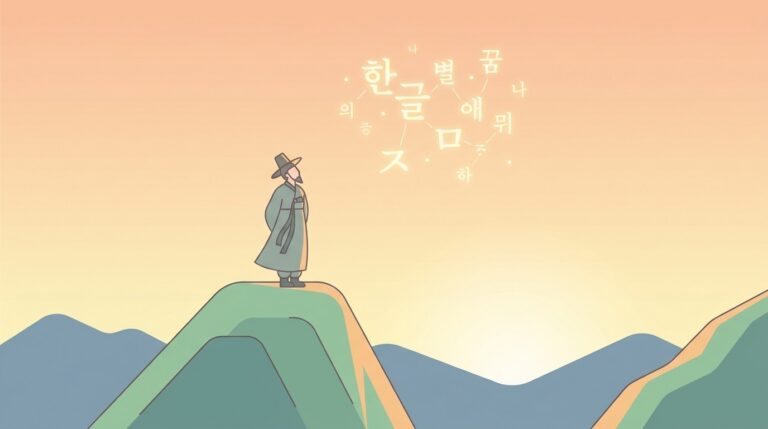
Reaching the Summit: Celebrating Your C2 Mastery and Navigating the Korean Universe
Phase 1: Empathy (Story-Driven Opening)
안녕하세요! 매일한글 에디터입니다. (Hello! I’m your Daily Hangul editor.)
Take a quiet breath and look back for a moment. Do you remember the very first time you struggled to distinguish between ㄱ (giyeok) and ㅋ (kieuk)? Do you recall standing before a busy kiosk in Hongdae, your palms sweating as you whispered a hesitant “아이스 아메리카노 한 잔 주세요 (Ice Americano han jan juseyo – One iced Americano, please)”? That was where your journey began. Now, look at where you stand today. You are dissecting the allegorical nuances of contemporary Korean cinema, debating socio-economic paradigms with Seoul academics, and appreciating the delicate poetic resonance of words that many native speakers struggle to articulate. You have officially ascended the highest peak of Korean language mastery: CEFR C2.
Reaching this summit is not merely an academic triumph; it is a profound transformation of how your mind perceives the world. You have built an entirely new intellectual self within the Korean linguistic landscape. As someone who has walked alongside international scholars, diplomats, and passionate learners for a decade, I can say with total conviction: what you have achieved is extraordinary. This milestone guide is built directly on real feedback from top-tier foreign professionals who navigated this transition from “fluent non-native” to “global intellectual flourishing in Korean.” Let us honor your relentless devotion, polish your rhetorical finesse, and explore how to wield your hard-earned mastery with effortless cultural grace.
Phase 2: Deep Dive into 3 Core Expressions
At the C2 tier, language ceases to be a transactional tool and becomes an art form. Here are three expressions that capture the zenith of intellectual achievement and respect.
1. 화룡점정을 찍다 (Hwaryongjeomjeong-eul jjikda)
- Pronunciation: [Hwa-ryong-jeom-jeong-eul jjik-da] (Think: Hwah-ryong-jum-jung-eul jeek-dah)
- Meaning: Literally “to paint the pupils of the dragon.” Nuance: Adding the definitive, crowning masterstroke that breathes life into an already monumental work.
- K-Culture Moment: Used by seasoned critics on arts panels or cultural talk shows (like You Quiz on the Block or literary roundtables) when discussing an auteur’s magnum opus.
- Editor’s Insight: This Hanja idiom (four-character idiom derived from a legendary Chinese painter whose dragons flew off the wall once their eyes were dotted) carries dramatic elevation. Reserve it for moments of triumphant culmination.
- Situation Spectrum: Casual 🚫 | Semi-formal ⚠️ | Formal ✅
- 🤔 Think About It: In English, we might say “the icing on the cake” or “the crowning touch,” but the Korean phrase evokes animating a mythical beast. How does this reflect the traditional East Asian reverence for spiritual vitality in art?
2. 지평을 넓히다 (Jipyeong-eul neolphida)
- Pronunciation: [Ji-pyeong-eul neol-pi-da] (Think: Jee-pyung-eul null-pee-dah)
- Meaning: Literally “to broaden the horizon.” Nuance: Expanding the philosophical, cultural, or intellectual paradigm through deep inquiry.
- K-Culture Moment: Frequently heard during award acceptance speeches by trailblazing Korean creators at international film festivals or academic symposia.
- Editor’s Insight: Beyond physical horizons, this expression signifies a paradigm shift. When someone praises your linguistic depth with this phrase, they are recognizing you as a cultural bridge-builder.
- Situation Spectrum: Casual ⚠️ | Semi-formal ✅ | Formal ✅
- 🤔 Think About It: English speaks of “widening horizons,” but Korean couples 지평 (jipyeong) with verbs of depth and breadth simultaneously. What horizons has learning Korean opened in your thought process?
3. 피와 땀이 서려 있다 (Pi-wa ttam-i seoryeo itda)
- Pronunciation: [Pi-wa ttam-i seo-ryeo it-da] (Think: Pee-wah ttahm-ee suh-ryuh eet-dah)
- Meaning: Literally “blood and sweat are permeated within.” Nuance: A solemn, heartfelt recognition that an achievement is steeped in unspoken sacrifices and profound dedication.
- K-Culture Moment: Used in historical documentaries and retrospectives celebrating individuals who dedicated their entire lives to preserving traditional craftsmanship or monumental scholarship.
- Editor’s Insight: The verb 서리다 (seorida) implies mist, aura, or condensation gathering over time. It recognizes that sweat and toil did not vanish—they are woven into the very fabric of who you have become.
- Situation Spectrum: Casual 🚫 | Semi-formal ✅ | Formal ✅
- 🤔 Think About It: How does your native language honor the invisible hours behind mastery? Korean deeply values the visible presence of invisible devotion.
Phase 3: Textbook Korean vs. Real Korean
At the C2 summit, naturalness lies in moving beyond stiff formality into refined rhetorical eloquence.
Situation 1: Congratulating a colleague on a lifetime intellectual achievement
- 📖 교과서 한국어: “당신의 큰 성취를 진심으로 축하드립니다.” (Dangsin-ui keun seongchwi-reul jinsim-euro chukhadeurimnida. – I sincerely congratulate your big achievement.)
- 🗣️ 진짜 한국어: “오랜 세월 묵묵히 갈고닦으신 내공이 드디어 찬란한 빛을 발하네요. 깊은 존경을 표합니다.” (Oren sewol mungmukhī galgodakk-eusin naegong-i deudieo challan-han bicheul balhaneyo. Gipeun jon-gyeong-eul pyohamnida. – The profound inner cultivation you silently honed across decades is finally shining brilliantly. I offer my profound respect.)
- 💡 왜 다를까?: High-level Korean celebrates 내공 (naegong – cultivated internal depth) and the patience of the process, rather than treating the achievement as a mere transactional trophy.
Situation 2: Acknowledging an intricate, multi-layered debate
- 📖 교과서 한국어: “이 문제는 매우 복잡하고 어렵습니다.” (I munje-neun maeu bokjaphago eoryeopseumnida. – This problem is very complex and difficult.)
- 🗣️ 진짜 한국어: “단칼에 무 자르듯 명쾌하게 재단하기엔 결이 참 다층적인 화두이지요.” (Dankal-e mu jareudeut myeongkwae-hage jaedanhagien gyeor-i cham dacheungjeok-in hwadu-ijiyo. – This is a topic with far too many nuanced layers to be sliced clean with a single stroke of the blade.)
- 💡 왜 다를까?: Idiomatic imagery like “단칼에 무 자르듯” (slicing a radish with a single stroke) signals high rhetoric, demonstrating that you grasp nuance rather than seeking reductionist answers.
Phase 4: K-Culture Deep Dive & Non-Verbal Manners
4-1. 눈치 (Nunchi) & Dignified Posture at the Peak
True fluency at C2 is expressed through quiet restraint. When Korean scholars or veteran masters receive high acclaim, they avoid triumphant chest-thumping or excessive self-aggrandizement. The non-verbal code at this level is 중후함 (Junghooham – gravitas) paired with 겸양 (Gyeomyang – modesty).
* The Gaze: Keep eye contact steady, warm, and receptive. When receiving high praise, cast your eyes slightly downward with an appreciative nod before meeting the speaker’s eyes again.
* The Bow: A gentle, deliberate head tilt of 15–30 degrees, placing your hands together respectfully in front of your lower torso, shows that your linguistic height has made you humble, not arrogant.
4-2. Cultural Code Analysis: The Philosophy of 결 (Gyeol)
In Korean aesthetics, nothing is purely static. The grain of wood, the flow of fabric, the tone of a voice, and the moral character of a thinker are all described as 결 (Gyeol). Directors like Park Chan-wook and Bong Joon-ho constantly speak of narrative “결.” As a C2 speaker, you are no longer just putting words together; you are attuning yourself to the cultural “결” of your listener. Achieving C2 means your Korean sounds natural because you flow with the emotional grain of Korean human relationships (정, Jeong).
Phase 5: Real-World Roleplay Scenario
Setting: An intimate dinner at a quiet Hanok tea salon in Samcheong-dong, Seoul, hosted by Professor Min (민 교수), an eminent literary scholar, following your guest lecture delivered entirely in Korean.
Turn 1 (Prof. Min):
🎭 Taking off his glasses, smiling with genuine admiration
“오늘 강연, 정말 압권이었습니다. 모국어가 아닌 언어로 사유의 깊이를 이토록 섬세하게 풀어내시다니 감탄했습니다.”
(Oneul gang-yeon, jeongmal ap-gwon-ieossseumnida. Mogug-eo-ga anin eon-eoro sayu-ui gip-ireul itorok seomsehage pureonaesidani gamtanhaessseumnida. – Today’s lecture was truly the highlight. I was awed by how delicately you unfurled such philosophical depth in a non-native tongue.)
Turn 2 (You):
🎭 Lowering your teacup with two hands, nodding with sincere humility
“과찬이십니다, 교수님. 교수님을 비롯한 여러 선배 학자분들의 학문적 토대 덕분에 겨우 첫걸음을 뗐을 뿐입니다.”
(Gwachan-isipnida, gyosunim. Gyosunim-eul birot-han yeoreo seonbae hakjabundeul-ui hakmunjeok todae deokbune gyeou cheotgeor-eum-eul ttess-eul ppun-ipnida. – You flatter me, Professor. I have merely taken my first tentative steps thanks to the academic foundation laid by senior scholars like yourself.)
Turn 3 (Prof. Min):
🎭 Pouring warm fermented green tea into your cup
“겸손까지 갖추셨군요. 언어라는 것이 단순한 소통을 넘어 한 사람의 영혼을 담는 그릇이라는데, 선생님의 한국어에는 온화한 품격이 깃들어 있습니다.”
(Gyeomson-kkaji gatchusyeossgunyo. Eon-eoraneun geos-i dansun-han sotong-eul neomeo han saram-ui yeonghon-eul damneun geureus-iraneunde, seonsaengnim-ui hangugeo-eneun onhwahan pumgyeok-i gitdeur-eo isseumnida. – You even carry modesty. They say language is a vessel that holds the soul beyond simple communication, and your Korean carries a gentle elegance.)
Turn 4 (You):
🎭 Gazing at the tea leaves swirling in the porcelain
“그 말씀을 들으니 지난 수년간 단어 하나, 문맥 하나를 두고 밤새 씨름하던 시간들이 주마등처럼 스쳐 지나갑니다.”
(Geu malsseum-eul deureuni jinan sunyeon-gan dan-eo hana, munmaek hana-reul dugo bamsae ssireumhadeon sigandeur-i jumadeung-cheoreom seochyeo jinagapnida. – Hearing that brings back a panorama of memories from the past years, wrestling all night over a single word and context.)
Turn 5 (Prof. Min):
🎭 Leaning forward, his expression turning deeply reflective
“그 치열했던 고뇌의 시간이 바로 지금의 화룡점정을 찍은 밑거름이었겠지요. 이제 선생님은 이 한국어의 바다에서 어디로 노를 저어 가실 생각입니까?”
(Geu chiyeolhaetdeon gonoe-ui sigan-i baro jigeum-ui hwaryongjeomjeong-eul jjigeun mitgeoreum-ieossgetjiyo. Ije seonsaengnim-eun i hangugeo-ui bada-eseo eodiro noreul jeo-eo gasil saenggak-ipnikka? – That fierce crucible of contemplation was undoubtedly the soil that dotted this crowning dragon. Where do you intend to row your oars next in this vast ocean of Korean?)
Turn 6 (You):
🎭 Making sincere, resolute eye contact
“한국어로 축적된 지혜와 저의 모국어 세계관을 잇는 가교가 되어, 두 문화가 더 깊은 층위에서 공명하도록 힘쓰고 싶습니다.”
(Hangugeo-ro chukjeok-doen jihye-wa jeo-ui mogug-eo segyegwan-eul inneun gagyo-ga doe-eo, du munhwa-ga deo gipeun cheung-wi-eseo gongmyeong-hadorok himsseugo sipseumnida. – I wish to become a bridge linking the wisdom accumulated in Korean with my native worldview, so both cultures can resonate at a deeper plane.)
Turn 7 (Prof. Min):
🎭 Raising his teacup with a wide, heartfelt smile
“참으로 든든하고 고마운 다짐입니다. 우리 지성계에 아주 귀한 도반이 생겼군요. 축하드립니다.”
(Cham-euro deundeunhago gomaun dajim-ipnida. Uri jiseong-gye-e aju gwihan doban-i saeng-gyeotgunyo. Chukhadeurimnida. – That is a truly reassuring and grateful resolve. Our intellectual community has gained a precious companion. Congratulations.)
Turn 8 (You):
🎭 Clinking cups gently at a slightly lower rim position
“흔들리지 않고 정진할 수 있도록 늘 곁에서 등대처럼 이끌어 주십시오. 대단히 감사합니다.”
(Heundeulliji anko jeongjin-hal su itdorok neul gyeot-eseo deungdae-cheoreom ikkeur-eo jusipsio. Daedanhi gamsahamnida. – Please guide me like a lighthouse by my side so that I may advance without wavering. Thank you profoundly.)
🔀 Interactive Decision Point
How would you respond if Professor Min asks: “Did you ever want to give up on this arduous road?”
- Option A: “포기하고 싶었던 적은 한 번도 없습니다. 한국어는 저에게 너무 쉬운 언어였거든요.” (Best? Bad? Risk?)
- Feedback [BAD]: Declaring Korean “too easy” undermines the shared appreciation of its profound depth and sounds boastful, violating the virtue of intellectual humility.
- Option B: “무수한 고비가 있었지만, 언어의 결 속에 숨겨진 삶의 통찰을 마주할 때마다 다시 일어설 용기를 얻었습니다.” (Best? Bad? Risk?)
- Feedback [BEST]: Perfect balance! Acknowledging the struggle while highlighting the philosophical rewards honors both your effort and the language itself.
- Option C: “네, 문법이 너무 비합리적이어서 매일 후회했습니다.” (Best? Bad? Risk?)
- Feedback [RISK]: Calling grammar “irrational” creates awkward tension and risks alienating your senior conversation partner.
Phase 6: 10-Second Emotional Shadowing Drill
Practice these lines with rhythm, breath control, and nuanced emotion. Slashes (/) indicate pause and intonation rests.
- [😌 깊은 감회와 자긍심을 담아 – Reflective & Dignified]
“수많은 밤을 지새우며 / 언어의 결을 더듬어 온 시간이 / 마침내 하나의 온전한 세계로 / 피어났습니다.”
(Su-maneun bam-eul jisae-umyeo / eon-eo-ui gyeol-eul deodeum-eo on sigan-i / machimnae hana-ui onjeon-han segye-ro / pi-eo-nass-seumnida. – The countless nights spent staying awake / tracing the texture of this language / have finally blossomed / into a complete universe of their own.) -
[🙏 진중하고 깊은 감사를 담아 – Profound Reverence & Sincerity]
“이 영광은 / 저 혼자만의 결실이 아니라 / 묵묵히 제 서툰 문장을 품어 준 / 모든 분들의 온기 덕분입니다.”
(I yeong-gwang-eun / jeo honjaman-ui gyeolsil-i anira / mungmukhī je seotun munjang-eul pumeo jun / modeun bundeul-ui ongi deokbun-ipnida. – This glory / is not mine alone / but thanks to the warmth of everyone / who embraced my unpolished sentences along the way.)
Phase 7: K-Culture Mini Dictionary
-
내공 (Naegong) | Internal Cultivation / Accumulated Inner Power
Originally from martial arts literature, this term is now ubiquitous in elite professional spheres. It describes the invisible reservoir of wisdom, technique, and resilience built over decades. -
일가견 (Ilgagyeon) | An Authoritative Perspective / Expertise
Used in high-level discussions: “그 분야에 일가견이 있다” (To possess recognized, profound authority on a subject). -
경지 (Gyeongji) | A Transcendent Stage / Realm of Mastery
Refers to reaching a philosophical or artistic state that ordinary practice cannot touch: “신의 경지에 이르다” (To attain an almost divine realm of skill). -
도반 (Doban) | A Spiritual Companion / Fellow Seeker on the Path
Originally a Buddhist term, now used by senior scholars and thinkers to describe an intellectual partner walking the same arduous journey of lifelong learning.
Phase 8: Traveler’s Survival Kit for Intellectual Explorers
When exploring Seoul’s literary and historical quarters as a C2 speaker, standard tourist phrases won’t cut it. Elevate your presence:
Survival Expressions TOP 3
- “이 서적의 초판본이나 관련 평론 자료를 열람할 수 있을까요?”
(I seojeok-ui chopanbon-ina gwanryeon pyeongron jaryo-reul yeollamhal su isseulkkayo? – May I peruse the first edition or critical commentary materials regarding this volume?)
Pro Tip: Use this at old book sanctuaries in Insadong or Cheonggyecheon to earn instant respect from book curators. -
“이 공간의 건축적 조형미와 전통적 차경(借景) 기법이 참으로 절묘하네요.”
(I gonggan-ui geonchukjeok johyeongmi-wa jeontongjeok chagyeong gipeob-i cham-euro jeolmyohaneyo. – The architectural aesthetic and traditional borrow-scenery technique here are truly sublime.)
Pro Tip: Drop this while admiring a courtyard view at a Bukchon cultural pavilion or museum tea house. -
“사유의 결을 가다듬기에 더없이 안성맞춤인 장소입니다.”
(Sayu-ui gyeol-eul gadadeumgie deoeopsi anseongmatchum-in jangso-ipnida. – This place is second to none for settling the rhythm of one’s thoughts.)
Pro Tip: The ultimate high-praise compliment for an artistic space or cafe owner.
Editor’s Travel Note
- App Navigation: Don’t rely on basic search filters. Use the Naver Map application download to search for “인문학 서점” (humanities bookstores) or “독립 북카페” (independent book cafes) around Seochon and Tongui-dong.
- Archival Access: The National Library of Korea in Seocho-gu offers advanced research passes. Bring identification and speak directly with reference librarians to explore rare manuscripts.
Phase 9: “One Step Deeper” (Philosophical Essay)
In contemporary Korean society, intellectual maturity is famously encapsulated by the proverb “벼는 익을수록 고개를 숙인다” (Byeoneun igeulsurok gogaereul suginda – The riper the rice stalk grows, the lower it bows its head). Mastery in the Korean cosmos is never a solitary tower; it is an organic, relational state. When you master a language as contextual and relational as Korean, you do not just conquer vocabulary; you willingly dissolve ego to make room for others in your speech. That you have climbed to this highest peak proves not merely your linguistic intellect, but your boundless capacity for cultural empathy.
💬 Your Turn: What was the single most difficult moment of your Korean learning journey, and what kept your passion unwavering? Share your story below—I would be honored to read your reflections in Korean!
Phase 10: FAQ & Avoiding Misunderstandings
Q: Can I use four-character idioms (사자성어) in daily casual conversation?
A: Use them sparingly with close friends! In casual peer settings, overusing classical idioms can sound stilted or pedantic. However, in essays, academic discussions, podcasts, and speeches, they demonstrate peerless sophistication.
Q: How do native Koreans really perceive a foreigner who speaks at the C2 level?
A: Beyond initial amazement, their perception shifts from seeing you as a “guest learner” to treating you as an intellectual equal. They will speak without filtering nuance, use evocative metaphors, and expect you to navigate high-context social currents effortlessly.
Q: Does reaching C2 mean my accent must be 100% native?
A: Absolutely not. At C2, communicative resonance, lexical precision, tone control, and philosophical nuance far outweigh having a flawless Seoul accent. A distinctive, refined international accent combined with profound eloquence is celebrated worldwide.
🚨 Common Mistakes Warning Board
- Mistake: Using blunt self-praise like “저 한국어 완벽해요” (My Korean is perfect).
- Correct Action: Say: “배울수록 그 깊이에 매료되어 끊임없이 정진하고 있습니다.” (The more I learn, the more fascinated I am by its depth, so I continue striving.)
- Mistake: Overloading sentences with obscure Hanja idioms until clarity is lost.
- Correct Action: Prioritize clarity of thought; let idiomatic flourishes serve as natural punctuation marks, not masks.
- Mistake: Forgetting the lower rim tea/drink clinking etiquette with respected seniors.
- Correct Action: Always tap your glass or cup slightly lower than your senior’s cup to signal gracious respect.
Phase 11: Action Mission & Community Engagement
- 🥉 Bronze Level: Write a 3-sentence philosophical journal entry in Korean summarizing the emotional core of your week using the word 결 (gyeol).
- 🥈 Silver Level: Share an insightful Korean quote from a book or lecture on your social media, accompanied by your own reflection using “화룡점정을 찍다.”
- 🥇 Gold Level: Engage in a 15-minute uninterrupted intellectual debate or discussion with a native speaker on an issue of culture, philosophy, or society without resorting to your native language.
- 🎮 K-Culture Mission: Watch a critically acclaimed Korean documentary or film director interview (such as Bong Joon-ho or Lee Chang-dong) and identify three instances where subtle non-verbal pauses communicate more than the spoken dialogue.
Phase 12: Interactive Quiz Challenge
Test your peak-level situational intuition!
- Situational Judgment: You have just delivered a celebrated keynote address at a Seoul forum. A senior professor praises you: “선생님의 혜안에 깊은 감명을 받았습니다.” Which response is most fitting?
- A) 당연합니다, 제가 이 분야 최고니까요.
- B) 좋게 봐주셔서 감사합니다. 과찬이시지만 더 정진하라는 격려로 새기겠습니다.
- C) 발음이 안 좋았을 텐데 괜찮으셨나요?
- Fill-in-the-Blank:
수많은 연구원들의 오랜 연구 끝에 드디어 신기술이 완성되며 프로젝트의 ( )을/를 찍었다. -
True or False Cultural Insight:
True / False: In traditional Korean intellectual dialogue, directly declaring complete victory in a philosophical debate is viewed as an admirable sign of rhetorical power.
👉 Click here to reveal the answers and explanations!
- Answer: B
- Explanation: Option B strikes the gold standard of Korean intellectual modesty: acknowledging the elder’s praise with gratitude, calling it an overstatement (과찬), and reframing it as fuel for continuous dedication. Option A is brazenly arrogant, while Option C displays unwarranted beginner-level self-doubt.
- Answer: 화룡점정 (Hwaryongjeomjeong)
- Explanation: Completing a groundbreaking innovation after years of research represents that definitive, animate masterstroke.
- Answer: False
- Explanation: In Korean intellectual tradition influenced by Neo-Confucianism and Daoism, leaving conversational room for mutual harmony (여백의 미) is valued far higher than crushing an opponent with blunt rhetorical domination.







