

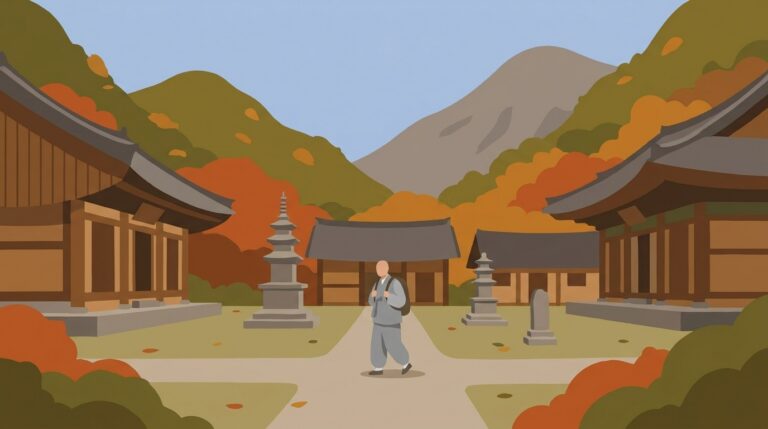
Phase 1: 공감 (Welcome to the Mountain Sanctuary!)
안녕하세요! 매일한글 에디터입니다. (Hello! I’m your Daily Hangul editor.)
Picture this: after hours on a winding bus leaving the neon lights of Seoul behind, you step through the majestic Iljumun (One Pillar Gate) of an ancient mountain temple. The crisp scent of pine needles fills the air, wind chimes sway under wooden eaves, and deep temple bells echo across the misty valley. But the second you step into the registration office, a friendly temple coordinator hands you a folded stack of earthy, oversized garments—a quilted vest and ultra-wide pants called 수련복 (suryeonbok).
Suddenly, your mind races with questions: Wait, does the vest zip up or tie? Which way is front? Why is everyone holding their hands tucked over their belly like ancient scholars? And if a monk walks past right now, am I supposed to bow to the floor or just nod?
One of our intermediate learners, Mark, once shared how he accidentally wore his temple vest inside-out and did a sharp 90-degree corporate business bow to a Buddhist nun, making everyone chuckle warmly. Going to a temple stay is one of the most rewarding healing experiences in Korea, but walking into a silent, ritual-rich environment can trigger instant culture shock.
Don’t worry! In this guide, built directly on real feedback from international travelers and temple hosts, you’ll master essential B1-level Korean phrases to navigate arrival, change into your temple clothing comfortably, and practice peaceful monastic etiquette with natural poise and confidence.
Phase 2: 핵심 표현 3선 심층 분석 (3 Core Expressions)
1. 수련복으로 갈아입으시면 돼요. (Suryeonbogeuro gara-ibeusimyeon dwaeyo.)
- Pronunciation: [Su-ryeon-bo-geu-ro ga-ra-i-beu-si-myeon dwae-yo] (Sounds like: soo-ryun-boh-geu-roh gah-rah-ee-beu-she-myun dweh-yo)
- Meaning: Literal: “You can change into the practice clothing.” | Nuance: A gentle, polite instruction commonly spoken by temple coordinators when assigning your room.
- K-Culture Moment: In travel variety shows like 2 Days & 1 Night or healing vlog series, guests are handed baggy grey outfits upon arrival and told this exact line before their retreat begins.
- Editor’s Insight: The grammar
-시면 돼요(-si-myeon dwaeyo) is a staple B1 pattern. Rather than commanding you with-십시오(-sip-sio), it politely softens the direction: “All you need to do is [action].” - Situation Spectrum: Casual: ⚠️ | Semi-formal: ✅ | Formal: ✅
- 🤔 Think About It: Notice how Korean instructions prioritize communal harmony and politeness by framing directives as gentle possibilities rather than stark rules.
2. 손을 모으고 차수를 해 주세요. (Soneul moeugo chasureul hae juseyo.)
- Pronunciation: [So-neul mo-eu-go cha-su-reul hae ju-se-yo] (Sounds like: so-nool moh-oo-goh chah-soo-rool heh joo-seh-yoh)
- Meaning: Literal: “Please bring your hands together and do chasu.” | Nuance: An instruction to adopt the respectful, mindful hand-clasp posture used when walking in temple courtyards.
- K-Culture Moment: Often heard during the temple orientation (오리엔테이션) when staff demonstrate temple physical mindfulness.
- Editor’s Insight: 차수 (chasu) refers to placing your right hand gently over your left hand resting at your lower abdomen (navel level). Asking someone to do this with
-해 주세요strikes the perfect balance of temple decorum and warmth. - Situation Spectrum: Casual: 🚫 | Semi-formal: ✅ | Formal: ✅
- 🤔 Think About It: Why does Korean culture emphasize body posture as a reflection of inner mindset? How does physical posture alter your verbal tone?
3. 합장하고 반배로 인사드려요. (Hapjanghago banbaero insadeuryeoyo.)
- Pronunciation: [Hap-jang-ha-go ban-bae-ro in-sa-deu-ryeo-yo] (Sounds like: hahp-jahng-hah-goh bahn-beh-roh een-sah-deu-ryuh-yoh)
- Meaning: Literal: “We greet by putting palms together and making a half-bow.” | Nuance: The fundamental Buddhist greeting used whenever you cross paths with monastics or fellow practitioners.
- K-Culture Moment: Seen in historical dramas (Sageuk) and modern K-Dramas whenever characters seek refuge in tranquil mountain hermitages.
- Editor’s Insight: Hapjang (합장) means pressing both palms together in front of your chest to symbolize unified mind and respect, while banbae (반배) is a waist bow of about 60 degrees.
- Situation Spectrum: Casual: ⚠️ | Semi-formal: ✅ | Formal: ✅
- 🤔 Think About It: In Western greetings, handshakes bridge space through physical touch. In Korean temple culture, space is honored without contact. What does keeping physical distance communicate in sacred spaces?
Phase 3: 교과서 한국어 vs 진짜 한국어 (Textbook vs. Real Korean)
Situation 1: Inquiring about clothing size adjustments
- 📖 교과서 한국어: 의복 치수가 작으니 교환을 요청합니다. (Uibok chisuga jageuni gyohwaneul yocheonghamnida. – “The clothing size is small, so I request an exchange.”)
- 🗣️ 진짜 한국어: 혹시 바지가 조금 작은데 한 치수 큰 걸로 바꿀 수 있을까요? (Hoksi bajiga jogeum jageunde han chisu keun geollo bakkul su isseulkkayo? – “By any chance, the pants are a bit tight; could I switch to one size larger?”)
- 💡 왜 다를까?: Real speakers rarely use stiff terms like
의복(garments) or요청합니다(I demand/request). Natural Korean uses hedging adverbs like혹시(by any chance) and soften requests with-을 수 있을까요?.
Situation 2: Asking where to take off your shoes
- 📖 교과서 한국어: 신발을 이곳에 탈의합니까? (Sinbareul igose taruihamnikka? – “Do I disrobe my footwear here?”)
- 🗣️ 진짜 한국어: 신발은 여기에 벗어두고 들어가면 되나요? (Sinbareun yeogie beoseodugo deureogamyeon doenayo? – “Should I take off my shoes here and head inside?”)
- 💡 왜 다를까?:
탈의is medical/bureaucratic vocabulary. Everyday Koreans use compound descriptive verbs like벗어두다(take off and place) combined with the comfortable confirmation-면 되나요?.
Phase 4: K-Culture 딥다이브 & 비언어적 매너 (Deep Dive & Non-Verbal Manners)
4-1. 눈치 (Nunchi) & Temple Body Language
- The Chasu Posture (차수): Whenever you are walking across temple grounds or standing in communal halls, avoid swinging your arms or shoving your hands into your pockets. Rest your right hand gently over your left hand right above your belly button. Walking quietly with chasu displays immediate nunchi (cultural tact).
- Threshold Etiquette (문턱 주의): Traditional temple doors have raised wooden thresholds (munteok). Never step directly on top of the threshold; always step completely over it. Stepping on it is traditionally believed to bring bad luck and damages the wooden frame.
- Low and Mindful Voice: Temples are quiet healing domains. Keep your vocal projection at 30% volume. Whispering or gentle mid-tones show respect for meditators.
4-2. Cultural Code: The Healing Power of “Temple Stay”
In high-stress Korean society, temple stays transitioned from purely religious pilgrimages into a beloved nationwide cultural phenomenon for burnt-out city dwellers. Variety shows like Hyori’s Homestay and YouTube healing vlogs regularly highlight the restorative nature of swapping skinny jeans and smartphones for loose cotton suryeonbok. When you put on the uniform, social status, corporate job titles, and fashion competitions evaporate—everyone becomes an equal traveler seeking calm.
Phase 5: 실전 롤플레이 시나리오 (Real-World Roleplay)
Setting: The registration hall at Woljeongsa Temple. Alex (an international guest) meets Bosal-nim (the temple stay manager).
- 보살님 (Bosal-nim): 어서 오세요! 템플스테이 예약하신 알렉스 님 맞으시죠? (Eoseo oseyo! Tempeulseutei yeyakhasin Allekseu nim majeosijo?)
🎭 Warmly bowing with a gentle smile and checking the guest roster. - 알렉스 (Alex): 네, 맞아요. 안녕하세요! (Ne, majayo. Annyeonghaseyo!)
🎭 Politely nodding with a slight bow. - 보살님 (Bosal-nim): 반갑습니다. 먼저 이 수련복으로 갈아입으시면 돼요. 조끼랑 바지예요. (Bangapseumnida. Meonjeo i suryeonbogeuro gara-ibeusimyeon dwaeyo. Jokkirang bajiyeyo.)
🎭 Hands over a neatly folded set of grey cotton clothing. - 알렉스 (Alex): 감사합니다. 짐은 방에 두고 바로 나오면 될까요? (Gamsahamnida. Jimeun bange dugo baro naomyeon doelkkayo?)
🎭 Taking the clothes carefully with both hands. - 보살님 (Bosal-nim): 네, 10분 뒤에 대웅전 앞마당에서 사찰 예절 안내가 시작돼요. (Ne, sip-bun dwie daeungjeon ammadang-eseo sachal yejeol annaega sijakdwaeyo.)
🎭 Pointing towards the courtyard path. - 알렉스 (Alex): 혹시 절 안에서 걸어 다닐 때 지켜야 할 규칙이 있나요? (Hoksi jeol aneseo georeo danil ttae jikyeoya hal gyuchigi innayo?)
🎭 Speaking softly with genuine curiosity. - 보살님 (Bosal-nim): 도량에서는 두 손을 배 앞에 모으는 ‘차수’를 하고 조용히 걸으시면 됩니다. (Doryang-eseoneun du soneul bae ape moeuneun ‘chasu’reul hago joyonghi georeusimyeon doemnida.)
🎭 Demonstrating the hand posture over her abdomen. - 알렉스 (Alex): 아, 이렇게 손을 모으는 거군요. 잘 배웠습니다! (A, ireoke soneul moeuneun geogunyo. Jal baewosseumnida!)
🎭 Carefully mirroring the posture and smiling.
🔀 Interactive Choice Point
You changed into your clothes, but you realize the waist elastic on the pants is excessively loose and keeps sliding down. What do you do?
- Option A: Silently roll the waistband three times and suffer through the walking meditation without saying anything.
- Option B: Run loudly across the yard shouting, “저기요! 옷이 너무 커요!” (Jeogiyo! Osi neomu keoyo! – Hey! The clothes are too big!)
- Option C: Calmly walk up to Bosal-nim, make a slight half-bow, and politely say: “저, 보살님, 바지가 조금 커서 그런데 혹시 작은 사이즈로 바꿀 수 있을까요?” (Jeo, Bosal-nim, bajiga jogeum keoseo geureonde hoksi jageun sa-ijeuro bakkul su isseulkkayo?)
Feedback:
- Option A (Risk): You will spend your whole weekend pulling up your pants during prostrations. Temple staff are extremely accommodating; it’s okay to ask!
- Option B (Bad): Breaking temple silence and using blunt language disturbs the peaceful atmosphere.
- Option C (Best!): Perfect! It combines proper respectful honorifics, quiet tone, and natural Korean phrasing.
Phase 6: 10초 감정 섀도잉 드릴 (10-Second Emotion Shadowing Drill)
Practice reading these out loud. Pay special attention to the pause slashes (/) and emotional cues:
[😊 차분하고 예의 바르게 / Calm and respectful]
수련복으로 / 갈아입고 / 금방 나오겠습니다.
(Suryeonbogeuro / gara-ipgo / geumbang naogesseumnida.)
“I will change into the practice clothes / and come right out.”-
[🧘 고요하고 조심스럽게 / Quiet and mindful]
절에서는 / 항상 차수를 하고 / 조용히 걸어요.
(Jeoreseoneun / hangsang chasureul hago / joyonghi georeoyo.)
“In the temple / we always keep our hands in chasu / and walk quietly.” -
[🙏 진심 어린 감사를 담아 / Sincere and appreciative]
사찰 예절을 / 친절하게 가르쳐 주셔서 / 감사합니다.
(Sachal yejeoreul / chinjeolhage gareuchyeo jusyeoseo / gamsahamnida.)
“Thank you / for kindly teaching me / temple etiquette.”
Phase 7: K-Culture 미니 사전 (Mini Dictionary)
- 수련복 (Suryeonbok) – Practice Uniform
Meaning: The loose cotton vest (jokki) and wide-leg trousers (baji) provided by temples. They are designed to allow blood circulation during long seated meditation and deep prostrations. - 차수 (Chasu) – Mindful Hand Posture
Meaning: The traditional walking posture where your right hand wraps around the left hand over your lower dantian/abdomen. It prevents unnecessary arm swinging and fosters calm focus. - 합장 (Hapjang) – Clasping Palms
Meaning: Placing both hands flat against each other before the chest. In Buddhist philosophy, it signifies collecting scattered thoughts and uniting duality into one peaceful mind. - 방사 (Bangsa) – Temple Lodging Room
Meaning: The assigned traditional sleeping quarters in a temple stay, often equipped with traditional ondol (underfloor heating) and sleeping mats (yo).
Phase 8: 여행자를 위한 생존 키트 (Traveler’s Survival Kit)
Top 3 Survival Phrases
- 혹시 더 큰 / 작은 사이즈 있어요? (Hoksi deo keun / jageun sa-ijeu isseoyo?)
Pro Tip: Use this right after receiving your suryeonbok if the shoulders or waist feel uncomfortable. - 공양 시간은 몇 시예요? (Gongyang siganeun myeot siyeyo?)
Pro Tip: Gongyang means monastic meals. Meals start promptly on the dot; missing the bell means missing dinner! - 신발은 방 앞에 두면 되나요? (Sinbareun bang ape dumyeon doenayo?)
Pro Tip: Helpful when checking into your bangsa (room) to confirm shoe alignment etiquette.
Editor’s Travel Note
- Booking: Make official reservations ahead of time via the Official Korean Temple Stay Reservation Portal to secure English-guided programs.
- Navigation: Google Maps often fails to provide walking paths in remote mountain temples. Be sure to rely on the Naver Map Navigation App for precise bus timetables and bus stop names.
- Packing Essentials: Pack plain white or dark socks without cartoon characters. Walking barefoot inside prayer halls (Daeungjeon) is considered impolite, so clean socks are mandatory even in summer.
Phase 9: “한 발 더 깊이” (Cultural Reflection)
In contemporary life, we express identity through our attire, loud opinions, and constant digital connectivity. Entering a Korean temple and donning the identical, baggy suryeonbok strips away these external markers. When everyone wears the same simple vest and adopts the quiet posture of chasu, social hierarchies vanish. This deliberate uniformity is not meant to suppress individuality, but to provide a rare sanctuary where your mind can finally stop performing for others.
💬 Your Turn: Have you ever experienced a place where simple body postures or special clothes instantly changed your mood? Would wearing loose temple clothes feel freeing or unfamiliar to you? Share your thoughts below!
Phase 10: FAQ & 흔한 실수 (FAQ & Common Mistakes)
Q: Can I wear my own clothes instead of the suryeonbok?
A: Most temples require you to wear the provided vest and pants during all official schedules (meals, ceremonies, meditation). However, you can wear a comfortable plain T-shirt underneath your vest, and you can wear your regular sleepwear inside your private room at night.
Q: How should I address temple staff and monks?
A: Address Buddhist monks as 스님 (Seu-nim). Female temple coordinators and lay volunteers are warmly addressed as 보살님 (Bo-sal-nim), and male coordinators as 거사님 (Geo-sa-nim).
Q: What if I have physical trouble sitting on the floor or bowing?
A: Temples are compassionate spaces! Simply inform the coordinator during orientation: “무릎이 조금 아파서 절하기가 힘들어요” (Mureupi jogeum apaseo jeolhagiga himdeureoyo – My knees hurt a bit, so bowing is difficult). They will provide a meditation cushion or allow a standing bow.
🚨 흔한 실수 (Common Mistakes Warning Board)
- Stepping on the temple door threshold (문턱): Always step over it, never plant your foot on top.
- Walking barefoot in halls: Always wear socks inside Buddha halls. Keep a spare pair in your pocket.
- Entering through the main central door of Buddha halls: The central door (Eodo) is reserved for monastics. Guests enter through the side doors (Sindo-mun), taking off their shoes neatly outside.
Phase 11: 액션 미션 (Action Missions)
- 🥉 Bronze Mission: Stand in front of your mirror right now. Place your right hand over your left hand on your belly button (chasu), take three deep mindful breaths, and whisper:
"절에서는 차수를 해요." (Jeoreseoneun chasureul haeyo.) - 🥈 Silver Mission: Write down our three Phase 2 expressions on your phone’s memo pad and record your voice reading them using your best gentle, respectful tone.
- 🥇 Gold Mission: When visiting a temple or attending an Asian cultural exhibit, practice greeting someone with hapjang (palms together) and a 60-degree half-bow while saying:
"반갑습니다, 스님!" - 🎮 K-Culture Mission: Search YouTube for a Korean Temple Stay vlog (search keyword:
템플스테이 브이로그). Spot the moment the creator changes into suryeonbok and leaves their shoes at the room entrance!
Phase 12: 인터랙티브 퀴즈 챌린지 (Quiz Challenge)
Question 1: Situational Judgment
You are walking toward the dining hall (Gongyang-gan) and you see a monk walking toward you in the corridor. What is the most polite action?
* A) Wave your hand high and say loudly, “안녕하세요!”
* B) Stop walking, put your palms together in hapjang, and make a quiet half-bow (banbae).
* C) Freeze in place, look at your shoes, and ignore them until they pass.
Question 2: Fill in the Blank
When walking peacefully across temple grounds, you should fold your right hand over your left on your stomach. This posture is called:
* “도량에서는 손을 모으는 ( )를 해야 합니다.”
Question 3: True or False
Inside traditional temple halls, it is totally acceptable to walk barefoot as long as the weather is hot.
* [ True / False ]
👉 Click to reveal answers & explanations!
-
Answer: B
Explanation: Whenever passing a monk or fellow practitioner, step slightly to the side, bring your palms together in hapjang, and bow at the waist (banbae). -
Answer: 차수 (Chasu)
Explanation: 차수 (chasu) is the core physical etiquette of mindful walking in Korean Buddhism. -
Answer: False
Explanation: Wearing clean socks is an essential sign of respect in temple Buddha halls year-round; bare feet are considered inappropriate.







