

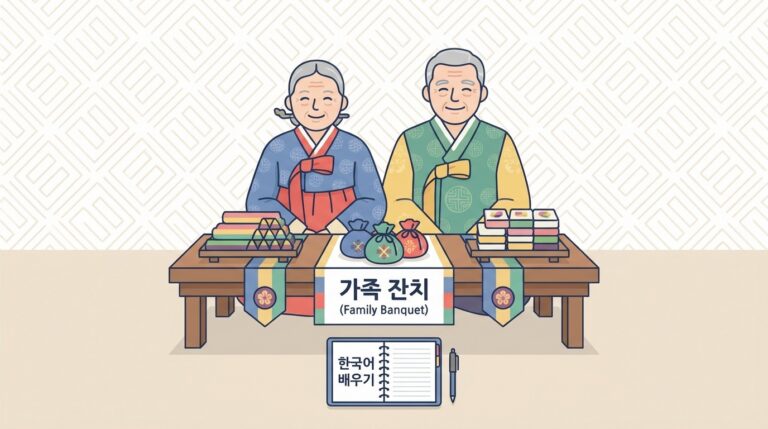
Phase 1: Empathy & Storytelling Opening
안녕하세요! 매일한글 에디터입니다. (Hello! This is your Daily Hangul editor.)
Imagine this scenario: your close Korean coworker or university buddy hands you a pearlescent invitation card. It is not for a standard Friday night birthday bash at a Hongdae pub. Instead, it is an invitation to their baby’s 돌잔치 (Doljanchi – 1st birthday party) or their mother’s 환갑 (Hwangap – 60th birthday) banquet at a grand traditional restaurant.
You walk into the banquet hall. Grandparents are dressed in glowing silk Hanboks, an altar is piled high with decorative rainbow rice cakes and fresh fruit, and an aura of deep reverence fills the air. You look around, panic sets in, and you wonder: “Do I just say 생일 축하해요 (Happy birthday)? Do I bow? What does all this even mean?”
In Western cultures, turning 1 or turning 60 is special, but in Korean culture, these are foundational life milestones steeped in centuries of survival, ancestral gratitude, and community bonding. Knowing the cultural heartbeat behind these milestones transforms your presence from a polite foreign spectator into genuine family (식구, shik-gu).
This guide was built directly from real experiences of our international students who felt intimidated by Korean family milestones. By mastering these cultural greetings, you won’t just offer polite words—you will touch the hearts of your Korean friend and their entire family on an unforgettable day.
Phase 2: Core Expressions Deep Dive
1. 첫 번째 생일을 진심으로 축하해요 (Cheot beonjjae saeng-ireul jinsimeuro chukahaeyo)
- Pronunciation: [Cheot beon-jjae saeng-ee-reul jin-sheem-eu-ro choo-kah-hae-yo] (Think: “Chut” like ‘shut’ + “bun-jae” + “sang-ear-rule” + “jin-sheem” + “choo-kah-hae-yo”)
- Meaning: Literal: “I sincerely congratulate [the baby’s] first birthday.” / Nuance: “Wishing health, long life, and endless blessings to your child.”
- K-Culture Moment: You will hear this in almost every family K-drama where relatives gather around a baby wearing a colorful dol-hanbok before the main celebration begins.
- Editor’s Insight: You are not saying this to the baby directly (who won’t understand), but to the proud parents. Adding “진심으로 (sincerely)” adds warmth and emotional weight that standard textbook Korean lacks.
- Situation Spectrum: Casual: ⚠️ | Semi-formal: ✅ | Formal: ✅
- 🤔 Think About It: In many Western birthdays, wishes focus on personal fun (“Have a blast!”). Why do Korean first birthday blessings focus heavily on gratitude and survival?
2. 환갑을 진심으로 축하드립니다. 항상 건강하세요 (Hwangabeul jinsimeuro chukadeurimnida. Hangsang geonganghaseyo)
- Pronunciation: [Hwan-gahb-eul jin-sheem-eu-ro choo-kah-deu-reem-nee-dah. Hahng-sahng gun-gahng-hah-seh-yo]
- Meaning: Literal: “I sincerely congratulate your Hwangap. Please always be healthy.” / Nuance: “Honoring your long, fruitful life journey, and wishing you vibrant longevity.”
- K-Culture Moment: Seen in dramas like Reply 1988 when the neighborhood unites to honor an elder who has weathered hard decades to raise children.
- Editor’s Insight: Notice the verb 축하드립니다 (chukadeurimnida). Because you are addressing someone turning 60, using 축하해요 sounds too informal. Always upgrade to the honorific “드리다 (deurida)” for elders.
- Situation Spectrum: Casual: 🚫 | Semi-formal: ⚠️ | Formal: ✅
- 🤔 Think About It: Why does East Asian culture celebrate reaching age 60 specifically as completing a cosmic calendar cycle?
3. 오래오래 건강하고 행복하세요 (Orae-orae geonganghago haengbokhaseyo)
- Pronunciation: [Oh-rae-oh-rae gun-gahng-hah-go haeng-bok-hah-seh-yo] (Sound rhythm: say “oh-rae” twice with a gentle bounce, like saying ‘long, long’)
- Meaning: Literal: “Please be healthy and happy for a long, long time.” / Nuance: “May you live a blessed, peaceful, and joy-filled life surrounded by loved ones.”
- K-Culture Moment: The heartwarming climax of a 70th (칠순, Chilsun) or 80th (팔순, Palsun) celebration when sons, daughters, and grandchildren bow deeply before the table.
- Editor’s Insight: Repeating “오래 (long)” as “오래오래” softens the imperative into a warm, heartfelt prayer. It is universally cherished by Korean elders.
- Situation Spectrum: Casual: ⚠️ | Semi-formal: ✅ | Formal: ✅
- 🤔 Think About It: How does your native language express wishes for longevity without sounding like you are reminding someone of their old age?
Phase 3: Textbook Korean vs. Real Korean
Situation 1: Congratulating the parents at a 1st Birthday (Doljanchi)
- 📖 교과서 한국어 (Textbook):
아기의 첫 돌을 축하합니다. (Agiui cheot doreul chukahamnida.) — “Congratulations on the baby’s first birthday.” - 🗣️ 진짜 한국어 (Real-Life Native):
아이가 너무 예뻐요! 1년 동안 키우시느라 정말 고생 많으셨어요. (Aiga neomu yeppeoyo! Il-nyeon dongan kiusineura jeongmal gosaeng maneusyeosseoyo.) — *”The baby is so adorable! You worked so hard raising them through this first year.” - 💡 왜 다를까? (Cultural Insight):
A Doljanchi honors the baby, but native Koreans know the true heroes are the parents who survived sleep deprivation. Recognizing their labor (고생 많으셨어요) builds an instant, deeply empathetic bond.
Situation 2: Greeting an elder at a 60th (Hwangap) or 70th (Chilsun) banquet
- 📖 교과서 한국어 (Textbook):
환갑을 축하드립니다, 할머니. (Hwangabeul chukadeurimnida, halmeoni.) — “Congratulations on your 60th birthday, grandmother.” - 🗣️ 진짜 한국어 (Real-Life Native):
어머님, 환갑 축하드려요! 여전히 너무 젊고 고우세요. (Eomeonim, hwangap chukadeuryeoyo! Yeojeonhi neomu jeolmgko gouseyo.) — *”Congratulations on your Hwangap, Mother! You still look so young and elegant.” - 💡 왜 다를까? (Cultural Insight):
Calling an active 60-year-old “grandmother” (할머니) can feel prematurely aged in modern South Korea. Today, 60 is considered young! Complimenting their youthful grace (고우세요) brings instant smiles.
Phase 4: K-Culture Deep Dive & Non-Verbal Manners
4-1. Nunchi (눈치) & Body Language Checklist
- The Envelope Hand-off (축의금 봉투 전달): Never hand congratulatory cash envelopes with one hand. Hold the envelope with both hands, elbows slightly tucked in, bowing your head 15 to 30 degrees. The recipient’s name goes on the front, while your name and affiliation go vertically on the lower-left back of the envelope.
- Doljabi Energy (돌잡이 호응): During the Doljanchi, the baby is placed before items like thread (longevity), money (wealth), pencil (scholarship), or microphone (entertainer). When the baby reaches out, lean forward and clap enthusiastically! Shouting “우와~!” shows your genuine investment in the family’s future.
- Seating Nunchi: Do not sit in the front center tables near the celebration altar. Those seats are reserved for immediate family and direct elders. Find a seat in the guest zone and wait for the hosts to invite you up for photos.
4-2. Cultural Code Analysis: The Meaning of Hwangap & Doljanchi
In ancient Korea, high infant mortality meant that surviving your first 365 days was a miraculous victory worth a massive village feast. Similarly, reaching 60 years meant completing the 60-year sexagenary cycle (간지, Ganji) of the Chinese zodiac—a rare sign of longevity.
Today, with Korea’s life expectancy exceeding 83 years, Hwangap is rarely a quiet somber ritual. Instead, it is celebrated with lively family dinners, luxury hotel buffets, custom photo banners (현수막), and flower-and-cash gift boxes (용돈박스). Understanding this evolutionary shift helps you participate with celebratory lightness rather than solemn tension.
Phase 5: Real-World Roleplay Scenario
- Location: A traditional Korean banquet hall in Insadong, Seoul.
- Characters:
- 민호 (Minho): Your close Korean friend.
- 어머님 (Minho’s Mother): The guest of honor celebrating her 60th birthday (Hwangap).
- You (Learner): Attending your first Korean family milestone party.
민호: 와, 와줘서 진짜 고마워! 우리 엄마 저기 계셔. 인사하러 가자!
(Wa, wajwoseo jinjja gomawo! Uri eomma jeogi gyesyeo. Insahareo gaja!)
“Wow, thank you so much for coming! My mom is over there. Let’s go greet her!”
🎭 Minho guides you toward a beautifully decorated table.
You: 민호야, 떨린다. 어머니께 예의 바르게 인사할게.
(Minhoya, tteollinda. Eomeonikke ye-ui bareuge insahalge.)
“Minho, I’m nervous! I’ll greet your mother respectfully.”
어머님: 어머, 민호 친구분이시구나! 바쁠 텐데 와줘서 정말 고마워요.
(Eomeo, Minho chingubunisiguna! Bappeul tende wajwoseo jeongmal gomawoyo.)
“Oh my, you must be Minho’s friend! Thank you so much for coming when you must be busy.”
🎭 She smiles warmly with hands clasped in front of her.
You: 어머님, 초대해 주셔서 감사합니다. 환갑을 진심으로 축하드립니다!
(Eomeonim, chodaehae jusyeoseo gamsahamnida. Hwangabeul jinsimeuro chukadeurimnida!)
“Mother, thank you for inviting me. I sincerely congratulate your 60th birthday!”
🎭 You bow respectfully at 30 degrees while speaking.
어머님: 고마워요! 한국말을 참 예쁘게 잘하네. 식사는 입에 맞으려나 모르겠어요.
(Gomawoyo! Hangukmareul cham yeppeuge jalhane. Siksaneun ibe majeuryeona moreugesseoyo.)
“Thank you! You speak such lovely Korean. I hope the banquet food suits your taste.”
You: 오늘 주인공이신데 정말 너무 고우세요! 항상 건강하세요.
(Oneul juingong-isinde jeongmal neomu gouseyo! Hangsang geonganghaseyo.)
“You are the star of today and look so elegant! Please always stay healthy.”
민호: 엄마, 내 친구 센스 대박이지?
(Eomma, nae chingu sense daebagiji?)
“Mom, doesn’t my friend have incredible manners?”
어머님: 호호, 정말 그렇네. 얼른 편한 자리 잡고 많이 들어요!
(Hoho, jeongmal georeonne. Eolleun pyeonhan jari japgo mani deureoyo!)
“Hoho, absolutely! Go grab a comfortable seat and eat plenty!”
🔀 Interactive Decision Point (Turn 9)
How will you hand over your congratulatory gift envelope (축의금) to Minho’s mother?
- Option A: Present the crisp white envelope using both hands with a gentle bow, saying: “어머님, 약소하지만 축하의 마음입니다.” (Mother, it is a small gesture, but it comes from my heart).
- Feedback [Best]: Perfect 100%! Showing humility through “약소하지만” (modest though it is) paired with two hands melts Korean elders’ hearts instantly.
- Option B: Pull out cash notes directly from your wallet and say: “생일 축하해요, 아줌마! 이거 받으세요!” (Happy birthday, Ajumma! Take this!)
- Feedback [Bad]: Social disaster! Handing naked cash without an envelope is considered crude, and calling a friend’s mother “Ajumma” instead of “Eomeonim” sounds disrespectful.
- Option C: Shove the envelope into Minho’s jacket pocket casually and say: “야, 민호야, 너한테 줄게.” (Hey Minho, I’ll just give it to you).
- Feedback [Risk]: Not catastrophic, but a missed opportunity. Elders love when guests greet them personally. Passing it secretly to your friend ignores the guest of honor.
Phase 6: 10-Second Emotion Shadowing Drill
Practice reading these out loud by matching the emotional pace and following the pause markers (/):
[✨ Warm & Earnest Tone]
어머님, / 환갑을 진심으로 축하드립니다. / 항상 건강하세요!
(Eomeonim, / hwangabeul jinsimeuro chukadeurimnida. / Hangsang geonganghaseyo!)-
[👶 Sparkly & Loving Tone]
돌잡이로 마이크를 잡았네요! / 나중에 멋진 사람이 될 거예요.
(Doljabiro maikeureul jabanneyo! / Najunge meotjin sarami doel geoyeyo.)
(The baby picked the microphone! They will become an amazing person.) -
[👏 Admiring & Bright Tone]
오늘 파티의 주인공이신데, / 한복이 정말 너무 잘 어울리세요!
(Oneul patiui juingong-isinde, / hanbogi jeongmal neomu jal eoulliseyo!)
(You are the star of today’s party, and your Hanbok suits you so beautifully!)
Phase 7: K-Culture Mini Dictionary
- 돌잡이 (Doljabi)
Meaning: The highlight fortune-telling ritual of a Korean first birthday. The baby is encouraged to pick an object that traditionally forecasts their future career and destiny. - 축의금 (Chuk-uigum)
Meaning: Congratulatory monetary gifts placed inside sealed envelopes. Gifted at weddings, Doljanchi, and milestone birthdays. - 환갑 / 칠순 (Hwangap / Chilsun)
Meaning: Hwangap celebrates the 60th birthday (turning 61 in traditional counting); Chilsun celebrates the 70th milestone. Both represent generational triumphs. - 답례품 (Dangnyepum)
Meaning: Return favors provided by the host family to thank every departing guest. Common items include custom hand towels, handcrafted salt, or premium rice cakes.
Phase 8: Traveler’s Survival Kit
Survival Expressions TOP 3
- 1. 초대해 주셔서 감사합니다 (Chodaehae jusyeoseo gamsahamnida)
Translation: Thank you for inviting me.
Pro Tip: Use this sentence the very second you make eye contact with your host. - 2. 식사가 정말 맛있어요 (Siksaga jeongmal masisseoyo)
Translation: The food is truly delicious.
Pro Tip: Hosts worry constantly about whether guests enjoyed the banquet food. Reassuring them shows deep empathy. - 3. 사진 한 장 찍어 드릴까요? (Sajin han jang jjigeo deurilkkayo?)
Translation: Shall I take a photo for you?
Pro Tip: Offer this to family groups standing in front of floral backdrops. You will immediately become the favorite guest.
Editor’s Travel Note: Practical Milestone Survival
- Finding Cash Envelopes: Need an elegant celebration envelope? Locate any nearby convenience store or stationery boutique via the Naver Map store locator. Ask the clerk: “축의금 봉투 있어요? (Do you have congratulatory cash envelopes?)”
- Envelope Cash Standard: For a close friend’s baby or parent: 50,000 to 100,000 KRW is standard. Crisp new bills withdrawn from an ATM are customary.
- Dress Code: Smart casual to semi-formal. Avoid all-black attire (which resembles funeral clothing) and overly neon nightclub wear. Pastel tones, blazers, and tidy shirts are ideal.
Phase 9: One Step Deeper (Cultural Reflection)
In Korean society, a birthday is rarely an individualistic celebration of “Look at me, it’s my special day.” Instead, family milestones are collective milestones of endurance, gratitude, and communal responsibility. When a child reaches their first birthday, the community honors the shared labor of the parents. When an elder reaches 60 or 70, the gathering honors the sacrifices made to build a stable home for future generations. When you step into that banquet hall and utter sincere wishes for health and endurance, you weave yourself into Korea’s living web of Jeong (정, deep communal affection).
💬 Your Turn: Have you ever attended a milestone celebration in Korea or your own home country? What is the most memorable tradition you observed? Share your thoughts below!
Phase 10: FAQ & Common Mistakes
Q: How much money should I put in the envelope (축의금) for a friend’s milestone party?
A: If you are an acquaintance or casual coworker attending solo, 50,000 KRW is the baseline polite minimum. For a close friend, 100,000 KRW (or more if attending with a partner) is standard etiquette. Odd-number amounts (3, 5, 7, 10—where 10 counts as complete) reflect positive yin-yang energy in Korean tradition.
Q: What gift should I buy if I don’t want to give cash for a Doljanchi?
A: While cash envelopes and 24K gold baby rings (돌반지) are the standard gifts, stylish baby clothing sets (size 12–18 months) or practical baby skincare gift sets are also warmly welcomed.
Q: If my Korean isn’t fluent, will elders be offended if I freeze up?
A: Absolutely not! Korean elders love seeing international guests participate in family events. Even a simple, two-handed bow and a bright smile saying “축하드립니다! 건강하세요!” will be rewarded with affectionate pats on the shoulder and second helpings of food.
🚨 Common Mistakes Alert
- Mistake: Handing over a crumpled cash note without an envelope.
Correct Action: Always prepare a clean white or silk envelope, write your name vertically on the lower left of the back side, and hand it over with both hands. - Mistake: Dressing in all-black funeral attire or flip-flops.
Correct Action: Wear clean smart-casual clothing with gentle colors to match the joyful celebration. - Mistake: Leaving immediately after eating without taking the return favor (답례품).
Correct Action: The host family prepared return gifts as a sign of mutual gratitude. Accept the 답례품 near the exit with a polite “감사합니다.”
Phase 11: Action Mission & Engagement
- 🥉 Bronze Mission: Practice saying “환갑을 진심으로 축하드립니다. 항상 건강하세요!” three times aloud in front of a mirror with a polite 30-degree bow.
- 🥈 Silver Mission: Write a mock congratulatory message on a notepad or your social media story incorporating today’s key phrase “오래오래 건강하고 행복하세요.”
- 🥇 Gold Mission: When a Korean acquaintance mentions an upcoming family event, surprise them by asking: “이번에 돌잡이 뭐 잡았으면 좋겠어요?” (What do you hope the baby picks during the Doljabi?).
🎮 K-Culture Mission: Watch an episode of a family K-drama (like Once Again or Reply 1988) and spot how family members interact during a birthday feast. Listen for the word 건강 (health)!
Phase 12: Interactive Quiz Challenge
1. Situation Check: You are greeting your Korean friend’s father at his 70th birthday banquet (칠순). Which greeting is the most natural and respectful?
(a) 아저씨, 칠순 축하해! 밥 많이 먹어!
(b) 아버님, 칠순을 진심으로 축하드립니다. 항상 건강하세요!
(c) 칠순 축하합니다. 나중에 술 한잔 사주세요!
2. Fill in the Blank: At a Doljanchi, when wishing for an elder’s or family’s ongoing well-being, we repeat the adverb for ‘long’ to sound affectionate:
“[______][______] 건강하고 행복하세요!”
3. True or False: Handing a congratulatory cash envelope using one hand is completely acceptable as long as you make direct eye contact and smile.
(True / False)
👉 Click to reveal answers & explanations!
- Answer: (b) — Calling a friend’s father 아버님 and using 축하드립니다 along with wishing for his health (항상 건강하세요) is the gold standard of respectful Korean etiquette.
- Answer: 오래오래 (Orae-orae) — Reduplicating 오래 turns it into a warm, rhythmic blessing for long-lasting health and joy.
- Answer: False — Handing anything to an elder—especially money—must always be done using two hands (두 손) to demonstrate genuine respect.







