

Ending the Night Right: Korean Phrases to Wrap Up Parties and Catch the Makcha
Phase 1: Empathy (Story Immersion Opening)
안녕하세요! 매일한글 에디터입니다. (Hello! I am your Daily Hangul editor.)
Picture this: You are at a buzzing pocha (street pub) in Hongdae with Korean friends or colleagues. The table is filled with sizzling grilled pork belly, bubbling kimchi jjigae, and green soju bottles. Everyone just shouted an energetic MZ toast like “Jjambbong!” and the room is full of laughter. But then, you glance down at your smartphone screen. The clock flashes 11:28 PM.
A collective gasp ripples across the table. In Seoul, this is the universal hour of suspense: the countdown to the last subway train. Do you freeze? Do you abruptly stand up and sprint out the door? Or do you awkwardly bow and recite a robotic textbook phrase like “Annyeonghi gasipsio” while everyone else is scrambling to pack their coats?
Many of our beginner learners tell us: “I know how to say hello and cheers, but I never know how to leave without ruining the warm mood!” Leaving a Korean gathering isn’t just about walking out; it’s an art of expressing warmth, making sure nobody is left stranded, and cementing friendships. Today, based on real feedback from international students and travelers, we will master the exact A2-level phrases that will make you sound like a considerate, culturally savvy Korean friend.
Phase 2: Core Expressions Deep Dive
1. 조심히 들어가요! (Josimhi deureogayo!)
- Pronunciation: [Jo-sim-hi deu-reo-ga-yo] (Sounds like “Joe-seem-he dew-ruh-gah-yo”)
- Meaning: Literal: “Enter [your home] carefully!” | Real Nuance: “Get home safe! / Safe travels home!”
- K-Culture Moment: Seen in almost every contemporary K-Drama when two leads part ways at a crosswalk or outside a convenience store under warm streetlights.
- Editor’s Insight: Koreans rarely say “Goodbye” (Annyeong) when parting after an evening out. Instead, they frame the departure around the destination—your home. Saying “deureogayo” (enter safely) acknowledges that someone is traveling back to their safe personal nest.
- Situation Spectrum: Casual (Friends): ⚠️ (Use 조심히 들어가! Josimhi deureoga!) | Semi-formal (Peers/Co-workers): ✅ | Formal (Bosses/Elders): ⚠️ (Use 조심히 들어가세요! Josimhi deureogaseyo!)
- 🤔 Think About It: In English, we often say “Have a good night.” Why do you think Korean specifically focuses on the physical action of entering your home safely?
2. 막차 시간 놓치지 마세요! (Makcha sigan notchiji maseyo!)
- Pronunciation: [Mak-cha si-gan not-chi-ji ma-se-yo] (Think of “Mawk-chah see-gahn no-chee-jee mah-say-yo”)
- Meaning: Literal: “Do not miss the last train time!” | Real Nuance: “Make sure you don’t miss the last train! / Don’t lose track of time!”
- K-Culture Moment: You will hear this echoed by thoughtful friends right around 11:30 PM when everyone checks their subway timetable apps simultaneously.
- Editor’s Insight: Makcha (막차) is composed of Mak (last) + Cha (vehicle/train/bus). In a city where late-night taxis can be tricky to hail during weekend peaks, reminding someone about makcha is a genuine act of care, never considered rude.
- Situation Spectrum: Casual: ⚠️ (Use 막차 놓치지 마! Makcha notchiji ma!) | Semi-formal: ✅ | Formal: ✅ (Very polite and considerate)
- 🤔 Think About It: How does public transit availability shape the night-out etiquette in your hometown compared to Seoul?
3. 집 도착하면 연락해요! (Jip dochakhamyeon yeollakhaeyo!)
- Pronunciation: [Jip do-chak-ha-myeon yeol-lak-hae-yo] (Pronounce like “Jeep doe-chahk-hah-myun yul-lahk-hay-yo”)
- Meaning: Literal: “When you arrive home, contact [me]!” | Real Nuance: “Text me when you get home safe!”
- K-Culture Moment: The classic line exchanged right as two friends separate onto different subway line platforms or before boarding a night bus.
- Editor’s Insight: Note the nasal sound shift in 연락 (spelled yeon-rak, pronounced yeol-lak). Sending a short KakaoTalk message like “도착! (Arrived!)” upon reaching home is standard social etiquette among close friends and dates in Korea.
- Situation Spectrum: Casual: ⚠️ (Use 도착하면 톡해! Dochakhamyeon tok-hae!) | Semi-formal: ✅ | Formal: 🚫 (With senior directors, they usually say this to you, not vice versa)
- 🤔 Think About It: Does sending a post-hangout text feel like an obligation or an expression of affection in your own culture?
Phase 3: Textbook Korean vs. Real Korean
Situation 1: Leaving a gathering before midnight
- 📖 교과서 한국어 (Textbook): 안녕히 가십시오. (Annyeonghi gasipsio. – “Please depart in peace.”)
- 🗣️ 진짜 한국어 (Real-life): 오늘 너무 즐거웠어요! 조심히 들어가세요! (Oneul neomu jeulgeowosseoyo! Josimhi deureogaseyo! – “I had so much fun today! Get home safely!”)
- 💡 왜 다를까? (Why is it different?): Annyeonghi gasipsio is ultra-formal, rarely heard outside of department store announcements or formal hotel desks. Saying it at a dinner gathering creates unnecessary emotional distance.
Situation 2: Urging friends to leave for public transit
- 📖 교과서 한국어 (Textbook): 마지막 열차 시간이 임박했습니다. (Majimak yeolcha sigani imbakhaessumnida. – “The final train time is imminent.”)
- 🗣️ 진짜 한국어 (Real-life): 벌써 막차 시간이에요! 얼른 가요! (Beolsseo makcha sigan-ieyo! Eolleun gayo! – “It’s already last-train time! Let’s hurry!”)
- 💡 왜 다를까? (Why is it different?): Real Koreans use the contracted everyday term 막차 (makcha) rather than the formal 마지막 열차 (majimak yeolcha). Pairing it with 얼른 (eolleun – quickly/hurry) conveys friendly urgency.
Phase 4: K-Culture Deep Dive & Non-Verbal Manners
4-1. 눈치 (Nunchi) & Parting Body Language
When the clock nears 11:30 PM, social radar (nunchi) is essential:
1. The Subtle Transit Check: Do not stare at your phone midway through someone’s story. Instead, take out your phone when someone else reaches for water or during a toast break, check your transit route, and softly put it face down.
2. The Half-Standing Bow: When announcing your departure, do not bolt upright. Place your napkin down, gather your bag onto your lap, slightly incline your upper body forward, and place both hands politely near your thighs or chest.
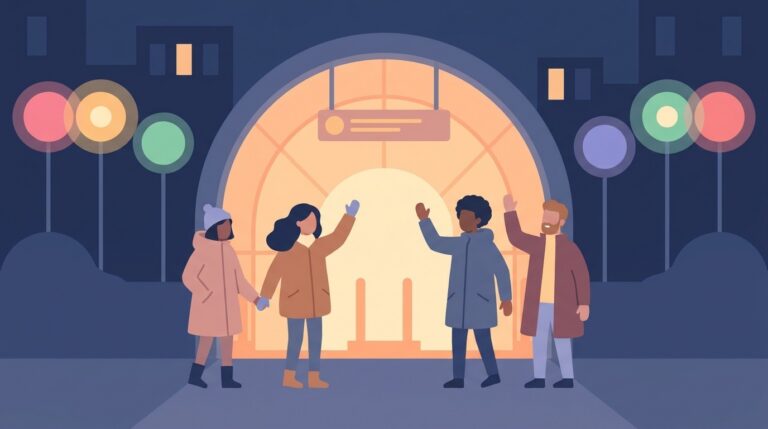
3. The Two-Handed Wave: At the subway turnstile, turn around and give a gentle two-handed wave before scanning your transit card. It shows you aren’t rushing just to escape their presence!
4-2. Cultural Code: The Sacred Mystery of “Makcha (막차)”
In Seoul and major metropolitan areas, subways begin wrapping up between midnight and 12:40 AM depending on the terminal station. Missing the makcha means two options: staying out until the first morning train (cheotcha, 첫차) around 5:30 AM, or fighting for late-night taxis alongside thousands of revelers. Because of this, “막차 타야 돼요! (I have to catch the last train!)” is considered an unbreakable, universally respected hall pass in Korean socializing. No host or manager will fault you for running to catch your train.
Phase 5: Real-Life Roleplay Scenario
Setting: A pocha near Hongdae Station, 11:35 PM. Glasses are being cleared, and the bill is about to be split (N-bbang).
Characters:
* Minji (민지): Warm, energetic Korean peer organizer.
* Alex (알렉스): Foreign exchange student (Target Level: A2).
- Turn 1 (Minji): 벌써 11시 반이네요! 시간 진짜 빠르다! (Beolsseo yeol-han-si ban-i-ne-yo! Sigan jinjja ppareuda!)
🎭 Checking her watch with round eyes.-> “It’s already 11:30! Time flies so fast!” - Turn 2 (Alex): 와, 벌써요? 저 지하철 막차 타야 돼요! (Wa, beolsseoyo? Jeo jihacheol makcha taya dwaeyo!)
🎭 Looking slightly startled and putting on his jacket.-> “Wow, already? I need to catch the last subway train!” - Turn 3 (Minji): 맞아요, 알렉스 씨 집 멀잖아요. 얼른 챙겨요! (Majayo, Alex ssi jip meoljanayo. Eolleun chaenggyeoyo!)
🎭 Handing Alex his scarf with a supportive smile.-> “Right, your home is far, Alex. Hurry and pack your things!” - Turn 4 (Alex): 오늘 초대해 줘서 정말 즐거웠어요. (Oneul chodaehae jwoseo jeongmal jeulgeowosseoyo.)
🎭 Giving a polite, friendly nod to the table.-> “Thank you for inviting me today, I had so much fun.” - Turn 5 (Minji): 저도요! 다음 주에 또 봐요. 막차 놓치지 마세요! (Jeodoyo! Daeum jue tto bwayo. Makcha notchiji maseyo!)
🎭 Clapping hands together warmly.-> “Me too! See you next week. Don’t miss the last train!” - Turn 6 (Alex): 네! 민지 씨도 조심히 들어가요! (Ne! Minji ssido josimhi deureogayo!)
🎭 Waving goodbye with both hands.-> “Yes! You get home safely too, Minji!” - Turn 7 (Minji): 고마워요! 집 도착하면 꼭 카톡 연락해요! (Gomawoyo! Jip dochakhamyeon kkok katok yeollakhaeyo!)
🎭 Pretending to type on an imaginary phone screen.-> “Thanks! Definitely text on KakaoTalk when you get home!” - Turn 8 (Alex): 네, 도착해서 바로 연락할게요! 안녕히 계세요! (Ne, dochakhaeseo baro yeollakhalgeyo! Annyeonghi gyeseyo!)
🎭 Bowing warmly before heading out the door.-> “Yes, I will text as soon as I arrive! Bye everyone!”
🔀 Interactive Decision Point
How would you conclude your departure at the door?
* Choice A: “저 먼저 가요. 잘 있어요.” (Jeo meonjeo gayo. Jal isseoyo. – I’m leaving first. Be well.)
* Choice B: “모두 막차 놓치지 마시고 조심히 들어가세요!” (Modu makcha notchiji masigo josimhi deureogaseyo! – Everyone, don’t miss the last train and get home safe!)
* Choice C: “저는 피곤해서 이만 퇴장하겠습니다.” (Jeoneun pigonhaeseo iman toejanghagesseumnida. – I am tired so I will now exit the venue.)
Feedback:
* Choice A (Risk): Grammatically fine, but sounds blunt and aloof, like you are severing ties.
* Choice B (BEST): Caring, inclusive, and natural! You show consideration for everyone’s safety and commute.
* Choice C (Bad): Sounds like an official resignation speech from a Victorian drama!
Phase 6: 10-Second Emotion Shadowing Drill
Read aloud, breathing at the / marks and channeling the indicated mood!
[🏃♂️ 촉박하고 다급하게 - Hurried & Urgently]- 벌써 열한 시 반이에요! / 막차 놓치겠어요! / 얼른 가요!
- (Beolsseo yeol-han si ban-i-e-yo! / Makcha notchigesseoyo! / Eolleun gayo!)
- “It’s already 11:30! / We might miss the last train! / Let’s move fast!”
[🥰 다정하고 따뜻하게 - Caring & Warm]- 오늘 너무 재미있었어요. / 조심히 들어가고, / 집 도착하면 연락해요!
- (Oneul neomu jaemi-isseosseoyo. / Josimhi deureogago, / jip dochakhamyeon yeollakhaeyo!)
- “I had so much fun today. / Get home safely, / and text when you get home!”
[👋 씩씩하고 안심시키며 - Reassuring & Energetic]- 걱정하지 마세요! / 저 막차 탔어요! / 내일 또 연락할게요!
- (Geokjeonghaji maseyo! / Jeo makcha tasseoyo! / Naeil tto yeollakhalgeyo!)
- “Don’t worry! / I caught the last train! / I’ll text again tomorrow!”
Phase 7: K-Culture Mini Dictionary
- 막차 (Mak-cha)
- Translation: The last scheduled transit (train or bus) of the night.
- Usage: Essential everyday slang/noun. Used as a natural and polite excuse to wrap up dinners or second rounds (2차).
- 귀가 (Gwi-ga)
- Translation: Returning home.
- Usage: Formal/semi-formal word seen in transit apps and notices (e.g., 안심귀가 서비스 = Safe Return Home Escort Service provided in Korean districts).
- 2차 (I-cha)
- Translation: Second round / After-party.
- Usage: Korean nightlife moves in rounds (1차 = dinner, 2차 = pub, 3차 = karaoke/noraebang). You can politely opt out by citing 막차.
- 톡해 (Tok-hae)
- Translation: Message me on KakaoTalk.
- Usage: Casual contraction of “카카오톡 해 (Send a KakaoTalk)”. Used between friends instead of saying “call me” (전화해).
Phase 8: Traveler’s Survival Kit
Top 3 Survival Phrases
- 막차 몇 시예요? (Makcha myeot siyeo-yo?)
- Meaning: “What time is the last train/bus?”
- Pro Tip: Ask this to station booth attendants or convenience store cashiers when checking nighttime commutes.
- 저 막차 타야 해서 먼저 일어날게요. (Jeo makcha taya haeseo meonjeo ireonalke-yo.)
- Meaning: “I need to catch the last train, so I will stand up (leave) first.”
- Pro Tip: The most polite, foolproof way to excuse yourself from a work dinner without offending anyone.
- 집에 잘 도착했어요! (Jibe jal dochakhaesseo-yo!)
- Meaning: “I made it home safely!”
- Pro Tip: Send this one-liner into the group chat before heading to bed to earn major manners points.
Editor’s Travel Note
Before heading out for drinks in Seoul, be sure to complete your 네이버 지도 앱 다운로드 (Naver Map app download). Unlike Google Maps, Naver Map provides real-time countdown clocks for makcha subway lines down to the exact platform door number. If you do miss your train, install Kakao T to hail late-night taxis or look for the “All-Night Owl Bus” (designated with an ‘N’ prefix, such as N15 or N26).
Phase 9: A Step Deeper (한 발 더 깊이)
In Western cultures, an individual’s journey home after dinner is often considered purely private business. However, in Korea, the warmth of an evening extends until the moment your front door clicks shut. This stems from Korea’s deep-rooted culture of Jeong (정)—an interconnected empathy that views mutual safety as a shared responsibility. When a Korean asks you, “집 도착하면 연락해요”, they are not tracking your whereabouts; they are wrapping you in communal care. Leaving a gathering isn’t just about saying goodbye; it is reassuring each other that everyone returned unharmed to their personal haven.
💬 Your Turn: Does your native language have an expression that specifically asks someone to confirm they got home safe? Share your culture’s after-party habits in the comments below!
Phase 10: FAQ & Common Mistakes
Q: What if my friends want to go to “2차” (Round 2) but I really need to go home?
A: Do not panic! Simply say with a warm smile: “오늘 정말 재미있었는데, 내일 일정이 있어서 저는 막차 타고 먼저 가볼게요!” (Oneul jeongmal jaemi-isseonneunde, naeil iljeongi isseoseo jeoneun makcha tago meonjeo gabolgeyo! – I had so much fun today, but I have things tomorrow so I’ll catch the last train and head out first!) Everyone will understand.
Q: If someone tells me “집 도착하면 연락해요”, do I really have to send a message?
A: Yes, a brief text like “저 잘 도착했어요! 오늘 감사했습니다! (I arrived well! Thank you for today!)” shows immense emotional intelligence (sens / 센스). If you fall asleep and forget, send a quick apologetic text next morning: “어제 씻고 바로 잠들었네요! 잘 들어왔습니다!”
Q: Is “잘 가 (Jal ga)” okay to say to my Korean boss or older colleagues?
A: No! 잘 가 (Jal ga) is strictly informal (반말) for close friends or younger people. For seniors or managers, always use: “조심히 들어가세요! (Josimhi deureogaseyo!)”
🚨 Common Mistakes Alert
- Mistake: Saying “안녕히 계세요 (Stay in peace)” when everyone is leaving the pub at the same time.
- Correct Action: If everyone is departing together onto the street, say “조심히 들어가세요! (Josimhi deureogaseyo!)” since nobody is staying behind.
- Mistake: Translating “Have a good night” directly as “좋은 밤 보내세요 (Joeun bam bonaeseyo)”.
- Correct Action: While understood, Koreans usually say “푹 쉬세요 (Puk swiseyo – Rest well)” or “조심히 들어가세요 (Josimhi deureogaseyo)”.
- Mistake: Disappearing quietly to catch the train without telling anyone (닌자 퇴근 / Ninja Exit).
- Correct Action: Even if you are in a rush, tap your friend’s shoulder and say “저 막차 때문에 먼저 가요! (Leaving first because of the last train!)”. Disappearing without a word is considered impolite.
Phase 11: Action Missions & Participation
- 🥉 Bronze Mission (Solo Practice): Stand in front of your mirror and practice saying: “오늘 너무 즐거웠어요! 막차 시간이라 먼저 가볼게요!” with a bright, apologetic smile.
- 🥈 Silver Mission (Social Share): The next time you watch a K-Drama with an evening street scene, listen carefully for “조심히 들어가” and tag us on Instagram stories with the scene!
- 🥇 Gold Mission (Real-world Challenge): Next time you meet Korean friends or language exchange partners, type “집 잘 도착했어요? (Did you arrive home well?)” on KakaoTalk 40 minutes after parting ways.
🎮 K-Culture Mission: Search your favorite K-pop idols’ vlogs (like SEVENTEEN’s Going Seventeen or BTS’s Run BTS dinners). Spot the moment someone looks at their watch and mentions the word 막차 (makcha)!
Phase 12: Interactive Quiz Challenge
Question 1 (Situation Judgment):
You are dining with your Korean language exchange partner. It is 11:40 PM and you both need to head home in opposite directions. Which phrase is the most natural to say as you separate?
* A) 안녕히 가십시오.
* B) 조심히 들어가고 집 도착하면 톡해!
* C) 식당에 남아 계세요.
Question 2 (Fill in the Blank):
“지하철 ( ) 놓치지 않게 얼른 뛰어가요!”
(Hurry and run so you don’t miss the last train!)
Question 3 (True or False Cultural Quiz):
True or False: Saying you need to leave a social party because of the makcha (last train) is considered disrespectful in Korean drinking etiquette.
👉 Click here to reveal answers & explanations!
- Answer 1: B! Since you are friendly exchange peers, “조심히 들어가고 집 도착하면 톡해!” (Get home safe and text when you get home!) is warm, modern, and perfectly natural.
- Answer 2: 막차 (Makcha – Last train/transit)! Remember this compound: 막 (last) + 차 (car/train).
- Answer 3: False! Catching the makcha is a universally understood, respected cultural pass in South Korea. Nobody expects you to get stranded!







