

Phase 1: Empathy & Storytelling Opening
안녕하세요! 매일한글 에디터입니다. (Hello! This is your Daily Hangul editor.)
Picture this: You just touched down in Seoul, resolved to keep up with your fitness routine. You find an energetic fitness center in Hongdae or Gangnam, full of trending K-pop beats and dedicated lifters. You strut in wearing your sharpest running shoes, ready to hit the treadmill. But right at the counter, the trainer smiles warmly, points down at your feet, and politely delivers a sentence that freezes you in your tracks: “실내 전용 운동화를 꼭 챙겨 오셔서 갈아 신으셔야 해요.”
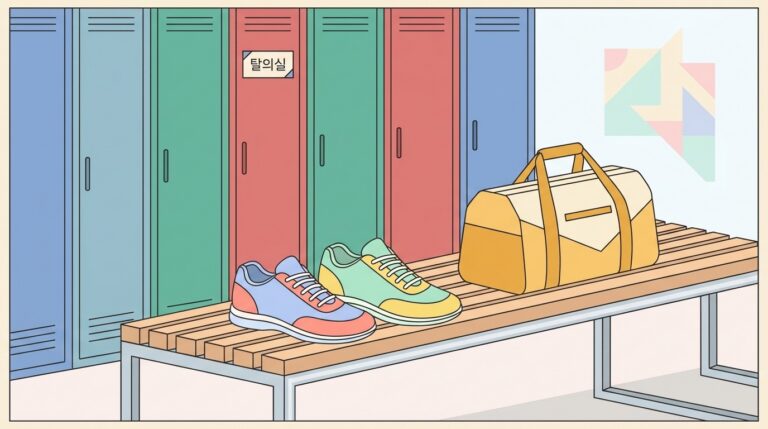
Panic sets in. Wait, aren’t these athletic shoes? Why can’t I step onto the gym floor? You look around and notice seasoned gym-goers sitting on a bench, slipping off their street sneakers, and pulling out a sparkling-clean pair from their gym duffle bags.
Don’t worry—you haven’t committed an unforgivable crime! This is one of the most common cultural surprises foreigners experience in South Korea. Because Korean culture draws a sacred line between “outside” and “inside” dirt, wearing outdoor footwear onto workout mats or cardio floors is a huge no-no. Learning how to navigate this rule not only saves you from awkward misunderstandings at the front desk, but it also shows the gym staff that you respect local gym culture. Based on real feedback from dozens of our expat learners, this guide will give you the exact phrases, cultural context, and confidence to register for a gym, chat with personal trainers, and handle the indoor shoe rule like an absolute pro!
Phase 2: 3 Core Expressions In-Depth
1. 실내 전용 운동화를 챙겨 오셔야 해요 (Silnae jeonyong undonghwareul chaenggyeo osyeoya haeyo)
- Pronunciation: [Sheel-nae jeon-yong oon-dong-hwa-reul chaeng-gyeo oh-syeo-ya hae-yo] (Sounds like Sheel-nay as in shield, jeon as in traditional pancake, and undong-hwa like ‘oondong’ workout + ‘hwa’ shoe).
- Meaning:
- Literal: “You must pack and bring indoor-dedicated workout shoes.”
- Natural Nuance: “Please remember to bring a separate pair of clean indoor sneakers to work out in.”
- K-Culture Moment: You will hear this in almost every Korean fitness vlog on YouTube or in dramas like Weightlifting Fairy Kim Bok-joo whenever athletes enter dedicated training rooms.
- Editor’s Insight: 전용 (jeonyong) means “exclusive use.” You will see this everywhere in Korea: 버스 전용 (bus only), 보행자 전용 (pedestrian only), and here, 실내 전용 (indoor use only). Adding 챙기다 (chaenggida) implies thoughtfully preparing and packing something ahead of time.
- Situation Spectrum:
- Casual: 실내 운동화 챙겨와! (Silnae undonghwa chaenggyeowa!) ⚠️ (Friends only)
- Semi-formal: 실내 운동화 챙겨 오셔야 해요. (Silnae undonghwa chaenggyeo osyeoya haeyo.) ✅ (Perfect for gyms and studios)
- Formal: 실내 전용 운동화를 지참해 주시기 바랍니다. (Silnae jeonyong undonghwareul jichamhae jusigi baramnida.) ✅ (Written notices)
- 🤔 Think About It: Why does Korean have a specific single word like 챙기다 that blends “to pack,” “to remember,” and “to take care of” into one emotional gesture?
2. 갈아 신으셔야 해요 (Gara sineusyeoya haeyo)
- Pronunciation: [Ga-ra shee-neu-syeo-ya hae-yo] (Sounds like Ga-ra like ‘garage’ without ‘ge’, and shin like shin guard).
- Meaning:
- Literal: “You must change and wear (shoes).”
- Natural Nuance: “You need to switch into them right here.”
- K-Culture Moment: Seen in variety shows like I Live Alone (나 혼자 산다) whenever a celebrity visits a Pilates or Crossfit studio and changes footwear right at the entryway threshold.
- Editor’s Insight: Korean has distinct verbs for wearing different items! You don’t just “put on” everything with one verb. For footwear (shoes, socks), always use 신다 (sinda). Combined with 갈아- (gara-), it means “to switch / change into.” If you were changing clothes, it would be 갈아입다 (gara-ipda).
- Situation Spectrum:
- Casual: 여기서 갈아 신어! (Yeogiseo gara sineo!) ⚠️ (Only to close gym buddies)
- Semi-formal: 신발 갈아 신으셔야 해요. (Sinbal gara sineusyeoya haeyo.) ✅ (Everyday polite staff communication)
- Formal: 운동화로 환복 및 갈아 신어 주십시오. (Undonghwaro hwanbok mit gara sineo jusipsio.) ✅ (Official athletic rules)
- 🤔 Think About It: In English, we “put on” a hat, shoes, a shirt, and a ring. Why do you think Korean developed entirely different verbs for feet, body, and headwear?
3. 락커에 두고 다녀도 되나요? (Rakkeoe dugo danyeodo doenayo?)
- Pronunciation: [Lah-kkeo-eh doo-go da-nyeo-do dwe-na-yo?] (Sounds like locker-eh, doo-go, dahn-yeo-doh dway-nah-yoh).
- Meaning:
- Literal: “Is it okay if I leave them in the locker and commute back and forth?”
- Natural Nuance: “Can I leave my shoes in a locker here so I don’t have to carry them every day?”
- K-Culture Moment: In K-Dramas where office workers hit the gym right after work, you always see them unlocking their small personal shoe locker (개인 락커) in the hallway.
- Editor’s Insight: The compound pattern ~고 다니다 (-go danida) means to do an action as part of an ongoing routine. Asking 두고 다녀도 되나요? saves your shoulders from hauling heavy sneakers across the Seoul subway every morning.
- Situation Spectrum:
- Casual: 락커에 두고 가도 돼? (Rakkeoe dugo gado dwae?) 🚫 (Too informal with trainers)
- Semi-formal: 락커에 두고 다녀도 되나요? (Rakkeoe dugo danyeodo doenayo?) ✅ (The gold standard question)
- Formal: 사물함 보관이 가능한지 문의드립니다. (Samulham bogwani ganeunghanji mun-uidirimnida.) ✅ (Customer service desk inquiry)
- 🤔 Think About It: In many Western gyms, day-use lockers are standard, but Korean gyms frequently rent out dedicated tiny shoe lockers for a small monthly fee. How does this reflect urban commuting lifestyle in high-density cities?
Phase 3: Textbook Korean vs. Real Korean
Situation 1: Asking if you can exercise in the shoes you’re wearing right now
- 📖 Textbook Korean:
제가 신고 온 신발을 운동할 때 신어도 됩니까?
(Jega singo on sinbareul undonghal ttae sineodo doemnikka?)
“Am I permitted to put on the footwear I came wearing when I undergo physical exercise?” - 🗣️ Real Korean:
이거 밖에서 신던 건데, 그냥 신으면 안 되죠?
(Igeo bakk-eseo sindeon geonde, geunyang sineumyeon an doejo?)
“I wore these outside… I can’t wear them inside, right?” - 💡 Why is it different? Koreans prefer soft, conversational self-awareness rather than stiff formal declarations. Acknowledging that the shoes were worn outdoors shows you already respect their gym rules before the trainer even corrects you.
Situation 2: Asking the trainer where to change shoes
- 📖 Textbook Korean:
운동화를 교체하는 장소가 어디에 위치해 있습니까?
(Undonghwareul gyochehaneun jangsoga eodie wichihae isseumnikka?)
“Where is the location situated at which one substitutes sports shoes?” - 🗣️ Real Korean:
신발 어디서 갈아 신어요?
(Sinbal eodiseo gara sineoyo?)
“Where should I change my shoes?” - 💡 Why is it different? Real Korean replaces dense Sino-Korean words like 교체 (replacement) and 위치 (location) with simple native verbs like 갈아 신다 and interrogative question words like 어디서.
Phase 4: K-Culture Deep Dive & Non-Verbal Manners
4-1. 눈치 (Nunchi) & Gestures: The Sacred Floor Threshold
When you enter a gym in Korea, look down immediately. Almost every fitness center has a clearly marked 현관 (entryway) or a sunken step where outdoor shoes stop. Even if nobody explicitly stops you, walking onto the rubber matting with wet or dusty outdoor sneakers will earn you uncomfortable, side-eye glances from everyone nearby.
- The Shoe Bag Lift: When speaking with the desk staff, hold up your separate shoe bag slightly and say: “실내 운동화 가져왔어요! (Silnae undonghwa gajyeowasseoyo! / I brought indoor shoes!)” This single physical gesture immediately establishes that you know gym etiquette.
- Carrying Shoes Gracefully: Never carry dirty sneakers by the laces swinging around near equipment. Keep them in a simple drawstring pouch or canvas bag until you reach the shoe bench.
4-2. Cultural Code: The Ondol Legacy in Modern Gyms
Why are Koreans so strict about indoor gym shoes? It all stems from 온돌 (Ondol)—Korea’s traditional underfloor heating culture. For centuries, Koreans sat, ate, and slept directly on spotless heated floors. The line separating outdoor grime from indoor living space is psychologically deeply ingrained.
Even in a gym loaded with stainless steel squat racks and imported plate-loaded machines, that floor is treated as a clean indoor sanctuary. Furthermore, fitness culture in Korea is intensely communal. Because trainees frequently do floor stretches, core exercises on yoga mats, and foam rolling, everyone cooperates to keep the floor clean enough to sit on.
Phase 5: Real-World Roleplay Scenario
Setting: Fitness 99 in Mapo-gu, Seoul. Energetic K-pop plays softly in the background. You step up to the front counter to consult about membership, greeted by Trainer Min-woo, an athletic instructor wearing a neat trainer tracksuit.
Characters:
* You: An enthusiastic expat eager to start training.
* Trainer Min-woo (트레이너 민우): Friendly, disciplined, and very helpful.
- Turn 1 (Min-woo):
안녕하세요! 헬스장 등록 상담 오셨어요?
(Annyeonghaseyo! Helseujang deungnok sangdam osyeosseoyo?)
“Hello! Are you here to consult about gym membership?”
🎭 Smiles warmly, holding a consultation clipboard. -
Turn 2 (You):
네, 한 달 등록하고 싶은데요. PT도 같이 상담받을 수 있나요?
(Ne, han dal deungnokhago sipeundeyo. PT-do gachi sangdambadeul su innayo?)
“Yes, I want to register for one month. Can I also consult about personal training?”
🎭 Gives a polite head nod. -
Turn 3 (Min-woo):
그럼요! 시설 먼저 둘러보시고, 라커랑 운동복 안내해 드릴게요.
(Geureomyo! Siseol meonje dulleobosigo, rakkeorang undongbok annaehae deurilgeyo.)
“Of course! Let’s tour the facilities first, and I will show you the lockers and gym wear.”
🎭 Points toward the training floor with an open palm. -
Turn 4 (You):
감사합니다. 혹시 운동할 때 신는 신발은 어떻게 해요?
(Gamsahamnida. Hoksi undonghal ttae sinneun sinbareun eotteoke haeyo?)
“Thank you. By the way, what should I do about the shoes I wear while exercising?”
🎭 Glances down at your current sneakers curiously. -
Turn 5 (Min-woo):
실내 전용 운동화를 꼭 챙겨 오셔서 갈아 신으셔야 해요. 밖에서 신던 건 바닥이 상해서 안 되거든요.
(Silnae jeonyong undonghwareul kkok chaenggyeo osyeoya haeyo. Bakk-eseo sindeon geon badagi sanghaeseo an doegeodeunyo.)
“You must bring dedicated indoor workout shoes and change into them. Shoes worn outside damage and dirty the floor, so they aren’t allowed.”
🎭 Gestures toward the entrance shoe racks. -
Turn 6 (You):
아, 그렇군요! 그럼 운동화를 매일 들고 다녀야 하나요?
(A, geureokgunyo! Geureom undonghwareul maeil deulgo danyeoya hanayo?)
“Ah, I see! Then do I have to carry my sneakers with me every day?”
🎭 Makes a slight carrying motion. -
Turn 7 (Min-woo):
개인 락커 신청하시면 신발 두고 다니실 수 있어요. 월 1만 원이에요.
(Gaein rakkeo sincheonghasimyeon sinbal dugo danisil su isseoyo. Wol il-man won-ieyo.)
“If you apply for a private locker, you can leave your shoes here. It’s 10,000 KRW per month.”
🎭 Taps the neat rows of numbered lockers nearby. -
Turn 8 (You):
좋아요! 락커도 같이 신청할게요.
(Joayo! Rakkeodo gachi sincheonghalgeyo.)
“Sounds great! I will register for the locker too.”
🎭 Smiles relieved and takes out your payment card.
🔀 Interactive Decision Point
Trainer Min-woo suddenly notices you looking at your current shoes and asks: “혹시 오늘 바로 운동하고 가실 건가요? (Hoksi oneul baro undonghago gasil geon-gayo? / Were you planning to work out right today?)” But you only have the outdoor sneakers on your feet! How do you answer?
- Option A: “네! 그냥 이 신발 깨끗하니까 오늘만 신을게요! (Ne! Geunyang i sinbal kkaekkeuthanikka oneulman sineulgeyo! / Yes! These shoes are clean so I’ll just wear them today!)”
- Feedback (Bad): ❌ Trainer Min-woo will look visibly uncomfortable. No matter how clean you think outdoor shoes are, street dirt is strictly prohibited on the machines.
- Option B: “운동화 밑창 물티슈로 닦으면 신어도 돼요? (Undonghwa mitchang multisyuro dakk-eumyeon sineodo dwaeyo? / If I wipe the soles with wet wipes, can I wear them?)”
- Feedback (Risk): ⚠️ Some neighborhood gyms might let this slide once in an emergency, but it puts the trainer on the spot and marks you as someone trying to skirt the rules.
- Option C: “오늘은 상담만 받고, 내일 실내 운동화 챙겨서 올게요! (Oneureun sangdamman batgo, naeil silnae undonghwa chaenggyeoseo olgeyo! / Today I’ll just do the consultation, and tomorrow I’ll bring my indoor shoes!)”
- Feedback (Best): ⭐ Perfect! 100/100 etiquette. Min-woo will appreciate your respect for their policy and will gladly prepare your locker for tomorrow.
Phase 6: 10-Second Emotion Shadowing Drill
Practice these exact voice inflections! Repeat them aloud three times each.
[😊 Bright & Courteous Question]
실내 전용 운동화 / 꼭 챙겨 와야 하나요?
(Silnae jeonyong undonghwa / kkok chaenggyeo waya hanayo?)
“Do I definitely need / to bring indoor workout shoes?”-
[💡 Curious & Practical]
개인 락커에 / 신발 두고 다녀도 되죠?
(Gaein rakkeoe / sinbal dugo danyeodo doejo?)
“I can leave my shoes / in a personal locker, right?” -
[🤝 Cooperative & Enthusiastic]
네! / 내일부터 / 깨끗한 운동화로 / 갈아 신을게요!
(Ne! / Naeilbuteo / kkaekkeuthan undonghwaro / gara sineulgeyo!)
“Yes! / Starting tomorrow / into clean workout shoes / I’ll switch!”
Phase 7: K-Culture Mini Dictionary
- 실내 운동화 (Silnae Undonghwa)
- Translation: Indoor athletic shoes.
- Real-world Usage: The dedicated pair of sneakers with clean rubber outsoles kept exclusively inside a gym, squash court, or indoor track.
- 개인 락커 / 사물함 (Gaein Rakkeo / Samulham)
- Translation: Private locker / storage box.
- Real-world Usage: Small paid compartments usually located in the hallways of gyms where members store shower kits and indoor sneakers so they can travel light.
- 일일권 (Il-ilgwon)
- Translation: One-day gym pass.
- Real-world Usage: Ideal for travelers! When dropping by a gym for a single workout without a long-term contract, ask: “일일권 얼마예요? (How much is a day pass?)”
- 헬스장 (Helseujang)
- Translation: Fitness center / Gym (Konglish from “Health”).
- Real-world Usage: In Korea, gyms are almost exclusively called 헬스장 (health-jang) rather than “gym.” The activity of lifting weights is colloquially called 헬스 (health).
Phase 8: Survival Kit for Travelers
Survival Expressions TOP 3
- 일일권으로 이용할 수 있나요?
(Il-ilgwoneuro iyonghal su innayo?)
Pro Tip: Use this at the counter if you only want to work out for one afternoon while traveling. - 운동복이랑 수건은 무료인가요?
(Undongbogirang sugeoneun muryo-in-gayo? / Are gym clothes and towels free?)
Pro Tip: Many Korean gyms provide clean t-shirts, shorts, and towels for free or a nominal fee! - 신발 갈아 신는 곳이 어디예요?
(Sinbal gara sinneun gosi eodiyeyo? / Where is the shoe-changing area?)
Pro Tip: Ask this before stepping past the entrance mat to avoid any foot-traffic faux pas.
Editor’s Travel Note
- Finding Foreigner-Friendly Gyms: Download the 네이버 지도 앱 다운로드 (Naver Map App Download) and search for “헬스장 일일권” (gym day-pass). Check reviews and look for photos of their shoe storage area.
- Payment Tip: Nearly all modern gyms in Seoul take international credit cards (Visa/Mastercard), but daily passes purchased via unmanned kiosks at 24-hour gyms sometimes require a Korean mobile authentication number. If so, simply press the staff call bell!
Phase 9: A Step Deeper (한 발 더 깊이)
In Western fitness culture, gym shoes are often just whatever sneakers you put on before leaving your house. But in South Korea, changing into indoor sneakers isn’t merely a hygiene policy—it is a social contract of mutual consideration (배려, baeryeo).
When you put on clean indoor shoes, you are non-verbally telling your fellow gym members: “I will not track street dust, rain, or dirt onto the floor where you do your core planks and stretches.” It reflects Korea’s high-density collective etiquette: individual freedom is gently balanced with community hygiene. By bringing your own clean sneakers, you transform from an outsider tourist into a thoughtful participant in local community life.
💬 Your Turn: Does your home country have separate footwear rules in fitness spaces, or is working out in outdoor shoes completely normal? Share your gym stories in the comments below!
Phase 10: FAQ & Common Mistakes
Q: Can I just wipe my outdoor running shoes thoroughly with wet tissues?
A: Generally, no. Trainers will usually decline this because microscopic gravel and moisture caught in outsole treads can scratch wooden floors or tear high-grade rubber gym mats. It’s much safer to bring a genuinely unworn or indoor-only pair.
Q: What kind of shoes are best as “indoor gym shoes” in Korea?
A: Any standard running shoe, cross-trainer, or flat-soled lifting shoe (like Converse or Vans) is completely fine—as long as the soles have never walked on outdoor sidewalks or pavement!
Q: Can I exercise in socks or bare feet if I forgot my indoor shoes?
A: In dedicated Pilates or yoga studios, bare feet or grip socks are standard. However, in standard free-weight and cardio gyms, working out in socks or slippers is strictly prohibited due to slipping and safety hazards with dropped weights.
🚨 Common Mistakes Warning Board
- Mistake: Stepping across the entryway line before switching shoes.
- Correct Action: Stop immediately at the bench or designated mat by the front desk, swap your shoes, and carry your street shoes to the designated locker.
- Mistake: Asking to borrow the trainer’s or gym’s spare shoes.
- Correct Action: While some upscale private PT studios have rental shoe services, 90% of neighborhood gyms do not provide rental shoes due to hygiene. Always bring your own.
- Mistake: Wearing flip-flops or Crocs onto the workout floor.
- Correct Action: Even if they are clean and indoor-only, open-toed shoes or casual slides are banned on Korean weightlifting floors for injury prevention.
Phase 11: Action Missions
- 🥉 Bronze Mission (Solo Practice): Stand in front of your mirror with your gym shoes and practice saying smoothly: “실내 운동화 가져왔어요! (Silnae undonghwa gajyeowasseoyo! / I brought indoor shoes!)”
- 🥈 Silver Mission (Social Share): Snap a flat-lay picture of your workout sneakers and gym pouch, post it on your Instagram Story or Threads, and caption it with: “실내 전용 운동화 준비 완료! 💪 (Indoor shoes ready!)”
- 🥇 Gold Mission (Real-World Execution): Walk into a local Korean gym or Pilates studio, greet the staff politely, and ask: “락커에 신발 두고 다녀도 되나요? (Can I leave my shoes in a locker?)”
🎮 K-Culture Challenge: Watch an episode of a Korean fitness or sports variety show (like Physical: 100 or A Clean Sweep). Spot the distinct footwear the participants change into when transitioning from outdoor staging areas to indoor training floors!
Phase 12: Interactive Quiz Challenge
Q1. You just bought a brand-new pair of sneakers from an ABC-Mart in Myeongdong and walked to the gym wearing them outside for 10 minutes. Can you wear them inside the gym?
* A) Yes, because they were purchased today and look brand new.
* B) No, because once they have touched the outdoor pavement, they are considered outdoor shoes.
* C) Yes, if you spray them with perfume at the front desk.
Q2. Fill in the blank with the correct verb for shoes:
* “체육관에서는 실내 운동화를 갈아 (_______) 해요.”
* A) 입어야 (ibeoya)
* B) 신으셔야 (sineusyeoya)
* C) 써야 (sseoya)
Q3. [True or False] In Korea, asking to rent a personal shoe locker (개인 락커) usually requires an additional small monthly fee.
* A) True
* B) False
👉 Click here to check your answers and detailed explanations!
Quiz Explanations
- Q1 Answer: B
- Why: In Korea, the rule is absolute: once a shoe touches outdoor asphalt or pavement, it carries outdoor contaminants. To count as 실내 전용 (indoor only), the soles must never have walked outside.
- Q2 Answer: B (신으셔야)
- Why: In Korean, footwear requires the verb 신다 (sinda). 입다 (ipda) is for clothing, and 쓰다 (sseuda) is for headwear or hats.
- Q3 Answer: A (True)
- Why: Most Korean fitness centers charge a modest fee (typically 10,000 to 20,000 KRW/month) for a dedicated shoe locker, though some promotional membership packages include it for free.







