

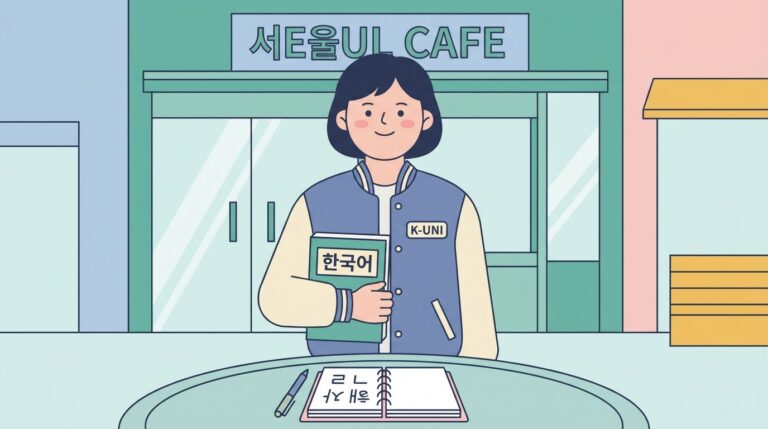
Talk About What You Do: How to Say ‘I Am a College Student’ in Natural Korean
Phase 1: Empathy (Story-Driven Opening)
안녕하세요! 매일한글 에디터입니다. (Hello! I’m your Daily Hangul editor.) Picture this: You’re sitting in a cozy, sunlit cafe in the bustling Hongdae university district of Seoul. The upbeat melody of the latest NewJeans track is humming in the background, and the student beside you—wearing a cool collegiate varsity jacket—turns around with a warm smile and asks: “Hoksi museun il haseyo?” (What do you do?). Your mind races back to the textbook page you memorized last week: “Jeo-neun hak-saeng-im-ni-da.” You blurt it out, stiff as a soldier, and suddenly the relaxed cafe vibe turns into an awkward formal interview!
Don’t worry—almost every single Korean learner goes through this exact robotic moment. In textbook land, everyone introduces themselves with rigid military-style endings. But in the real world of K-dramas, university campus chats, and friendly encounters, natural conversational Korean is much warmer, simpler, and surprisingly easy to master. Today, we are breaking down how to introduce your daily life and studies using the friendly, versatile -이에요 / -예요 (-ieyo / -yeyo) ending. Based on real-world classroom feedback from hundreds of beginners just like you, this guide gives you the exact phrases you need so you can speak with pure confidence from day one!
Phase 2: Top 3 Core Expressions
1. 저는 대학생이에요 (Jeoneun daehaksaeng-ieyo)
- Pronunciation: [Jeo-neun dae-hak-saeng-ee-yeo] (Sounds like: “Juh-noon day-hock-seng-ee-yo”)
- Meaning: Literal: “As for me, university-student I am.” | Real Nuance: “I’m a college student!”
- K-Culture Moment: You hear this in every classic campus K-Drama like Weightlifting Fairy Kim Bok-joo or Cheese in the Trap whenever students meet during club orientation!
- Editor’s Insight: Notice the ending 이에요 (-ieyo). Because 대학생 (daehaksaeng) ends with a final consonant sound (받침, batchim “ㅇ”), we attach 이에요 so the sound rolls off your tongue like silk: dae-hak-saeng-i-e-yo.
- Situation Spectrum: Casual: ⚠️ (drop ‘yo’ with same-age friends) | Semi-formal: ✅ (Perfect for daily life!) | Formal: ✅
- 🤔 Think About It: In English, we simply say “I’m a student.” Why do you think Korean specifically distinguishes high schoolers (고등학생) from college students (대학생) even in casual chatter?
2. 무슨 일 하세요? (Museun il haseyo?)
- Pronunciation: [Moo-seun il ha-se-yo?] (Sounds like: “Moo-soon eel ha-seh-yo?”)
- Meaning: Literal: “What work do you do?” | Real Nuance: “What line of work are you in?” or “What do you do for a living?”
- K-Culture Moment: Seen in romantic dramas like Business Proposal during blind dates or awkward elevator encounters between colleagues.
- Editor’s Insight: This is the most polite and natural way to inquire about someone’s occupation. The honorific infix -세요 (-seyo) shows respect without feeling stuffy.
- Situation Spectrum: Casual: 🚫 | Semi-formal: ✅ | Formal: ✅
- 🤔 Think About It: Notice that Koreans ask “What work do you do?” instead of “What is your job title?” Reflect on how this reflects focus on daily activity rather than just a corporate label.
3. 회사에 다녀요 (Hoesa-e danyeoyo)
- Pronunciation: [Hwe-sa-eh da-nyeo-yo] (Sounds like: “Hweh-sah-eh dahn-yuh-yo”)
- Meaning: Literal: “I attend/commute to a company.” | Real Nuance: “I work at an office / I’m an office worker.”
- K-Culture Moment: The iconic line every exhausted modern 20-something sighs in slice-of-life dramas like Misaeng: Incomplete Life.
- Editor’s Insight: Beginners often try to say “저는 회사원이에요” (I am an office worker). While not wrong, native speakers almost universally prefer the action verb 다녀요 (danyeoyo – commute/regularly attend).
- Situation Spectrum: Casual: ⚠️ (with close peers: 회사 다녀) | Semi-formal: ✅ | Formal: ✅
- 🤔 Think About It: The verb 다니다 (danida) is used for both attending school (학교에 다녀요) and going to work (회사에 다녀요). What does this reveal about how Korean connects school life and corporate routines?
Phase 3: Textbook Korean vs. Real Korean
Situation 1: Stating You Are in College
- 📖 교과서 한국어 (Textbook): 저는 학생입니다. (Jeoneun haksaeng-imnida.)
- 🗣️ 진짜 한국어 (Real-life): 저 대학생이에요. (Jeo daehaksaeng-ieyo.)
- 💡 왜 다를까? (Why is it different?): In regular conversations, the polite polite-informal ending -이에요 (-ieyo) sounds far warmer and friendlier than the rigid, news-anchor style -입니다 (-imnida). Also, saying 대학생 (university student) is much more informative than just general “student” (학생).
Situation 2: Stating You Have a Corporate Job
- 📖 교과서 한국어 (Textbook): 제 직업은 회사원입니다. (Je jigeobeun hoesawon-imnida.)
- 🗣️ 진짜 한국어 (Real-life): 저 일반 회사 다녀요. (Jeo ilban hoesa danyeoyo.)
- 💡 왜 다를까? (Why is it different?): Saying “My job is an office worker” sounds like you are reading your own resume aloud! Locals prefer saying they “attend a company” or describe themselves as a 직장인 (jik-jang-in – working professional).
Phase 4: K-Culture Deep Dive & Non-Verbal Manners
4-1. 눈치 (Nunchi) & Body Language
When introducing yourself in Korea, your posture speaks louder than your words!
* The Modest Nod (목례, Mokrye): You don’t need a full 90-degree waist bow in a casual setting. A crisp, respectful 15-degree head nod while saying “안녕하세요!” (Annyeonghaseyo!) establishes instant rapport.
* Two-Hand Rule: If you are exchanging student IDs, business cards, or even passing a menu across the table, always use both hands or support your right forearm with your left hand. It signals mindfulness and respect (nunchi).
4-2. Campus Culture: The Famous ‘과잠’ (Gwajam)
If you visit any university campus in Seoul—like Yonsei in Sinchon or Korea University in Anam—you will spot students rocking varsity bomber jackets with their university logo on the back and their major embroidered on the sleeve. These are called 과잠 (Gwajam – Department Jacket). When someone asks “어느 학교 다녀요?” (Which school do you attend?), being a college student isn’t just about classes; it is a vibrant social identity filled with department festivals, study groups, and lively membership training retreats!
Phase 5: Real-Life Roleplay Scenario
- Setting: A trendy community cafe near Hongik University Station. Sunlight streams through brick windows.
- NPC Character: Minho (민호), a friendly third-year design major who helps run the weekend international language exchange table.
Dialogue:
1. 민호 (Minho): 안녕하세요! 처음 뵙겠습니다. (Annyeonghaseyo! Cheoeum boepgetseumnida. – “Hello! Nice to meet you for the first time.”)
🎭 Bows his head gently with an open, welcoming smile.
2. You: 안녕하세요! 반갑습니다. (Annyeonghaseyo! Bangapseumnida. – “Hello! Nice to meet you too.”)
🎭 You smile and return a light, polite head nod.
3. 민호 (Minho): 혹시 학생이세요, 아니면 일하세요? (Hoksi haksaeng-iseyo, animyeon ilhaseyo? – “By any chance, are you a student, or do you work?”)
🎭 Taps his notebook lightly and leans in attentively.
4. You: 저는 대학생이에요! (Jeoneun daehaksaeng-ieyo! – “I am a college student!”)
🎭 Answering brightly and making comfortable eye contact.
5. 민호 (Minho): 아, 진짜요? 전공이 뭐예요? (A, jinjjayo? Jeongongi mwoyeyo? – “Oh, really? What is your major?”)
🎭 Eyes light up with genuine curiosity.
6. You: 한국어 공부하고 있어요. (Hangugeo gongbuhago isseoyo. – “I am studying Korean.”)
🎭 Gesturing toward your study notebook on the table.
7. 민호 (Minho): 대박! 한국어 발음 정말 좋으세요. (Daebak! Hangugeo baleum jeongmal joeuseyo. – “Awesome! Your Korean pronunciation is really good.”)
🎭 Claps his hands softly in encouragement.
8. You: 감사합니다! 아직 배우는 중이에요. (Gamsahamnida! Ajik baeuneun jung-ieyo. – “Thank you! I am still learning.”)
🎭 Laughs modestly with both hands placed lightly on your lap.
🔀 Interactive Choice Point
After Minho compliments your Korean, he asks: “민호: 주말에는 보통 뭐 해요?” (What do you usually do on weekends?) How do you reply?
- Choice A: 저는 카페에서 한국어 숙제해요. (Jeoneun kape-eseo hangugeo sukjehaeyo. – “I do Korean homework at cafes.”)
- Choice B: 몰라요. 아무것도 안 해요. (Mollayo. Amugeotdo an haeyo. – “Don’t know. I do nothing.”)
- Choice C: 야! 너 주말에 뭐 해? (Ya! Neo jumale mwo hae? – “Hey dude! What are you doing this weekend?”)
Feedback:
* Choice A [BEST! 🌟]: Natural, polite, and continues the conversation smoothly! Minho might even recommend his favorite study cafes.
* Choice B [BAD ⚠️]: Too abrupt and flat. While grammatically okay, it closes off communication instantly and feels dismissive.
* Choice C [HIGH RISK 🚨]: Danger zone! Calling someone you just met 야 (Ya) and using casual panmal (너/해) will shock them. Keep polite honorifics until you agree to drop formal speech!
Phase 6: 10-Second Emotion Shadowing Drill
Say these aloud! Pay attention to the slash markers / for natural pause points and match the emotional cues:
[😊 Bright & Enthusiastic]- 저 / 대학생이에요! (Jeo / daehaksaeng-ieyo! – “I’m / a college student!”)
[🤔 Polite Curiosity]- 혹시 / 무슨 일 하세요? (Hoksi / museun il haseyo? – “By any chance, / what kind of work do you do?”)
[💼 Calm & Professional]- 저 / 일반 회사 다녀요. (Jeo / ilban hoesa danyeoyo. – “I / work at an office.”)
[🥰 Modest & Sweet]- 아직 / 공부하는 중이에요. (Ajik / gongbuhaneun jung-ieyo. – “I’m still / in the middle of learning.”)
Phase 7: K-Culture Mini Dictionary
- 과잠 (Gwajam): University Major Jacket (Varsity Bomber).
- Usage: Worn proudly by college students across Korea during spring and autumn as a badge of campus belonging.
- 개강 (Gaegang): Start of the Semester / First day of college.
- Usage: Every March and September, social media explodes with memes about 개강 anxiety and reuniting with classmates.
- 취준생 (Chwijunsaeng): Job-Seeker / Preparing for employment.
- Usage: Short for 취업 준비생 (chwieop junbisaeng). Used by graduates who study for corporate licensing exams.
- 알바 (Alba): Part-time job.
- Usage: Derived from the German Arbeit. Korean university students often say “나 오늘 알바 가야 해” (I have to go to my part-time shift today).
Phase 8: Traveler’s Survival Kit
Survival Expressions TOP 3
- 학생증 할인 돼요? (Haksaengjeung halin dwaeyo?)
- Pronunciation: [Hak-saeng-jeung ha-lin dway-yo?]
- Pro Tip: Ask this at museum ticket booths, palace entrances, or theater counters across Seoul to unlock youth discounts!
- 대학생이에요. (Daehaksaeng-ieyo.)
- Pronunciation: [Dae-hak-saeng-ee-yeo.]
- Pro Tip: Keep this sentence handy when interacting at university youth hostels or language clubs.
- 여기 학생 할인 있어요? (Yeogi haksaeng halin isseoyo?)
- Pronunciation: [Yeo-gi hak-saeng hal-in ees-suh-yo?]
- Pro Tip: “Is there a student discount here?” Short, sweet, and saves you precious Won!
Editor’s Travel Note
When navigating university towns like Sinchon, Hyehwa, or Hongdae, Google Maps often lags behind updated walking shortcuts. Be sure to check the Naver Map transit navigation app for real-time bus arrival times and student cafeteria locations. Remember that university campuses in Korea are open to the public—feel free to explore their gorgeous libraries, green plazas, and budget-friendly student cafeterias (학식, haksik)!
Phase 9: A Step Deeper (Reflective Insight)
In Western cultures, asking “What do you do?” within two minutes of meeting someone can sometimes feel intrusive or overly focused on corporate status. In Korea, however, asking about someone’s occupation or student status isn’t about judging your wealth; it is about social positioning and linguistic harmony. Korean grammar requires speakers to adjust politeness endings and respectful vocabulary based on age and social role. By understanding whether you are a student or a working professional, your conversational partner knows how to treat you politely, what topics to suggest, and how to build a comfortable social connection.
💬 Your Turn: In your home country, what is the very first question people ask when breaking the ice? Does asking about someone’s job feel casual or intrusive? Share your thoughts in the comments below!
Phase 10: FAQ & Avoiding Misunderstandings
Q: What is the difference between 학생 (haksaeng) and 대학생 (daehaksaeng)?
A: 학생 (haksaeng) is the broad term for any student (elementary, middle, high school, or college). 대학생 (daehaksaeng) specifically denotes a college/university undergraduate student. If you are an adult learner, saying 대학생 prevents people from mistaking you for a high schooler!
Q: When do I use 이에요 (-ieyo) vs 예요 (-yeyo)?
A: It depends on the presence of a final bottom consonant (batchim):
* Noun ends with a consonant: Attach 이에요 (-ieyo) (e.g., 대학생 + 이에요 = 대학생이에요)
* Noun ends with a vowel: Attach 예요 (-yeyo) (e.g., 의사 [doctor] + 예요 = 의사예요)
Q: Can I just say “저는 학생” without any ending?
A: No! In Korean, a noun cannot simply float alone at the end of a sentence. You must always attach an ending like 이에요 / 예요 in standard conversation. Dropping it completely sounds broken and incomplete.
🚨 Common Mistakes Alert Board
- Mistake: Saying “저는 학생입니다” to casual peer friends at a cafe table.
- Correct Action: Use “저 대학생이에요” (Jeo daehaksaeng-ieyo) for a much warmer, natural tone.
- Mistake: Confusing -이에요 and -예요.
- Correct Action: Check the final syllable! If there is a bottom consonant, pick the 3-syllable ending -i-e-yo.
- Mistake: Saying “제 직업은 학생이에요” (My occupation is student).
- Correct Action: Say “저는 대학생이에요”. Mentioning the word “occupation” (직업) out loud sounds like filling out a paper visa application!
Phase 11: Action Mission & Engagement
- 🥉 Bronze Mission (Solo Practice): Stand in front of your mirror and practice saying: “안녕하세요! 저 대학생이에요.” 5 times with a bright smile.
- 🥈 Silver Mission (Social Share): Leave a comment below introducing your current occupation or study field using the pattern: 저는 [Occupation/Status]이에요/예요!
- 🥇 Gold Mission (Real Life): Next time you meet a Korean speaker or tutor, open your self-introduction with “저는 대학생이에요” without glancing at your notes!
- 🎮 K-Culture Mission: Watch an episode of a campus drama (such as Weightlifting Fairy Kim Bok-joo) and spot when students use the word 대학생 or wear their 과잠.
Phase 12: Interactive Quiz Challenge
Test your skills before you head out onto campus!
1. Situational Judgment
You are introducing yourself to your new Korean language exchange partner at a cafe. Which phrase sounds the most natural?
* A) 제 직업은 학생입니다.
* B) 저는 대학생이에요.
* C) 야, 나 학생.
👉 Click to reveal Answer & Explanation
Correct Answer: B
Explanation: Option B is polite, warm, and natural for daily conversation. Option A sounds like a formal legal document, and Option C is overly rude slang for a first meeting!
2. Fill-in-the-Blank
Choose the correct ending for the sentence: “저는 선생님 (Teacher) ______.”
* Hint: Does ‘선생님’ end with a bottom consonant?
👉 Click to reveal Answer & Explanation
Correct Answer: 이에요 (선생님이에요)
Explanation: Since ‘님’ ends with the bottom consonant “ㅁ” (batchim), we attach 이에요 (seon-saeng-nim-i-e-yo).
3. Cultural True or False
True or False: In Korea, asking someone if they are a student or office worker during early meetings is considered very rude.
👉 Click to reveal Answer & Explanation
Correct Answer: False!
Explanation: It is a standard, polite way to gauge social context and choose the right level of respect and conversational topics.







