

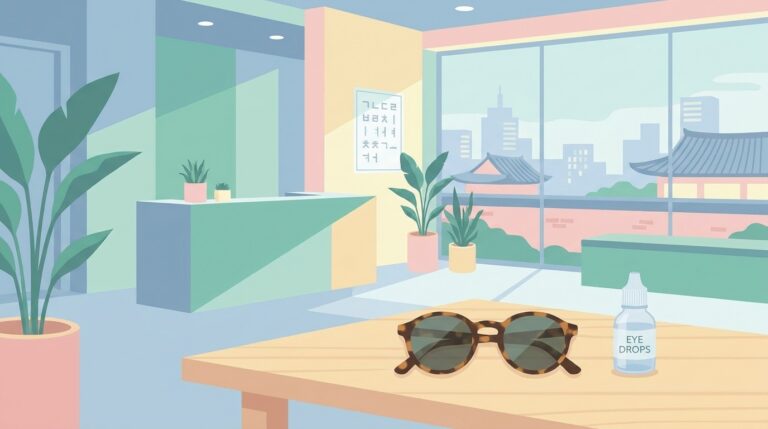
Clear Vision in Seoul: Post-Op Care Guide for Vision Correction Surgery
Phase 1: Empathy (스토리 몰입형 오프닝)
안녕하세요! 매일한글 에디터입니다. (Hello! It’s your Daily Hangul editor.)
Picture this: You just walked out of a premier eye clinic in Gangnam after a smooth SMILE LASIK procedure. Your vision is already brightening up, but as the anesthesia wears off, the bustling neon lights of Seoul suddenly feel blinding. The pharmacist hands you a bag with three different dropper bottles and a pair of tinted safety glasses, speaking rapidly in polite Korean: “수술 후에는 자외선 차단을 위해 보안경을 쓰시고…” Your heart races. Which bottle goes first? How often? What if you accidentally miss a dose or expose your healing eyes to sunlight? Post-op care can feel intimidating in your native language, let alone in Korean. In this guide, backed by real medical consultation feedback and expat experiences, you will master the intermediate (B2) vocabulary and conversational flow necessary to navigate aftercare, eye-drop schedules, and recovery protocols with complete peace of mind.
Phase 2: Core Expressions (핵심 표현 3선 심층 분석)
1. 자외선 차단을 위해 보안경이나 선글라스를 착용하세요.
- Pronunciation: Jauiseon chadaneul wihae boan-gyeong-ina seongullaseureul chakyonghaseyo. (Sound analogy: Jah-wee-sun cha-dahn-eul wee-hae boh-ahn-gyung-ee-nah sun-glah-seu-reul chahk-yong-hah-seh-yoh)
- Meaning: Literal: “For UV blocking, wear protective glasses or sunglasses.” | Nuance: A firm post-op medical instruction emphasizing strict UV defense to prevent corneal haze and scarring.
- K-Culture Moment: In modern Korean lifestyle vlogs and celebrity recovery videos, you often see influencers strolling around Garosu-gil right after surgery rocking oversized black sunglasses or chic clear UV-blocking frames (보안경).
- Editor’s Insight: Notice the noun 보안경 (safety/protective glasses) rather than normal 안경 (glasses). Doctors use this specific term for clear UV-filtering and impact-resistant shields.
- Situation Spectrum: Casual ⚠️ | Semi-formal ✅ | Formal ✅
- 🤔 Think About It: In Korea, wearing sunglasses indoors right after medical treatment is completely understood and respected as health compliance, whereas in some cultures it might be misread as eccentric.
2. 처방받은 항생제 안약은 시간 맞춰 점안하셔야 해요.
- Pronunciation: Cheobangbadeun hangsaengje anyageun sigan matchwo jeomanhasyeoya haeyo. (Sound analogy: Chuh-bahng-bah-deun hahng-saeng-jeh ahn-yahg-eun she-gahn maht-chwuh juh-mahn-hah-shyuh-yah hae-yoh)
- Meaning: Literal: “You must instill the prescribed antibiotic eye drops on schedule.” | Nuance: Highlights the absolute necessity of sticking to an exact dosing interval to prevent bacterial infection.
- K-Culture Moment: Medical dramas like Hospital Playlist frequently feature diligent medical staff instructing patients to “시간 맞춰” (right on time) take their medications.
- Editor’s Insight: While everyday Korean uses 안약을 넣다 (to put in eye drops), medical personnel and pharmacists prefer the clinical Sino-Korean verb 점안하다 (to instill drops into the eye).
- Situation Spectrum: Casual 🚫 | Semi-formal ✅ | Formal ✅
- 🤔 Think About It: Why do Koreans emphasize 시간 맞춰 so strictly? The culture places tremendous value on following systemized, rule-based routines to ensure rapid, flawless recovery.
3. 무방부제 인공눈물은 건조할 때마다 수시로 넣어주세요.
- Pronunciation: Mubangbuje in-gongnunmureun geonjohal ttaemada susiro neoeojuseyo. (Sound analogy: Moo-bahng-boo-jeh een-gong-noon-mool-eun gun-joh-hahl ttae-mah-dah soo-she-roh nuh-uh-joo-seh-yoh)
- Meaning: Literal: “Please put in preservative-free artificial tears frequently whenever dry.” | Nuance: Reassuring instruction to hydrate the eyes as often as needed without worrying about overuse side effects.
- K-Culture Moment: Look inside the pouch of any Korean office worker or student, and you will almost certainly spot small disposable ampoules of single-use artificial tears.
- Editor’s Insight: 수시로 means “frequently/as needed.” Unlike antibiotics which require set intervals, artificial tears without preservatives can be used on demand.
- Situation Spectrum: Casual ⚠️ | Semi-formal ✅ | Formal ✅
- 🤔 Think About It: Single-use vials are everywhere in Korea because hygiene standards discourage multi-dose bottles containing harsh preservatives during corneal healing.
Phase 3: Textbook Korean vs. Real Korean (교과서 한국어 vs 진짜 한국어)
Situation 1: Asking how often to apply drops
- 📖 교과서 한국어: 약을 몇 시간 간격으로 점안해야 합니까? (Yageul myeot sigan gan-gyeogeuro jeomanhaeya hamnikka? / At what interval must I instill the medication?)
- 🗣️ 진짜 한국어: 이거 몇 시간 텀으로 넣으면 돼요? (Igeo myeot sigan teomeuro neoeumyeon dwaeyo? / What hourly interval should I keep between these drops?)
- 💡 왜 다를까?: In actual clinic consultations, native speakers blend the English loanword ‘term’ (텀, meaning time interval) with natural spoken verbs like 넣다 rather than using formal Sino-Korean vocabulary.
Situation 2: Checking if indoor lighting requires sunglasses
- 📖 교과서 한국어: 실내에서도 자외선 차단 안경을 착용해야 합니까? (Silnaeesodo jauiseon chadan an-gyeongeul chakyonghaeya hamnikka? / Must I wear UV protective glasses indoors as well?)
- 🗣️ 진짜 한국어: 실내에서도 보안경 계속 끼고 있어야 해요? (Silnaeesodo boan-gyeong gyesok kkigo isseoya haeyo? / Do I still need to keep these protective glasses on inside?)
- 💡 왜 다를까?: Native speakers use the colloquial verb 끼다 (to wear on eyes/hands) instead of the stiff formal verb 착용하다 (to wear/don gear).
Phase 4: K-Culture Deep Dive & Non-verbal Manners
4-1. Nunchi & Gestures
When receiving medication instructions at a Korean clinic pharmacy, always accept the instruction sheet and dropper bottles with both hands (두 손으로 받기). Nod your head slightly each time the pharmacist repeats a critical instruction like 시간 맞춰서 (on schedule). If you need to put on your sunglasses right inside the pharmacy due to photophobia, briefly apologize or explain with a light nod: “눈이 부셔서 바로 착용할게요” (My eyes are sensitive to light so I will put these on right away). This shows considerate nunchi without drawing awkward stares.
4-2. Cultural Code: The ‘Ppalli-Ppalli’ vs. ‘Cheoljeohan’ Dynamic
Korea is world-renowned for lightning-fast (빨리빨리) medical procedures—often completing pre-op scans and surgery within a single day. However, this speed is balanced by exceptionally strict, meticulous (철저한) post-operative care. In Korea, patients are expected to take ownership of their healing regimen. Nobody will judge you for wearing oversized safety goggles inside subway trains or cafes; in fact, Koreans view protective eyewear post-surgery as a sign of smart, responsible self-care.
Phase 5: Real-World Roleplay Scenario
Setting: Gangnam Seoul Eye Clinic Pharmacy counter. Pharmacist Min-ji is reviewing post-surgery eye care instructions with Alex, who just had SMILE surgery.
- 간호사/약사 민지: 알렉스 님, 수술 잘 끝나셨어요. 복약 지도 간단히 해드릴게요. (Alex nim, susul jal kkeutnasyeosseoyo. Bogyak jido gandani haedeurilgeyo. / Alex, your surgery went very well. Let me give you brief instructions on your medications.)
🎭 [상냥한 미소로 약봉투를 가리키며] - 알렉스: 네, 아직 조금 뻑뻑하긴 한데 괜찮아요. 잘 들을게요. (Ne, ajik jogeum ppeokbbeokhagin hande gwaenchanayo. Jal deureulgeyo. / Yes, it feels a bit gritty still, but I am okay. I will listen carefully.)
🎭 [눈을 깜빡이며 경청하는 태도로] - 간호사/약사 민지: 이 파란색 항생제 안약은 4시간마다 시간 맞춰서 꼭 점안하셔야 감염을 막을 수 있어요. (I paransaek hangsaengje anyageun nesiganmada sigan matchwoseo kkok jeomanhasyeoya gam-yeomeul mageul su isseoyo. / This blue antibiotic drop must be instilled every 4 hours on schedule to prevent infection.)
🎭 [파란색 병을 집어 올리며] - 알렉스: 알겠습니다. 그럼 이 투명한 인공눈물도 시간 맞춰 넣어야 하나요? (Algetseumnida. Geureom i tumyeonghan in-gongnunmuldo sigan matchwo neoeoya hanayo? / Understood. Then do I also need to put these clear artificial tears on a schedule?)
🎭 [일회용 눈물 팩을 가리키며] - 간호사/약사 민지: 아니요, 무방부제 인공눈물은 건조하거나 시릴 때마다 수시로 넣어주시면 돼요. (Aniyo, mubangbuje in-gongnunmureun geonjohagone siril ttaemada susiro neoeojusimyeon dwaeyo. / No, you can instill the preservative-free artificial tears frequently whenever your eyes feel dry or stinging.)
🎭 [손으로 부드럽게 점안 동작을 흉내 내며] - 알렉스: 다행이네요. 외출할 때 보안경이랑 선글라스는 언제까지 써야 하죠? (Dahaeng-ineyo. Oechulhal ttae boan-gyeong-irang seongullaseuneun eonjekkaji sseoya hajyo? / That is a relief. How long do I have to wear the protective glasses and sunglasses when going outside?)
🎭 [보안경을 만지작거리며] - 간호사/약사 민지: 각막 회복과 자외선 차단을 위해 최소 일주일은 외출 시 필수예요. 실내에서도 불빛이 눈부시면 보안경을 써주세요. (Gakmak hoebok-gwa jauiseon chadaneul wihae choeso iljuireun oechul si pilsu-yeyo. Silnaeesodo bulbichi nunbusimyeon boan-gyeongeul sseojuseyo. / For corneal recovery and UV protection, they are mandatory when outside for at least a week. If indoor lighting feels glaring, wear your protective glasses inside too.)
🎭 [보안경을 건네며 당부하듯] - 알렉스: 네, 알려주신 대로 알람 맞춰두고 철저히 관리할게요! 감사합니다. (Ne, allyeojusin daero allam matchwodugo cheoljeohi gwanlihalgeyo! Gamsahamnida. / Yes, I will set alarms as instructed and manage it thoroughly! Thank you.)
🎭 [두 손으로 약봉투를 소중히 챙기며]
🔀 Interactive Choice Point
What would you say if the pharmacist asks if you have any questions before leaving?
- Option A: “항생제 넣고 인공눈물 넣을 때 중간에 몇 분 정도 쉬어야 해요?” (Hangsaengje neohgo in-gongnunmul neoeul ttae jung-gane myeot bun jeongdo swieoya haeyo? / How many minutes should I wait between antibiotic drops and artificial tears?)
- Outcome: Best! Pharmacists will applaud this sharp question. (Standard rule: wait at least 5 to 10 minutes between different drops so the first one doesn’t wash out).
- Option B: “귀찮은데 그냥 두 개 한꺼번에 섞어서 넣으면 안 돼요?” (Gwichaneunde geunyang du gae hankkeobeone seokkeoseo neoeumyeon an dwaeyo? / It is troublesome, can’t I just mix them together and drop them in?)
- Outcome: Bad! This alarms the pharmacist and risks severe eye contamination or diluted medication.
- Option C: “선글라스 쓰면 좀 어두워서 그런데 실외에서는 안 쓰면 안 될까요?” (Seongullaseu sseumyeon jom eoduwoseo geureonde sil-woe-eseoneun an sseumyeon an doelkkayo? / Sunglasses make it too dark, can I skip wearing them outside?)
- Outcome: Risk! Skipping UV protection risks corneal haze and permanent complications. The staff will strongly warn you against this.
Phase 6: 10-Second Emotion Shadowing Drill
[🧐 진지하고 꼼꼼하게]
처방받은 항생제 안약은 / 시간 맞춰서 / 꼭 점안하셔야 해요.
(Cheobangbadeun hangsaengje anyageun / sigan matchwoseo / kkok jeomanhasyeoya haeyo.)-
[🕶️ 조심스럽고 차분하게]
외출하실 때는 / 자외선 차단을 위해 / 선글라스를 착용하세요.
(Oechulhasil ttaeneun / jauiseon chadaneul wihae / seongullaseureul chakyonghaseyo.) -
[💧 안도하며 상쾌하게]
무방부제 인공눈물은 / 뻑뻑할 때마다 / 수시로 넣어줄게요.
(Mubangbuje in-gongnunmureun / ppeokbbeokhal ttaemada / susiro neoeojulgeyo.)
Phase 7: K-Culture Mini Dictionary
- 점안 (Jeoman, 點眼) | Instillation of eye drops
- Usage: A clinical term found on medical receipts, medication bags, and doctor instructions. Used in formal phrases like 1일 4회 점안 (Instill 4 times daily).
- 무방부제 인공눈물 (Mubangbuje In-gongnunmul) | Preservative-free artificial tears
- Usage: Single-use vials sold at pharmacies without preservatives. Vital for post-LASIK/LASEK care to keep the corneal surface hydrated without causing toxic irritation.
- 보안경 (Boan-gyeong) | Protective eyewear / Safety spectacles
- Usage: Clear glasses with UV protection and blue light filtering, specifically provided to shield recovering eyes from wind, debris, and unconscious rubbing during sleep.
- 복약 지도 (Bogyak Jido) | Medication consultation / Drug counseling
- Usage: The legal, professional consultation session where a pharmacist explains when, how, and why to take your prescribed treatments.
Phase 8: Traveler’s Survival Kit
Top 3 Survival Expressions
- 눈이 너무 부셔요. (Nun-i neomu busyeoyo.)
- Pro Tip: Use this if indoor clinic or taxi lights are piercing post-surgery. It means “My eyes are too sensitive to light / It is too glaring.”
- 안약 넣는 순서가 어떻게 되나요? (Anyak neonneun sunseoga eotteoke doenayo?)
- Pro Tip: If you are confused by multiple bottles, ask this to get the exact sequence from the nurse.
- 일회용 인공눈물 한 통 주세요. (Il-hoeyong in-gongnunmul han tong juseyo.)
- Pro Tip: Hand this sentence to any pharmacy clerk when running low on tears. You don’t need a prescription for over-the-counter single-use tears.
Editor’s Travel Note
Need emergency artificial tears late at night or on a Sunday? Standard pharmacies might be closed, but you can check open locations via the official government portal 휴일지킴이약국 웹사이트 or open your 네이버 지도 앱 and search for ‘연중무휴 약국’ (open 365 days pharmacy). Never buy multi-dose contact lens rewetting drops from convenience stores for post-op care; always look for dedicated 무방부제 인공눈물 at certified pharmacies.
Phase 9: “One Step Deeper” (한 발 더 깊이)
In Korean society, following medical advice to the letter is deeply intertwined with the concept of 성실함 (sincerity and diligence). Patients who strictly honor recovery rules are respected for their self-discipline and sense of civic cooperation. The meticulous nature of post-op care in Korea is not meant to overwhelm you; rather, it reflects a communal desire to ensure your treatment achieves a flawless, lifelong outcome.
💬 Your Turn: Have you ever undergone medical or aesthetic treatments abroad? How would you handle setting alarms for Korean drop schedules during your travels? Share your thoughts below!
Phase 10: FAQ & Common Mistakes
Q: Can I reuse single-use preservative-free artificial tear vials if there is liquid left?
A: Officially, no. Korean ophthalmologists strongly recommend discarding each single-use ampoule within 12 to 24 hours of opening because they contain zero antimicrobial preservatives. Once opened, bacteria can proliferate quickly on the tip.
Q: How long should I wait between applying the antibiotic drops and artificial tears?
A: You should wait at least 5 to 10 minutes. If you instill them back-to-back immediately, the second drop will wash away the first medication before the cornea can absorb it.
Q: Do I really need sunglasses on an overcast, cloudy day in Seoul?
A: Yes! Up to 80% of UV rays penetrate through clouds. During the initial corneal epithelial healing period, UV exposure can trigger haze (각막 혼탁) or regression. Keep your sunglasses or UV protective glasses on whenever outside.
🚨 Common Mistakes Warning Board
- Mistake: Using the verb 먹다 (to eat/ingest) for drops.
- Correct Action: Eye drops are applied or dropped: use 안약을 넣다 (colloquial) or 점안하다 (clinical).
- Mistake: Rubbing your eyes when they itch or feel gritty (비비다).
- Correct Action: Instead of rubbing, instill single-use artificial tears and blink gently (인공눈물을 넣고 부드럽게 깜빡이기).
- Mistake: Touching the tip of the dropper directly to your eyeball or eyelashes.
- Correct Action: Keep the dropper tip suspended 1–2 cm away from the eye to maintain sterile conditions.
Phase 11: Action Missions
- Bronze Mission (Solo Practice): Read the Phase 6 Shadowing Drill out loud 3 times in front of a mirror while practicing holding an imaginary eye dropper safely.
- Silver Mission (Social Share): Post an Instagram story or note with your favorite phrase from today—such as “시간 맞춰서 점안해야 해요”—and tag your study buddy.
- Gold Mission (Real Application): Visit a local Korean pharmacy or simulated dialogue session and successfully request 무방부제 인공눈물 entirely in Korean.
- 🎮 K-Culture Mission: Watch an episode of a medical drama or beauty vlog and listen for the words 자외선 차단 (UV protection) or 처방 (prescription)!
Phase 12: Interactive Quiz Challenge
Test your knowledge with these three practical questions!
1. Situation Judgment (상황 판단)
You just instilled your prescribed antibiotic drop. You feel dryness right away. What should you do?
* A) Instill artificial tears immediately to soothe the sting.
* B) Wait 5 to 10 minutes before putting in the preservative-free artificial tears.
* C) Rub your eyelids firmly to help the antibiotic absorb.
2. Fill-in-the-Blank (빈칸 채우기)
수술 후에는 각막 보호를 위해 외출할 때 ( ) 차단 선글라스를 착용해야 해요.
* Hint: Two characters meaning Ultraviolet rays.
3. True or False Culture Quiz (O/X 퀴즈)
In Korea, wearing dark sunglasses or clear protective safety glasses inside cafes and subways after eye surgery is considered rude and disruptive.
* (True / False)
👉 Click to view Answers & Explanations (정답 및 해설 보기)
- Answer: B
- Explanation: You must wait 5 to 10 minutes between different ophthalmic solutions so the active antibiotic agent is not diluted or washed out.
- Answer: 자외선 (Jauiseon / UV rays)
- Explanation: 자외선 차단 means UV protection, essential for preventing post-surgical corneal scarring.
- Answer: False
- Explanation: It is considered completely normal, wise, and responsible self-care after vision correction procedures!







