

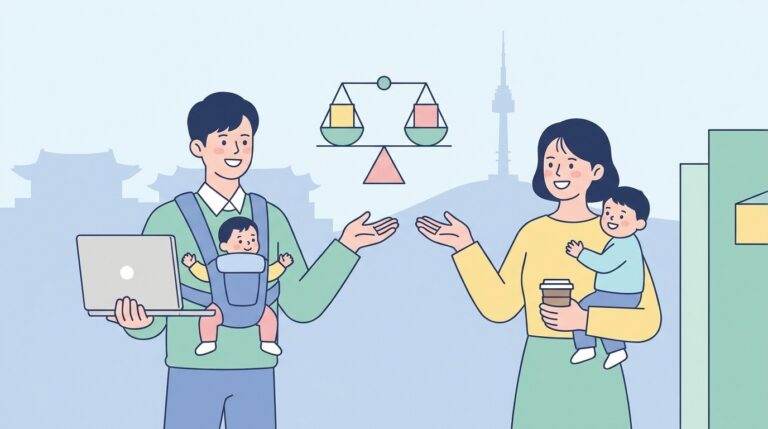
Reality Check: What Young Koreans Actually Think About the Low Birthrate
Phase 1: Empathy (Real Talk from Seoul)
안녕하세요! 매일한글 에디터입니다. (Hello! I am your Daily Hangul editor.)
If you have been watching recent K-Dramas like Because This Is My First Life or workplace reality shows, you have probably noticed a major shift in how young Koreans talk about their future. A generation ago, getting married in your late twenties and having two children was considered the standard life milestone. Today, when you sit down at an Euljiro cafe with Korean friends in their late twenties or thirties, the conversation sounds strikingly different. You will often hear weary sighs over iced Americanos: “How can anyone afford an apartment in Seoul?” or “Taking leave at my company is still so stressful.”
Korea’s low birthrate (저출산 – jeochulsan) and aging society (고령화 사회 – goryeonghwa sahoe) are not just dry economic statistics on the evening news; they represent deep daily anxieties about housing prices, brutal work hours, and competitive education costs. In response, both the Korean government and private companies are introducing support packages: expanded parental leave, flexible work hours, and special housing quotas for newlyweds. However, talking about these topics requires tact, empathy, and the right vocabulary. Many intermediate Korean learners tell us: “I want to join discussions about social issues with my Korean coworkers, but I only know stiff textbook words!”
This guide is crafted directly from real conversations on the streets of Seoul and workplace feedback from international professionals in Korea. By mastering these contemporary expressions, you will move beyond simple tourist small talk and connect with native speakers on the issues that genuinely shape their daily lives.
Phase 2: Core Expressions In-Depth Analysis
Here are three essential expressions you need to understand modern discussions about family support and work culture in Korea.
1. 육아휴직을 쓰다 (yuka-hyujik-eul sseuda)
- Pronunciation: yoo-gah-hyoo-jeek-eul sseu-dah (Rhymes loosely with “you-got-huge-eek” + “ssoo-dah”)
- Meaning: Literal: “To use childcare leave” | Real Nuance: “To take parental leave (for either mothers or fathers).”
- K-Culture Moment: In the office drama Misaeng, asking to take time off often required immense courage. Today, you will hear younger managers say: 남성 육아휴직도 점점 늘어나는 추세예요 (Namseong yuka-hyujik-do jeomjeom neureonaneun chuseyeyo – Male parental leave is also steadily increasing).
- Editor’s Insight: While textbook grammar suggests 육아휴직을 신청하다 (to formally apply for parental leave), in real office speech people almost universally say 육아휴직을 쓰다 (to use/take parental leave) or 육아휴직 들어가다 (to go on parental leave).
- Situation Spectrum: Casual: ✅ | Semi-formal: ✅ | Formal: ✅
- 🤔 Think About It: In many Western countries, parental leave is viewed as an individual legal entitlement. Why do you think Korean employees often feel the need to say “눈치 보며 쓰다” (to take leave while anxiously reading others’ reactions)?
2. 유연근무제 (yuyeon-geunmuje)
- Pronunciation: yoo-yeon-geun-moo-jeh (Think “you-yawn” + “gun” + “moo-jeh”)
- Meaning: Literal: “Flexible work system” | Real Nuance: “Flexible working arrangements (staggered hours, core-time systems, or telecommuting).”
- K-Culture Moment: Tech employees in Pangyo Silicon Valley sharing their daily schedule on YouTube vlogs: 저희 회사는 유연근무제라서 출퇴근이 자유로워요 (Jeohui hoesaneun yuyeon-geunmujeraseo chultoegeuni jayurowoyo – Our company uses flexible work hours, so commuting times are flexible).
- Editor’s Insight: Combining 유연 (flexible) and 근무제 (work system), this term is the ultimate corporate buzzword for 워라밸 (worabal – work-life balance). It signifies a departure from the traditional 9-to-6 mandatory office culture.
- Situation Spectrum: Casual: ✅ | Semi-formal: ✅ | Formal: ✅
- 🤔 Think About It: How does introducing flexible working hours redefine traditional Korean workplace loyalty, which was historically demonstrated by staying late until your boss went home?
3. 신혼부부 특별공급 [특공] (sinhon-bubu teukbyeol-gonggeup [teukgong])
- Pronunciation: sheen-hon-boo-boo teuk-byeol-gong-geup / Shortened: teuk-gong
- Meaning: Literal: “Newlywed special supply” | Real Nuance: “Government apartment subscription quota reserved exclusively for newlyweds.”
- K-Culture Moment: Friends at a wedding reception leaning in to whisper: 이번에 청약 넣었어? 신혼부부 특공 노려봐! (Ibeone cheongyak neoeosseo? Sinhon-bubu teukgong noryeobwa! – Did you apply for the apartment lottery? You should target the newlywed quota!)
- Editor’s Insight: Real estate is practically Korea’s national pastime. The term 특별공급 is almost always shortened to 특공 (teukgong) in casual and semi-formal conversations among friends and colleagues.
- Situation Spectrum: Casual: ✅ (특공) | Semi-formal: ✅ | Formal: ✅ (신혼부부 특별공급)
- 🤔 Think About It: In your home country, is affordable housing linked to marriage and birthrates through state-sponsored lotteries, or handled purely by private markets?
Phase 3: Textbook Korean vs. Real-Life Korean
Situation 1: Talking about someone taking parental leave
- 📖 교과서 한국어 (Textbook Korean):
김 대리님은 내일부터 육아를 위한 법적 휴직을 시작하십니다. (Gim daerinimeun naeilbuteo yukareul wihan beopjeok hyujigeul sijakhasimnida.)
“Assistant Manager Kim will commence statutory leave for infant care starting tomorrow.” - 🗣️ 진짜 한국어 (Real-Life Korean):
김 대리님 내일부터 육아휴직 들어가세요. (Gim daerinim naeilbuteo yuka-hyujik deureogaseyo.)
*”Assistant Manager Kim is starting parental leave tomorrow.” - 💡 왜 다를까? (Why is it different?): Textbook phrasing uses heavy, legalistic vocabulary like 법적 휴직 (statutory leave). Real Koreans use the dynamic verb phrase 들어가다 (to enter into / start an extended period of absence).
Situation 2: Asking if your company allows staggered commute times
- 📖 교과서 한국어 (Textbook Korean):
우리 회사는 탄력적인 노동 시간 제도를 시행하고 있습니까? (Uri hoesaneun tallyeokjeogin nodong sigan jedeoreul sihaenghago itseumnikka?)
“Is our company implementing an elastic labor duration regulation?” - 🗣️ 진짜 한국어 (Real-Life Korean):
저희 팀도 시차출퇴근제나 유연근무 쓸 수 있어요? (Jeohui timdo sicha-chultoegeunje-na yuyeon-geunmu sseul su isseoyo?)
*”Can our team also use staggered hours or flexible schedules?” - 💡 왜 다를까? (Why is it different?): While 탄력근무제 exists in labor manuals, modern office workers specifically ask for 시차출퇴근제 (staggered commute times) or simply 유연근무 (flexible work).
Phase 4: K-Culture Deep Dive & Non-Verbal Manners
4-1. 눈치 (Nunchi) & Delicate Gestures
When discussing marriage, children, and government welfare benefits in Korean workplaces, your non-verbal cues matter as much as your grammar:
* The Empathetic Tilt: When a colleague shares their struggle balancing work and family, maintain gentle eye contact and nod slowly with a slight head tilt. Avoid wide-eyed shock or loud exclamations.
* Avoid Direct Inquiries on Marital Status: Never ask a coworker, “결혼 언제 하세요?” (Gyeolhon eonje haseyo? – When are you getting married?) or “아이 계획 있으세요?” (Ai gyehoek isseuseyo? – Do you have plans for children?). These personal questions are now considered insensitive boundary violations (사생활 침해).
* Supportive Agreement: Instead of prying, use sympathetic filler phrases like “요즘은 다들 고민이 많죠” (Yojeumeun dadeul gomini manjyo – Everyone has a lot on their minds these days) with hands loosely folded in front of you.
4-2. Cultural Code Analysis: The Reality Behind “워킹맘” (Working Moms) & “육아대디” (Parenting Dads)
In popular K-Dramas like Work Later, Drink Now or Green Mothers’ Club, parenting in modern Korea is depicted as an intense tag-team sport. The concept of 독박육아 (dokbak-yuka – solo parenting without partner support) was long a grievance among Korean women.
Today, the government’s aggressive push for “3+3 육아휴직제” (incentivizing both parents to take simultaneous leave) has spurred a major social shift. You will see young fathers pushing luxury strollers in Hangang parks on Tuesday mornings—a scene that would have been unthinkable twenty years ago. Understanding this cultural pivot helps you appreciate why policies like 유연근무제 are not viewed as minor perks, but as existential lifelines for young households.
Phase 5: Real-Life Roleplay Scenario
Setting: A cozy coffee shop near an IT hub in Pangyo during Friday lunch break.
Characters:
* 민재 (Min-jae): Senior Team Lead, recently returned from a 6-month paternity leave.
* 알렉스 (Alex – You): Foreign marketing specialist preparing to settle down long-term in Seoul.
Dialogue:
- 알렉스: 민재 팀장님, 복귀하신 지 벌써 한 달 되셨네요. 육아휴직 어떠셨어요?
(Min-jae timjangnim, bokgwihasin ji beolsseor han dal doesyeonneyo. Yuka-hyujik eotteosyeosseoyo?)
🎭 Leaning forward politely with warm interest
“Team Lead Min-jae, it has already been a month since you returned. How was your parental leave?” -
민재: 솔직히 회사 일보다 힘들더라고요! 그래도 아이랑 애착을 쌓을 수 있어서 정말 값진 시간이었어요.
(Soljiki hoesa ilboda himdeuldeoragoyo! Geuraedo airang aechageul ssaeul su isseoseo jeongmal gapjin siganieosseoyo.)
🎭 Chuckling with affectionate exhaustion
“Honestly, it was harder than office work! But bonding with my baby made it truly worthwhile.” -
알렉스: 요즘은 남자 직원분들도 육아휴직 많이 쓰는 분위기인가 봐요.
(Yojeumeun namja jigwonbundeuldo yuka-hyujik mani sseuneun bwiginka bwayo.)
🎭 Nodding thoughtfully
“It seems like many male employees are taking parental leave these days.” -
민재: 맞아요. 정부 지원금도 늘었고, 회사에서도 유연근무제를 적극 장려하고 있거든요.
(Majayo. Jeongbu jiwongeumdo neureotgo, hoesaeseodo yuyeon-geunmujereul jeokgeuk jangnyeohago itgeodeunyo.)
🎭 Smiling proudly while sipping coffee
“Exactly. Government subsidies increased, and our company actively encourages flexible hours too.” -
알렉스: 그래도 서울 집값 생각하면 아직 결혼이나 육아가 부담스럽긴 하죠.
(Geuraedo Seoul jip-gap saenggakhamyeon ajik gyeolhon-ina yukaga budamseureopgin hajyo.)
🎭 Speaking in a quiet, sympathetic tone
“Still, thinking about Seoul housing prices, marriage and child-rearing must feel burdensome.” -
민재: 그게 가장 큰 문제예요. 그래서 다들 신혼부부 특공에 목을 매는 거죠.
(Geuge gajang keun munjeyeyo. Geuraeseo dadeul sinhon-bubu teukgonge mogeul maeneun geojyo.)
🎭 Sighing softly while nodding in total agreement
“That is the biggest issue. That is why everyone desperately pins their hopes on the newlywed housing quota.” -
알렉스: 지원 정책이 더 다양해져서 청년들 부담이 좀 줄어들면 좋겠어요.
(Jiwon jeongchaegi deo dayanghaejyeoseo cheongnyeondeul budami jom jureodeulmyeon jokesseoyo.)
🎭 Offering an encouraging half-smile
“I really hope support policies diversify more so young people carry less burden.” -
민재: 그러게요. 그래도 알렉스 씨처럼 공감해 주는 동료가 있어서 든든하네요!
(Geureogeyo. Geuraedo Alex-ssicheoreom gonggamhae juneun dongnyoga isseoseo deundeunhaneyo!)
🎭 Tapping Alex lightly on the shoulder with appreciation
“Indeed. Still, it feels reassuring to have an understanding teammate like you, Alex!”
🔀 Interactive Branching Moment
Min-jae asks you about your plans for the weekend. How do you respond?
- Option A: “저도 이번에 한국에서 오래 살고 싶어서 신혼부부 특공이나 주택 청약 조건들을 좀 찾아보려고요!” (I want to live in Korea long-term, so I plan to research newlywed quotas and apartment subscription rules!)
- 👉 Feedback [Best]: Natural, respectful, and demonstrates you understand local life goals and Korean civic systems.
- Option B: “팀장님 집은 자가예요? 전세예요? 대출 얼마나 받으셨어요?” (Is your home owned or jeonse? How much loan did you take out?)
- 👉 Feedback [Risk]: Inquiring directly into private debt and housing equity feels intrusive unless you are intimate childhood friends.
- Option C: “한국은 애 낳으면 돈 준다는데 그냥 빨리 낳는 게 이득 아닌가요?” (Korea pays money if you have a kid, so isn’t it more profitable to have one quickly?)
- 👉 Feedback [Bad]: Trivializes complex socio-economic hardship and sounds deeply cynical.
Phase 6: 10-Second Emotion Shadowing Drill
Practice matching the exact rhythm, pause breaks (/), and emotional resonance of a native speaker.
- Drill 1 [😊 부드럽고 공감하며 – Gentle & Empathetic]:
“요즘은 회사에서도 / 육아휴직을 / 적극적으로 권장하는 편이에요.”
(Yojeumeun hoesaeseodo / yuka-hyujigeul / jeokgeukjeogeuro gwonjanghaneun pyeonieoyo.)
“These days, even companies / tend to actively / encourage parental leave.” -
Drill 2 [🤔 조심스럽고 현실적으로 – Thoughtful & Realistic]:
“주택 문제가 해결되지 않으면 / 청년들이 결혼을 망설일 수밖에 / 없죠.”
(Jutaek munjega haegyeoldoeji aneumyeon / cheongnyeondeuri gyeolhoneul mangseoril subakke / eopjyo.)
“Unless housing issues are resolved, / young people have no choice / but to hesitate about marriage.” -
Drill 3 [✨ 희망차고 지지하며 – Warm & Encouraging]:
“유연근무제가 확대되어서 / 일과 삶의 균형이 / 꼭 맞춰지면 좋겠어요.”
(Yuyeon-geunmujega hwakdaedoeeoseo / ilgwa salmui gyunhyeongi / kkok matchwojimyeon jokesseoyo.)
“With flexible hours expanding, / I truly hope / work and life achieve a healthy balance.”
Phase 7: K-Culture Mini Dictionary
-
워라밸 (Worabal)
Pronunciation: wo-ra-bael | English: Work-Life Balance
Usage: Short for “Work-Life Balance” (워크-라이프 밸런스). Used extensively in recruitment, corporate reviews, and daily social banter (e.g., “우리 회사는 워라밸이 정말 좋아요”). -
딩크족 (DINK-jok)
Pronunciation: ding-keu-jok | English: DINK (Dual Income, No Kids) Couples
Usage: Combines the English acronym DINK with the Korean suffix 족 (tribe/group). Refers to intentionally child-free married couples focusing on career and lifestyle. -
영끌 (Yeongkkeul)
Pronunciation: yeong-kkeul | English: Gathering Every Last Penny (Soul-pulling)
Usage: An abbreviation of “영혼까지 끌어모으다” (pulling together even your soul). Represents the extreme financial stretch young Koreans make to secure mortgage down payments before real estate prices spike. -
저출산 (Jeochulsan)
Pronunciation: jeo-chul-san | English: Low Birthrate
Usage: The formal sociological term used in broadcasts and newspapers to discuss population decline, fertility rates, and demographic shifts.
Phase 8: Traveler & Expat Survival Kit
Top 3 Real-Life Survival Phrases:
- “임산부 배려석 비워둘게요.” (Imsanbu baeryeoseok biwodulgeyo.)
Pro Tip: Said on subways or buses regarding the pink seats designated for pregnant passengers: “I will leave the maternity courtesy seat vacant.” - “유연근무 신청 어디서 하나요?” (Yuyeon-geunmu sincheong eodiseo hanayo?)
Pro Tip: Crucial for expats at Korean companies: “Where do I submit my application for flexible work hours?” - “가족돌봄휴가 쓸 수 있을까요?” (Gajok-dolbom-hyuga sseul su isseulkkayo?)
Pro Tip: Essential for unexpected family emergencies: “May I take family-care emergency leave?”
Editor’s Travel & Life Note:
- Public Transit Courtesy: In Seoul Metro (Lines 1–9), you will notice pink-hued seats marked 임산부 배려석 (Seats reserved for expectant mothers). Even when trains are packed, locals customarily leave them unoccupied. Keeping them empty is a visible demonstration of social consideration.
- Essential Navigation: When commuting during staggered work hours, always check real-time crowd levels using the Seoul Subway official transit updates on Naver Map. It displays accurate car-by-car passenger congestion rankings.
Phase 9: 한 발 더 깊이 (One Step Deeper)
For decades, South Korea’s miraculous economic rise was powered by an unspoken social contract: fierce sacrifice, endless overtime, and dedicating your youth to the collective benefit of the family and company. Today’s 2030 generation (twenties and thirties) is renegotiating that contract. They cherish personal fulfillment, mental health, and financial autonomy just as much as traditional milestones. Supporting policies like expanded parental leave and newlywed housing allotments are not viewed simply as financial handouts; they represent an ongoing societal evolution to create a world where young people feel safe bringing new life into the future.
💬 Your Turn: In your own country, what is the biggest reason young people choose to postpone or embrace family life? Is it housing, career pressure, or personal lifestyle? Drop your perspective in the comments below!
Phase 10: FAQ & Common Mistakes
Q: Can foreign residents in Korea apply for newlywed housing special quotas (신혼부부 특공)?
A: Generally, publicly subsidized apartment subscriptions (청약) require Korean citizenship or permanent residency for primary holders. However, international expats legally married to Korean nationals can frequently qualify under multicultural family provisions or joint-household quota categories.
Q: Is taking paternity leave (남성 육아휴직) still looked down upon in Korean companies?
A: While smaller, traditional manufacturing or family-owned businesses (중소기업) may still exhibit subtle peer resistance (눈치), major conglomerates (대기업) and public corporations now mandate and actively celebrate male parental leave. In fact, many companies penalize managers whose teams fail to utilize their allotted leave.
Q: What is the practical difference between 유연근무제 and 재택근무?
A: 유연근무제 is an umbrella term covering all flexible working systems, including staggered arrival times (시차출퇴근) and compressed workweeks. 재택근무 (jaetaek-geunmu) refers specifically to telecommuting or working remotely from home.
🚨 Common Mistakes Alert:
- ❌ Mistake: Using “애기 휴가” (baby vacation).
- ✅ Correct Action: Say 육아휴직 (parental leave) or 출산휴가 (maternity leave). 휴직 specifies formal leave, while 휴가 usually implies vacation.
- ❌ Mistake: Asking coworkers “왜 애 안 낳으세요?” (Why aren’t you having kids?).
- ✅ Correct Action: Keep discussions general: “요즘 육아 지원 정책이 많이 늘었네요” (Childcare support policies have increased a lot these days).
- ❌ Mistake: Pronouncing 특공 as “teuk-kong” with aspirated ‘k’.
- ✅ Correct Action: Pronounce it with a firm tense stop: 특공 [teuk-gong].
Phase 11: Action Missions & Engagement
- 🥉 Bronze Mission (Solo Mastery): Practice saying “유연근무제 덕분에 워라밸이 좋아졌어요” (Thanks to flexible work hours, my work-life balance improved) three times aloud in front of a mirror with smooth natural rhythm.
- 🥈 Silver Mission (Social Connection): Leave a comment on a Korean creator’s lifestyle vlog using the phrase: “육아휴직 응원합니다! 힘내세요!” (Supporting your parental leave! Cheer up!).
- 🥇 Gold Mission (Real Life): Next time you chat with a Korean coworker or language partner, ask their perspective on work flexibility: “회사에서 유연근무제 써보신 적 있으세요?” (Have you ever used flexible work hours at your company?).
- 🎮 K-Culture Mission: Watch an episode of a modern Korean office drama (such as Agency or Doctor Cha) and listen closely for the words 육아휴직, 특공, or 워라밸.
Phase 12: Interactive Quiz Challenge
Test how well you understand the language of modern Korean society!
1. Situational Judgment
Your coworker Min-ji just announced she is having a baby. What is the most supportive and natural Korean phrase to say?
* A) 왜 일 그만두세요? (Why are you quitting work?)
* B) 육아휴직 편하게 쓰시고 몸조리 잘하세요! (Please take your parental leave comfortably and take good care of your health!)
* C) 신혼부부 특공 당첨되었어요? (Did you win the newlywed apartment lottery?)
2. Fill-in-the-Blank
출퇴근 시간을 자유롭게 조정하는 제도를 “________”(이)라고 불러요.
(The system where you freely adjust commuting hours is called ________.)
3. Cultural True or False
In modern Korea, the abbreviation “특공” is frequently used in casual real estate conversations to mean “Special Attack Unit” rather than housing quotas. (True / False)
👉 Click to reveal answers & explanations!
- Answer: B | Wishing someone comfortable use of their leave (육아휴직) and good postpartum health recovery (몸조리) is the warmest, most respectful workplace etiquette.
- Answer: 유연근무제 (Flexible work system) | Or specifically 시차출퇴근제 (staggered commute system).
- Answer: False | While 특공 historically came from 특수공격대 (Special Attack Forces), in modern civilian everyday life, it almost exclusively refers to 신혼부부 특별공급 (Special Housing Allocation for Newlyweds).







