

Phase 1: Empathy (Real-Life Opening)
안녕하세요! 매일한글 에디터입니다. (Hello! I’m your Daily Hangul editor.)
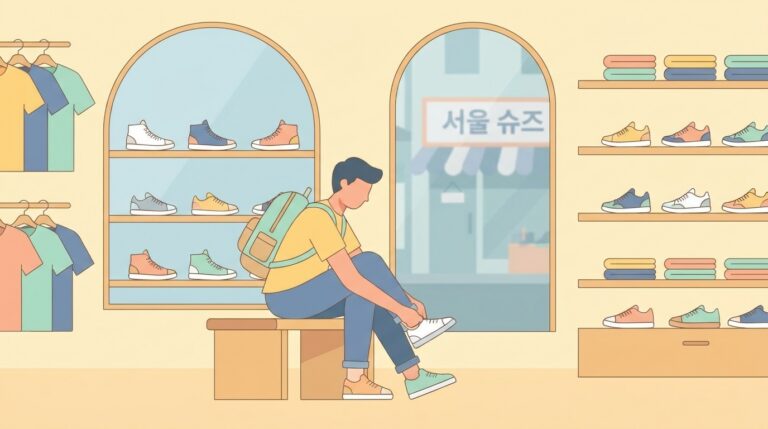
Imagine walking down the stylish streets of Seongsu-dong (성수동), famous for its bespoke shoe ateliers and trendy pop-up shops. You spot a sleek pair of loafers or minimalist sneakers in a boutique window. Your heart skips a beat—they look stunning! You step inside, eager to try them on. But as soon as you slide your foot in, you feel that all-too-familiar pinch across your toes. Korean shoe silhouettes often taper sharply at the sides, meaning standard sizes can feel unusually tight for many international visitors.
You want to ask the clerk if they have a half size larger because your feet are a bit wide. However, your mind goes blank. How do you describe foot width without sounding rude or awkward? Do you say “My foot is big” or “The shoe is small”? You don’t want to leave empty-handed with blister-inducing shoes, nor do you want to awkwardly gesture at your feet while blushing.
Don’t worry! This guide is crafted specifically from actual learner experiences and everyday shopping reality in Seoul. Today, you will master the gentle, natural way Koreans talk about shoe width, comfort, and color comparisons at an easy A2 level. Let’s make sure your next shopping spree is 100% painless!
Phase 2: Core Expressions Breakdown
1. 발볼이 넓은 편이에요 (Balbori neolbeun pyeon-ie-yo)
- Pronunciation: [Bal-bo-ri neol-beun pyeon-ee-yo] (Think of ‘bal’ like ‘ball’, and ‘pyeon’ rhyming with ‘yawn’ but starting with a snappy ‘py’ sound.)
- Meaning: Literal: “My foot-ball is on the wide side.” / Nuance: “My feet are a bit on the wider side.”
- K-Culture Moment: In K-dramas where characters go shopping before a makeover date, you often hear them casually mention their foot traits to the boutique attendant with this soft sentence ending.
- Editor’s Insight: In Korean, rather than flatly stating “My feet are wide” (발이 넓어요), native speakers soften descriptions of their bodies using
-(으)ㄴ 편이다(“on the side of”). It sounds modest, polite, and completely natural. - Situation Spectrum:
- Casual (Friends): ⚠️ (Use 발볼 넓은 편이야)
- Semi-formal (Store clerks, everyday public): ✅ Perfect
- Formal (Job interview, official speech): 🚫 (Too casual for high formality)
- 🤔 Think About It: Why do you think Korean uses “on the side of” instead of direct adjectives when talking about personal physical traits?
2. 반 사이즈 크게 신는 게 편해요 (Ban sa-i-jeu keu-ge sin-neun ge pyeon-hae-yo)
- Pronunciation: [Ban sa-ee-jeu keu-ge shin-neun ge pyon-hae-yo] (Say ‘ban’ like ‘bun’, and ‘ge’ like the ‘ge’ in ‘get’.)
- Meaning: Literal: “Wearing half-size bigger is comfortable.” / Nuance: “Going up half a size is much more comfortable for me.”
- K-Culture Moment: Commonly heard in Korean sneaker unboxing videos on YouTube when creators advise viewers on sizing up for chunky streetwear kicks.
- Editor’s Insight: Notice the verb
신다(sinda), which exclusively means “to wear on one’s feet.” English uses “wear” for everything, but in Korean, shoes, socks, and stockings always use신다! - Situation Spectrum:
- Casual: ⚠️ (반 사이즈 크게 신는 게 편해)
- Semi-formal: ✅ Perfect
- Formal: ✅ (반 사이즈 크게 신는 것이 편합니다)
- 🤔 Think About It: How does your native language distinguish verbs for wearing items on different parts of the body?
3. 다른 색상도 신어볼 수 있나요? (Dareun saek-sang-do sin-eo-bol su innayo?)
- Pronunciation: [Da-reun saek-ssang-do shin-eo-bol su in-na-yo?] (Imagine saying ‘saek’ like ‘sack’, followed by a crisp ‘ssang’.)
- Meaning: Literal: “Can I also try putting on a different color?” / Nuance: “Could I try this in another color as well?”
- K-Culture Moment: When shopping in Dongdaemun or Hongdae, you will hear shoppers ask this while pointing back and forth between display shoes.
- Editor’s Insight:
색상(saeksang) sounds slightly more professional and shopping-oriented than the basic word색(saek). Using~아/어 보다(“to try doing something”) turns an order into a polite request. - Situation Spectrum:
- Casual: ⚠️ (다른 색도 신어볼 수 있어?)
- Semi-formal: ✅ Perfect
- Formal: ✅ (다른 색상도 착용해 볼 수 있습니까?)
- 🤔 Think About It: In customer service situations, why does asking “May I try?” create a more cooperative atmosphere than saying “Show me another color”?
Phase 3: Textbook Korean vs. Real Korean
Situation 1: Asking for a bigger size
- 📖 Textbook Korean: 더 큰 신발을 주세요. (Deo keun sinbareul juseyo. / “Give me bigger shoes.”)
- 🗣️ Real Korean: 반 사이즈 큰 걸로 신어볼게요. (Ban sa-i-jeu keun geollo sin-eobolgeyo. / “I’ll try a half-size larger one.”)
- 💡 Why is it different? The textbook phrasing can sound demanding or blunt in retail settings. Real Koreans express what they intend to try on (
신어볼게요), which treats the fitting room experience as an active collaboration with the staff.
Situation 2: Expressing that the shoes feel tight
- 📖 Textbook Korean: 이 신발은 작습니다. (I sinbareun jakseumnida. / “These shoes are small.”)
- 🗣️ Real Korean: 옆이 좀 끼네요. (Yeobi jom kki-ne-yo. / “It pinches a bit on the sides.”)
- 💡 Why is it different? Saying a shoe “is small” sounds like you are diagnosing a defect. Saying
옆이 좀 끼네요accurately points out the specific sensation of narrowness, immediately signaling to the staff that width, not overall length, is the issue.
Phase 4: K-Culture Deep Dive & Non-Verbal Manners
4-1. Nunchi (눈치) & Body Language at Shoe Stores
- Always look for the shoehorn (구두주걱): When trying on leather shoes or loafers in Korea, crushing the back heel is considered extremely bad manners. Staff will appreciate your respect for the merchandise if you reach for the provided long shoehorn (구두주걱, gudujugeok).
- The Soft Side Glance: When checking fit, gently shift your weight and lightly tap the toe of your shoe on the floor while glancing at the clerk. Saying
음, 발볼이 조금...(Eum, balbori jogeum… / “Hmm, the width is a little…”) allows the clerk to exercise nunchi and instantly fetch a wider size without putting you on the spot.
4-2. Cultural Insight: The Millimeter System & Seongsu-dong Ateliers
In South Korea, shoe sizes are measured strictly in millimeters (mm), such as 240, 255, or 270. Half sizes exist in 5mm increments (e.g., 260 to 265). In places like Seongsu-dong, many local shops will even offer to stretch the width (발볼 넓힘 서비스) for free if you love the design but need an extra millimeter of room around your toes!
Phase 5: Real-Life Roleplay Scenario
Setting: ShoeBox Hongdae, an energetic boutique with pop music softly playing. A tidy display rack shows off the latest autumn collection.
Characters:
* Min-jun (민준): The attentive, friendly 20-something store clerk wearing an apron.
* You: A traveler hunting for comfortable walking shoes.
[1] 민준: 손님, 찾으시는 사이즈 있으세요?
    (Sonnim, chajeusineun sa-i-jeu isseuseyo?)
    "Customer, is there a size you are looking for?"
    🎭 Smiling politely with hands folded in front.

[2] You: 네, 이거 260으로 신어볼 수 있나요?
    (Ne, igeo i-baek-yuk-sipeuro sin-eo-bol su innayo?)
    "Yes, can I try this in 260?"
    🎭 Pointing gently with an open palm toward the beige sneaker.

[3] 민준: 네, 잠시만요! 가져다드릴게요.
    (Ne, jamsimanyo! Gajyeodadeurilgeyo.)
    "Sure, one moment! I'll bring it right over."
    🎭 Dashes to the stockroom and returns quickly with the box.

[4] You: (신어본 뒤) 음, 조금 꽉 끼는 것 같아요.
    (Eum, jogeum kkwak kki-neun geot gat-ayo.)
    "Hmm, it feels a bit tight."
    🎭 Wiggling toes and checking the mirror with a thoughtful expression.

[5] 민준: 길이가 작으세요, 아니면 발볼이 끼시나요?
    (Giriga jageuseyo, animyeon balbori kkisinayo?)
    "Is the length too short, or is the width pinching?"
    🎭 Kneeling down respectfully to observe the fit.

[6] You: 제가 발볼이 넓은 편이라 반 사이즈 크게 신는 게 편해요.
    (Jega balbori neolbeun pyeon-ira ban sa-i-jeu keu-ge sin-neun ge pyeon-hae-yo.)
    "My feet are on the wide side, so going up half a size is comfortable."
    🎭 Lightly patting the side of the sneaker.

[7] 민준: 아, 그러시면 265로 신어보세요. 착용감이 훨씬 편하실 거예요.
    (A, geureosimyeon i-baek-yuk-sib-o-ro sin-eoboseyo. Chakyonggami hwolssin pyeonhasil geoyeyo.)
    "Ah, in that case, try on 265. The fit will be much more comfortable!"
    🎭 Handing over the fresh pair with two hands.

[8] You: 와, 딱 맞네요! 다른 색상도 있나요?
    (Wa, ttak manne-yo! Dareun saek-sang-do innayo?)
    "Wow, it fits perfectly! Do you have this in other colors too?"
    🎭 Smiling brightly and walking a few steps across the carpet.
🔀 Interactive Choice Moment
After trying on the 265, you notice the black version looks very stylish on the shelf. What do you say to Min-jun?
* Choice A: 저기요, 까만색 줘요. (Jeogiyo, kkamansaek jwoyo.)
* Choice B: 블랙 색상도 265로 한번 신어봐도 될까요? (Beullaek saeksangdo i-baek-yuk-sib-o-ro hanbeon sin-eobwado doelkkayo?)
* Choice C: 이 신발은 색이 마음에 안 들어요. (I sinbareun saegi maeume an deureoyo.)
Feedback:
* Choice A (Risk): Too blunt! Saying 줘요 (give me) without polite hedges can come across as demanding or cold.
* Choice B (Best!): Outstanding! It clearly states the color, the exact size, and softens the request with 한번 ~해봐도 될까요? (“Could I try…?”).
* Choice C (Bad): Saying you don’t like the color directly can make the clerk feel awkward after helping you find the right fit.
Phase 6: 10-Second Emotion Shadowing Drill
Practice these lines out loud! Follow the pause slashes (/) and tap into the emotion.
[👟 Polite & Inquiring]
발볼이 넓은 편이라 / 반 사이즈 크게 신는 게 편해요.
(Balbori neolbeun pyeon-ira / ban sa-i-jeu keu-ge sin-neun ge pyeon-hae-yo.)-
[😌 Comfortable & Relieved]
우와, / 265가 / 훨씬 착용감이 편하네요!
(U-wa, / i-baek-yuk-sib-o-ga / hwolssin chak-yong-gami pyeon-ha-ne-yo!) -
[✨ Curious & Excited]
이 가방이랑 / 같은 색상 신발도 / 신어볼 수 있나요?
(I gabang-i-rang / gateun saeksang sinbaldo / sin-eo-bol su innayo?)
Phase 7: K-Culture Mini Dictionary
- 발볼 (Bal-bol)
- Meaning: Foot width / the ball of the foot.
- Usage: Essential whenever you shop for footwear in Korea. Add
넓다(wide) or좁다(narrow) to describe your build.
- 착용감 (Chak-yong-gam)
- Meaning: Wear comfort / fit texture.
- Usage: Combines 착용 (wearing) + 감 (feeling). Used constantly in fashion reviews for shoes, bags, and outerwear.
- 치수 (Chi-su)
- Meaning: Measurement / size denomination.
- Usage: Often interchangeable with 사이즈 (sa-i-jeu). You will hear: 한 치수 크게 주세요 (“Please give me one size up”).
- 품절 (Pum-jeol)
- Meaning: Sold out / out of stock.
- Usage: If a popular color or size is unavailable, clerks will regretfully say:
그 사이즈는 품절입니다(That size is sold out).
Phase 8: Traveler’s Survival Kit
Top 3 Survival Expressions
- 이거 260(이백육십) 있어요? (Igeo i-baek-yuk-sip isseoyo? / “Do you have this in 260?”)
- Pro Tip: Korean shoe sizes correspond to centimeters multiplied by 10 (26 cm = 260 mm).
- 가방 무게가 가벼운 편인가요? (Gabang muge-ga gabyeo-un pyeon-in-gayo? / “Is this bag on the lighter side?”)
- Pro Tip: Ideal when browsing leather bags where weight is a deciding factor.
- 양쪽 다 신어봐도 돼요? (Yangjjok da sin-eobwado dwaeyo? / “Can I try on both feet?”)
- Pro Tip: Stores usually display only one shoe (typically the right shoe). Always ask before slipping both on!
Editor’s Travel Note
- Navigate your way to famous shoe hubs like Seongsu Handmade Shoe Street or Hongdae shopping alleys by downloading the Naver Map app mobile guide. Google Maps often lacks walking paths in Korea, making Naver Map your ultimate travel partner.
- Credit cards and mobile payments (Apple Pay, Samsung Pay) are standard in almost all shoe stores, but tax-free refunds are instant if you show your physical passport at the register!
Phase 9: One Step Deeper
In Korean communication, relational harmony (hwa, 화) is maintained by softening personal statements. When you say 발볼이 넓은 편이에요 (“My feet are on the wide side”), you avoid making an absolute statement. This pattern -(으)ㄴ 편이다 shows up constantly in Korean social life—whether discussing your personality, spice tolerance, or clothing preferences. It invites the other person into a dialogue rather than dropping a rigid fact.
💬 Your Turn: Do you usually size up or stick to true-to-size when buying shoes? Let us know in the comments using ~편이에요!
Phase 10: FAQ & Common Mistakes
Q: How do I convert US/UK/EU shoe sizes into Korean millimeters?
A: A general rule of thumb: US Men’s 8.5 is roughly 265mm; US Women’s 7 is roughly 240mm. EU 38 is approximately 240mm-245mm. Check the conversion chart on your phone beforehand, as Korean sizes strictly use millimeters.
Q: Can I ask to stretch a shoe if it feels slightly tight around the toes?
A: Yes! At specialty shoe shops or department stores, ask: 발볼 좀 늘려주실 수 있나요? (Balbol jom neullyeojusil su innayo? / “Could you stretch the width a bit?”). Many shoe stores have a mechanical stretcher on-site.
Q: What is the polite way to ask for matching bag colors?
A: Point to the bag and ask: 이 가방과 어울리는 신발 색상이 있을까요? (I gabanggwa eoullineun sinbal saeksangi isseulkkayo? / “Is there a shoe color that matches this bag?”).
🚨 Common Mistakes Warning Board
- Mistake: Saying
이 신발 입어볼게요(I sinbal ib-eobolgeyo).- Correction:
입다is only for clothes on your torso/legs. For shoes, always use신어볼게요(sin-eobolgeyo).
- Correction:
- Mistake: Asking for sizes in inches or generic numbers like “Size 8”.
- Correction: Always say the millimeter number (e.g.,
이백오십오/ 255mm).
- Correction: Always say the millimeter number (e.g.,
- Mistake: Stepping onto store carpets with your street shoes on.
- Correction: In high-end shoe boutiques, step onto the designated fitting rug with socks on, or use the shoe mats provided.
Phase 11: Action Mission & Engagement
- 🥉 Bronze Mission (Solo): Look at your favorite pair of sneakers right now. Say out loud in Korean:
내 발볼은 넓은 편이에요(My foot width is on the wide side) 3 times with confidence. - 🥈 Silver Mission (Social): Leave a comment below comparing two colors using:
[Color A]보다 [Color B]가 더 예쁜 편이에요(Color B is on the prettier side compared to Color A). - 🥇 Gold Mission (Real-World): Walk into an ABC Mart or Korean boutique and ask the clerk directly:
반 사이즈 큰 걸로 신어볼게요(Ban sa-i-jeu keun geollo sin-eobolgeyo).
🎮 K-Culture Mission: Watch any Korean fashion vlog or variety show shopping episode this week. Listen closely for the word 착용감 (comfort/fit) and comment when you spot it!
Phase 12: Interactive Quiz Challenge
Question 1 (Situational): You tried on a leather shoe, and your toes feel squished sideways, but the length is fine. What is the most natural thing to say to the clerk?
* A) 발이 너무 뚱뚱해요. (Bari neomu ttungttunghaeyo.)
* B) 발볼이 넓은 편이라 반 사이즈 크게 신어볼게요. (Balbori neolbeun pyeon-ira ban sa-i-jeu keu-ge sin-eobolgeyo.)
* C) 신발을 다시 만드세요. (Sinbareul dasi mandeuseyo.)
Question 2 (Fill in the Blank): Complete the sentence with the correct verb for trying on shoes:
“다른 색상도 한번 (________) 볼 수 있나요?”
* A) 입어 (ibeo)
* B) 신어 (sineo)
* C) 써 (sseo)
Question 3 (True or False): In Korea, shoe sizes are typically labeled in UK/US single-digit numbers rather than millimeters.
* (True / False)
Click here for Answers and Explanations!
- Q1 Answer: B
- Explanation: Choice B politely explains your foot profile using
-(으)ㄴ 편이라and requests a half-size up. Choice A is overly self-critical, and Choice C is completely impolite!
- Explanation: Choice B politely explains your foot profile using
- Q2 Answer: B (신어)
- Explanation: Shoes are always paired with
신다(신어보다).입다is for clothing, and쓰다is for hats or glasses.
- Explanation: Shoes are always paired with
- Q3 Answer: False
- Explanation: Korea uses the millimeter (mm) system (e.g., 230, 245, 270) exclusively for shoe measurements.
- Explanation: Korea uses the millimeter (mm) system (e.g., 230, 245, 270) exclusively for shoe measurements.







