

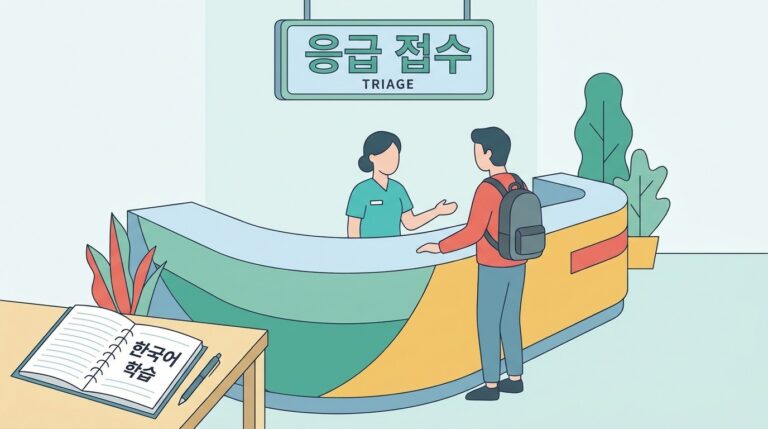
안녕하세요! 매일한글 에디터입니다.
Imagine this: It is 2:30 AM in Seoul. You’ve had a wonderful evening exploring the neon-lit alleyways of Hongdae or enjoying street food in Busan. Suddenly, a sharp, burning pain grips your lower stomach. You break out in a cold sweat. In K-dramas like Hospital Playlist or Romantic Doctor, Teacher Kim, emergency rooms look intensely fast-paced, with doctors shouting clinical jargon and rushing stretchers through automatic doors.
In real life, arriving at a Korean emergency room (응급실, eung-geup-sil) at night can feel overwhelmingly intimidating—especially when you are hurting and the triage nurse asks you questions in rapid Korean. What if you cannot explain when the pain started? What if you cannot tell them how bad it hurts on a scale of 1 to 10?
Take a deep, calming breath. You are not alone. As your Daily Hangul cultural navigator, I have accompanied dozens of international friends through this exact midnight panic. Korea has one of the world’s most efficient emergency triage systems (KTAS), and knowing just a few foundational A2 phrases will get you prompt care, safe pain relief, and even a live medical interpreter on speakerphone. Let us master these lifesavers together step by step.
Phase 2: 3 Key Expressions Deep Dive
1. 언제부터 아팠어요? (Eonjebuteo apasseoyo?)
- Pronunciation: Eon-je-bu-teo a-pa-sseo-yo? (Think of “un-jell” without the ‘l’ + “boo-toe” + “ah-pah-so-yo” like a warm sigh).
- Meaning: “When did it start hurting?” (Literal: From when were you sick/in pain?)
- K-Culture Moment: Every medical K-drama triage scene features this exact sentence. The triage nurse locks eyes with the patient, clipboard in hand, asking this first to determine urgency.
- Editor’s Insight: Notice the marker -부터 (-buteo), which means “from” or “since.” When answering, you can simply attach a time before it: 어제 저녁부터요 (Eoje jeonyeok-buteo-yo / Since yesterday evening) or 두 시간 전부터요 (Du sigan jeon-buteo-yo / Since two hours ago).
- Situation Spectrum:
- Casual: 언제부터 아팠어? (⚠️ Only with close friends)
- Semi-formal / Polite: 언제부터 아팠어요? (✅ Standard hospital triage)
- Formal: 증상이 언제부터 시작되었습니까? (✅ Official doctor consultation)
- 🤔 Think About It: In English, we often ask “How long has this been going on?” focusing on the duration. Korean triage staff instinctively ask for the exact starting point (from when). How does identifying the precise starting anchor change your sense of urgency?
2. 1부터 10 중에 7 정도예요 (Il-buteo sip junge chil jeongdoyeyo)
- Pronunciation: Il-bu-teo sip jung-e chil jeong-do-ye-yo (Pronounce chil like “chill” and jeong-do like “jung-dough”).
- Meaning: “On a scale of 1 to 10, it is about a 7.” (Literal: Among 1 to 10, it is around 7.)
- K-Culture Moment: Seen in emergency triage desks when staff evaluate whether you need immediate intravenous (IV) pain relief before formal blood tests.
- Editor’s Insight: Korean emergency staff use the KTAS (Korean Triage and Acuity Scale). 정도 (Jeongdo) means “about” or “around.” Adding 정도예요 softens your statement politely while clearly giving your pain rating.
- Situation Spectrum:
- Casual: 한 7 정도야 (⚠️ Casual only)
- Semi-formal: 1부터 10 중에 7 정도예요 (✅ Perfect for ER staff)
- Formal: 통증 척도 10점 만점에 7점입니다 (✅ Formal medical assessment)
- 🤔 Think About It: Many learners hesitate to rate pain high because Korean culture emphasizes enduring discomfort (cham-gi). But in an ER, being honest and direct saves lives. Are you more prone to understate or exaggerate pain in your own culture?
3. 의료 통역을 요청할 수 있어요? (Uiryo tong-yeog-eul yocheonghal su isseoyo?)
- Pronunciation: Ui-ryo tong-yeog-eul yo-cheong-hal su i-sseo-yo? (Ui-ryo sounds like “wee-ryo”; tong-yeok sounds like “tong-yuck”).
- Meaning: “Can I request medical interpretation?”
- K-Culture Moment: In modern university hospitals in Seoul, emergency desks connect foreign patients directly with medical interpretation hotlines (such as the 1330 Korea Travel Helpline or 119 emergency translation).
- Editor’s Insight: 요청할 수 있어요? is the gold standard A2 polite question pattern: Verb stem + -(으)ㄹ 수 있어요? (“Can I…?”). Memorize this structure; it works for anything you need in Korea.
- Situation Spectrum:
- Casual: 통역 불러줘 (🚫 Inappropriate in an ER)
- Semi-formal: 의료 통역 요청할 수 있어요? (✅ Natural and clear)
- Formal: 외국어 의료 통역 서비스를 부탁드립니다 (✅ Very formal registration)
- 🤔 Think About It: Asking for an interpreter is not a sign of weakness; it prevents medical errors. Why do many travelers feel guilty asking for interpretation support?
Phase 3: Textbook Korean vs. Real Korean
Situation 1: Explaining your symptoms at the intake desk
- 📖 Textbook Korean: 어디가 불편하십니까? (Eodiga bulpyeonhasimnikka? / Where are you experiencing discomfort?)
- 🗣️ Real Korean: 어디가 아파서 오셨어요? (Eodiga apaseo osyeosseoyo? / Where does it hurt? What brought you in?)
- 💡 Why the Difference? While textbooks teach ultra-formal customer service Korean, emergency triage nurses talk fast and humanly. They prioritize speed and clarity using comfortable polite forms (-아/어서 오셨어요?).
Situation 2: Stating when the pain kicked in
- 📖 Textbook Korean: 통증이 세 시간 전에 발생하였습니다. (Tongjeung-i se sigan jeone balsaenghayeossseumnida. / The pain occurred three hours ago.)
- 🗣️ Real Korean: 세 시간 전부터 배가 너무 아파요. (Se sigan jeonbuteo baega neomu apayo. / My stomach has been hurting really badly since three hours ago.)
- 💡 Why the Difference? In urgent pain, native speakers drop heavy Hanja words like balsaeng (occurrence) and use direct sensory words: 배가 아파요 (stomach hurts), 머리가 깨질 것 같아요 (head feels like it is splitting).
Phase 4: K-Culture Deep Dive & Non-verbal Manners
4-1. Nunchi & Gestures: Triage Desk Etiquette
Korean emergency departments are divided into strict zones based on urgency, not arrival order. When you speak to the intake nurse:
* Use direct physical indication: Point clearly with an open hand (or fingers grouped) to your quadrant of pain—upper abdomen (위, wi), lower right abdomen (맹장, maengjang / appendix area), or chest (가슴, gaseum).
* Keep your ARC (Alien Registration Card) or Passport ready: Hold it with two hands when handing it over. Even in acute pain, offering documents with two hands shows respectful composure that nurses instantly appreciate.
* Stay calm and concise: Emergency medical workers in Korea work under tremendous pressure. Speaking in short, clear subject-object-verb chunks (Eoje bam-buteo / Bae-ga / Man-i apayo) yields faster assistance than long wandering stories.
4-2. Cultural Code Analysis: The KTAS Speed & “Ppalli-Ppalli”
If you have watched medical dramas like Hospital Playlist, you will notice that Korean medical staff act with lightning speed. Korea uses the KTAS (Korean Triage and Acuity Scale) from Level 1 (resuscitation) to Level 5 (non-urgent). If your condition is deemed KTAS 4 or 5, you might wait longer while severe trauma patients go first. Mentioning your objective pain scale number (1부터 10 중에 7이나 8) provides medical staff the exact clinical marker they need to categorize your condition accurately under KTAS protocols.
Phase 5: Real-World Roleplay Scenario
Setting: 3:00 AM at a General Hospital Emergency Room triage counter in Sinchon, Seoul.
Characters:
* Nurse Minji (간호사 민지): Sharp, attentive, and evaluating urgency quickly.
* Alex (알렉스): An international traveler experiencing sudden severe stomach cramps.
Turn 1
* Nurse Minji: 환자분, 어디가 아파서 오셨어요? (Hwanjabun, eodiga apaseo osyeosseoyo?)
🎭 Triage nurse checks Alex’s ID while looking directly into his eyes.
“Patient, where does it hurt? What brought you in tonight?”
Turn 2
* Alex: 배가 너무 찌르듯이 아파요. (Baega neomu jjireudeusi apayo.)
🎭 Alex clutches his lower right stomach and bows slightly in pain.
“My stomach hurts terribly, like a sharp stabbing pain.”
Turn 3
* Nurse Minji: 증상이 언제부터 시작되었어요? (Jeungsang-i eonjebuteo sijakdoe-eosseoyo?)
🎭 Nurse types briskly on the intake keyboard.
“When did these symptoms start?”
Turn 4
* Alex: 오늘 새벽 한 시부터요. 두 시간 전이에요. (Oneul saebyeok han sibuteo-yo. Du sigan jeon-i-e-yo.)
🎭 Alex gestures with two fingers to reinforce the time frame.
“Since 1:00 AM tonight. About two hours ago.”
Turn 5
* Nurse Minji: 통증 정도가 1부터 10 중에 어느 정도예요? (Tongjeung jeongdoga il-buteo sip junge eoneu jeongdoyeyo?)
🎭 Nurse holds up a visual pain scale chart with numeric indicators.
“On a scale of 1 to 10, how severe is your pain level?”
Turn 6
* Alex: 1부터 10 중에 8 정도예요. 참기 힘들어요. (Il-buteo sip junge pal jeongdoyeyo. Chamgi himdeureoyo.)
🎭 Alex winces, breathing out slowly.
“On a scale of 1 to 10, it is about an 8. It is very hard to endure.”
Turn 7
* Alex: 혹시 영어 의료 통역을 요청할 수 있어요? (Hoksi yeong-eo uiryo tong-yeog-eul yocheonghal su isseoyo?)
🎭 Alex shows his smartphone screen prepared with medical terms.
“By any chance, could I request English medical interpretation?”
Turn 8
* Nurse Minji: 네, 통역 서비스 전화 연결해 드릴게요. 잠시만 앉아 계세요. (Ne, tong-yeok seobiseu jeonhwa yeongyeolhae deurilgeyo. Jamsiman anja gyeseyo.)
🎭 Nurse dials the interpretation helpline and gestures toward the yellow triage priority seating.
“Yes, I will connect you to our telephone interpretation service right away. Please take a seat right here for a moment.”
🔀 Interactive Decision Point
The nurse asks if you have taken any painkillers at home. What is your response?
- Option A: “몰라요. 그냥 약 줘요!” (Mollayo. Geunyang yak jwoyo! / I don’t know. Just give me medicine!)
- Option B: “한 시간 전에 타이레놀 한 알 먹었어요.” (Han sigan jeone ta-i-re-nol han al meogeosseoyo. / I took one Tylenol an hour ago.)
- Option C: “안 아파요, 괜찮아요.” (An apayo, gwaenchanayo. / It doesn’t hurt, I am fine.)
Feedback:
- Option A (Bad): Demanding medication without disclosing what you have already taken can cause dangerous drug interactions and medical delays.
- Option B (Best! ⭐): Precise, transparent, and clinical! Stating the drug name (타이레놀, Tylenol) and time frame (한 시간 전에) helps doctors prescribe IV medications safely.
- Option C (Risk ⚠️): Downplaying severe abdominal pain risks appendix rupture or delayed diagnostics. Always tell the truth in the ER!
Phase 6: 10-Second Emotion Shadowing Drill
Practice pausing at the slashes (/) and channeling the exact emotion tagged in brackets:
[😣 In sharp pain / Clutched posture]
어제 밤부터 / 배가 찌르듯이 / 너무 아파요.
(Eoje bambuteo / baega jjireudeusi / neomu apayo.)
Since last night / like stabbing / my stomach hurts so bad.-
[🗣️ Clear, calm, and objective]
통증은 / 1부터 10 중에 / 8 정도예요.
(Tongjeung-eun / il-buteo sip junge / pal jeongdoyeyo.)
The pain / on a scale from 1 to 10 / is around an 8. -
[🙏 Polite, earnest request]
혹시 / 영어 의료 통역을 / 연결해 주실 수 있나요?
(Hoksi / yeong-eo uiryo tong-yeog-eul / yeong-gyeolhae jusil su innayo?)
By any chance / English medical interpretation / could you please connect me?
Phase 7: K-Culture Mini Dictionary
- 응급실 (Eung-geup-sil) | Emergency Room (ER)
Found at General Hospitals (종합병원). Look for the glowing red sign at night. - 접수처 (Jeop-su-cheo) | Intake / Registration Counter
Where you present your identification, fill out the basic intake sheet, and undergo triage before entering the acute care ward. - 의료 통역 (Ui-ryo tong-yeok) | Medical Interpretation
Specialized translation provided by Korean emergency call centers (119 / 1330) or hospital international healthcare centers. - 진통제 (Jin-tong-je) | Painkiller / Analgesic
Crucial word when doctors ask if you need pain relief: “진통제 놔 드릴까요?” (Shall we administer a painkiller?).
Phase 8: Traveler’s Survival Kit
Top 3 Lifesaver Phrases
- 도와주세요, 너무 아파요. (Dowajuseyo, neomu apayo.)
Do-wa-ju-se-yo, neo-mu a-pa-yo.
Pro Tip: Use this to signal an emergency worker immediately upon walking through the sliding doors. - 어디로 가야 해요? (Eodiro gaya haeyo?)
Eo-di-ro ga-ya hae-yo?
Pro Tip: Large university ERs can be maze-like; use this to navigate between triage, blood test labs, and CT scan rooms. - 영수증과 진단서 주세요. (Yeongsujeung-gwa jindanseo juseyo.)
Yeong-su-jeung-gwa jin-dan-seo ju-se-yo.
Pro Tip: Vital for overseas travel insurance reimbursement before you leave the hospital billing window.
Editor’s Travel Note
- Locate Night Pharmacies & Open ERs: Check emergency room status via the Emergency Medical Info App E-Gen portal or call the 24/7 tourist helpline directly through the Korea Tourism Organization 1330 Helpline.
- Night Taxi Transit: If calling an ambulance feels too drastic for non-life-threatening emergencies, hail a taxi using the Kakao T app and set the destination to the nearest 대학병원 응급실 (University Hospital Emergency Room).
- Payment: Korean ERs universally accept major international credit cards (Visa/Mastercard). Keep your itemized hospital receipt (진료비 세부내역서) for insurance claims!
Phase 9: “한 발 더 깊이” (One Step Deeper)
In many Western hospital cultures, describing pain is deeply personalized, and patients often tell the narrative story surrounding their injury. In Korea, emergency medicine is rooted in community efficiency (Ppalli-ppalli) coupled with profound medical empathy (Jeong). When Korean doctors ask for numbers between 1 and 10, they are not being cold; they are executing a collective triage designed to allocate immediate life-saving care without losing a single second. Adapting to this crisp, objective communication style is your ultimate key to navigating Korea’s top-tier healthcare system.
💬 Your Turn: Have you ever experienced a medical visit while traveling abroad? How do you usually rate your pain when asked by a doctor? Share your story in the comments below!
Phase 10: FAQ & Avoiding Misunderstandings
Q: Can I dial 119 directly if I do not speak any Korean?
A: Yes! When you dial 119 in South Korea, state “English, please” immediately. The dispatcher will bring a 3-way conference interpreter (available 24/7) onto the line within 10 to 20 seconds.
Q: Will Korean emergency rooms turn foreign travelers away without National Health Insurance (NHIS)?
A: Absolutely not. Korean emergency departments treat any patient in critical need regardless of nationality or insurance status. You will pay the standard uninsured foreigner rate at discharge, which you can claim back later via travel insurance.
Q: What if I only know the brand name of my home medication?
A: Show the chemical/generic name on your phone (e.g., “Ibuprofen”, “Acetaminophen”) rather than regional brand names. Korean doctors read generic English pharmaceutical names flawlessly.
🚨 흔한 실수 (Common Mistakes) Warning Board
- Mistake: Answering “괜찮아요” (I’m okay) out of politeness when you are in agony.
Correct Action: Be brutally honest: 안 괜찮아요. 많이 아파요. (I am not okay. It hurts a lot.) - Mistake: Forgetting the time marker -부터 (-buteo) and only saying random numbers.
Correct Action: Pair time words with from: 두 시간 전부터 (Since two hours ago). - Mistake: Not requesting an interpreter early.
Correct Action: Ask at the triage desk immediately: 의료 통역 부탁드립니다 (Medical interpretation, please).
Phase 11: Action Missions & Community Engagement
- 🥉 Bronze Mission (Solo Shadowing): Read aloud the sentence “1부터 10 중에 7 정도예요” three times in front of your mirror with a serious expression.
- 🥈 Silver Mission (Social Sharing): Screenshot Phase 8’s Survival Kit and save it to your phone’s “Korea Trip Emergency” photo album or share it with your travel companion.
- 🥇 Gold Mission (Real-world Practice): Next time you watch a medical K-drama episode, listen carefully for the words 언제부터 (from when) and 아파요 (hurts) and type the timestamp in our comment section!
- 🎮 K-Culture Mission: Watch Episode 1 of Hospital Playlist (슬기로운 의사생활) and spot how the emergency room nurses prioritize incoming patients.
Phase 12: Interactive Quiz Challenge
1. Situational Judgment
You arrive at the ER triage desk at 2:00 AM. The nurse asks: “증상이 언제부터 시작되었어요?” How do you answer that your pain began 3 hours ago?
* A) 세 시예요. (It is three o’clock.)
* B) 세 시간 전부터요. (Since three hours ago.)
* C) 1부터 10 중에 3이에요. (It is 3 on a scale of 1 to 10.)
👉 Click to Reveal Answer & Explanation
Correct Answer: B
Explanation: 세 시간 전부터요 (Se sigan jeonbuteo-yo) combines “three hours ago” (세 시간 전) with the starting point marker (-부터). Option A just tells the clock time, and Option C mistakenly answers the pain intensity question.
2. Fill-in-the-Blank
Complete the sentence to say: “On a scale of 1 to 10, it is about an 8.”
1부터 10 중에 [ ______ ] 정도예요.
👉 Click to Reveal Answer & Explanation
Correct Answer: 8 (팔 / pal)
Explanation: Numbers for the pain scale utilize Sino-Korean numbers: 일(1), 이(2), 삼(3), 사(4), 오(5), 육(6), 칠(7), 팔(8), 구(9), 십(10).
3. True or False Cultural Quiz
True or False: In Korea, asking for telephone medical interpretation (의료 통역) in an emergency room will offend doctors because they expect you to speak fluent Korean.
👉 Click to Reveal Answer & Explanation
Correct Answer: False!
Explanation: Korean hospital staff welcome medical interpreters with open arms! Clear communication prevents diagnostic errors, saves precious time, and ensures accurate treatment.







