

Phase 1: Empathy & Storytelling
안녕하세요! 매일한글 에디터입니다. (Annyeonghaseyo! It is your Daily Hangul editor.)
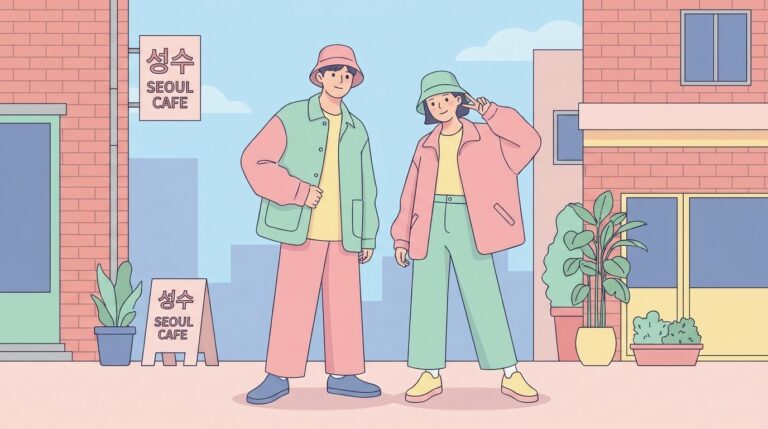
Picture this: You are sipping an iced oat latte in a trendy cafe in Seongsu-dong, the Brooklyn of Seoul. The autumn breeze is crisp, indie music plays in the background, and someone walks past your table wearing the most effortlessly cool outfit you have ever seen—an oversized vintage blazer, chunky sneakers, and an adorable silver shoulder bag. Your inner hype-person screams, “I need to tell them how amazing they look!”
So you search your brain for Korean words. What pops up? The stiff phrase from chapter two of your beginner textbook: “당신의 옷이 아름답습니다 (Dangsin-ui os-i areumdapsumnida / Your clothing is beautiful).” You hesitate. If you say that, will you sound like a 19th-century royal court diplomat? Yes, unfortunately, you will.
Many of our beginner students tell us they freeze up in these everyday moments. You want to make friends, share positive energy, and connect through your love for K-fashion, but textbook Korean feels robotic. In this guide, built directly from real feedback from Seoul culture navigators and beginner learners like you, we will give you three golden, natural slang phrases to hype up anyone’s OOTD (Outfit of the Day). By the time you finish this lesson, you will be complimenting outfits with the exact charm and natural flair of a warm Korean bestie!
Phase 2: Core Expressions Deep Dive
1. 착장 찢었다! (Chakjang jjijeotda!)
- Pronunciation: [Chakjang jjijeotda] (Sounds like chahk-jahng jee-jot-dah. The first syllable chak rhymes with “chalk”, and jjijeotda sounds like a dramatic rip—imagine tearing paper with confidence!)
- Meaning: Literal: “The outfit tore [the stage]!” | Real Nuance: “You absolutely killed this look!” / “Outfit on fire!”
- K-Culture Moment: Whenever a K-pop idol steps onto the airport departure runway wearing high-fashion streetwear, fans flood Twitter and Weverse with comments like “오늘 착장 찢었다! (Oneul chakjang jjijeotda!)”
- Editor’s Insight: Chakjang (착장) comes from clothing/wearing, basically meaning OOTD or full fit. Jjijeotda (찢었다) literally means “tore it up.” Just like in English when we say an artist “tore up the dance floor” or “slayed,” Koreans use this to show someone’s outfit completely crushed the fashion game.
- Situation Spectrum:
- Casual (Friends, same-age peers, social media): ✅
- Semi-formal (Polite stranger in a cafe, add -요: 착장 찢었어요!): ⚠️
- Formal (Job interview, meeting professors or in-laws): 🚫
- 🤔 Think About It: In English, we often praise individual items (“I love your boots”). Why do you think Korean slang focuses on 착장 (the cohesive whole look) rather than just single pieces?
2. 찰떡이다! (Chaltteogida!)
- Pronunciation: [Chaltteogida] (Sounds like chahl-tteok-ee-dah. Tteok is pronounced with a crisp, popped “T” sound just like Korean chewy rice cake!)
- Meaning: Literal: “It is sticky rice cake!” | Real Nuance: “It suits you like a glove!” / “A match made in heaven!”
- K-Culture Moment: In K-Dramas, when a lead character tries on a quirky beret or a chic trench coat in a boutique dressing room, their best friend claps their hands together and squeals: “대박, 완전 찰떡이다! (Daebak, wanjeon chaltteogida!)”
- Editor’s Insight: Chaltteok is sweet, chewy glutinous rice cake that sticks tight. Saying an outfit or color is chaltteok means it hugs your unique vibe perfectly. It praises how well you carry the clothes, making it the highest compliment you can give.
- Situation Spectrum:
- Casual (Close friends, casual social settings): ✅
- Semi-formal (Polite compliment with -예요: 완전 찰떡이에요!): ✅
- Formal (Official business presentations): 🚫
- 🤔 Think About It: Food metaphors are everywhere in Korean culture. How does comparing a person’s style to food change the emotional warmth of a compliment compared to your native language?
3. 완전 취저! (Wanjeon chwijeo!)
- Pronunciation: [Wanjeon chwijeo] (Sounds like wahn-jeon chwee-juh. Wanjeon means “totally”, and chwijeo sounds breezy and snappy.)
- Meaning: Literal: “Total taste-sniper!” | Real Nuance: “Totally my vibe!” / “This is so my aesthetic!”
- K-Culture Moment: When beauty and fashion vloggers on YouTube show off their haul and hold up a vintage pastel knit, the screen graphic sparkles with captions reading “완전 취저템 (Wanjeon chwijjeo-tem / Total vibe item)!”
- Editor’s Insight: Chwijeo (취저) is an abbreviation of Chwihyang Jeogyeok (취향저격), which translates to “taste sniper.” It means something shot directly through your personal taste and hit the bullseye. It is humble and warm because you are admiring their style through your own appreciation.
- Situation Spectrum:
- Casual (Text messages, peer chats): ✅
- Semi-formal (Shopping staff or warm casual talks with -예요: 완전 취저예요!): ✅
- Formal (Work environment): 🚫
- 🤔 Think About It: Why do modern young Koreans love abbreviations (줄임말 / jurimmal) so much when expressing emotional reactions?
Phase 3: Textbook Korean vs. Real Korean
Situation 1: Praising someone’s general outfit
- 📖 교과서 한국어 (Textbook): 당신의 옷이 매우 예쁩니다. (Dangsin-ui os-i maeu yeppeumnida.) — Your clothes are very pretty.
- 🗣️ 진짜 한국어 (Real-life): 오늘 착장 대박 예뻐요! (Oneul chakjang daebak yeppeoyo!) — Your outfit today is insanely pretty!
- 💡 왜 다를까? (Why is it different?): In everyday spoken Korean, using the pronoun “당신 (dangsin)” sounds combative or oddly translated from Western books. Real Koreans skip pronouns and use trendy words like 착장 (chakjang / outfit) and 대박 (daebak / awesome) to sound natural and friendly.
Situation 2: Telling someone an accessory suits them
- 📖 교과서 한국어 (Textbook): 모자가 당신에게 잘 어울립니다. (Mojaga dangsinege jal eoullimnida.) — The hat suits you well.
- 🗣️ 진짜 한국어 (Real-life): 모자 완전 찰떡이에요! (Moja wanjeon chaltteogieyo!) — That hat is a total match for you!
- 💡 왜 다를까? (Why is it different?): While “잘 어울려요 (jal eoullyeoyo)” is fine and polite, younger speakers love using “찰떡이에요 (chaltteogieyo)” to inject infectious charm and lively excitement into casual compliments.
Phase 4: K-Culture Deep Dive & Non-Verbal Manners
4-1. Nunchi (눈치) & Non-Verbal Body Language
When delivering a fashion compliment in Korea, body language makes all the difference! If you stare someone up and down from their head to their shoes before talking, that can trigger their nunchi radar into thinking you are judging them (스캔하다 / scan-hada).
* Eye Contact & Smile: Keep your eyes focused warmly on their face, nodding slightly with a wide, bright smile.
* The Seal Clap (물개박수): A subtle, gentle two-hand clap at chest level right before you say “대박! (Daebak!)” signals pure, harmless excitement.
* The Soft Gesture: When complimenting an item (like their bag or coat), make an open-palm gesture toward the item rather than pointing aggressively with an index finger.
4-2. Fashion Hotspots: Seongsu and Hongdae Street Vibe
In Seoul’s fashion hubs like Hongdae (streetwear, experimental, Y2K) and Seongsu (minimal chic, curated vintage), complimenting strangers is becoming a huge social trend, especially around photo spots. If you see someone rocking a classic Kku-an-kku (꾸안꾸 / effortless chic) look, giving them a casual compliment bridges language barriers immediately.
Phase 5: Real-Life Roleplay Scenario
Setting: A vibrant, sunlit vintage pop-up boutique in Seongsu-dong. Indie vinyl beats hum quietly.
Character: Min-ji (민지), a friendly, ultra-stylish shop curator wearing an oversized houndstooth blazer and a cool ballcap.
- Turn 1 (Min-ji): 안녕하세요! 천천히 구경해 보세요. (Annyeonghaseyo! Cheoncheonhi gugyeonghae boseyo.)
- 🎭 Action: Min-ji bows warmly from behind the wooden counter with a friendly smile.
- English: “Hello! Please take your time looking around.”
- Turn 2 (You): 안녕하세요! 저기… 오늘 직원분 착장 찢었어요! (Annyeonghaseyo! Jeogi… oneul jik-won-bun chakjang jjijeosseoyo!)
- 🎭 Action: You make a gentle open hand gesture toward her blazer and smile with excitement.
- English: “Hello! Excuse me… your outfit today is absolutely fire!”
- Turn 3 (Min-ji): 어머, 진짜요? 감사합니다! 부끄럽네요. (Eomeo, jinjyayo? Gamsahamnida! Bukkeureopneyo.)
- 🎭 Action: Min-ji covers her mouth slightly in surprise, her cheeks blushing with delight.
- English: “Oh my gosh, really? Thank you so much! I am getting shy.”
- Turn 4 (You): 특히 모자가 완전 찰떡이에요! (Teukhi mojaga wanjeon chaltteogieyo!)
- 🎭 Action: You nod approvingly, pointing softly toward her ballcap.
- English: “Especially that cap, it suits you like a glove!”
- Turn 5 (Min-ji): 손님 패션도 장난 아닌데요? 센스 대박이세요! (Sonnim paesyeondo jangnan anindeyo? Senseu daebak-iseyo!)
- 🎭 Action: She leans forward slightly, admiring your denim jacket.
- English: “Your fashion is no joke either! You have amazing style sense!”
- Turn 6 (You): 에이, 아니에요. 여기 옷들 완전 취저예요. (Ei, anieyo. Yeogi otddeul wanjeon chwijeoyeyo.)
- 🎭 Action: You wave both hands lightly in playful modesty, then glance around the racks.
- English: “Oh, no way. The clothes here are totally my aesthetic.”
- Turn 7 (Min-ji): 편하게 입어보세요! 피팅룸 저쪽에 있어요. (Pyeonhage ibeoboseyo! Piting-rum jeojjoge isseoyo.)
- 🎭 Action: She gestures happily toward the fitting room curtain.
- English: “Feel free to try anything on! The fitting room is right over there.”
- Turn 8 (You): 네, 감사합니다! (Ne, gamsahamnida!)
- 🎭 Action: You smile happily, feeling instant friendship and warmth.
- English: “Yes, thank you!”
🔀 Interactive Decision Point
After Min-ji compliments your jacket back in Turn 5, how do you respond?
* Option A: “당신도 옷이 좋습니다.” (Dangsin-do os-i joeusumnida.)
* Option B: “에이, 아니에요! 감사합니다!” (Ei, anieyo! Gamsahamnida!)
* Option C: “네, 저 패션 천재예요.” (Ne, jeo paesyeon cheonjaeyeyo.)
Detailed Feedback:
* Option A (Risk / Unnatural): Using 당신 (dangsin) feels weirdly cold and stiff, creating social awkwardness. Avoid this!
* Option B (Best Choice): Culturally flawless! Koreans appreciate modest self-dismissal (에이, 아니에요 / Oh, no way) followed by a thankful smile.
* Option C (Humorous / Bad for A1): Saying “Yes, I am a fashion genius” can sound funny among close friends, but to a store clerk you just met, it might come across as overly arrogant unless your comedic delivery is flawless.
Phase 6: 10-Second Emotion Shadowing Drill
Practice matching the pauses (/) and feeling the emotion milestones!
- Drill 1:
[✨ Starstruck and amazed]- 오늘 착장 / 진짜 대박이에요! (Oneul chakjang / jinjja daebak-ieyo!)
- Meaning: “Your outfit today / is seriously incredible!”
- Drill 2:
[🥰 Heartwarming and sincere]- 그 모자, / 완전 찰떡이에요! (Geu moja, / wanjeon chaltteog-ieyo!)
- Meaning: “That hat, / suits you so perfectly!”
- Drill 3:
[🤩 Eyes sparkling with excitement]- 이 스타일 / 완전 취저예요! (I seutail / wanjeon chwijeo-yeyo!)
- Meaning: “This style / is totally my vibe!”
Phase 7: K-Culture Mini Dictionary
- 착장 (Chakjang) | Noun
- Meaning: Full outfit / OOTD.
- Usage: Used everywhere from Instagram captions to fashion store chats to praise someone’s head-to-toe coordination.
- 찰떡 (Chaltteok) | Noun / Slang Modifier
- Meaning: Perfect fit / Tailor-made match.
- Usage: Comes from chewy rice cake. Use it whenever a color, hairstyle, or garment harmonizes seamlessly with someone’s appearance.
- 꾸안꾸 (Kku-an-kku) | Compound Slang
- Meaning: Effortless chic (“Dressed up, but looking like you didn’t try too hard”).
- Usage: Short for 꾸민 듯 안 꾸민 듯 (kkumin deut an kkumin deut). Used to describe minimalist, comfortable, yet stylish outfits.
- 취저 (Chwijeo) | Noun / Abbreviation
- Meaning: Taste sniper / My exact aesthetic.
- Usage: Short for 취향저격 (chwihyang jeogyeok). Used for things, designs, or outfits that instantly hit your personal preference.
Phase 8: Traveler’s Survival Kit
Top 3 Survival Phrases for Fashion Lovers
- 사진 찍어 드릴까요? (Sajin jjigeo deurilkkayo?)
- Romanization: Sah-jin jjee-geo deu-ril-kkah-yo?
- Meaning: “Would you like me to take your photo?”
- Pro Tip: If you see someone with a gorgeous outfit at an aesthetic cafe, offering this will instantly make you their favorite human.
- 이거 어디서 샀어요? (Igeo eodiseo sasseoyo?)
- Romanization: Ee-geo eo-dee-seo sah-sseo-yo?
- Meaning: “Where did you buy this?”
- Pro Tip: Great for asking about an accessory or jacket in a friendly, conversational way.
- 입어봐도 돼요? (Ibeobwado dwaeyo?)
- Romanization: Ee-beo-bwah-doh dway-yo?
- Meaning: “May I try this on?”
- Pro Tip: Essential for shopping in boutique districts like Hongdae, Hannam-dong, or Seongsu.
Editor’s Travel Note
When hunting for unique outfits in Seoul, skip Google Maps (which has limited walking route features in South Korea) and be sure to use the Naver Map app (네이버 지도 앱). Search for keywords like “성수동 빈티지샵 (Seongsu-dong vintage shops)” or “인생네컷 (Life Four Cuts)” to find local photo booths right next to trendy boutiques where you can snap pictures of your newly styled fit!
Phase 9: One Step Deeper
In Korean society, compliments are not just surface-level praise; they function as social glue (jeong / 정). Notice how Korean compliment slang rarely praises the person in isolation (“You are hot”). Instead, it praises the harmony between the person and their environment: 찰떡 (it matches you), 착장 (the harmony of the whole fit), and 취저 (how it connects to shared taste).
When you compliment someone’s OOTD using these phrases, you are validating their personal identity and artistic expression. In a collective culture that works hard to respect others, telling someone they nailed their look creates an immediate feeling of belonging.
💬 Your Turn: What is your go-to outfit when you want to feel confident? What item in your wardrobe would you describe as “완전 찰떡 (chaltteok)”? Tell us in the comments below!
Phase 10: FAQ & Common Mistakes
Q: Can I use “착장 찢었다!” with older people or my professor?
A: Definitely not! “찢었다” is heavy youth slang. With older people, professors, or bosses, stick to polite, classic honorific expressions like “오늘 옷차림이 정말 멋지십니다 (Oneul otcharim-i jeongmal meotjisimnida / Your attire is truly splendid today).”
Q: Can I use “찰떡이다” for things other than clothes?
A: Yes! It is incredibly versatile. You can use it for hair colors (“염색 완전 찰떡이에요! / That hair color suits you so well!”), makeup lipstick shades, or even two best friends who get along great (“둘이 완전 찰떡궁합이야! / You two are a match made in heaven!”).
Q: Is “대박 (Daebak)” still used in Korea, or is it outdated?
A: It is an immortal classic! While some internet slang fades quickly, 대박 has achieved permanent status in everyday spoken Korean across all age groups to express excitement or shock.
🚨 Common Mistakes Warning Board
- Saying “당신의 옷이 예뻐요” to a stranger:
- Problem: Sounds cold, stiff, or like bad automated translation.
- Correct Action: Drop “당신” entirely! Just say: “오늘 착장 예뻐요! (Oneul chakjang yeppeoyo!)”
- Mispronouncing 찰떡 (Chaltteok) as “Chaltok”:
- Problem: The double consonant ㄸ needs a crisp, popped “T” sound.
- Correct Action: Say “Chahl-tteok” with tension in your tongue.
- Using slang without -요 (-yo) with shop staff:
- Problem: Dropping -요 makes it casual talk (반말 / banmal), which can sound rude to staff.
- Correct Action: Always add “-요” (e.g., “완전 찰떡이에요!”) to keep it polite and friendly.
Phase 11: Action Missions
- 🥉 Bronze Mission (Solo Shadowing): Stand in front of your mirror in your favorite outfit today. Point to your reflection and say with high energy: “오늘 내 착장 찢었다! (Oneul nae chakjang jjijeotda!)”
- 🥈 Silver Mission (Social Media): Find a K-pop idol’s airport fashion photo on Instagram or X (Twitter). Leave a polite comment: “오늘 착장 완전 취저예요! (Oneul chakjang wanjeon chwijeo-yeyo!)”
- 🥇 Gold Mission (Real-Life Connection): The next time you visit a Korean cafe, grocery market, or meet a Korean friend, compliment one accessory using: “[Item] 완전 찰떡이에요! (Wanjeon chaltteogieyo!)”
- 🎮 K-Culture Mission: Watch any behind-the-scenes music video video or dance practice on YouTube. Turn on Korean captions and count how many times you spot the word 착장 in the title or subtitles!
Phase 12: Interactive Quiz Challenge
Question 1: Scenario Judgment
You are visiting a vintage store in Hongdae. You want to tell the friendly clerk that her knit sweater matches her aesthetic so naturally. Which phrase is the warmest and most natural?
* A) 당신의 스웨터가 아름답습니다.
* B) 스웨터 완전 찰떡이에요!
* C) 스웨터 찢었다.
Question 2: Fill in the Blank
When an outfit is so in line with your personal style that it feels like it “shot directly through your taste,” you say:
“이 가방 완전 [ ]예요! (I gabang wanjeon [ ]-yeyo!)”
Question 3: True or False
True or False: Calling someone’s outfit “착장 찢었다!” can be safely said to your boss during an official corporate annual meeting in Seoul.
👉 Click to reveal answers & explanations!
- Answer: B (스웨터 완전 찰떡이에요!)
- Explanation: Option A is unnatural textbook speech with the awkward pronoun “당신”, and Option C lacks the polite ending “-요”. Option B strikes the perfect balance of trendy slang and polite respect!
- Answer: 취저 (Chwijeo)
- Explanation: Chwijeo is short for 취향저격 (Taste sniper), meaning totally my vibe!
- Answer: False
- Explanation: “찢었다” is casual slang for friends and peers. Using it with a boss or in formal business settings is inappropriate.
- Explanation: “찢었다” is casual slang for friends and peers. Using it with a boss or in formal business settings is inappropriate.







