

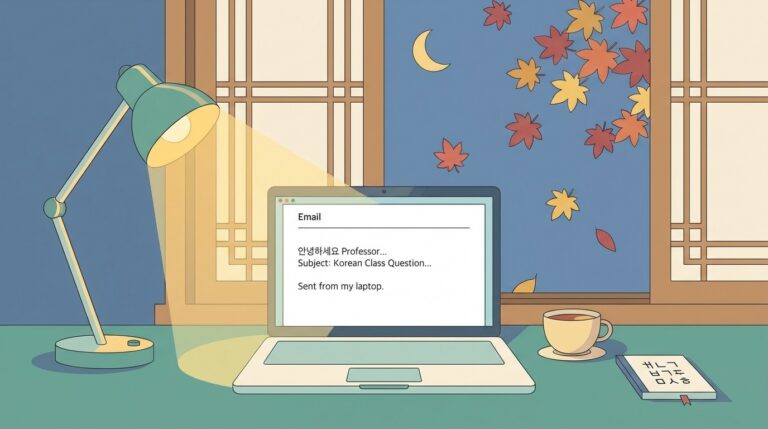
Nail Your Korean Lab Interview: How to Write the Perfect Same-Day Thank-You Email
Phase 1: Empathy (Story-Driven Opening)
안녕하세요! 매일한글 에디터입니다. (Hello! This is your Daily Hangul editor.)
Imagine this scene straight out of a Korean university drama: You’ve just walked out of the engineering building at Yonsei or KAIST. Your formal suit feels tight, your palms are still slightly damp from holding a notepad, and your brain is buzzing from processing ninety minutes of rapid-fire academic discussions. You survived your lab interview (랩실 면담 – raepsil myeondam)! Professor Park asked probing questions about your research proposal, and the senior lab researchers (seonbaenimdeul) kindly gave you a tour of the equipment and even bought you an iced Americano.
You head back to your studio apartment, kick off your shoes, and collapse onto the sofa thinking, “Phew, it’s finally over.” But wait! In the world of Korean academia, the interview is only half the battle. The unspoken make-or-break ritual happens that very evening: the post-interview thank-you email.
Many intermediate (B2) Korean learners freeze at this exact moment. How do I express profound gratitude without sounding like an ancient historical drama? How should my email to the professor differ from the one I send to the senior students who showed me around? And what is the polite window of time to click ‘Send’?
Over the past ten years coaching international researchers and graduate students entering top Korean universities, I have seen brilliant applicants leave a flat impression simply because their follow-up email sounded like an emotionless automated receipt. On the flip side, a warm, culturally calibrated thank-you email sent before the sun sets can establish you as someone with exceptional nunchi (눈치), humility, and academic professionalism. Let’s make sure your hard work today turns into a solid acceptance letter tomorrow!
Phase 2: Core Expressions Deep Dive
Here are three essential expressions tailored specifically for post-interview thank-you emails, balancing academic deference and warm professionalism.
1. 바쁘신 와중에도 귀한 시간 내어 주셔서 진심으로 감사드립니다.
- Pronunciation: [Bappeusin wajung-edo gwihan sigan naeeo jusyeoseo jinsim-euro gamsadeurimnida.] (Think: Bah-ppeo-sheen wah-joong-eh-doh gwee-hahn she-gahn neh-uh joo-shuh-suh jeen-sheem-oo-roh gahm-sah-deu-reem-nee-dah)
- Meaning: “Thank you sincerely for making valuable time for me amidst your busy schedule.”
- K-Culture Moment: This is the iconic line spoken by aspiring researchers in campus dramas like Law School or Start-Up when meeting a distinguished mentor. It instantly frames the mentor’s time as an honor given to the applicant.
- Editor’s Insight: The phrase “귀한 시간” (gwihan sigan – precious/valuable time) paired with “내어 주시다” (naeeo jusida – to spare or carve out for someone) is the gold standard of Korean academic etiquette. It shows you recognize the professor’s demanding calendar.
- Situation Spectrum: Casual 🚫 | Semi-formal ⚠️ | Formal ✅
- 🤔 Think About It: In many Western academic cultures, a brief “Thanks for your time today!” is standard. Why does Korean culture emphasize the professor’s busy state (바쁘신 와중) before thanking them? Consider how acknowledging the other person’s burden reflects Korean social consideration.
2. 면담 중 나누어 주신 조언 덕분에 연구 방향을 더 깊이 고민해 볼 수 있었습니다.
- Pronunciation: [Myeondam jung nanueo jusin joeon deokbune yeongu banghyang-eul deo gipi gominhae bol su isseosseumnida.] (Think: Myun-dahm joong nah-noo-uh joo-sheen joh-uhn deok-boo-neh yun-goo bahng-hyahng-eul duh gee-pee go-meen-heh bohl soo eet-ssuh-ssum-nee-dah)
- Meaning: “Thanks to the advice you shared during the interview, I was able to reflect much more deeply on my research direction.”
- K-Culture Moment: Used by a student acknowledging their mentor’s intellectual impact. It shows you were not just nodding along, but actually digesting their scholarly insight.
- Editor’s Insight: Generic thank-yous feel impersonal. By using “나누어 주신 조언 덕분에” (thanks to the advice you shared) and linking it to “연구 방향” (research direction), you prove your academic dedication and listening skills.
- Situation Spectrum: Casual 🚫 | Semi-formal ⚠️ | Formal ✅
- 🤔 Think About It: Notice the word 덕분에 (deokbune – thanks to you). In Korean, attributing positive intellectual outcomes to a mentor’s guidance is a quintessential marker of academic modesty (겸양의 미덕).
3. 따뜻하게 맞아주시고 랩실 생활에 대해 자세히 알려주셔서 큰 힘이 되었습니다.
- Pronunciation: [Ttatteuthage majajusigo raepsil saenghware daehae jasehi allyeojusyeoseo keun himi doeotseumnida.] (Think: Ttah-tteut-hah-geh mah-jah-joo-she-goh raep-sheel seng-hwah-reh deh-heh jah-seh-hee ahl-lyuh-joo-shuh-suh kkeun heem-ee dway-uht-seum-nee-dah)
- Meaning: “Welcoming me so warmly and explaining lab life in detail was an immense help to me.”
- K-Culture Moment: The sentence you write to the head lab senior (랩장 – raepjang) or the graduate student who took you aside to share insider tips on the professor’s working style.
- Editor’s Insight: When emailing seniors, going full archaic formal can make you seem unapproachable, but being too casual is disrespectful. This sentence strikes the ideal balance—warm, polite, and deeply appreciative of their peer support.
- Situation Spectrum: Casual 🚫 | Semi-formal ✅ | Formal ✅
- 🤔 Think About It: How does your native language differentiate gratitude sent to a superior (the professor) versus a peer mentor (the senior researcher)?
Phase 3: Textbook Korean vs. Real Korean
Let’s see how standard classroom Korean compares to high-impact, authentic Korean for graduate school communication.
Situation 1: Expressing gratitude to the Professor for their guidance
- 📖 교과서 한국어 (Textbook Korean): 시간을 내주셔서 감사합니다. (Sigan-eul naejusyeoseo gamsahamnida.) — “Thank you for giving me time.”
- 🗣️ 진짜 한국어 (Real Korean): 오늘 바쁘신 일정 중에도 귀한 시간을 할애해 주셔서 진심으로 감사드립니다. (Oneul bappeusin iljeong jung-edo gwihan sigan-eul haraehae jusyeoseo jinsim-euro gamsadeurimnida.) — “I sincerely thank you for allocating your precious time today despite your packed schedule.”
- 💡 왜 다를까? (Why the difference?): In graduate school contexts, 할애하다 (haraehada – to allocate/carve out) and 귀한 시간 convey sophisticated professional deference that standard 시간을 내주다 lacks.
Situation 2: Thanking senior lab members for giving you advice and showing you the lab
- 📖 교과서 한국어 (Textbook Korean): 도와주셔서 고맙습니다. (Dowajusyeoseo gomapseumnida.) — “Thanks for helping me.”
- 🗣️ 진짜 한국어 (Real Korean): 오늘 선배님께서 랩실 분위기와 연구 주제에 대해 친절히 들려주신 덕분에 큰 동기부여가 되었습니다. (Oneul seonbaenimkkeseo raepsil bun-wigiga-wa yeongu juje-e daehae chinjeolhi deullyeojusin deokbune keun donggibuyeoga doeotseumnida.) — “Thanks to you kindly sharing insights about the lab atmosphere and research topics today, I gained immense motivation.”
- 💡 왜 다를까? (Why the difference?): Simply saying 도와주셔서 고맙습니다 feels generic. Seniors want to see that their insider tour resonated with you and boosted your motivation (동기부여).
Phase 4: K-Culture Deep Dive & Non-Verbal Manners
4-1. Nunchi & Etiquette: The “Same-Day Golden Window”
In Korean professional and academic life, sending a follow-up email has a strict expiration date: the same day, ideally between 6:00 PM and 9:00 PM.
* Too Early (Within 30 minutes): Feels rushed, like an automated template you had ready in your drafts.
* Too Late (Past 10:00 PM): Intrusive. In Korea, professors and students often have mobile email alerts synchronized, so late-night emails can disturb personal resting hours.
* Next Day: Acceptable only if your interview finished after 7:00 PM. If so, send it early morning (between 8:30 AM and 9:30 AM).
* Subject Line Precision: Never leave the subject line as just “감사합니다”. Use the standard Korean academic formula:
[면담 감사] OOO 교수님, 오늘 면담에 응해주셔서 진심으로 감사드립니다 (지원자 김줄리안)
(Bracket tag + Recipient name + Core intent + Sender name).
4-2. Cultural Code: The Dual-Track Relationship (교수님 vs. 선배님)
A Korean research laboratory (연구실 / 랩실) operates like an extended family and an apprentice guild combined. While the professor (지도교수님) decides your official admission, the current senior students (선배님들) often hold veto power. If a senior tells the professor, “The candidate seemed slightly arrogant or aloof during our coffee chat,” your chances drop dramatically.
Sending separate, personalized emails—one elevated and intellectual to the professor, and one warm, respectful, and observant to the senior—shows mastery of Korean social navigation (사회생활).
Phase 5: Real-World Roleplay Scenario
Setting: It is 7:15 PM. Julian (an applicant from Canada) is sitting at a cafe right outside the university gates, drafting his thank-you emails on his laptop. He receives a quick Kakao message from Min-woo, the senior lab member who guided him earlier.
Characters:
* 민우 선배 (Min-woo Senior): Ph.D. student and lab manager; supportive but attentive to manners.
* 줄리안 (Julian): Prospective master’s student preparing his thank-you notes.
— Dialogue —
- 민우 선배: 줄리안 씨, 오늘 면담 보느라 고생 많으셨어요! 집에는 잘 들어가셨나요?
(Julian ssi, oneul myeondam boneura gosaeng maneusyeosseoyo! Jib-eneun jal deureogasyeonnayo?)
“Julian, great work surviving the interview today! Did you get home safe?” -
줄리안: 🎭 [정중하게 휴대폰을 두 손으로 쥐고 빠르게 답장하며] 네, 선배님! 덕분에 편안한 마음으로 잘 귀가했습니다.
(Ne, seonbaenim! Deokbune pyeon-anhan ma-eum-euro jal gwigahaetseumnida.)
“Yes, Senior Min-woo! Thanks to you, I got back feeling comfortable and at ease.” -
민우 선배: 교수님께서 오늘 줄리안 씨 연구 계획서 인상 깊게 보신 것 같더라고요. 랩실 식구들도 다들 좋게 봤어요.
(Gyosunimkkeseo oneul Julian ssi yeongu gyehoekseo insang gipge bosin geot gatdeoragoyo. Raepsil sikgudeuldo dadeul joke bwasseoyo.)
“The professor seemed quite impressed with your research proposal today. The lab members also had a really good impression.” -
줄리안: 🎭 [안도의 숨을 내쉬며 진심 어린 감사함을 담아] 선배님께서 사전에 연구실 분위기를 편안하게 설명해 주신 덕분입니다.
(Seonbaenimkkeseo sajeone yeongusil bun-wigireul pyeon-anhage seolmyeonghae jusin deokbunimnida.)
“It is all thanks to you explaining the lab atmosphere so comfortably beforehand, Senior.” -
민우 선배: 에이, 별말씀을요. 혹시 교수님께 메일 드릴 거면 오늘 저녁 9시 전에 보내는 게 좋아요. 교수님이 일찍 주무시거든요.
(Ei, byeolmalsseum-eullyo. Hoksi gyosunimkke me-il deuril geomyeon oneul jeonyeok ahopsi jeone bonaeneun ge joayo. Gyosunim-i iljjik jumusigeodeunyo.)
“Oh, don’t mention it. By the way, if you’re sending an email to the professor, it’s best to send it before 9 PM. He goes to bed early.” -
줄리안: 🎭 [시계를 확인하며 노트북 메일 창을 열고] 네! 지금 막 메일 초안을 작성하여 검토 중이었습니다.
(Ne! Jigeum mak me-il cho-an-eul jakseonghayeo geomto jung-ieotseumnida.)
“Yes! I just drafted the email and was reviewing it right now.” -
민우 선배: 꼼꼼하시네요! 보내고 나서 푹 쉬어요. 결과 나올 때까지 너무 긴장하지 말고요.
(Kkomkkomhasineyo! Bonaego naseo puk swieoyo. Gyeolgwa naol ttaekkaji neomu ginjanghaji malgoyo.)
“You’re very thorough! Send it and get some deep rest. Don’t be too anxious until the results come out.” -
줄리안: 🎭 [정중하게 고개 숙이는 이모티콘을 덧붙이며] 세심하게 챙겨주셔서 정말 감사드립니다. 선배님도 오늘 편안한 저녁 보내십시오!
(Sesimhage chaenggyeojusyeoseo jeongmal gamsadeurimnida. Seonbaenimdo oneul pyeon-anhan jeonyeok bonaesipsio!)
“Thank you so much for looking out for me so attentively. Have a restful evening as well, Senior!”
🔀 Interactive Choice Point
You are about to send your formal email to Professor Park. What closing line should you choose?
- Option A: 교수님, 오늘 면담 즐거웠습니다! 다음 학기에 꼭 뵙고 싶습니다. 조만간 또 연락할게요!
- Option B: 바쁘신 중에도 귀한 가르침을 주셔서 감사드리며, 환절기에 늘 건강 유의하시기를 바랍니다. OOO 올림.
- Option C: 오늘 말씀 감사했습니다. 합격 여부는 언제쯤 알 수 있는지 메일로 회신 부탁드립니다.
Feedback:
* Option A (Risk): Too casual! 즐거웠습니다 (it was fun/enjoyable) is used between peers for outings, not for an academic evaluation. 연락할게요 sounds overly informal to a superior.
* Option B (Best ✅): Flawless! Acknowledges teachings (귀한 가르침), expresses seasonal health wishes (환절기 건강 유의), and ends with the humble closer OOO 올림 (Sincerely / Respectfully presented by OOO).
* Option C (Bad 🚫): Presumptuous and pushy. Asking for the admissions decision immediately in a thank-you note destroys the gracious spirit of the email.
Phase 6: 10-Second Emotion Shadowing Drill
Read these sentences aloud, pausing at the slashes / and matching the emotional cues!
Sentence 1 [🙇♂️ With deep humility and profound gratitude]:
교수님, / 오늘 바쁘신 일정 중에도 / 귀한 시간 내어 면담해 주셔서 / 진심으로 감사드립니다.
(Gyosunim, / oneul bappeusin iljeong jung-edo / gwihan sigan naeeo myeondamhae jusyeoseo / jinsim-euro gamsadeurimnida.)
Sentence 2 [✨ Brightly, reflecting academic passion and inspiration]:
나누어 주신 고견 덕분에 / 제 연구의 부족한 부분을 보완하고 / 새로운 시각을 얻을 수 있었습니다.
(Nanueo jusin gogyeon deokbune / je yeongu-ui bujokhan bubun-eul bowanhago / saeroun sigag-eul eodeul su isseosseumnida.)
Sentence 3 [🤝 Warmly with polite peer appreciation]:
선배님께서 랩실 생활을 솔직하게 들려주셔서 / 대학원 진학에 대한 확신을 갖게 되었습니다.
(Seonbaenimkkeseo raepsil saenghwar-eul soljik-hage deullyeojusyeoseo / daehagwon jinhag-e daehan hwaksineul gatge doeotseumnida.)
Phase 7: K-Culture Mini Dictionary
- 랩실 (Raepsil)
Literal: Lab room (from English laboratory + Korean sil / 室).
Usage: The heartbeat of Korean STEM and graduate life. More than just a room, it denotes the tight-knit social unit of students working under one professor. -
선배님 (Seonbaenim)
Literal: Senior / Respected predecessor.
Usage: The absolute standard honorific for any student in an academic cohort ahead of you. Dropping the -nim (선배) in early stages can sound overly bold or rude. -
컨택 (Keontaek)
Literal: Contact.
Usage: Specifically refers to cold-emailing or reaching out to prospective academic advisors before applying to graduate school (“교수님께 사전 컨택 메일 보냈어?”). -
지도교수 (Jidogyosu)
Literal: Guiding / Advising Professor.
Usage: Your academic advisor who oversees your thesis and research. In Korea, this relationship often lasts a lifetime, carrying strong patriarchal or mentorship dynamics.
Phase 8: International Graduate Student Survival Kit
Top 3 Survival Expressions
- 결과에 상관없이 많은 배움을 얻은 시간이었습니다.
(Gyeolgwa-e sang-gwan-eopsi maneun baeum-eul eodeun sigan-ieotseumnida.)
Pro Tip: “Regardless of the outcome, it was a time of immense learning.” This shows maturity and sportsmanship. - 부족한 저를 따뜻하게 이끌어 주셔서 감사드립니다.
(Bujokhan jeoreul ttatteuthage ikkeureo jusyeoseo gamsadeurimnida.)
Pro Tip: “Thank you for warmly guiding someone who still has much to learn.” A classic Korean humble expression (겸양 표현). - 앞으로도 연구실의 뛰어난 성과를 늘 응원하겠습니다.
(Apeurodo yeongusil-ui ttwieonan seonggwareul neul eung-wonhagetseumnida.)
Pro Tip: “I will continue cheering for the outstanding achievements of the lab.” Leaves a warm, gracious final impression.
Editor’s Campus Travel Note
- Study Cafes around Campuses: When you need a fast Wi-Fi connection and complete quiet right after an interview, search for nearby spaces on the Naver Map application. Typing “스터디카페” (study cafe) will show places equipped with silent zones and printers.
- Email Formatting Check: Before hitting send on an institutional email, send a test email to your phone to ensure Korean character encoding hasn’t broken the formatting.
Phase 9: “One Step Deeper” (Cultural Reflection)
In Korean society, interpersonal connections are maintained through 인사성 (Insa-seong)—the innate habit and grace of recognizing others through timely greetings. Writing a thank-you email isn’t viewed as transactional networking; rather, it is seen as closing a circle of care (배려). The advisor gave you their attention without charge, and the seniors offered you their insider wisdom. By returning that kindness with a reflective note before the day ends, you show that you understand 인간관계 (human relational balance) within a hierarchical collectivist setting.
💬 Your Turn: Have you ever hesitated to send a follow-up email after an interview because you were worried about sounding either too informal or too stiff? How does post-interview etiquette in your home country compare? Share your thoughts below!
Phase 10: FAQ & Common Mistakes
Q: Should I email the professor and the senior students in one joint email?
A: No, never combine them. Always send two separate emails. The email to the professor must use formal honorifics (하십시오체 / 올림) focusing on academic insights and gratitude for their time. The email to the lab senior should use respectful yet friendlier polite forms (해요체 / 선배님), thanking them for showing you the facility and sharing candid advice.
Q: What is the ideal length for a Korean academic thank-you email?
A: Around 3 to 4 short paragraphs (150–250 Korean words). Professors receive hundreds of emails daily. If it’s too long, it becomes a burden to read; if it’s two lines, it looks indifferent. Open with greetings, state one specific takeaway from their conversation, express your gratitude, and finish with a seasonal health wish.
Q: Should I attach my CV or portfolio again in this thank-you email?
A: Do not reattach them unless the professor explicitly asked for additional materials. Adding attachments unsolicited makes it look like an aggressive sales pitch rather than a genuine note of thanks.
🚨 Common Mistakes Alert
- Mistake 1: Addressing the professor as “선생님” instead of “교수님”
Correct Action: In graduate school contexts, always address university faculty as[성함] 교수님(e.g., 박은우 교수님). 선생님 is polite in daily life, but 교수님 is the required academic title. - Mistake 2: Signing off with “수고하세요”
Correct Action: 수고하세요 means “keep up the hard labor” and is strictly used downwards by a superior to a subordinate. To a professor, end with환절기에 늘 건강 유의하시기를 바랍니다followed by[본인 이름] 올림. - Mistake 3: Sending the email past 11 PM
Correct Action: If you miss the 9:00 PM evening window, schedule the email (예약 발송) to arrive at 8:45 AM the next morning.
Phase 11: Action Missions
- 🥉 Bronze Mission (Solo Practice): Write down the core sentence:
바쁘신 와중에도 귀한 시간 내어 주셔서 진심으로 감사드립니다three times in your study notebook, checking the spacing (띄어쓰기) around 내어 주셔서. - 🥈 Silver Mission (Shadowing): Record yourself reading the 10-Second Shadowing Drills in Phase 6 with your voice memo app. Focus on softening your final intonation at -드립-니-다.
- 🥇 Gold Mission (Real Application): Draft a complete 3-paragraph thank-you email following the guide, replacing the bracketed sections with your target professor’s name and your own research topic.
- 🎮 K-Culture Mission: Watch an episode of a campus-based K-Drama (like Weightlifting Fairy Kim Bok-joo or Cheese in the Trap) and spot how students address their 선배님 versus their 교수님.
Phase 12: Interactive Quiz Challenge
Q1 (Situational): Which of the following is the most appropriate closing signature for Julian’s email to Professor Park?
1. 줄리안 씀 (Julian sseum)
2. 줄리안 드림 (Julian deurim)
3. 줄리안 올림 (Julian ollim)
4. 줄리안 보냄 (Julian bonaem)
Q2 (Fill-in-the-Blank): Fill in the appropriate honorific particle:
면담 중 나누어 주신 조언 [ ___ ] 연구 방향을 더 깊이 고민해 볼 수 있었습니다.
1. 때문에 (ttaemune)
2. 덕분에 (deokbune)
3. 탓에 (tase)
4. 바가지에 (bagajie)
Q3 (True or False): You can use the phrase “수고하셨습니다” in an email to a professor to thank them for their hard work.
* [ ] True
* [ ] False
👉 Click to reveal answers & explanations!
- Q1 Answer: 3 (줄리안 올림)
Explanation: While 드림 is acceptable in business contexts, 올림 (respectfully raised up) is the gold standard when writing to a professor in graduate academia. 씀 and 보냄 are strictly for peers or juniors. - Q2 Answer: 2 (덕분에)
Explanation: 덕분에 attributes positive outcomes to someone’s favor or help (“thanks to”). 때문에 is neutral, and 탓에 is used for negative blame (“fault of”). - Q3 Answer: False
Explanation: 수고하셨습니다 or 수고하세요 carries the nuance of acknowledging labor from a position of equal or higher authority. To a professor, always use 감사드립니다 or 고생 많으셨습니다 (only when contextually permissible, though 감사드립니다 is far safer).







