

Exchange Your Foreign Driver’s License in Korea: The Stress-Free Guide
Phase 1: Empathy (Real-Life Expat Story)
안녕하세요! 매일한글 에디터입니다. (Hello! I’m your Daily Hangul editor.)
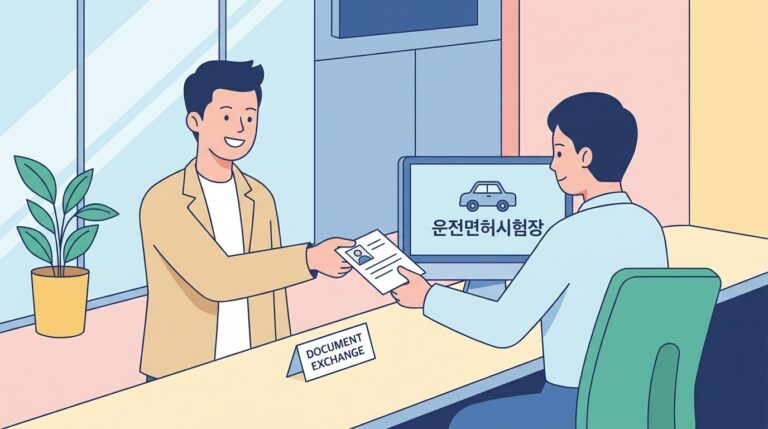
Picture this: You are standing right in the middle of the buzzing Gangnam Driver’s License Examination Office (강남운전면허시험장). Digital chimes are ringing every four seconds, instant photo booths flash in the corner, and people are darting between windows clutching bundles of paperwork. You have held a driver’s license in your home country for years, and now you are ready to hit the road in Korea—maybe take that picturesque drive along Jeju’s coastal road or cruise out toward the serene mountains of Gangwon-do.
Then comes the sudden panic: Do I have to retake the entire Korean driving course, parallel park inside those tiny yellow lines, and take the scary road driving test (도로주행)?
Take a deep breath! Here is the golden truth: if your home country has a mutual recognition agreement (상호인정협정) with the Republic of Korea, you are officially exempt from the practical road driving test. All you need to do is submit verified documents, pass a quick health and vision check, and clear a straightforward computerized written test (학과시험).
Navigating Korean civil service counters in another language can feel overwhelming, but when you know exactly what to say and what to listen for, the process transforms into an empowering cultural victory. This guide draws directly from the real-life triumphs and missteps of our global learners at Daily Hangul. Let’s make exchanging your driver’s license smooth, stylish, and completely stress-free!
Phase 2: 3 Key Expressions for the Counter
1. 외국 면허증 교환하러 왔어요. (Oeguk myeonheojeung gyohwanhareo wasseoyo.)
- Pronunciation: [Oe-guk myeon-heo-jeung gyo-hwan-ha-reo wat-seo-yo] (Think: “Way-gook myun-huh-jeung gyo-hwan-ha-ruh wah-ssuh-yo”)
- Meaning: Literal: “I came to exchange a foreign license.” | Nuance: A polite, direct statement declaring your business clearly as soon as you sit down at the counter.
- K-Culture Moment: Just like on reality TV shows such as Welcome, First Time in Korea? (어서와 한국은 처음이지?), international residents show up at district offices with neat files in hand, starting right off with this line.
- Editor’s Insight: The grammar pattern -러 왔어요 (-reo wasseoyo) means “I came in order to [verb].” It is the single most useful administrative Korean formula you will ever learn for banks, clinics, and government offices.
- Situation Spectrum: Casual 🚫 | Semi-formal ✅ | Formal ✅
- 🤔 Think About It: In English, we often beat around the bush: “Hi, I was wondering if you could possibly help me switch over my overseas driving credentials?” Korean public offices prioritize speed and clarity. Why do you think Korean administrative culture values goal-first statements?
2. 제 나라 면허증은 필기시험만 보면 되나요? (Je nara myeonheojeungeun pilgisieomman bomyeon doenayo?)
- Pronunciation: [Je na-ra myeon-heo-jeung-eun pil-gi-si-eom-man bo-myeon doe-na-yo] (Pronounce “pil-gi” like “peel-ghee”, and “bo-myeon” like “boh-myun”)
- Meaning: Literal: “For my country’s license, is it sufficient if I only see the written exam?” | Nuance: “Does my country qualify to exchange the license with just the written test?”
- K-Culture Moment: Reminiscent of scenes in K-dramas where a foreign character sorts out local legalities before planning a scenic countryside getaway with friends.
- Editor’s Insight: The tiny particle -만 (-man, only) paired with -(으)면 되나요? (-(eu)myeon doenayo?, is it enough if…?) softens your tone while verifying legal exemptions without sounding entitled.
- Situation Spectrum: Casual 🚫 | Semi-formal ✅ | Formal ✅
- 🤔 Think About It: In Korean, you do not “take” an exam; you see it (시험을 보다 – sieomeul boda). How does shifting from “taking” a test to “viewing/experiencing” a test alter your psychological mindset toward testing?
3. 적성검사랑 서류 확인 먼저 해 드릴게요. (Jeokseonggeomsa-rang seoryu hwagin meonjeo hae deurilgeyo.)
- Pronunciation: [Jeok-seong-geom-sa-rang seo-ryu hwa-gin meon-jeo hae deu-ril-ge-yo] (Rhymes softly with “duck-sung gum-sa-rang”)
- Meaning: Literal: “I will perform the aptitude check and document verification for you first.” | Nuance: The standard reassurance from a clerk showing they are taking care of your case step-by-step.
- K-Culture Moment: Showcases iconic Korean administrative ppalli-ppalli (fast and accurate) service, where your documents get stamped and organized in minutes.
- Editor’s Insight: 적성검사 (jeokseonggeomsa) literally means aptitude test, but at license centers, it refers to the standard physical and vision check located in the clinic downstairs.
- Situation Spectrum: Casual 🚫 | Semi-formal ✅ (Received from clerk) | Formal ✅
- 🤔 Think About It: Notice the honorific helper verb 해 드리다 (hae deurida), meaning “to do something for someone’s benefit.” Notice how Korean service providers build customer-first hospitality directly into grammatical verb endings.
Phase 3: Textbook Korean vs. Real Korean
Situation 1: Inquiring about Road Test Exemption
- 📖 교과서 한국어 (Textbook Korean):
“저의 출신 국가는 기능 및 도로주행 시험이 면제되는 국가입니까?”
(Jeoui chulsin gukkaneun gineung mit dorojuhaeng sieomi myeonjedoeneun gukka-imnikka? / Is my country of origin a country where functional and on-road driving tests are exempted?) - 🗣️ 진짜 한국어 (Real Korean):
“저 [미국/영국/독일] 면허인데, 도로주행 면제 맞죠?”
(Jeo [Miguk/Yeongguk/Dogil] myeonheo-inde, dorojuhaeng myeonje matjyo? / I have a [US/UK/German] license, so I’m exempt from the road driving test, right?) - 💡 왜 다를까? (Why the difference?):
No one in a live civil office uses stiff phrases like “출신 국가” (country of origin). Stating your nationality simply and wrapping up with the friendly confirmation particle -맞죠? (-matjyo?, right?!) keeps the conversation nimble and clear.
Situation 2: Asking where to take the eye & physical check
- 📖 교과서 한국어 (Textbook Korean):
“신체 적성검사를 수검하는 장소는 어디에 위치합니까?”
(Sinche jeokseonggeomsareul sugeomhaneun jangsoneun eodie wichi-hamnikka? / Where is the place located where one undergoes the physical aptitude test?) - 🗣️ 진짜 한국어 (Real Korean):
“시력검사랑 신체검사는 어디서 받아요?”
(Siryeokgeomsa-rang sinchegeomsaneun eodiseo badayo? / Where do I get the eye exam and physical check done?) - 💡 왜 다를까? (Why the difference?):
Real native speakers replace dense Sino-Korean verbs like “수검하다” (to undergo examination) with the everyday verb 받다 (batda, to receive/undergo), making speech warm and natural.
Phase 4: K-Culture Deep Dive & Non-Verbal Manners
4-1. 눈치 (Nunchi) & Civil Desk Etiquette
- The Two-Hand Document Presentation (두 손으로 서류 건네기): When handing over your foreign passport, apostilled verification, and original driver’s license, hold the paper or folder with both hands, lightly supporting your right forearm with your left hand or holding both edges with thumbs facing you. This small non-verbal signal broadcasts respect and triggers instant warmth from government staff.
- The Number Ticket Vigilance (번호표 매너): Avoid hovering directly in front of the window while another citizen is seated. Wait behind the yellow line until your number flashes and chimes on the digital board. Keeping your papers fully unfolded and organized in the order requested demonstrates wonderful social awareness (nunchi).
4-2. Cultural Insight: Unlocking the Korean Road Trip Freedom
In Korea, your driver’s license is more than an official ID card—it is your passport to hidden weekend travel. Many car-sharing platforms (like Socar and GreenCar) and rental companies require a valid Korean license. Once exchanged, you are free to embark on famous healing road trips, like coastal Route 7 along the East Sea or winding through the countryside cafes featured in dramas like Hometown Cha-Cha-Cha. Exchanging your license is your first real step toward exploring Korea off the beaten subway track!
Phase 5: Real Roleplay Scenario
Setting: Window 4 at the Seoul Gangnam Driver’s License Examination Office. Officer Kim (NPC), professional, organized, and wearing a warm smile, is seated behind the acrylic counter.
- Turn 1 (Alex):
안녕하세요! 외국 면허증 교환 신청하러 왔어요.
(Annyeonghaseyo! Oeguk myeonheojeung gyohwan sincheonghareo wasseoyo. / Hello! I came to apply for a foreign license exchange.)
🎭 [두 손으로 서류 봉투를 정중히 내밀며 / Politely handing over the document envelope with both hands] -
Turn 2 (Officer Kim):
네, 번호표와 서류 이쪽에 주시겠어요? 면허증 원본이랑 아포스티유 확인하겠습니다.
(Ne, beonhopyowa seoryu ijjoge jusigesseoyo? Myeonheojeung wonbon-irang apositlyu hwaginhagesseumnida. / Yes, could you give me your ticket and documents here? I’ll check your original license and apostille.)
🎭 [서류를 넘겨받아 도장을 꼼꼼히 살피며 / Reviewing the documents carefully and checking official stamps] -
Turn 3 (Alex):
제 나라가 협정 체결국이라서 필기시험만 보면 된다고 들었어요.
(Je naraga hyeopjeong chegyeolguk-iraseo pilgisieomman bomyeon doendago deureosseoyo. / I heard that because my country has an agreement, I only need to take the written test.)
🎭 [눈을 맞추며 부드러운 미소로 확인을 요청하며 / Making eye contact with a gentle smile requesting confirmation] -
Turn 4 (Officer Kim):
네, 맞습니다! 협정 체결국이시라 도로주행은 면제되시고 학과시험만 치르시면 됩니다.
(Ne, matseumnida! Hyeopjeong chegyeolguk-isira dorojuhaeng-eun myeonjedoesigo hagkwasieomman chireusimyeon doemnida. / Yes, that’s correct! Since your country has an agreement, you are exempt from the road driving test and only need to take the written test.)
🎭 [컴퓨터 화면을 확인하며 접수증을 출력하며 / Checking computer screen and printing out the registration slip] -
Turn 5 (Alex):
다행이네요! 필기시험은 영어로 응시 가능한가요?
(Dahaeng-ineyo! Pilgisieomeun yeong-eoro eungsi ganeunghangayo? / What a relief! Is the written exam available in English?)
🎭 [안도하는 표정으로 살짝 고개를 끄덕이며 / Nodding slightly with a visibly relieved expression] -
Turn 6 (Officer Kim):
네, 한국어뿐만 아니라 영어, 중국어, 베트남어로도 보실 수 있어요. 지하 1층에서 신체검사 먼저 받고 오세요.
(Ne, hangueoppunman anira yeong-eo, jung-guk-eo, beteunameo-rodo bosil su isseoyo. Jiha ilcheung-eseo sinchegeomsa meonjeo batgo oseyo. / Yes, in addition to Korean, you can take it in English, Chinese, or Vietnamese. Please go to basement level 1 for the physical test first.)
🎭 [지하 계단 방향을 손바닥 전체로 정중히 안내하며 / Directing toward the stairs with an open palm] -
Turn 7 (Alex):
감사합니다! 신체검사 끝나면 바로 2층 PC 시험장으로 가면 되죠?
(Gamsahamnida! Sinchegeomsa kkeutnamyeon baro icheung PC sieomjang-euro gamyeon doejo? / Thank you! Once the physical exam is done, I go straight to the 2nd-floor PC test room, right?)
🎭 [접수증을 챙겨 가방에 넣으며 / Packing the application paper carefully into a bag] -
Turn 8 (Officer Kim):
네, 합격 도장 받으시고 다시 이 창구로 오시면 당일 발급해 드립니다. 파이팅입니다!
(Ne, hapgyeok dojang badeusigo dasi i changguro osimyeon dang-il balgeup-hae deurimnida. Paiting-imnida! / Yes, get the passing stamp and come back to this counter, and we’ll issue it today. Fighting!)
🎭 [밝게 웃으며 접수 번호를 전산 완료 처리하며 / Smiling brightly while marking the ticket complete in the system]
🔀 Interactive Decision Point
Suppose Officer Kim suddenly asks: “뒷면에 영문이 들어간 영문 운전면허증으로 발급해 드릴까요?” (Shall I issue it as an English Integrated Driver’s License with English details on the back?) How do you respond?
- Choice A: “네! 뒷면에 영문 들어간 걸로 발급해 주세요.” (Ne! Dwinmyeone yeongmun deureogan geollo balgeuphae juseyo.)
Feedback: [BEST!] Clear, polite, and confident. You receive an integrated license that allows you to drive in over 30 countries overseas without a separate International Driving Permit. - Choice B: “외국인이니까 당연히 영어로 줘야 하는 거 아니에요?” (Oeguk-in-inikka dang-yeonhi yeong-eoro jwoya haneun geo anieyo?)
Feedback: [BAD] Confrontational and rude. Standard Korean licenses are Korean-only; opting for the bilingual English back has a separate small fee (around 10,000 KRW) and requires applicant consent. - Choice C: “아무거나 제일 싼 걸로 알아서 해주세요.” (Amugeona jeil ssan geollo araseo haejuseyo.)
Feedback: [RISK] You might save 2,000 KRW, but you end up with a domestic Korean-only license card that cannot be used internationally when you travel home.
Phase 6: 10-Second Emotion Shadowing Drill
Practice out loud! Match the emotional markers and pause briefly at each slash mark (/).
[😊 안도하며 정중하게 / Relieved & Polite]
“저 / 협정 체결국 면허라서 / 필기만 보면 되죠?”
(Jeo / hyeopjeong chegyeolguk myeonheoraseo / pilgiman bomyeon doejo?)-
[🧐 정확하고 똑 부러지게 / Crisp & Focused]
“외국 면허증 교환하러 왔는데 / 서류 확인 부탁드립니다.”
(Oeguk myeonheojeung gyohwanhareo wanneunde / seoryu hwagin butakdeurimnida.) -
[✨ 설레고 당차게 / Excited & Confident]
“PC 학과시험 / 영어 버전으로 / 응시할게요!”
(PC hagkwasieom / yeong-eo beojeon-euro / eungsihalgeyo!)
Phase 7: K-Culture Mini Dictionary
- 상호 인정 협정 (Sangho injeong hyeopjeong) | Noun | Mutual Recognition Agreement
Usage: The bilateral agreement between South Korea and recognized nations allowing driver’s license recognition without a road test. - 학과시험 (Hakgwasieom) | Noun | Written / PC-Based Knowledge Exam
Usage: The 40-question computerized exam covering traffic laws, road signs, and safe driving regulations (requires 60 points to pass for Class 2 Ordinary). - 적성검사 (Jeokseonggeomsa) | Noun | Aptitude / Physical Test
Usage: The mandatory medical check (predominantly standard vision acuity test) conducted on-site at license centers. - 영문 운전면허증 (Yeongmun unjeonmyeonheojeung) | Noun | English Integrated Driver’s License
Usage: A Korean license with personal information written in English on the back, legally recognized in dozens of international jurisdictions.
Phase 8: Traveler’s Survival Kit
Top 3 On-Site Survival Phrases
- 1. 어디서 대기해요? (Eodiseo daegihaeyo?)
Where do I wait?
Pro Tip: Use this when you are unsure if you should wait in the common lobby or outside the designated testing room door. - 2. 번호표 다시 뽑아야 하나요? (Beonhopyo dasi ppobaya hanayo?)
Do I need to take another queue ticket?
Pro Tip: After finishing your vision check downstairs, ask this at the main information counter so you don’t lose time. - 3. 오늘 바로 발급되나요? (Oneul baro balgeupdoenayo?)
Can it be issued today?
Pro Tip: If you pass your written test before 4:30 PM, the counter usually prints your physical plastic card in under 15 minutes!
Editor’s Administrative Guide
Before heading out, always verify your home country’s eligibility on the KoROAD Driver License Examination Office website. Remember to bring: (1) Valid foreign license, (2) Original passport, (3) Alien Registration Card (ARC), (4) Embassy Certificate or Apostille, (5) Certificate of Fact on Entry and Exit (출입국사실증명서), and (6) Three 3.5cm x 4.5cm passport-sized color photos.
Phase 9: A Step Deeper (Cultural Reflection)
In many Western cultures, interacting with administrative bureaucracy can feel impersonal, cold, and strictly procedural. In Korea, however, civil desks weave together high-speed digital efficiency with warm relational cues. Notice how officers use the highest honorific marker -시 (-si) even when stating simple requirements: “도로주행은 면제되십니다” (You are exempt from the driving test).
Language in Korea functions as a communal cushion; being polite and organized is not merely about etiquette—it is about respecting the collective tempo of the community. When you greet an officer in Korean and hand your documents over thoughtfully, you step out of the tourist bubble and participate directly in Korean civic life.
💬 Your Turn: What driving habit or road regulation in Korea surprised you the most when you first arrived? Share your funniest observation in the comments below!
Phase 10: FAQ & Common Mistakes
Q: What happens to my original foreign driver’s license when I exchange it?
A: KoROAD safely holds your foreign license at the center. When you travel abroad or return home, simply present your outbound airline ticket and Korean license at the same center, and they will return your original foreign license immediately.
Q: Are all countries exempt from the road driving test?
A: No. Only countries that have formal mutual recognition agreements (협정 체결국) with Korea qualify for the written-test-only route. Non-agreement countries must pass both the written test and the on-course practical driving skill test (기능시험).
Q: In what languages can I take the computer-based written test?
A: The PC-based knowledge exam is officially provided in four languages: Korean, English, Chinese, and Vietnamese. You can choose your preferred language right on the touchscreen monitor.
🚨 Common Mistakes Alert
- Mistake: Bringing an uncertified, informal English translation of your foreign license.
Correct Action: Submit an official Apostille or an authenticated translation certificate issued directly by your embassy in Korea. - Mistake: Forgetting the Certificate of Fact on Entry and Exit (출입국사실증명서).
Correct Action: Print this document from the Minwon24 website or visit any local community service center (주민센터) before visiting KoROAD. - Mistake: Bringing selfies or photos older than 6 months.
Correct Action: Korean license photos must have a plain white background without hats or colored glasses (3.5cm x 4.5cm). If needed, use the on-site photo booth at the testing center for about 10,000 KRW.
Phase 11: Action Missions
- 🥉 Bronze Mission (Solo Practice): Stand in front of your mirror and practice saying: “외국 면허증 교환하러 왔어요” three times with a confident smile.
- 🥈 Silver Mission (Community Share): Share this exchange tip with an expat group or friend who is planning a road trip to Jeju Island.
- 🥇 Gold Mission (Live Action): Visit the KoROAD website or local center, take your queue ticket, and greet the window officer in Korean using two-handed etiquette!
- 🎮 K-Culture Mission: Watch an episode of a Korean drama featuring a road trip or car scene, and listen carefully for the words 운전 (unjeon, driving) or 면허증 (myeonheojeung, license).
Phase 12: Interactive Quiz Challenge
Test your knowledge before visiting the center!
1. Situational Judgment
You have completed your document submission and vision test. What should you say to the desk officer when asking for the English version of the PC test?
* A) “영어 시험 없어요? 그냥 쉬운 걸로 주세요.”
* B) “필기시험 영어로 보고 싶은데, 가능할까요?”
* C) “한국어로만 봐야 한다고 들었는데 맞나요?”
2. Fill in the Blank
“제 나라 면허증은 도로주행 없이 [_________]만 보면 교환돼요.”
(Hint: The word for written/academic test)
3. True or False
Q: You will permanently lose your original home country’s driver’s license once you exchange it for a Korean license. (True / False)
👉 Click here to reveal answers & explanations!
- Answer: B
Explanation: “필기시험 영어로 보고 싶은데, 가능할까요?” (I would like to take the written test in English, is that possible?) is polite, natural, and directly communicates your preference. -
Answer: 필기시험 (or 학과시험)
Explanation: Both 필기시험 (pilgisieom) and 학과시험 (hakgwasieom) refer to the written PC-based knowledge test. -
Answer: False
Explanation: KoROAD stores your original license safely. You can retrieve it whenever you travel abroad by showing your flight ticket!







