

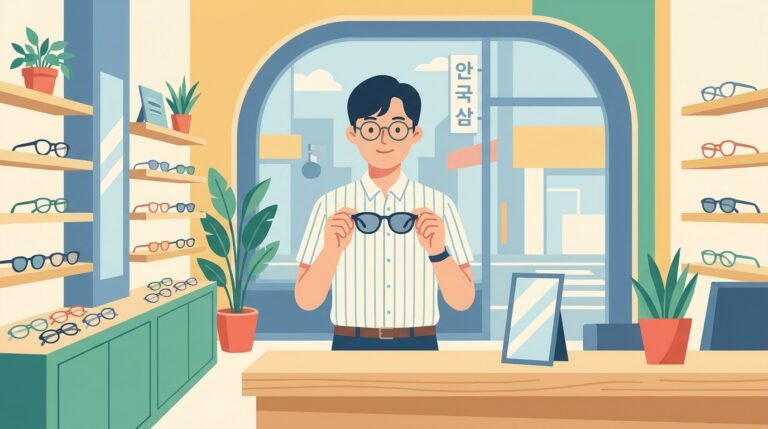
Korea Optical Shop Survival Guide: Protect Your Eyes in Style
Phase 1: 공감 (Story-driven Empathy Opening)
안녕하세요! 매일한글 에디터입니다. (Hello! I am your Daily Hangul editor.)
Picture this: You have just spent your third consecutive evening in Seoul binge-watching your favorite K-drama in your cozy Airbnb, or maybe you have been pulling late hours at a hip cafe in Seongsu-dong staring at your laptop screen while sipping an iced Americano. Suddenly, your eyes sting, feel dry, and start watering. You look in the mirror and think, “I need blue-light blocking glasses, and I need them now.”
Luckily, South Korea is universally famous for having the fastest, most stylish, and surprisingly affordable optical shops in the world. Walking down the streets of Hongdae or Myeongdong, you will spot sleek eyewear boutiques like Davich, Gentle Monster, and countless independent shops called 안경원 (angyeong-won). In Korea, you can walk in without an appointment, get a complimentary computerized eye test, pick a trendy frame, and walk out with custom lenses in under 20 minutes!
However, for beginner (A2) learners, stepping inside can feel intimidating. What if the optician asks questions in rapid-fire Korean? How do you say “blue-light blocking” without waving your hands like a broken robot? Many of our Daily Hangul learners have shared this exact anxiety: “I knew what I wanted in English, but I froze when the optician handed me a tray of lenses!”
Do not worry! Today, your Korean best friend has got your back. We are going to master simple, natural, and polite A2 expressions so you can confidently walk into any Korean optical shop, protect your eyes from screens, and rock that chic K-drama office worker look.
Phase 2: 핵심 표현 3선 심층 분석 (Top 3 Key Expressions)
1. 블루라이트 차단 렌즈로 하고 싶어요. (Beulluraitu chadan renjeuro hago sipeoyo.)
- Pronunciation: [beul-lu-ra-i-teu cha-dan ren-jeu-ro ha-go si-peo-yo] (Think of it like saying “Blue light” with a gentle Korean accent, followed by “cha-dan” which sounds like a karate chop “cha!” + “dan”)
- Meaning: Literal: “I want to do with blue-light blocking lenses.” / Nuance: “I would like to get blue-light blocking lenses, please.”
- K-Culture Moment: This is the signature line uttered by overworked rookie office workers in dramas like Misaeng or King the Land when upgrading their everyday eyewear after staring at spreadsheets all week.
- Editor’s Insight: In Korean service counters, instead of saying “I want to buy” (사고 싶어요 – sago sipeoyo), natives almost always use the verb 하다 (hada – to do) when selecting an option from a menu or catalog: “~로 하고 싶어요” (~ro hago sipeoyo – I’d like to go with ~).
- Situation Spectrum:
- Casual (to close friends): 🚫 블루라이트 차단으로 할래. (Beulluraitu chadan-euro hallae.)
- Semi-formal (to opticians/staff): ✅ 블루라이트 차단 렌즈로 하고 싶어요. (Beulluraitu chadan renjeuro hago sipeoyo.)
- Formal (business presentation/interviews): ⚠️ 블루라이트 차단 렌즈로 맞추고자 합니다. (Beulluraitu chadan renjeuro matchugoja hamnida.)
- 🤔 Think About It: In English, we usually specify “I want to buy lenses.” Why do Koreans prefer “I want to do with…”? Does using “to do” (하다) shift the focus from a financial transaction to a collaborative decision with the optician?
2. 컴퓨터를 오래 봐서 눈이 피로해요. (Keompyuteoreul orae bwaseo nuni pirohaeyo.)
- Pronunciation: [keom-pyu-teo-reul o-rae bwa-seo nu-ni pi-ro-hae-yo] (“Orae” sounds like “all-day” with an ‘r’, and “piro” sounds like espresso-level fatigue)
- Meaning: Literal: “Because I watch the computer for a long time, my eyes are fatigued.” / Nuance: “My eyes feel strained from looking at computers all day.”
- K-Culture Moment: Imagine a tired university student visiting an optical shop near Sinchon during midterms, holding their temples and sighing with this sentence.
- Editor’s Insight: The grammatical connector -아서/어서 (-aseo/eoseo) connects your cause (looking at screens) directly to your physical symptom (tired eyes). It lets the optician instantly recommend computer-specific anti-glare coatings.
- Situation Spectrum:
- Casual: 🚫 컴퓨터 많이 봐서 눈 피곤해. (Keompyuteo mani bwaseo nun pigonhae.)
- Semi-formal: ✅ 컴퓨터를 오래 봐서 눈이 피로해요. (Keompyuteoreul orae bwaseo nuni pirohaeyo.)
- Formal: ⚠️ 장시간 모니터 사용으로 안구 피로감이 큽니다. (Jangsigan moniteo sayong-euro angu pirogami keumnida.)
- 🤔 Think About It: Notice how Korean uses 피로 (piro – systemic fatigue) instead of just 아파요 (apayo – it hurts). When explaining symptoms to service professionals in Korea, naming the type of tiredness helps them pinpoint your solution.
3. 시력 검사 받을 수 있나요? (Siryeok geomsa badeul su innayo?)
- Pronunciation: [si-ryeok geom-sa ba-deul su in-na-yo] (“Siryeok” sounds like “she-ryeok”, and “innayo” rolls off the tongue like a soft question)
- Meaning: Literal: “Can I receive an eyesight test?” / Nuance: “Could I get an eye exam here?”
- K-Culture Moment: When an international traveler walks into a high-tech optical store in Myeongdong, timidly asking this question, only to be welcomed with a cheerful “네, 이쪽으로 앉으세요!” (Yes, please take a seat over here!).
- Editor’s Insight: In Korea, basic optometrist exams at retail glasses shops are almost always free if you purchase frames or lenses. Using ~받을 수 있나요? (~badeul su innayo? – Can I receive…?) is the golden ticket to polite inquiries anywhere in Korea.
- Situation Spectrum:
- Casual: 🚫 시력 검사 돼? (Siryeok geomsa dwae?)
- Semi-formal: ✅ 시력 검사 받을 수 있나요? (Siryeok geomsa badeul su innayo?)
- Formal: ⚠️ 시력 검사가 가능하십니까? (Siryeok geomsaga ganeunghasimnikka? – A bit overly stiff!)
- 🤔 Think About It: In your country, do you need an advance appointment at a doctor’s clinic for an eye prescription? How does Korea’s walk-in retail test culture compare?
Phase 3: 교과서 한국어 vs 진짜 한국어 (Textbook vs. Real Korean)
Situation 1: Asking for blue-light protection feature
- 📖 교과서 한국어 (Textbook):
- 청색광 차단 기능을 추가해 주십시오. (Cheongsaekgwang chadan gineung-eul chugahae jusipsio.)
- 🗣️ 진짜 한국어 (Real Life):
- 블루라이트 차단 넣어주세요. (Beulluraitu chadan neoeo-juseyo.)
- 💡 왜 다를까? (Why the difference?):
Textbooks love Sino-Korean words like 청색광 (cheongsaekgwang – blue ray light), but 99% of modern Koreans and optometrists use the English loanword 블루라이트 (beulluraitu). Also, instead of the rigid “추가해 주십시오” (please add this feature), Koreans say 넣어주세요 (neoeo-juseyo – please put it in), just like adding syrup to your latte!
Situation 2: Explaining dry and strained eyes
- 📖 교과서 한국어 (Textbook):
- 제 시각 기관에 피로감이 누적되었습니다. (Je sigak gigwane pirogami nujeokdoe-eotsumnida.)
- 🗣️ 진짜 한국어 (Real Life):
- 눈이 너무 뻑뻑하고 침침해요. (Nuni neomu bpeokbbeokhago chimchimhaeyo.)
- 💡 왜 다를까? (Why the difference?):
Korean is rich in sensory mimetic words. 뻑뻑하다 (ppeokppeokhada) describes the dry, gritty sensation when you blink after looking at a display, and 침침하다 (chimchimhada) refers to blurry, dim vision. Using these makes you sound instantly authentic!
Phase 4: K-Culture 딥다이브 & 비언어적 매너 (K-Culture Deep Dive & Non-verbal Manners)
4-1. 눈치 (Nunchi) & Optical Shop Etiquette
- Chin on the Rest, Eyes on the Hot-Air Balloon: During the eye test, the optician will guide you to a digital autorefractor. Rest your chin on the pad and look inside. You will likely see a tiny image of a hot-air balloon on an open road. Keep both eyes wide open and do not squint! If you feel awkward, a gentle nod and smiling eyes signal you are ready.
- The Two-Handed Fitting: When the optician hands you the newly adjusted glasses frame to try on, always accept it with two hands (or one hand lightly supporting your opposite wrist). Put them on, look around the shop, blink a few times, and look down at your phone to check comfort.
- Nodding with ‘아, 네!’ (Ah, yes!): While the technician explains lens thickness (압축 – apchuk) or coatings, nodding while uttering a polite “아, 네~” shows you are actively engaged (Nunchi in action!).
4-2. The K-Eyewear Phenomenon
In Korea, glasses are not just medical devices; they are quintessential fashion statements. Walk around Hongdae or Seongsu, and you will notice K-pop idols, influencers, and university students sporting clear acetate frames, minimalist titanium rounds, or chic browline glasses—even with zero prescription! Because Korean screen time is among the highest globally due to intense gaming, tech careers, and smartphone usage, 블루라이트 차단 안경 (blue-light glasses) are considered an everyday self-care necessity, just like sunscreen.
Phase 5: 실전 롤플레이 시나리오 (Real-Life Roleplay Scenario)
- Setting: A bright, minimalist optical store in Seongsu-dong, filled with warm jazz music and sleek wooden display trays.
- NPC Character: Min-jun (민준 씨), a friendly, stylish optician wearing neat wire-rimmed glasses and a clean linen apron.
— dialogue starts —
Turn 1: 민준 (Min-jun)
“어서 오세요! 찾으시는 스타일 있으세요?”
(Eoseo oseyo! Chajeusineun seutail isseuseyo?)
“Welcome! Are you looking for any specific style?”
🎭 Smiles warmly and gestures toward the display shelves.
Turn 2: 나 (You)
“저, 컴퓨터를 오래 봐서 블루라이트 차단 렌즈로 하고 싶어요.”
(Jeo, keompyuteoreul orae bwaseo beulluraitu chadan renjeuro hago sipeoyo.)
“Um, I look at computers for a long time, so I want to get blue-light blocking lenses.”
🎭 Points gently toward your own eyes and smiles.
Turn 3: 민준 (Min-jun)
“아, 눈이 많이 피로하시겠어요. 혹시 지금 안경이나 렌즈 착용 중이신가요?”
(A, nuni mani pirohasigesseoyo. Hoksi jigeum angyeong-ina renjeu chagyong jung-isingayo?)
“Ah, your eyes must be so tired. By any chance, are you currently wearing glasses or contact lenses?”
🎭 Leans forward with an empathetic expression.
Turn 4: 나 (You)
“아니요, 평소에는 안 써요. 시력 검사 받을 수 있나요?”
(Aniyo, pyeongso-eneun an sseoyo. Siryeok geomsa badeul su innayo?)
“No, I usually don’t wear any. Can I get an eye exam?”
🎭 Shakes head gently and asks politely.
Turn 5: 민준 (Min-jun)
“네, 물론이죠! 검사는 무료예요. 이쪽 검사실로 오세요.”
(Ne, mullon-ijyo! Geomsaneun muryo-yeyo. Ijjok geomsasillo oseyo.)
“Yes, of course! The exam is free. Please come into the testing room here.”
🎭 Politely extends an open palm pointing toward the examination room.
(Exam finishes smoothly 5 minutes later…)
Turn 6: 민준 (Min-jun)
“도수는 거의 없으셔서 보호용 기본 렌즈에 블루라이트 차단만 넣으시면 돼요.”
(Dosuneun geoui eopseosyeoseo bohoyong gibon renjeue beulluraitu chadanman neoeusimyeon dwaeyo.)
“You barely need any prescription, so you can just add blue-light blocking to basic protective lenses.”
🎭 Shows two sample lens options against a blue laser pointer.
Turn 7: 나 (You)
“좋아요! 얼마나 걸려요?”
(Joayo! Eolmana geollyeoyo?)
“Sounds great! How long does it take?”
🎭 Checks watch with a curious, excited look.
Turn 8: 민준 (Min-jun)
“테 고르시면 15분 만에 완성됩니다! 편하게 둘러보세요.”
(Te goreusimyeon sibobun mane wanseongdoemnida! Pyeonhage dulleoboseyo.)
“Once you pick a frame, it will be done in just 15 minutes! Feel free to look around comfortably.”
🎭 Hands you a small shopping basket for frames.
— dialogue ends —
🔀 Interactive Branch Point (What will you say next?)
Now that Min-jun invited you to pick a frame, how do you respond?
- Option A: “가장 가벼운 안경테 추천해 주세요.” (Gajang gabyeoun angyeong-te chucheonhae juseyo. – Please recommend the lightest frame.)
- Option B: “안경테 공짜로 주세요!” (Angyeong-te gongjjaro juseyo! – Give me the frame for free!)
- Option C: “나 갈래.” (Na gallae. – I’m leaving.)
— Feedback —
* Option A [BEST 🎉]: Fantastic choice! Korean opticians love recommending ultra-light featherweight titanium (티타늄) frames that won’t give you headaches while working at your desk.
* Option B [BAD 🚫]: Yikes! While eye exams are often complimentary, frames and lenses have clear price tags. Demanding free items can be perceived as disrespectful.
* Option C [RISK ⚠️]: This is rude informal banmal (반말). Min-jun will be utterly confused by why you suddenly dropped all honorifics and walked away!
Phase 6: 10초 감정 섀도잉 드릴 (10-Second Emotion Shadowing Drill)
Practice reading these aloud with feeling! Focus on natural pauses marked with /.
- [🥱 피곤하고 솔직하게 – Exhausted and honest]
- “컴퓨터를 / 오래 봐서 / 눈이 너무 / 피로해요.”
(Keompyuteoreul / orae bwaseo / nuni neomu / pirohaeyo.)
Tip: Let your voice drop softly at the end with a sigh of relief.
- “컴퓨터를 / 오래 봐서 / 눈이 너무 / 피로해요.”
- [👀 궁금하고 공손하게 – Curious and polite]
- “혹시 / 시력 검사 / 받을 수 있나요?”
(Hoksi / siryeok geomsa / badeul su innayo?)
Tip: Raise your pitch slightly on ‘있나요?’ with an open, friendly face.
- “혹시 / 시력 검사 / 받을 수 있나요?”
- [😊 똑부러지고 명확하게 – Confident and clear]
- “블루라이트 차단 / 꼭 넣어주세요!”
(Beulluraitu chadan / kkok neoeo-juseyo!)
Tip: Emphasize ‘꼭’ (kkok – definitely) to sound assertive yet pleasant.
- “블루라이트 차단 / 꼭 넣어주세요!”
Phase 7: K-Culture 미니 사전 (Mini Dictionary)
- 안경원 (Angyeong-won) (noun): Optical shop / Optician boutique. While older folks might say 안경점 (angyeong-jeom), modern shops prefer ‘안경원’.
- 도수 (Dosu) (noun): Prescription strength / Lens power. When the optician asks “도수 넣으실 거예요?” they mean “Do you want prescription lenses or non-prescription plano lenses?”
- 압축 (Apchuk) (noun): Compression / High-index lens thinning. If you have strong myopia, staff might ask: “두 번 압축할까요?” (Shall we double-compress/thin down the lenses?).
- 안경테 (Angyeong-te) (noun): Eyeglass frame. You will see shelves sorted by price: 30,000 KRW, 50,000 KRW, 90,000 KRW, etc.
Phase 8: 여행자를 위한 생존 키트 (Traveler’s Survival Kit)
Survival Expressions TOP 3
- 안경 닦이 더 주실 수 있나요? (Angyeong dakki deo jusil su innayo?)
- “Could I please have an extra microfiber lens cloth?”
- Pro Tip: Korean microfiber cloths feature adorable city maps or K-illustrations and are often given freely with a smile.
- 이거 써봐도 돼요? (Igeo sseobwado dwaeyo?)
- “May I try this one on?”
- Pro Tip: Most frames on display are free for customers to try on directly, but asking this shows supreme manners!
- 도수 없는 보호 안경이에요. (Dosu eomneun boho angyeong-ieyo.)
- “These are non-prescription protective glasses.”
Editor’s Travel Note
- Finding Top Shops: Download the Naver Map app on your phone and search “안경원” or famous nationwide chains like 다비치안경 (Davich Optical), 으뜸50안경 (Eutteum 50), or trendy designer showrooms in Seongsu and Hongdae.
- Tax Refund Alert: Many large eyewear shops in tourist districts offer instant duty-free tax refunds! Keep your passport handy to save an extra 5–8% on the spot.
Phase 9: “한 발 더 깊이” (Deep Cultural Reflection)
Have you ever wondered why Korean optical shops are so astonishingly fast? In many Western countries, getting new glasses takes an optometrist appointment, waiting for an off-site laboratory to manufacture the lenses, and picking them up two weeks later.
In Korea, the blend of the famous 빨리빨리 (Ppalli-ppalli – hurry, hurry) cultural mindset and hyper-dense commercial competition gave rise to on-site lens edging laboratories directly inside retail shops. While you sip a complimentary canned coffee or browse phone accessories next door, an optometrist expertly cuts and mounts your blue-light lenses right there. It reflects Korea’s deep service philosophy: make high quality effortless and respect the customer’s precious time.
💬 Your Turn: How long does it usually take to get prescription or protective glasses in your home country? Would you like to try getting glasses made in 15 minutes during your next trip to Korea? Share your thoughts in the comments below!
Phase 10: FAQ & 흔한 실수 (FAQ & Common Mistakes)
Q: Do I need to book an eye exam in advance at a Korean optical shop?
A: Generally, no! Most retail optical shops in Korea welcome walk-ins for eye tests right on the spot. Only specialized medical ophthalmology clinics (안과 – angwa) require prior appointments or long waits.
Q: Can they duplicate my current glasses’ prescription without an exam?
A: Yes, absolutely! Just hand them your current glasses and say: “이 안경 도수랑 똑같이 맞춰주세요.” (I angyeong dosurang ttokgati matchwo-juseyo. – Please make them identical to this prescription.) They have automated lensometers that read your prescription in seconds.
Q: How much do basic blue-light blocking lenses cost in Korea?
A: Non-prescription blue-light blocking lenses usually start from roughly 20,000 KRW to 40,000 KRW (approx. $15–$30 USD). Adding thinner high-index compression for strong prescriptions may raise it to 50,000–80,000 KRW.
🚨 Common Mistakes Warning Board
- Saying ‘청색광’ instead of ‘블루라이트’: While grammatically correct, using Sino-Korean cheongsaekgwang can sound overly literary or clinical. Stick to 블루라이트 (beulluraitu)!
- Forgetting to mention you wear contacts before the test: If you have contact lenses in your eyes, your cornea is temporarily reshaped, which affects the autorefractor readings. Always tell the staff: “렌즈 꼈어요” (Renjeu kkyeosseoyo – I am wearing contacts) so they can offer you a lens case to take them out first.
- Using ‘주문하고 싶어요’ (I want to order) for custom specs: While understood, it sounds like ordering fried chicken delivery. Use “맞추고 싶어요” (matchugo sipeoyo – I want to fit/customize glasses) or “~로 하고 싶어요” (I want to go with ~) for eyewear.
Phase 11: 액션 미션 & 참여 유도 (Action Missions)
- 🥉 Bronze Mission (Solo Practice): Record yourself on your smartphone voice memo saying: “블루라이트 차단 렌즈로 하고 싶어요” three times with crisp, smooth intonation.
- 🥈 Silver Mission (Social Share): Snap a selfie wearing your favorite pair of glasses (or your tired screen face!), post it on your Instagram Story, tag
@DailyHangul, and caption it with: “컴퓨터를 오래 봐서 눈이 피로해요!” - 🥇 Gold Mission (Real-world Challenge): Visit an optical shop in Korea (or write to an online Korean optical vendor) and ask: “시력 검사 받을 수 있나요?” in full Korean.
- 🎮 K-Culture Mission: Watch an episode of a contemporary workplace K-drama (like Extraordinary Attorney Woo or Agency) and spot whenever a character adjusts their glasses during long screen sessions!
Phase 12: 인터랙티브 퀴즈 챌린지 (Interactive Quiz Challenge)
Test your knowledge before your optical shop adventure!
Question 1: Situation Judgement
You are at the optical store and want to tell the optician that you work on a computer all day and need eye protection. Which sentence is the most natural?
* (A) 컴퓨터 싫어해서 안경 사요. (Keompyuteo sileohaeseo angyeong sayo.)
* (B) 컴퓨터를 오래 봐서 블루라이트 차단 렌즈로 하고 싶어요. (Keompyuteoreul orae bwaseo beulluraitu chadan renjeuro hago sipeoyo.)
* (C) 제 눈에 컴퓨터를 넣어주세요. (Je nune keompyuteoreul neoeojuseyo.)
Question 2: Fill-in-the-Blank
Fill in the missing word meaning “prescription power”:
* “저는 눈이 나빠서 ( )를 넣어야 해요.” (Because my eyesight is bad, I need to add [prescription power].)
Question 3: True or False (Culture)
In Korea, eye exams conducted inside retail optical stores usually take 2 to 3 days to process before you receive results. (True / False)
👉 Click here to reveal answers & explanations!
- Question 1 Answer: (B)
Explanation: Sentence (B) is polite, natural, and accurately communicates your screen usage and blue-light lens requirement. (A) means “I hate computers so I buy glasses,” and (C) means “Please insert a computer into my eye!” - Question 2 Answer: 도수 (Dosu)
Explanation: 도수 (dosu) is the official term for lens prescription power in Korea. - Question 3 Answer: False
Explanation: Retail eye exams in Korea are instant! Using digital machines, the optician reads your eyes immediately, and your glasses are often cut and fitted within 15 to 20 minutes.
You are now fully prepared to get the sharpest vision and coolest frames in Korea! Stay tuned to Daily Hangul for your next everyday survival adventure.







