

The Ultimate Guide to Korean Supermarket Tasting Corners for Absolute Beginners
Phase 1: Empathy (Story-driven Opening)
안녕하세요! 매일한글 에디터입니다. (Hello! I am your Daily Hangul editor.)
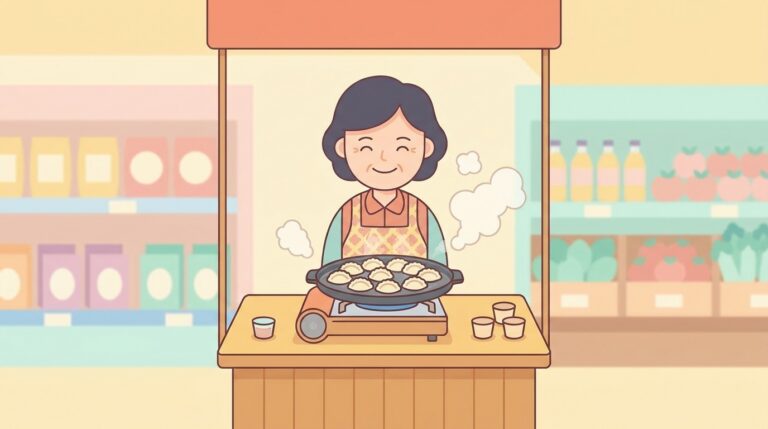
Picture this: You are walking through the wide, shiny aisles of a bustling Korean hypermarket like E-Mart or Lotte Mart after a long day of sightseeing. Suddenly, the irresistible aroma of sizzling bulgogi and pan-fried dumplings hits you. Ahead, you spot a lively tasting stand with an enthusiastic Imo (auntie) skillfully flipping bite-sized treats with metal tongs. A small crowd of shoppers gathers around with tiny toothpicks in hand.
Your stomach rumbles, but your feet freeze. Your heart beats faster: “Can I just take one? Do I need to speak Korean? What if she yells at me to buy the giant 2-kilogram family pack?”
If you have ever awkwardly circled a food stand three times pretending to examine the soy sauce aisle because you were too nervous to take a free sample, breathe easy! Every single Korean learner has been there. Tasting corners—known locally as sisik (시식)—are not commercial traps designed to corner tourists; they are an affectionate, prideful celebration of Korean food culture. Today, based on real feedback from dozens of our absolute beginner learners, I am handing you the exact, bite-sized survival phrases and unspoken social rules you need. By the end of this guide, you will approach that sizzling griddle with a relaxed smile, enjoy every delicious morsel, and exit the interaction with genuine native confidence.
Phase 2: Core Expressions In-Depth Analysis
1. 하나 먹어 봐도 돼요? (Hana meogeo bwado dwaeyo?)
- Pronunciation: Hana meogeo bwado dwaeyo? (Sound analogy: Think of saying “Ha-na” like the name Hannah, “mug-uh” like sipping a hot mug, and “dway-yo” rhyming with sway-yo).
- Meaning: Literal: “Even if I try eating one, is it okay?” | Actual Nuance: “May I try one piece, please?”
- K-Culture Moment: Seen frequently in Korean variety shows like Omniscient Interfering View or K-Dramas whenever stars visit grocery markets and politely ask permission before snacking on newly cooked samples.
- Editor’s Insight: The word hana (하나) means “one.” Using it softens your request dramatically, signaling respect for the store’s inventory and showing you are not there to raid the entire tray.
- Situation Spectrum:
- Casual (Friends): 🚫 하나 먹어 봐도 돼? (Too blunt for a store employee)
- Semi-formal (Polite everyday): ✅ 하나 먹어 봐도 돼요?
- Formal (High respect): ⚠️ 하나 먹어 보아도 되겠습니까? (Grammatically correct, but way too stiff for a grocery mart)
- 🤔 Think About It: In many Western countries, free samples sit passively on platters with napkins. In Korea, asking permission—even when the food is clearly offered—creates an instant human connection with the seller. How does initiating conversation change your grocery shopping experience back home?
2. 맛있어요! (Masisseoyo!)
- Pronunciation: Mas-iss-eo-yo! (Sound analogy: Say “Mah-she” like the word marshy without the ‘r’, followed by “saw-yo”).
- Meaning: Literal: “Taste exists!” | Actual Nuance: “This is delicious! / It’s really good!”
- K-Culture Moment: Every Korean culinary show features guests holding their cheeks in bliss while enthusiastically shouting, “Waa, masisseoyo!”
- Editor’s Insight: This is your golden ticket. You do not need complex vocabulary to praise the food. Saying this with genuine enthusiasm warms the vendor’s heart immediately and counts as the highest currency of politeness.
- Situation Spectrum:
- Casual: 🚫 맛있어 (Only say to close peers)
- Semi-formal: ✅ 맛있어요!
- Formal: ✅ 정말 맛있습니다! (A bit formal, but highly flattering)
- 🤔 Think About It: Notice how the Korean word for delicious (mat-itda) combines the noun mat (taste) and the verb itda (to exist). If a dish has flavor, it is delicious! How does your native language conceptualize tastiness?
3. 괜찮아요, 감사합니다. (Gwaenchanhayo, gamsahamnida.)
- Pronunciation: Gwaen-chan-ha-yo, gam-sa-ham-ni-da. (Sound analogy: “Gwen-chan-ha-yo” sounds like Gwen + Chan + Ha + Yo, followed by “Gahm-sa-hahm-nee-da”).
- Meaning: Literal: “It is okay, I am thankful.” | Actual Nuance: “I’m alright (no thank you), but thank you so much for the sample!”
- K-Culture Moment: Characterized in workplace dramas when a character politely declines an invitation or an extra serving without hurting anyone’s feelings.
- Editor’s Insight: Many foreigners freeze because they fear that eating a free dumpling obligates them to buy the whole package. In Korean culture, this phrase is the ultimate, polite, zero-guilt exit strategy. It means: “Thank you for the taste, but I will pass on purchasing today.”
- Situation Spectrum:
- Casual: 🚫 괜찮아 (Never use with elders or staff)
- Semi-formal: ✅ 괜찮아요, 감사합니다.
- Formal: ✅ 정중히 사양하겠습니다 (Way too dramatic; sounds like rejecting a diplomatic treaty)
- 🤔 Think About It: In English, we often say “No, thanks.” In Korean, using the word Aniyo (No) directly can feel abrupt and defensive. Why do you think Korean defaults to gwaenchanhayo (“I am fine”) instead?
Phase 3: Textbook Korean vs. Real-Life Korean
Situation 1: Asking if you can try a sample
- 📖 교과서 한국어 (Textbook Korean): 이것을 시식해도 됩니까? (Igeoseul sisikhaedo doepnikka? – “Am I permitted to sample this item?”)
- 🗣️ 진짜 한국어 (Real-life Korean): 하나 먹어 봐도 돼요? (Hana meogeo bwado dwaeyo? – “Can I try one piece?”)
- 💡 왜 다를까? (Why the difference?): The Sino-Korean noun sisik (시식) is official marketing terminology. Real shoppers speak with warm, everyday native verbs like meogeo boda (to try eating).
Situation 2: Declining to buy after eating
- 📖 교과서 한국어 (Textbook Korean): 저는 이것을 구매하지 않겠습니다. (Jeoneun igeoseul gumaehaji ankessseumnida. – “I shall not purchase this item.”)
- 🗣️ 진짜 한국어 (Real-life Korean): 괜찮아요, 감사합니다! (Gwaenchanhayo, gamsahamnida! – “I’m good, thank you!”)
- 💡 왜 다를까? (Why the difference?): Nobody announces their refusal to purchase out loud. Korean social communication relies heavily on indirect politeness, signaling departure with a soft thank-you.
Phase 4: K-Culture Deep Dive & Non-Verbal Manners
4-1. 눈치 (Nunchi) & Gestures
At a Korean tasting booth, non-verbal etiquette speaks louder than grammar:
1. The Respectful Reach: Never spear a sample with one arm stretched out casually while looking the other way. When picking up a toothpick or paper cup, place your non-dominant hand lightly under your wrist or against your chest. This centuries-old gesture subtly conveys deference.
2. The Micro-Bowing Routine: When the vendor extends a freshly griddled sample toward you, give a crisp, small 15-degree nod of acknowledgment.
3. Trash Awareness: Never toss used toothpicks into the fresh food tray or drop paper cups onto grocery shelves! Always search for the small paper cup attached to the booth edge labeled Ssu-re-gi-tong (쓰레기통 – trash bin).
4-2. Culture Code: The “Jeong” of the Supermarket Sisik
Korean grocery hypermarkets (E-Mart, Homeplus, Hanaro Mart) consider tasting corners an art form. The vendors running these booths are often middle-aged women affectionately referred to as Imo (auntie) or Eomeoni (mother). They are master cooks and persuasive sales champions who pride themselves on the concept of Jeong (정)—a deep, warm human affection and hospitality.
When an Imo tells you, “Eat while it is hot!”, she genuinely wants you to experience good food. You are under zero legal or moral contract to buy the item, but acknowledging her hard work with a joyful reaction creates a delightful, heartwarming bridge between cultures.
Phase 5: Real-World Roleplay Scenario
Setting: The sizzling dumpling section on the B1 food floor of E-Mart in Yongsan, Seoul. Steam billows from an electric skillet operated by a cheerful vendor wearing a hairnet and apron.
Characters:
* Imo (The Tasting Vendor): Sizzling pork and kimchi mandu at lightning speed.
* You (A1 Korean Explorer): Hungry, curious, and practicing your Korean manners.
- Imo: 손님, 만두 하나 드셔 보세요! 뜨거워요!
(Sonnim, mandu hana deusyeo boseyo! Tteugeowoyo!)
“Customer, try one dumpling! It’s piping hot!”
🎭 [Smiling warmly, pointing a pair of long metal tongs toward a platter of toothpicked dumplings] -
You: 하나 먹어 봐도 돼요?
(Hana meogeo bwado dwaeyo?)
“Can I try one?”
🎭 [Stepping closer with a slight head nod, hands clasped politely] -
Imo: 그럼요! 여기 있어요. 조심해요!
(Geureomyo! Yeogi isseoyo. Josimhaeyo!)
“Of course! Here you go. Be careful!”
🎭 [Hands you a toothpick with a golden-brown dumpling] -
You: 감사합니다!
(Gamsahamnida!)
“Thank you!”
🎭 [Supporting your right elbow with your left hand as you take the toothpick, gently blowing on the dumpling] -
You: 음! 진짜 맛있어요!
(Eum! Jinjja masisseoyo!)
“Mmm! It’s really delicious!”
🎭 [Eyes lighting up with an authentic, appreciative nod] -
Imo: 맛있죠? 오늘 1+1 행사해요! 하나 사요!
(Masitjyo? Oneul won-peulleoseu-won haengsahaeyo! Hana sayo!)
“Tastes good, right? Today we have a Buy-1-Get-1-Free deal! Pick one up!”
🎭 [Holding up two taped packages of frozen dumplings with a bright sales pitch] -
You: 아, 괜찮아요. 감사합니다!
(A, gwaenchanhayo. Gamsahamnida!)
“Ah, I’m okay. Thank you so much!”
🎭 [Politely waving your hand side to side at chest level with an apologetic smile] -
Imo: 네, 좋은 쇼핑 하세요!
(Ne, joeun syoping haseyo!)
“Okay, enjoy the rest of your shopping!”
🎭 [Chuckles warmly and flips the next batch on the skillet]
🔀 Interactive Decision Point
The Imo asks: “Oneul won-peulleoseu-won haengsahaeyo! Hana sayo!” (We have a 1+1 promo! Buy one!). What do you do?
- Option A: You shout “No, no, no!” and immediately sprint away down the dairy aisle.
- Outcome: Bad. Running away makes the interaction awkward, and saying “No!” repeatedly sounds defensive. The auntie just wanted to share the discount!
- Option B: You smile, bow slightly, wave your hand gently at chest level, and say, “괜찮아요, 감사합니다!” (Gwaenchanhayo, gamsahamnida!).
- Outcome: Best! Perfectly polite, natural, and friendly. She will smile back and return to cooking, with zero hard feelings.
- Option C: You say “이거 얼마예요?” (Igeoeolmayeyo? – How much is this?) because you are afraid saying no is rude.
- Outcome: Risk. If you truly want to purchase it, great! But if you ask the price just to be polite, you risk getting tangled in a complex conversation about sales bundles you don’t actually want to carry home.
Phase 6: 10-Second Emotion Shadowing Drill
Repeat each line out loud three times. Pay close attention to the pause markers (/) and the emotional cues!
[😋 군침 돌며 수줍게 / Shyly & mouth-watering]
하나 / 먹어 봐도 / 돼요?
(Hana / meogeo bwado / dwaeyo?)
Guide: Keep your pitch rising gently at the end of “돼요?” like a friendly inquiry.-
[🤩 감탄하며 눈을 동그랗게 / Amazed with wide eyes]
와! / 진짜 / 맛있어요!
(Wa! / Jinjja / masisseoyo!)
Guide: Stress the word “진짜” (jinjja) with enthusiasm to make the compliment shine. -
[😊 정중하고 상냥하게 / Polished, polite & kind]
괜찮아요, / 감사합니다!
(Gwaenchanhayo, / gamsahamnida!)
Guide: Soften “괜찮아요” without dropping your voice abruptly; conclude with a bright “감사합니다.”
Phase 7: K-Culture Mini Dictionary
-
시식 (Sisik)
Translation: Food sampling / Free tasting.
Daily Usage: Found on overhead placards throughout supermarkets. Look for 시식 코너 (sisik koneo – tasting corner). If you see this sign, you are officially welcome to try food for free! -
이모님 (Imonim)
Translation: Respected Auntie.
Daily Usage: While literally meaning maternal aunt, Koreans affectionately call friendly female food vendors and restaurant staff Imo or Imonim. It immediately breaks down formality and brings warm smiles. -
덤 (Deom)
Translation: Free bonus item / Extra scoop.
Daily Usage: A foundational concept of Korean merchant culture. If an auntie likes your politeness, she might hand you an extra dumpling or tape an additional mini sauce packet to your grocery box as deom. -
1+1 (원플러스원 / Won-peulleoseu-won)
Translation: Buy One, Get One Free (BOGO).
Daily Usage: You will see bright stickers reading “1+1” or “2+1” everywhere across Korean supermarkets and convenience stores. Always look for these before paying full price!
Phase 8: Traveler’s Survival Kit
Top 3 Survival Phrases
- 이거 매워요? (Igeo maewoyo?)
Romanization: I-geo mae-wo-yo?
Pro Tip: Essential if you have low spice tolerance! If the sample looks red or saucy, ask this before taking a bite. - 휴지 있어요? (Hyuji isseoyo?)
Romanization: Hyu-ji iss-eo-yo?
Pro Tip: “Do you have a napkin/tissue?” Invaluable when tasting juicy pork belly or saucy tteokbokki on the go. - 버려도 돼요? (Beoryeodo dwaeyo?)
Romanization: Beo-ryeo-do dwae-yo?
Pro Tip: Pointing your used toothpick at the small trash cup while asking this ensures you don’t litter accidentally.
Editor’s Travel Note
- Navigation Guide: Before heading out, make sure you complete your Naver Map navigation app download. Google Maps often lags with walking directions in South Korea, but Naver Map shows exact supermarket branch locations, basement floor maps, and operating hours.
- Smart Supermarket Sunday Rule: Most large hypermarkets (E-Mart, Lotte Mart, Homeplus) legally close on the 2nd and 4th Sunday of every month to support traditional local markets. Check the store status on your map app before visiting!
- Payment & Bags: Credit cards and mobile payments (Apple Pay at select retailers, Samsung Pay everywhere) are standard. Note that Korean grocery stores do not provide free plastic bags; bring a canvas tote or buy a 100-won municipal trash bag at the register to pack your groceries.
Phase 9: “한 발 더 깊이” (One Step Deeper)
In Western supermarket culture, shopping is largely individualistic, silent, and transaction-driven. You select pre-packaged goods, scan them at self-checkout, and rarely exchange words. In contrast, Korean supermarkets intentionally maintain human warmth within hyper-modern spaces.
The tasting booth is a direct descendant of the traditional Korean open market (sijang), where sharing a warm spoonful of food was an act of communal bond (jeong). By stepping forward, tasting a sample, and uttering a brief “Masisseoyo!”, you are participating in a living cultural tradition that values human interaction over mechanical efficiency.
💬 Your Turn: What food tasting customs exist in your home country? Have you ever felt shy trying samples abroad? Drop a comment below and share your shopping stories with our community!
Phase 10: FAQ & Common Mistakes
Q: Do I have to buy the product if I eat a sample?
A: Absolutely not! Sampling is 100% free with zero obligation. Vendors hope you enjoy it enough to buy, but simply saying “Gwaenchanhayo, gamsahamnida” with a smile is completely respected.
Q: Can I take more than one piece?
A: It is standard etiquette to take only one piece per person. If you are shopping with a partner, each of you may take one toothpick. Taking three or four pieces in a row without buying is frowned upon.
Q: Can children or solo travelers approach the tasting corner alone?
A: Yes! Solo travelers are warmly welcomed. However, vendors will often caution younger children about hot pans or spicy seasonings before handing them a toothpick.
🚨 Common Mistakes (흔한 실수) Warning Board
- Mistake 1: Grabbing food using bare hands or personal chopsticks.
Correct Action: Always use the provided toothpicks or wait for the vendor to hand you a mini paper cup. - Mistake 2: Leaving toothpicks on regular grocery shelves.
Correct Action: Drop your used toothpick into the tiny trash cup taped to the tasting cart or look for trash bins located at the end of the aisle. - Mistake 3: Saying “아니요” (Aniyo – No) harshly when declining to buy.
Correct Action: Say “괜찮아요, 감사합니다” (Gwaenchanhayo, gamsahamnida). It sounds polite, warm, and natural.
Phase 11: Action Mission & Engagement
Ready to put this knowledge to the test? Take on the Daily Hangul 3-Tier Challenge!
- 🥉 Bronze Mission (Solo Practice): Stand in front of your mirror with a toothpick. Practice saying “Hana meogeo bwado dwaeyo?” and “Jinjja masisseoyo!” with confident facial expressions three times.
- 🥈 Silver Mission (Audio Recording): Record a 10-second voice note using our emotion shadowing drill from Phase 6. Listen back to check if your voice rises naturally on the polite ending “dwaeyo?”.
- 🥇 Gold Mission (Real-Life Supermarket): Walk up to an active tasting corner at a Korean mart. Take one sample, make eye contact, say “Masisseoyo!”, and politely conclude with “Gwaenchanhayo, gamsahamnida!”.
🎮 K-Culture Mission: On your next K-Drama or Korean variety show marathon (like Running Man or I Live Alone), spot a scene where characters visit a supermarket or street cart. Did you hear them say “Hana” or “Masisseo”? Share your discovery in the comments!
Phase 12: Interactive Quiz Challenge
Test your grocery mart street smarts below!
Question 1 (Situation Judgment)
You take a piece of fried dumpling from an E-Mart tasting stand. It tastes wonderful! The vendor asks if you want to buy the bundle. You are staying in a hotel without a kitchen, so you cannot cook. What should you say?
* A) 사지 않겠습니다! (Saji ankessseumnida!)
* B) 싫어요! (Sireoyo!)
* C) 괜찮아요, 감사합니다! (Gwaenchanhayo, gamsahamnida!)
Question 2 (Fill in the Blank)
Fill in the missing word to politely ask for one sample:
* “_______ 먹어 봐도 돼요?” (_______ meogeo bwado dwaeyo?)
Question 3 (True or False Cultural Trivia)
True or False: If you eat a free sample at a Korean supermarket tasting corner, it is legally required to put the item in your shopping cart.
👉 Click to reveal answers & explanations!
Answers & Explanations:
- Answer: C) 괜찮아요, 감사합니다!
Explanation: Option A is unnaturally stiff and robotic; Option B means “I hate it!” which is very rude. Option C is the perfect, warm way to decline purchasing. - Answer: 하나 (Hana)
Explanation: Hana means “one.” The phrase Hana meogeo bwado dwaeyo? means “Can I try one piece?” - Answer: False!
Explanation: Tasting (sisik) is completely free of charge and carries zero purchase obligation. It is a promotional gesture rooted in Korean hospitality!







