

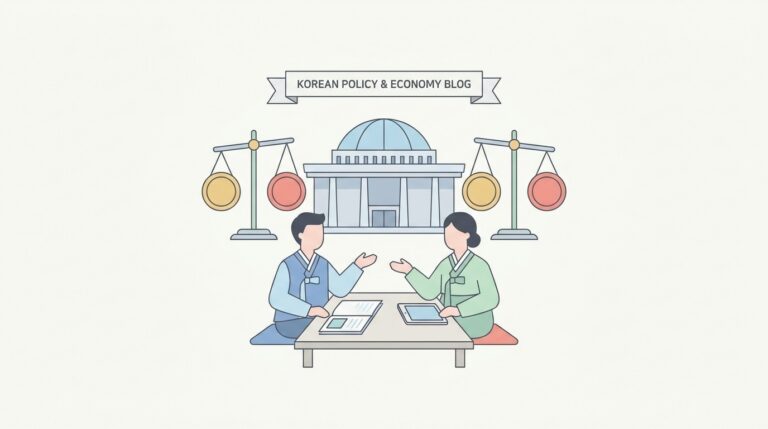
Mastering High-Level Korean: Debating Fiscal Policy and Bipartisan Consensus
Phase 1: 공감 (Story-Immersive Opening)
안녕하세요! 매일한글 에디터입니다.
Have you ever settled in with a cup of tea to watch a sophisticated K-Drama like Chief of Staff (보좌관) or flipped open the political economy section of a major Korean newspaper, only to find yourself utterly paralyzed? You see veteran politicians passionately hammering tables, debating state budgets, and exchanging heavy phrases about national debt, while you’re left desperately clinging to basic textbook vocabulary.
Many of our advanced C1 learners tell us: “Editor, I can order food, joke with friends, and even navigate an office meeting in Seoul. But the moment the topic turns to state finance, tax policies, and parliamentary debate, I feel completely tongue-tied!”
It is an intimidating hurdle. Discussing 재정 건전성과 조세 정책 (Fiscal Sustainability and Tax Policy) isn’t just about vocabulary; it requires understanding the delicate art of Korean rhetorical diplomacy. In Korean policymaking, how you frame the tension between aggressive economic stimulus and fiscal discipline reveals your cultural maturity. By mastering this unit’s expressions, you will gain the power to participate in sophisticated editorial debates, policy seminars, and high-level corporate discussions with genuine poise. This guide is crafted directly from field notes, real debate transcripts, and years of coaching international professionals.
Phase 2: 핵심 표현 3선 심층 분석 (Top 3 Core Expressions)
1. 초당적 합의 (Chodangjeok hap-ui)
- Pronunciation: [Chodangjeok habui] (Think of ‘cho’ like ‘choke’ without the k, ‘dang’ like a bell’s ‘ding-dong’, and ‘habui’ sounding like ‘hob-we’ spoken rapidly).
- Meaning: Literal: “Trans-party agreement” | Nuanced: True bipartisan consensus where national interest overtakes partisan warfare.
- K-Culture Moment: In political thrillers like Stranger (비밀의 숲), you often hear reformist leaders whisper this phrase behind closed doors when trying to pass urgent socio-economic relief legislation.
- Editor’s Insight: Notice the prefix 초- (cho-), meaning transcendence or ultra-. It’s not just a compromise; it carries the noble connotation of rising above tribal politics.
- Situation Spectrum: Casual 🚫 | Semi-formal ⚠️ | Formal ✅
- 🤔 Think About It: Does your native culture frame political compromise as a virtue or as a sign of weakness? In Korean discourse, seeking an ‘합의’ (consensus) is traditionally seen as the pinnacle of statesmanship.
2. 재정 건전성을 유지하다 (Jaejeong geonjeonseong-eul yujihada)
- Pronunciation: [Jae-jeong geon-jeon-seong-eul yu-ji-ha-da] (Flow smoothly: ‘jae-jeong’ sounds like ‘jaye-jong’, followed by ‘gun-jun-song’).
- Meaning: Literal: “Maintain fiscal soundness” | Nuanced: Preserving national creditworthiness and sovereign debt discipline to shield against future macro shocks.
- K-Culture Moment: Watch any Korean live budget hearing at the National Assembly (국회 예결위). Whenever supplementary budgets (추경) are brought up, fiscal conservatives immediately deploy this exact phrase.
- Editor’s Insight: 건전성 (Soundness/Health) uses the same root as “건강” (health). In Korean institutional thought, national finances are treated like a living organism’s vital signs.
- Situation Spectrum: Casual 🚫 | Semi-formal ⚠️ | Formal ✅
- 🤔 Think About It: Why does Korea emphasize debt ratio thresholds so strictly compared to Western economies? (Hint: The historical trauma of the 1997 IMF Asian Financial Crisis plays a massive role).
3. 단기 경기 대응과 중장기 지속가능성을 조화시키다 (Dangi gyeonggi daeeung-gwa jungjanggi jisokganeungseong-eul johwasikida)
- Pronunciation: [Dan-gi gyeong-gi dae-eung-gwa jung-jang-gi ji-sok-ga-neung-seong-eul jo-hwa-si-ki-da]
- Meaning: Literal: “Harmonize short-term economic response and mid-to-long-term sustainability.”
- K-Culture Moment: Frequently featured in keynote addresses at the Ministry of Economy and Finance (기획재정부) briefings when explaining budget allocations.
- Editor’s Insight: The verb 조화시키다 (to harmonize) is a vital diplomat’s tool. Rather than saying “A versus B,” C1 communicators use harmony verbs to build collaborative policy compromises.
- Situation Spectrum: Casual 🚫 | Semi-formal ⚠️ | Formal ✅
- 🤔 Think About It: Korean political rhetoric often borrows Confucian concepts of balance (중용, Jungyong). How does this affect how policy friction is mediated?
Phase 3: 교과서 한국어 vs 진짜 한국어 (Textbook vs. Real-Life Korean)
Situation 1: Calling for emergency economic relief without reckless spending
- 📖 교과서 한국어: 지금 정부는 돈을 많이 써서 경기를 살려야 하지만, 빚이 늘어나면 안 되니까 조심해야 합니다. (Jigeum jeongbuneun doneul mani sseoseo gyeonggireul sallyeoya hajiman, biji neureonamyeon an doenikka josimhaeyahapnida. / The government needs to spend money to save the economy, but debt shouldn’t increase so we must be careful.)
- 🗣️ 진짜 한국어: 단기 경기 방어를 위한 맞춤형 재정 투입과 중장기 재정 준칙 확립이 균형을 이뤄야 합니다. (Dangi gyeonggi bangeoreul wihan matchumhyeong jaejeong tuipgwa jungjanggi jaejeong junchik hwangnibi gyunhyeongeul irwoeyahapnida. / Targeted fiscal injection for short-term economic defense and the establishment of mid-to-long-term fiscal rules must strike a balance.)
- 💡 왜 다를까?: Advanced Korean policy speech replaces colloquial expressions like “돈을 쓰다” (spend money) with refined administrative terms like “재정 투입” (fiscal injection) and “재정 준칙” (fiscal anchors/rules).
Situation 2: Urging rival political factions to stop bickering
- 📖 교과서 한국어: 여당과 야당은 싸우지 말고 국민을 위해 빨리 결정하세요. (Yeodanggwa yadangeun ssauji malgo gungmineul wihae ppalli gyeoljeonghaseyo. / Ruling and opposition parties should stop fighting and decide quickly for the citizens.)
- 🗣️ 진짜 한국어: 정쟁을 지양하고 민생 안정을 위한 초당적 결단을 내려야 할 시점입니다. (Jeongjaengeul jiyanghago minsaeng anjeongeul wihan chodangjeok gyeoldaneul naeryeoya hal sijeomimnida. / It is time to eschew partisan strife and make a bipartisan decision for the stabilization of public livelihood.)
- 💡 왜 다를까?: Phrases such as “정쟁을 지양하다” (eschew factional fighting) and “초당적 결단” (bipartisan resolve) reflect the formal standard expected in serious civic and economic debates.
Phase 4: K-Culture 딥다이브 & 비언어적 매너 (K-Culture Deep Dive & Non-Verbal Manners)
4-1. 눈치 (Nunchi) & Professional Gestures
When debating fiscal policies with Korean counterparts:
* Lower Your Vocal Pitch, Don’t Raise Volume: In Western debates, sharp inflections show passion. In Korean boardroom and parliamentary settings, raising your voice is interpreted as losing emotional control (흥분). Senior policy experts deliver heavy critique with measured, low-toned deliberation.
* The Open-Palm Gesture: When gesturing toward alternative fiscal solutions, avoid pointing a single finger. Rest your four fingers together and gesture with an open palm toward the screen or document. It conveys institutional respect while advancing firm points.
* Nunchi at Closed Doors: In high-stakes deliberations, Korean negotiators frequently signal readiness for a compromise by subtly shifting from formal honorific declarations (-하십시오) to reflective statements (-할 필요성이 대두되고 있습니다).
4-2. Cultural Code Analysis: The IMF Trauma and Fiscal Restraint
Why does Korea place such exceptional cultural weight on “건전재정” (Sound Finance)? The 1997 Asian Financial Crisis (known simply in Korea as the “IMF 사태”) left a deep mark on national psychology. Citizens donated personal gold rings to pay off sovereign debt. Consequently, running budget deficits carries strong moral and economic scrutiny. Whenever expansionary budgets are proposed, advocates must rigorously prove that the measures are temporary, targeted, and backed by long-term sustainability plans.
Phase 5: 실전 롤플레이 시나리오 (Real-World Roleplay Scenario)
Setting: A conference room at the National Assembly Research Service (국회입법조사처) in Yeouido, Seoul. Senior Policy Researcher Han Min-seok (한민석) and Foreign Economic Advisor Sarah are negotiating a draft budget evaluation report.
- Turn 1 (Han): 이번 추가경정예산안 편성을 두고 여야의 이견이 좁혀지지 않고 있군요. (Ibeon chugagyeongjeongyesanan pyeonseongeul dugo yeoyaui igyeoni jophyeojiji anko itgunyo. / 🎭 Sighs while adjusting his glasses, spreading the economic brief across the table. / Disagreements between the ruling and opposition parties over this supplementary budget seem irreconcilable.)
- Turn 2 (Sarah): 네, 경기 침체에 대응하기 위한 확장 재정의 필요성과 재정 건전성 악화에 대한 우려가 팽팽합니다. (Ne, gyeonggi chimche-e daeeunghagi wihan hwakjang jaejeong-ui piryoseong-gwa jaejeong geonjeonseong akhwa-e daehan uryeoga paengpaenghamnida. / 🎭 Maintains steady eye contact, speaking in a firm yet calm cadence. / Indeed. The necessity of expansionary spending to counter the economic downturn stands in tense opposition to concerns over worsening fiscal health.)
- Turn 3 (Han): 맞습니다. 재정 적자 폭이 커지면 대외 신인도에도 부담이 될 텐데요. (Masseumnida. Jaejeong jeokja pogi keojimyeon dae-oe sin-indo-edo budami doel tendeyo. / 🎭 Taps pen thoughtfully against his notebook. / Exactly. If the fiscal deficit widens, it could weigh heavily on our sovereign credit rating.)
- Turn 4 (Sarah): 그렇다고 지출을 과도하게 긴축하면 취약계층의 타격이 극심해집니다. (Geureotdago jichureul gwadohage ginchukhamyeon chwiyakgyecheung-ui tagyeogi geuksimhaejimnida. / 🎭 Nods empathetically, offering a gentle open-palm gesture. / Still, excessive austerity will disproportionately devastate vulnerable demographics.)
- Turn 5 (Han): 결국 단기 경기 대응의 유연성과 중장기 지속가능성을 조화시키는 묘수가 필요하겠지요? (Gyeolguk dangi gyeonggi daeeung-ui yuyeonseong-gwa jungjanggi jisokganeungseong-eul johwasikineun myosuga piryohagetjiyo? / 🎭 Leans forward with an expectant, inquiring gaze. / In the end, we need an astute strategy that balances short-term flexibility with long-term sustainability, don’t we?)
- Turn 6 (Sarah): 바로 그 지점입니다. 양측을 설득하기 위해선 초당적 합의가 전제되어야 합니다. (Baro geu jijeomimnida. Yangcheugeul seoldeukhagi wihon chodangjeok habuiga jeonj镜edoeeoya hamnida. / 🎭 Smiles subtly, keeping her tone grounded and convincing. / That is precisely the crux. Securing bipartisan consensus is an absolute prerequisite to persuade both camps.)
- Turn 7 (Han): 초당적 합의라… 그렇다면 보고서의 핵심 권고안은 어떻게 프레이밍하면 좋을까요? (Chodangjeok habuira… Geureotdamyeon bogoseo-ui haeksim gwon-goaneun eotteoke peureim-inghayeon joeulkkayo? / 🎭 Crosses his arms thoughtfully, nodding in agreement. / Bipartisan consensus… Then how should we frame the primary recommendations of our policy report?)
- Turn 8 (Sarah): 한시적 지원책 마련과 동시에 엄격한 재정준칙 법제화를 병행하자고 제안합시다. (Hansijeok jiwonchaek maryeon-gwa dongsie eomgyeokhan jaejeongjunchik beopjehwareul byeonghaenghajago je-anhapssida. / 🎭 Presents the finalized executive summary document on the table. / Let us propose pairing temporary relief measures with the statutory enactment of strict fiscal anchors.)
🔀 인터랙티브 분기점 (Interactive Branching Point)
How would you answer Senior Researcher Han’s question in Turn 7?
* Option A (Best): “단기 부양책을 집행하되, 중장기 재정 준칙을 입법화하는 로드맵을 함께 제시하여 초당적 합의를 이끌어내야 합니다.” (Execute short-term stimulus while establishing a legislative roadmap for mid-to-long-term fiscal rules to build bipartisan consensus.) -> Feedback: Perfect! Balances both economic priorities using precise institutional rhetoric.
* Option B (Bad): “돈을 더 이상 쓰지 말고 국가 부채부터 무조건 갚아야 한다고 씁시다.” (Let’s write that we shouldn’t spend any more money and must pay off national debt unconditionally.) -> Feedback: Too blunt. Ignores short-term welfare and sounds unsophisticated for a C1 policy advisor.
* Option C (Risk): “정치인들이 알아서 합의할 때까지 우리 의견을 명확히 밝히지 않는 것이 안전합니다.” (It is safer to avoid taking a stand until the politicians figure out an agreement themselves.) -> Feedback: Passive and unhelpful. Fails to provide analytical leadership.
Phase 6: 10초 감정 섀도잉 드릴 (10-Second Emotional Shadowing Drill)
Practice reading these sentences aloud, pausing at the slashes (/) and feeling the emotional direction.
[🧐 단호하고 설득력 있게 / Firm & Persuasive]
단기 경기 대응의 유연성과 / 중장기 지속가능성을 / 조화롭게 이끌어내야 합니다.
(Dangi gyeonggi daeeung-ui yuyeonseong-gwa / jungjanggi jisokganeungseong-eul / johwaropge ikkeureonaeya hamnida.)-
[🤝 포용적이고 진지하게 / Diplomatic & Sincere]
정파적 이익을 넘어서 / 국가 경제를 위한 / 초당적 합의가 절실합니다.
(Jeongpajeok i-igeul neomeoseo / gukga gyeongjereul wihan / chodangjeok habuiga jeolsilhamnida.) -
[⚖️ 객관적이고 단호하게 / Analytical & Measured]
재정 건전성의 훼손은 / 국가 신인도 하락이라는 / 치명적인 부메랑이 될 수 있습니다.
(Jaejeong geonjeonseong-ui hwesoneun / gukga sin-indo haragiraneun / chimyeongjeogin bumerang-i doel su itseumnida.)
Phase 7: K-Culture 미니 사전 (Mini Policy Dictionary)
- 추경 (Chugyeong / 追更) | Supplementary Budget
- Short for 추가경정예산. Whenever sudden domestic crises, floods, or pandemics hit, the executive branch drafts a “추경안” to allocate unbudgeted funds.
- 세수 결손 (Sesu gyeolson) | Tax Revenue Shortfall
- When collected taxes fall short of the original annual national projection. A frequent headline trigger in Korean fiscal debates.
- 확장재정 (Hwakjang jaejeong) | Expansionary Fiscal Policy
- The economic approach of increasing government spending and deficit financing to stimulate aggregate demand during downturns.
- 건전재정 (Geonjeon jaejeong) | Sound Fiscal Policy (Fiscal Discipline)
- An approach emphasizing balanced budgets, spending restraint, and keeping national sovereign debt ratios within safe benchmarks.
Phase 8: 여행자를 위한 생존 키트 (Professional Expat Survival Kit)
High-Value Policy Discussion Survival Phrases:
- 재정 여력이 충분한가요? (Jaejeong yeoryeogi chungbunhangayo?)
- “Does the government have sufficient fiscal buffer?”
- Pro Tip: Use this in investment seminars or economic symposiums to test a company’s or government’s resource runway.
- 초당적인 차원에서 재검토가 필요합니다. (Chodangjeogin chawoneseo jaegeomtoga piryohamnida.)
- “A review is required from a bipartisan standpoint.”
- Pro Tip: An elegant way to stop deadlock in contentious boardrooms or working groups.
- 단기적 처방에 그쳐서는 안 됩니다. (Dangijeok cheobange geuchyeoseoneun an doemnida.)
- “It must not remain merely a short-term temporary fix.”
- Pro Tip: Use this when recommending deeper systemic reforms rather than band-aid solutions.
Editor’s Travel & Living Note
If you reside in Seoul or frequently travel to Korea for business, you can observe these debates live. Visit the National Assembly Visitors Center in Yeouido by checking the official National Assembly Public Access Portal for admission times. Furthermore, tracking legislation via the official Korea Law Information Center Mobile Application will dramatically accelerate your reading comprehension of economic acts and statutes.
Phase 9: “한 발 더 깊이” (Deep Cultural Reflection)
In modern Korean society, fiscal discourse is intertwined with intergenerational equity (세대 간 형평성). Because South Korea faces an ultra-low birthrate and a rapidly aging society, state debt isn’t viewed merely as an abstract financial metric; it represents the financial obligations that will be inherited by the youth. When politicians debate “초당적 합의,” they are not just negotiating between political parties—they are balancing the current generation’s survival against the future generation’s viability. Reaching this balance requires humility and moral responsibility.
💬 Your Turn: How does your home country handle the tradeoff between immediate social welfare spending and long-term national debt? Do you observe genuine bipartisan agreements, or deep political gridlock? Share your thoughts below in Korean!
Phase 10: FAQ & 오해 방지 (FAQ & Common Mistakes)
Q: Can ‘초당적’ be used in ordinary business or personal contexts?
A: Technically yes, but metaphorically. In business, you might say “부서 간 갈등을 넘어서 초당적으로 협력합시다” (Let’s transcend cross-departmental friction and cooperate on a grand scale). However, in everyday social settings with friends, using “초당적” sounds overly dramatic and theatrical unless meant as a deliberate joke.
Q: What is the difference between ‘건전재정’ and ‘긴축재정’?
A: “건전재정” (Sound finance) refers to the overarching principle or status of maintaining financial equilibrium, stability, and transparency. “긴축재정” (Austerity finance), on the other hand, refers to the active, deliberate policy action of slashing public spending to balance the ledger.
Q: Why do Korean commentators use ‘여야’ instead of naming specific parties?
A: The acronym 여야 (Yeo-Ya) combines 여당 (Ruling party) and 야당 (Opposition party). In institutional Korean discourse, referencing “여야” places institutional civic duty upon both sides rather than blaming an individual faction.
🚨 흔한 실수 (Common Mistakes)
- Mistake: Confusing “합의” (consensus/agreement) with “협상” (negotiation).
- Incorrect: 초당적 협상을 이루었습니다.
- Correct Action: Use 초당적 합의를 도출했습니다 (Derived a bipartisan consensus).
- Mistake: Directly translating “government money” as “정부 돈”.
- Incorrect: 정부 돈을 아껴야 합니다.
- Correct Action: Say 국고를 절감해야 합니다 or 재정을 건전하게 관리해야 합니다.
- Mistake: Mixing up “단기적” (short-term) and “일시적” (temporary) carelessly.
- Correct Action: Use 단기 경기 대응 for economic timeframe adjustments, and 한시적 지원 for sunsetted relief funding.
Phase 11: 액션 미션 & 참여 유도 (Action Missions)
- Bronze Mission (Solo Practice): Read the Phase 6 Shadowing sentences aloud 3 times, focusing on maintaining an authoritative, steady tempo without rushing.
- Silver Mission (Social Sharing): Write a 2-sentence commentary in Korean on an economic news article using the phrase
재정 건전성과 경기 부양을 조화시키다and share it on your social media or language learning app. - Gold Mission (Real-World Use): In your next corporate meeting, seminar, or advanced language exchange, employ the phrase: “장기적인 지속가능성을 고려해 초당적인(초부서적인) 합의점을 찾아야 합니다.”
- 🎮 K-Culture Mission: Watch a press conference clip from the Ministry of Economy and Finance on YouTube and tally how many times you spot the words 추경, 건전성, and 지속가능성.
Phase 12: 인터랙티브 퀴즈 챌린지 (Interactive Quiz Challenge)
1. Situational Judgment:
You are participating in an academic panel discussing Korea’s supplementary budget. Which of the following statements provides the most objective, advanced framing?
* (A) 야당이 반대하니까 그냥 돈을 쓰지 않는 것이 좋습니다.
* (B) 단기적 경기 방어와 중장기 재정 건전성 간의 균형을 모색하는 초당적 합의가 요구됩니다.
* (C) 정부는 무조건 돈을 많이 풀어서 국민들을 도와줘야 합니다.
2. Fill-in-the-Blank:
“급격한 부채 증가를 억제하고 국가 신인도를 지키기 위해서는 엄격한 재정 ______을/를 확립해야 한다.”
* Hints: [건전성, 경기, 지양]
3. True or False:
In Korean economic rhetoric, the phrase “초당적 합의” is generally avoided because compromise is seen as political failure. (True / False)
👉 Click here to reveal Answers & Explanations!
- Answer: (B)
- Explanation: Option (B) demonstrates advanced C1 register by balancing opposing policy concerns with terms like
단기적 경기 방어,재정 건전성, and초당적 합의.
- Explanation: Option (B) demonstrates advanced C1 register by balancing opposing policy concerns with terms like
- Answer: 건전성 (Geonjeonseong)
- Explanation: “재정 건전성” (Fiscal soundness) is the established collocation for safeguarding sovereign credit.
- Answer: False
- Explanation: Quite the opposite! “초당적 합의” is considered one of the highest moral achievements in Korean political discourse, transcending factional divides for the national good.
- Explanation: Quite the opposite! “초당적 합의” is considered one of the highest moral achievements in Korean political discourse, transcending factional divides for the national good.







