

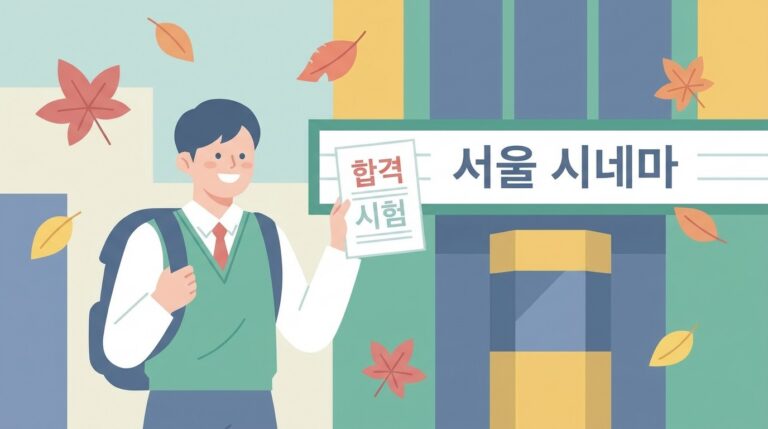
The Magic Ticket: Surviving and Thriving in Korea’s Post-Suneung Culture
Phase 1: Empathy (Story Immersion Opening)
안녕하세요! 매일한글 에디터입니다. (Hello! It’s your Daily Hangul editor.)
Picture this: It’s the third Friday of November. You walk into a bustling shopping district like Hongdae or Gangnam, and the entire atmosphere feels different. The usual heavy tension that blankets Seoul has magically evaporated. Suddenly, everywhere you look—from mega-cinemas and hair salons to K-BBQ buffets and theme parks—there are posters screaming “수험생 여러분, 수고하셨습니다!” (Exam takers, you worked so hard!) alongside mind-boggling discount rates of 30% to 60%.
Then you spot high school seniors flashing a modest, laminated slip of paper at the counter: their 수험표 (suheompyo), or exam registration slip. In that moment, this paper is practically a VIP golden ticket. Many of our international learners share: “I saw everyone getting half-price movie tickets and haircuts right after Suneung day, but I had no idea what was happening or how to ask about it without feeling awkward!”
Korea’s 수능 (Suneung – College Scholastic Ability Test) is legendary for its pressure, but the day after Suneung marks one of the most heartwarming cultural phenomenons in Korea: a nationwide festival of empathy and reward. In this guide, grounded in real student feedback and everyday Seoul street reality, we’ll explore the vibrant expressions, social nuances, and cultural codes you need to navigate post-Suneung discounts and chat like an insider.
Phase 2: Core 3 Expressions In-Depth
1. 수험표 할인 돼요? (Suheompyo hal-in dwaeyo?)
- Pronunciation: [Soo-heom-pyo hal-in dway-yo?] (Think of ‘suheom’ like the English name ‘Sue’ followed by ‘hum’, and ‘pyo’ like ‘pure’ without the ‘re’.)
- Meaning: “Can I get a discount with my test slip?” (Literal: “Is exam-slip discount possible?”)
- K-Culture Moment: You will hear this phrase echoed hundreds of times in K-Dramas featuring high school graduations, like Reply 1988 or Weightlifting Fairy Kim Bok-joo, whenever teens storm a pizza shop after finals.
- Editor’s Insight: The ending -돼요? (dwaeyo?) is Korea’s ultimate conversational Swiss Army knife. Instead of phrasing questions stiffly with complicated grammar, asking if something is done or works with ~돼요? instantly sounds native and friendly.
- Situation Spectrum: Casual (⚠️ with friends only: 수험표 할인 돼?), Semi-formal (✅ 수험표 할인 돼요?), Formal (✅ 수험표 할인 적용되나요?)
- 🤔 Think About It: In many Western cultures, discounts are strictly tied to student IDs or memberships. Why do you think Korean society offers such sweeping commercial perks based solely on an exam slip?
2. 이제 해방이에요! (Ije haebang-ieyo!)
- Pronunciation: [Ee-jay hae-bang-ee-yeo-yo] (Say ‘hae’ like ‘head’ without the ‘d’, and ‘bang’ like a celebratory party popper.)
- Meaning: “I am finally free!” (Literal: “Now it is liberation!”)
- K-Culture Moment: Idols and teen actors taking the Suneung often step in front of press cameras outside test centers, throwing their hands in the air and yelling this exact sentence.
- Editor’s Insight: 해방 (haebang) historically means national liberation or emancipation. Using such an intense historical noun for finishing a school exam highlights the colossal pressure Korean teenagers carry throughout their youth.
- Situation Spectrum: Casual (✅ 이제 해방이다!), Semi-formal (✅ 이제 해방이에요!), Formal (⚠️ 이제 해방되었습니다)
- 🤔 Think About It: How does your native language express the end of a long period of intense academic pressure? Is it as dramatic as “liberation”?
3. 그동안 고생 많았어요 (Geudongan gosaeng manasseoyo)
- Pronunciation: [Goo-dong-an go-saeng mah-nahs-seo-yo] (Pronounce ‘gosaeng’ smoothly like ‘go-sang’ with an open throat.)
- Meaning: “You have been through so much hardship / You worked so hard all this time.”
- K-Culture Moment: Cashiers, cafe baristas, and older relatives say this warmly as they stamp discount coupons or hand over drinks to post-exam students.
- Editor’s Insight: Unlike a simple “Good job,” 고생 (gosaeng) explicitly acknowledges physical and emotional suffering. Offering this phrase validates the other person’s sacrifice.
- Situation Spectrum: Casual (⚠️ 고생 많았어 – to juniors/peers), Semi-formal (✅ 그동안 고생 많았어요), Formal (✅ 그동안 고생 많으셨습니다)
- 🤔 Think About It: Korean communication constantly acknowledges collective endurance. How does acknowledging someone’s struggle build closeness in your own culture?
Phase 3: Textbook Korean vs. Real Korean
Situation 1: Inquiring about special exam benefits at a box office
- 📖 교과서 한국어 (Textbook): 대학수학능력시험 수험생 할인 혜택이 적용됩니까? (Daehak-suhak-neungryeok-siheom suheomsaeng hal-in hyetaek-i jeok-yong-doepnikka?)
- 🗣️ 진짜 한국어 (Real-life): 수험표 보여드리면 할인 되나요? (Suheompyo boyeodeurimyeon hal-in doenayo?)
- 💡 왜 다를까? (Why is it different?): Textbook phrases rely on lengthy Sino-Korean administrative jargon. Real Koreans streamline the sentence to action and result: “If I show the slip, does the discount work?”
Situation 2: Expressing relief after finishing a huge hurdle
- 📖 교과서 한국어 (Textbook): 모든 시험 일정이 끝나서 대단히 만족스럽습니다. (Modeun siheom iljeong-i kkeutnaseo daedanhi manjeokseureopseumnida.)
- 🗣️ 진짜 한국어 (Real-life): 와, 진짜 이제 살 것 같아요! (Wa, jinjja ije sal geot gat-ayo!)
- 💡 왜 다를까? (Why is it different?): Koreans express extreme emotional relief through physical revival metaphors: 이제 살 것 같아요 literally means “Now I feel like I’ll live!”
Phase 4: K-Culture Deep Dive & Non-Verbal Manners
4-1. 눈치 (Nunchi) & Respectful Presentation
When presenting your 수험표 (exam slip) or checking for promotions:
* Two-Hand Rule (양손 사용): Hand over your exam paper or ID using both hands, thumbs lightly holding the edges. It demonstrates that you treat this official document and the clerk with mutual respect.
* The Eye Contact Sweet Spot: Look at the staff’s eyes briefly with a modest smile, then glance down slightly as they examine the slip. Staring intently can feel confrontational in Korean service settings.
4-2. The Cultural Phenomenon: “The Post-Suneung Rite of Passage”
In Korea, the period right after Suneung is a seasonal commercial and emotional holiday. High schoolers transition almost overnight into young adulthood:
* Hair & Beauty: Salons offer staggering 50% discounts because students traditionally rush to get their first perm or dye their hair brown or blonde (which was often restricted by school dress codes).
* Theme Park Pilgrimage: Throngs of test-takers flood Lotte World or Everland in their school uniforms to take celebratory rollercoaster photos with animal ear headbands.
* Collective Grace: The entire country feels collective sympathy for these teenagers. Even if an establishment doesn’t advertise a discount, a kindly restaurant imo (auntie) will often slip an extra soda or side dish onto their table with a proud smile.
Phase 5: Real-World Roleplay Scenario
Setting: The ticketing counter of a grand cinema in Hongdae on the Saturday morning after Suneung.
Character: Min-ji (a warm and energetic cinema counter attendant).
- Turn 1 (Min-ji): 어서 오세요, 메가시네마입니다! 예매 도와드릴까요? (Eoseo oseyo, megasinema-imnida! Yemae dowadeurilkkayo?)
🎭 [밝게 미소 지으며 티켓 모니터를 가리킨다]— “Welcome to Mega Cinema! May I help you with your booking?” - Turn 2 (You): 네, 오늘 영화 두 장 보려고 하는데요. (Ne, oneul yeonghwa du jang boryeogo haneundeyo.)
🎭 [손가락 두 개를 살짝 펴 보이며 미소 짓는다]— “Yes, we’d like to watch two tickets today.” - Turn 3 (Min-ji): 네, 어떤 영화로 보시겠어요? (Ne, eotteon yeonghwa-ro bosigesseoyo?)
🎭 [키보드에 손을 올리며]— “Sure, which movie would you like to see?” - Turn 4 (You): 2시 상영작이요. 혹시 수험표 할인 돼요? (Dusi sang-yeong-jag-iyo. Hoksi suheompyo hal-in dwaeyo?)
🎭 [가방에서 코팅된 수험표를 두 손으로 꺼내며]— “The 2 PM screening, please. By any chance, is the test-taker discount applicable?” - Turn 5 (Min-ji): 네! 동반 1인까지 7천 원에 관람 가능하세요. 수험표랑 신분증 확인 부탁드립니다. (Ne! Dongban il-in-kkaji chil-cheon won-e gwallam ganeunghaseyo. Suheompyo-rang sinbunjeung hwag-in butakdeurimnida.)
🎭 [손을 모아 공손히 건네받을 준비를 한다]— “Yes! You and one accompanying person can watch for 7,000 KRW each. May I please verify your exam slip and ID?” - Turn 6 (You): 여기 있어요. 친구 것도 같이 보여드릴게요. (Yeogi isseoyo. Chingu geot-do gachi boyeodeurilgeyo.)
🎭 [수험표 두 장을 두 손으로 직원 앞에 공손히 내려놓는다]— “Here they are. I’ll show you my friend’s as well.” - Turn 7 (Min-ji): 네, 확인되셨습니다. 그동안 진짜 고생 많으셨어요! 팝콘 콤보 3천 원 할인 쿠폰도 함께 드릴게요. (Ne, hwag-indoesyeosseumnida. Geudongan jinjja gosaeng maneusyeosseoyo! Popkon kombo sam-cheon won hal-in kupon-do hamkke deurilgeyo.)
🎭 [영수증과 쿠폰을 건네며 진심 어린 눈빛으로 고개를 끄덕인다]— “All verified. You really went through so much hardship! I’ll also give you a 3,000 KRW popcorn combo coupon.” - Turn 8 (You): 와, 정말 감사합니다! 맛있게 먹을게요. (Wa, jeongmal gamsahamnida! Mas-itge meogeulgeyo.)
🎭 [두 손으로 티켓을 받으며 살짝 목례한다]— “Wow, thank you so much! We will enjoy it.”
🔀 Interactive Decision Point
Suppose Min-ji tells you the promotion expired yesterday. What do you say?
* Option A: “아, 어쩔 수 없죠. 그냥 일반 요금으로 결제해 주세요!” (Ah, eojjeol su eopjyo. Geunyang ilban yogeum-euro gyeoljehae juseyo!)
* Option B: “왜 안 돼요? 인터넷에서는 된다고 했는데요!” (Wae an dwaeyo? Inteonet-eseoneun doendago haenneundeyo!)
* Option C: “깎아주시면 안 돼요? 저 진짜 수능 봤는데요!” (Kkakka-jusimyeon an dwaeyo? Jeo jinjja suneung bwanneundeyo!)
Feedback:
* Option A (Best): Polite, graceful, and honors social harmony. The staff will deeply appreciate your understanding.
* Option B (Bad): Confrontational and breaks 눈치 (nunchi). Cinema workers do not create corporate policies.
* Option C (Risk): Playful whining can sometimes charm an elderly street-vendor, but at chain franchises with digital POS systems, it only creates embarrassment.
Phase 6: 10-Second Emotion Shadowing Drill
[😊 설레고 기대에 찬 목소리로]
저기요, / 혹시 수험표 할인 / 적용되나요?
(Jeogiyo, / hoksi suheompyo hal-in / jeok-yong-doenayo?)-
[😮 감격스럽고 후련하게]
드디어 끝났다, / 이제 진짜 / 자유예요!
(Deudieo kkeutnatda, / ije jinjja / jayu-yeyo!) -
[🥺 따뜻하고 위로하듯이]
그동안 마음고생 / 정말 많았어요. / 푹 쉬어요.
(Geudongan ma-eum-gosaeng / jeongmal manasseoyo. / Puk swieoyo.)
Phase 7: K-Culture Mini Dictionary
- 수험표 (Suheompyo) | Test Identification Slip — The paper slip with your test number and photo. Post-Suneung, it doubles as a temporary social status card providing discounts across Seoul until February.
- 수능 특수 (Suneung Teuksu) | Suneung Economic Boom — The seasonal wave of consumer spending triggered right after the exam as hundreds of thousands of liberated students and their families spend money at restaurants, electronics stores, and travel agencies.
- 재수생 (Jaesusaeng) | Retake Student — A student who has decided to study an extra year to retake the Suneung for a higher score. They carry the same exam slip and receive the exact same warm discounts!
- 해방감 (Haebang-gam) | Sense of Complete Liberation — That euphoric, floating emotional state experienced when an enormous burden is lifted from your shoulders.
Phase 8: Traveler’s Survival Kit
Top 3 Survival Phrases
- 학생 할인 있어요? (Haksaeng hal-in isseoyo?) — [Hahk-saeng hal-in ees-seo-yo?] (Pro Tip: If you don’t have an exam slip but hold a valid university or high school International Student ID, many tourist attractions will still grant you a standard student discount!)
- 수험표 잃어버렸는데 재발급 돼요? (Suheompyo ireobeoryeonneunde jaebalgeup dwaeyo?) — [Soo-heom-pyo eer-eo-beo-ryeon-neun-de jae-bal-geup dway-yo?] (Pro Tip: Useful if you ever need to ask about re-issuing lost registration passes).
- 동반 할인도 되나요? (Dongban hal-in-do doenayo?) — [Dong-ban hal-in-doh dway-nah-yo?] (Pro Tip: Many post-exam promotions extend 20-30% off to 1 accompanying friend or parent!)
Editor’s Travel Note
If you travel in Korea during mid-to-late November, expect major shopping hubs like Myeongdong, Sinchon, and Coex to be bustling with special promos. Download the Naver Map app route finder to scout designated youth districts where discount events cluster together. Always carry your passport or international student card alongside digital passes, as cashiers frequently match names for verification.
Phase 9: “One Step Deeper” (Reflective Prompt)
In Western societies, secondary education exams are often regarded as individual milestones or private academic achievements. In Korea, however, the Suneung is a collective national ceremony: airplane takeoff times are rescheduled during the English listening test, stock markets open an hour late to clear morning traffic, and complete strangers offer hot tea to cold test-takers at dawn.
The widespread discounts offered the next day represent far more than smart marketing. They function as a collective apology and emotional embrace from Korean adults to the younger generation: “We know how ruthless our competitive schooling is. You survived it. Now enjoy the world.”
💬 Your Turn: How does your home culture celebrate the end of major youth rites of passage? Share your stories and perspectives in the comments below!
Phase 10: FAQ & Common Mistakes
Q: Can foreign tourists use Suneung discounts?
A: Officially, standard post-Suneung discounts require the actual printed Korean CSAT slip (수험표). However, during this festive season, many retail and beauty shops extend similar promotional rates to foreign exchange students or young tourists who show an International Student Identity Card (ISIC) and ask politely with “학생 할인도 되나요?” (Haksaeng hal-in-do doenayo?).
Q: How long do these post-Suneung discounts typically last?
A: While some restaurant events last for just 1 to 2 weeks after test day, major theme parks (Lotte World, Everland), movie theater chains (CGV, Megabox, Lotte Cinema), and beauty salons typically keep discounts active through the end of December, with several lasting until February when university matriculation begins.
Q: What should I do if a cashier asks for my ID alongside the exam slip?
A: Simply present your ARC (Alien Registration Card) or Passport alongside the slip. The staff only needs to confirm that the birthdate or name matches the information printed on the voucher.
🚨 Common Mistakes Alert
- Mistake: Demanding a discount with an aggressive tone like “깎아줘요!” (Kkakka-jwoyo! – Cheapen it!).
- Correct Action: Always inquire gently using modal questions: “수험생 할인 받을 수 있을까요?” (Suheomsaeng hal-in badeul su isseulkkayo?).
- Mistake: Showing a blurry photo of someone else’s exam slip on a phone.
- Correct Action: Establishments explicitly inspect the physical paper slip or verified digital government certificates (Government24 app). Keep the physical paper clean and intact.
- Mistake: Assuming all members in your group get the discount.
- Correct Action: Always ask **”동반 몇 명까지 돼요?” (Dongban myeot myeong-kkaji dwaeyo? – Up to how many accompanying people does it apply?)
Phase 11: Action Missions
- 🥉 Bronze Mission (Solo Shadowing): Read the 3 sentences in Phase 6 out loud 5 times in front of a mirror, mimicking both the hand gestures and the emotional pauses.
- 🥈 Silver Mission (SNS & Peer Practice): Leave a comment below using the phrase 이제 해방이에요! along with one stressful thing you finished this week.
- 🥇 Gold Mission (Real-world Challenge): Next time you visit a Korean cafe, cinema, or store with an ongoing promotion, politely ask “혹시 할인 돼요?” (Hoksi hal-in dwaeyo?) while handing over your payment card with two hands.
- 🎮 K-Culture Quest: Search Instagram or YouTube Shorts for the hashtag
#수험표할인(#SuheompyoHal-in). Note down three quirky businesses (e.g., laser eye surgery clinics, nail salons, gym memberships) offering discounts!
Phase 12: Interactive Quiz Challenge
Question 1 (Situational Judgment): You are at an amusement park ticket booth right after Suneung. How do you ask if your test slip gives you and your best friend a discount?
* A) 이거 공짜로 줘요. (Igeo gongjja-ro jwoyo.)
* B) 수험표 보여드리면 동반 할인도 되나요? (Suheompyo boyeodeurimyeon dongban hal-in-do doenayo?)
* C) 시험 끝났으니까 돈 내지 않을게요. (Siheom kkeutnasseunikka don naeji aneulgeyo.)
Question 2 (Fill-in-the-Blank): Complete this comforting phrase often spoken to test-takers:
그동안 _________ 많았어요! (Geudongan _________ manasseoyo! / You worked so hard all this time!)
Question 3 (True or False Cultural Trivia):
True or False: During the Suneung English listening comprehension exam in Korea, airplanes are forbidden from landing or taking off at airports across the country.
👉 Click here to reveal the Answers & Explanations!
- Answer 1: B — Polite, natural, and accurately checks for the accompanying companion benefit (동반 할인).
- Answer 2: 고생 (Gosaeng) — The phrase “그동안 고생 많았어요” warmly honors the enduring hard work someone has sustained.
- Answer 3: TRUE! — To eliminate noise pollution during the 35-minute English listening section, the Korean Ministry of Land, Infrastructure and Transport bans all flights from landing or taking off nationwide!







