

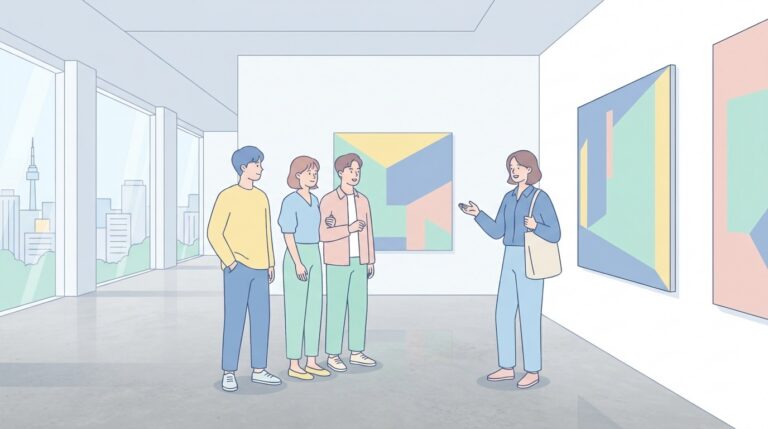
Phase 1: 공감 (A Friendly Opening)
안녕하세요! 매일한글 에디터입니다.
Have you ever stood in front of an abstract painting at the National Museum of Modern and Contemporary Art (MMCA) in Seoul, tilting your head and wondering, “What in the world am I looking at?” You walk past sleek white gallery walls in Samcheong-dong, hoping for an artistic epiphany, only to end up feeling like you just looked at a blank canvas with a giant price tag.
You are definitely not alone! In fact, one of our students, Sarah, confessed that on her first solo trip to a gallery in Insadong, she wandered silently for twenty minutes before leaving, feeling completely detached. But here is the local secret that seasoned Seoulites swear by: Korean museums offer incredible docent tours (도슨트 투어). When you sync your visit with a passionate docent’s storytelling session, abstract shapes suddenly turn into heart-wrenching love stories, political metaphors, and cultural milestones. Best of all, docent sessions are almost always free!
Today, we will equip you with simple A2-level Korean phrases to ask about docent schedules, rent audio guides, and chat about the artworks. This guide is crafted directly from real learner feedback and classroom roleplays, giving you the natural confidence to turn a quiet museum stroll into a rich cultural adventure.
Phase 2: 핵심 표현 3선 심층 분석 (Top 3 Core Expressions)
1. 도슨트 투어 몇 시에 시작해요? (Doseonteu tueo myeot sie sijakaeyo?)
- Pronunciation: [Doh-seun-teu too-eo myeot shee-eh she-jahk-hae-yo?] (Think of saying “dough-scent tour” combined with “she” and “start-hae-yo”)
- Meaning: “What time does the docent tour start?”
- Literal vs. Nuance: Literally “Docent tour what hour at starts?” Rather than sounding like a robotic inquiry, asking this at the ticket booth makes you sound like an enthusiastic, culturally curious visitor.
- K-Culture Moment: Seen frequently in lifestyle vlogs and K-Dramas where the protagonist rushes to a special retrospective exhibition and checks the time with the front desk.
- Editor’s Insight: The word 도슨트 (doseonteu) is borrowed from English, but in Korea, it refers specifically to the volunteer or staff docent who gives a guided walk. Adding 몇 시에 시작해요? (What time does it start?) is an essential A2 building block you can reuse at movie theaters, concerts, and pop-up stores!
- Situation Spectrum:
- Casual (반말): 도슨트 투어 몇 시에 시작해? ⚠️ (Only with close peers)
- Semi-formal (해요체): 도슨트 투어 몇 시에 시작해요? ✅ (Perfect for ticket desk & information counters)
- Formal (하십시오체): 도슨트 투어는 몇 시에 시작합니까? ✅ (Polite, but slightly stiff for small private galleries)
- 🤔 Think About It: In many Western museums, guided tours require pricey advance bookings. In Korea, most public museum docent tours operate as open walk-ins. How does free communal storytelling shape the way Koreans appreciate art together?
2. 해설 들으면서 보니까 훨씬 재밌어요. (Haeseol deureumyeonseo bonikka hwolssin jaemisseoyo.)
- Pronunciation: [Hae-seol deu-reu-myeon-seo boh-nee-kka hwol-ssin jae-mee-sseo-yo.] (Connect “deureumyeonseo” smoothly like “deu-reu-myeon-seo”)
- Meaning: “Listening to the explanation makes viewing it so much more interesting.”
- Literal vs. Nuance: Literally “Explanation while-listening seeing-because, much more fun-is.” It expresses spontaneous appreciation when realizing how much context adds to your viewing experience.
- K-Culture Moment: You’ll hear gallery visitors whispering this to their friends after learning that a mysterious brushstroke represents the Han River at dawn.
- Editor’s Insight: The grammar pattern -(으)면서 (while doing…) combined with -(으)니까 (because I noticed that…) helps beginner speakers connect two actions naturally. 훨씬 (hwolssin) means “far more / much more”, giving your reaction a genuine pop of emotion!
- Situation Spectrum:
- Casual (반말): 해설 들으면서 보니까 훨씬 재밌어. ✅ (Great for your travel buddy)
- Semi-formal (해요체): 해설 들으면서 보니까 훨씬 재밌어요. ✅ (Ideal to say politely to the docent at the end)
- Formal (하십시오체): 해설을 들으며 관람하니 훨씬 유익합니다. ⚠️ (Too literary for casual conversation)
- 🤔 Think About It: Korean social dynamics value shared emotional reactions (공감, gong-gam). When you compliment a docent’s storytelling, does it change the atmosphere from an academic lecture into a shared human experience?
3. 오디오 가이드 대여할 수 있나요? (Odio gaideu daeyeohal su innayo?)
- Pronunciation: [Oh-dee-oh gah-ee-deu dae-yeo-hal soo een-nah-yo?]
- Meaning: “Can I rent an audio guide?”
- Literal vs. Nuance: “Audio guide to rent possible is?” A soft, courteous way to request a headset device or QR-code guide when you miss the live docent schedule.
- K-Culture Moment: Characters visiting royal palaces like Gyeongbokgung or modern photography exhibitions asking the counter staff for English audio guides.
- Editor’s Insight: The verb 대여하다 (daeyeohada) means “to rent / to borrow temporarily”. The question ending -(으)ㄹ 수 있나요? sounds much softer and warmer than a rigid -대여됩니까?.
- Situation Spectrum:
- Casual (반말): 오디오 가이드 빌릴 수 있어? 🚫 (Never use with staff!)
- Semi-formal (해요체): 오디오 가이드 대여할 수 있나요? / 빌릴 수 있어요? ✅ (Standard polite standard)
- Formal (하십시오체): 오디오 가이드를 대여할 수 있습니까? ✅ (Very polite)
- 🤔 Think About It: Modern Korean galleries often replace physical handsets with smartphone web apps. Why do you think Korea adopted mobile-first audio guides faster than traditional rental counters?
Phase 3: 교과서 한국어 vs 진짜 한국어 (Textbook vs. Real Korean)
Situation 1: Inquiring about the Docent Tour Schedule
- 📖 교과서 한국어: 도슨트 해설은 몇 시에 시작합니까? (Doseonteu haeseoreun myeot sie sijakamnikka? – At what hour does the docent commentary commence?)
- 🗣️ 진짜 한국어: 혹시 도슨트 투어 몇 시예요? (Hoksi doseonteu tueo myeot si-yeyo? – By any chance, what time is the docent tour?)
- 💡 왜 다를까? Textbook Korean leans heavily on formal -nikka endings and formal nouns like haeseol. Real visitors soften their approach with 혹시 (hoksi – by any chance) and use the breezy, polite noun ending -몇 시예요? (what time is it? ).
Situation 2: Asking If Rental is Possible
- 📖 교과서 한국어: 오디오 기기를 대여하기를 원합니다. (Odio gigireul daeyeohagireul wonhamnida. – I desire to rent an audio device.)
- 🗣️ 진짜 한국어: 오디오 가이드 대여 돼요? (Odio gaideu daeyeo dwaeyo? – Is audio guide rental available?)
- 💡 왜 다를까? Koreans rarely say “I desire to… (~기를 원합니다)”. Instead, native speakers pair the noun with the magical verb 돼요? (dwaeyo? – Does it work? / Is it possible?) for effortless everyday communication.
Phase 4: K-Culture 딥다이브 & 비언어적 매너 (Deep Dive & Manners)
4-1. 눈치(Nunchi) & Body Language in Korean Galleries
- The Respectful Distance Nod (끄덕끄덕): During docent tours in Korea, docents don’t expect vocal interruptions. Instead, when they reveal a surprising backstory about an artist, visitors quietly nod their heads (끄덕끄덕, kkeudeok-kkeudeok) and let out a gentle, muted “아~ (Ah~)”. It shows engagement without disrupting the peaceful gallery space.
- The Whispering Posture: If you want to translate a sentence to your companion, cover your mouth lightly with your hand and whisper at half-breath. In Korean galleries, maintaining a quiet soundscape is considered the ultimate gallery courtesy (관람 예절).
- Forming a Semi-Circle (반원): When the docent stops at a painting, never block the front directly in front of the caption tag. Natural nunchi means stepping back into a loose semi-circle so everyone can see the brushwork.
4-2. Cultural Code: The “Museum Date” (미술관 데이트) Trend
In modern Korea, visiting an art museum is no longer just for academic scholars. It has evolved into one of the top trendsetting date activities (미술관 데이트) for young couples and friends in cultural hubs like Hannam-dong, Samcheong-dong, and Seongsu-dong.
Korean exhibition spaces are meticulously split into Listening/Viewing Zones and Photo Zones (포토존). When following a docent tour, attendees stay focused and refrain from taking snapping photos with camera shutter sounds. Once the docent finishes, visitors revisit their favorite artworks to snap quiet, aesthetic “life shots” (인생샷). Participating in a docent tour gives you both the cultural depth and the secret artistic backstory to make your gallery date unforgettable!
Phase 5: 실전 롤플레이 시나리오 (Real-Life Roleplay)
- Location: The information foyer of an art gallery near Bukchon Hanok Village.
- Characters:
- You (A2 Korean Learner): Visiting an exhibition and eager to join the guided walk.
- Min-ji (민지 – Docent & Gallery Staff): Friendly, holding a small wireless headset microphone.
Turn 1
* You: 저기요, 혹시 오늘 도슨트 투어 있어요?
* (Jeogiyo, hoksi oneul doseonteu tueo isseoyo?)
* “Excuse me, by any chance, is there a docent tour today?”
* 🎭 Politely raise your hand slightly and step toward the desk with a friendly smile.
Turn 2
* Min-ji: 네! 오후 두 시하고 네 시에 있어요.
* (Ne! Ohu du sihago ne sie isseoyo.)
* “Yes! We have them at 2:00 PM and 4:00 PM.”
* 🎭 Checks her timetable schedule on the clipboard and smiles warmly.
Turn 3
* You: 지금 한 시 오십 분이니까 곧 시작하네요!
* (Jigeum han si osip bun-inikka got sijakhaneyo!)
* “Since it’s 1:50 PM right now, it starts soon!”
* 🎭 Look at your wristwatch with happy surprise.
Turn 4
* Min-ji: 맞아요. 1전시실 입구 앞에서 기다리시면 돼요.
* (Majayo. Il-jeonsisil ipgu ap-eseo gidarisimyeon dwaeyo.)
* “That’s right. You can wait in front of the Exhibition Hall 1 entrance.”
* 🎭 Points gently toward the archway on the left.
Turn 5
* You: 도슨트 설명 듣는 거 무료예요?
* (Doseonteu seolmyeong deunneun geo muryo-yeyo?)
* “Is listening to the docent explanation free?”
* 🎭 Tilts head slightly with curious eyes.
Turn 6
* Min-ji: 네, 입장권만 있으시면 무료로 들으실 수 있어요.
* (Ne, ipjanggwonman isseusimyeon muryoro deureusil su isseoyo.)
* “Yes, as long as you have your admission ticket, you can listen for free.”
* 🎭 Hands you an exhibition brochure.
Turn 7
* You: 감사합니다! 해설 들으면서 열심히 볼게요.
* (Gamsahamnida! Haeseol deureumyeonseo yeolsimhi bolgeyo.)
* “Thank you! I will enjoy watching while listening to the commentary.”
* 🎭 Bows slightly at 15 degrees to show gratitude.
Turn 8
* Min-ji: 즐거운 관람 되세요! 잠시 후에 뵐게요.
* (Jeulgeoun gwallam doeseyo! Jamsi hu-e boelgeyo.)
* “Have a wonderful viewing! See you in just a moment.”
* 🎭 Gives an encouraging wave and heads toward the tour meeting sign.
🔀 Interactive Decision Point
The docent tour ends, and Min-ji asks the group: “혹시 질문 있으신 분 계실까요? (Does anyone have any questions?)” What do you do?
- Choice A: Say nothing, immediately pull out your phone, and start snapping loud flash pictures in front of the artwork.
- Choice B: Walk up to Min-ji, bow lightly, and say: “해설 덕분에 정말 재밌게 봤어요. 감사합니다! (Thanks to your explanation, I really enjoyed viewing it. Thank you!)”
- Choice C: Shout loudly across the room: “야! 이 그림 얼마야? (Hey! How much is this painting?)” in casual banmal.
Feedback:
- Choice A (Bad): Breaking the silence with camera clicks and flash disrupts the peaceful gallery vibe and violates museum rules.
- Choice B (Best!): Perfect! In Korean culture, acknowledging the docent’s hard work with a warm compliment leaves a memorable, heartwarming impression.
- Choice C (Risk!): Danger! Using informal banmal with gallery staff sounds impolite, and asking about artwork prices during a non-commercial museum tour is considered taboo.
Phase 6: 10초 감정 섀도잉 드릴 (10-Second Emotional Shadowing Drill)
Practice these lines with rhythm, pausing at / and infusing the emotion specified in brackets!
[🤔 호기심 가득하고 정중하게 - Curious & Polite]
저기요, / 혹시 오늘 / 도슨트 투어 몇 시에 있어요?
(Jeogiyo, / hoksi oneul / doseonteu tueo myeot sie isseoyo?)-
[😊 감탄하며 진심 어린 어조로 - Impressed & Warm]
해설 들으면서 보니까 / 작품이 훨씬 / 재미있네요!
(Haeseol deureumyeonseo bonikka / jakpumi hwolssin / jaemi-n-neyo!) -
[🎧 차분하고 조심스럽게 - Calm & Inquiring]
오디오 가이드는 / 어디서 / 대여할 수 있나요?
(Odio gaideuneun / eodiseo / daeyeohal su innayo?)
Phase 7: K-Culture 미니 사전 (Mini Dictionary)
- 도슨트 (Doseonteu) | Docent / Exhibition Guide
- Usage: Widely used across contemporary Korean art centers to describe exhibition guides who offer scheduled oral commentaries.
- 해설 (Haeseol) | Explanation / Commentary
- Usage: Refers to the explanatory narrative behind an art piece or historical artifact. You’ll often see signs for 해설 시간 (Haeseol sigan – Commentary hours).
- 오디오 가이드 (Odio Gaideu) | Audio Guide
- Usage: Can refer to both physical rental devices and QR-code-based mobile guide apps available on your smartphone.
- 관람 (Gwallam) | Viewing / Exhibition Attendance
- Usage: The formal term for viewing exhibitions, movies, or historical sites. Commonly seen in greetings like 즐거운 관람 되세요 (Enjoy your visit).
Phase 8: 여행자를 위한 생존 키트 (Traveler’s Survival Kit)
Survival Expressions TOP 3
- 한국어 해설이에요, 영어 해설이에요? (Hangugeo haeseori-eyo, yeong-eo haeseori-eyo?)
- Meaning: “Is it a Korean tour or an English tour?”
- Pro Tip: Major museums like the National Museum of Korea offer scheduled English docent sessions. Always verify language schedules beforehand!
- 신분증 맡겨야 하나요? (Sinbunjeung matgyeoya hanayo?)
- Meaning: “Do I need to leave my ID card?”
- Pro Tip: Renting physical audio guides in Korea often requires leaving an ID card (such as an Alien Registration Card, passport, or driver’s license) as a deposit.
- 이어폰 사용해야 돼요? (Ieopon sayonghaeya dwaeyo?)
- Meaning: “Do I have to use earphones?”
- Pro Tip: If you use a mobile audio guide on your phone, galleries strictly require personal earphones so sound doesn’t echo through the quiet halls.
Editor’s Travel Note
- Navigation & Mobile Guides: When exploring Seoul’s gallery quarters, consult 네이버 지도 앱 다운로드 to check opening days, as many galleries close on Mondays. For grand public exhibitions, you can review ticket reservations and tour notices in advance via the 국립현대미술관 모바일 가이드 안내.
- Payment & Rentals: Audio guide rentals generally cost between 2,000 KRW and 3,000 KRW, payable with standard credit cards or T-money transport cards.
Phase 9: “한 발 더 깊이” (One Step Deeper)
In Western galleries, viewing art is often seen as a strictly individual, solitary meditation. Visitors put on headphones and roam in private silence. In Korea, however, art appreciation frequently embraces a communal warmth. Joining a docent group allows strangers to walk together, chuckling at an artist’s personal anecdotes and gasping collectively at historical revelations. Docents weave social history, personal philosophy, and humor into their walk, turning a museum into a living theater of collective empathy.
💬 Your Turn: Have you ever attended a guided museum tour in your home country or in Korea? Did having a guide change the way you felt about the artworks? Share your experiences in the comments below!
Phase 10: FAQ & 오해 방지 (FAQ & Common Mistakes)
Q: Do I need to book docent tours in advance at Korean art galleries?
A: At most major national and public galleries (like MMCA or the Seoul Museum of Art), standard docent tours are walk-ins! You simply gather at the designated tour start point 5 minutes before the scheduled time.
Q: Can beginners in Korean really understand a Korean docent tour?
A: Absolutely! Docents use clear enunciation, expressive hand gestures, and visual slides. Even if you only catch 30–40% of the vocabulary, watching what they point at and catching emotional keywords will dramatically enhance your understanding.
Q: Are audio guides free if I have my own smartphone?
A: Yes! Many institutions now offer free streaming guides through official museum apps or QR codes on the wall. Just remember to bring your own wired or Bluetooth earphones.
🚨 흔한 실수 (Common Mistakes) Warning Board
- Mistake: Assuming all docent tours cost extra money.
- Correct Action: Most docent tours in Korea are free with admission! Never hesitate to ask: “도슨트 설명 무료예요? (Is the docent commentary free?)”.
- Mistake: Forgetting wired earphones for smartphone audio guides.
- Correct Action: Keep a pair of earphones in your daypack, as phone speakers are strictly prohibited inside gallery rooms.
- Mistake: Using casual words like “빌려줘 (lend me)” when asking rental desk staff.
- Correct Action: Always use polite honorific forms like “대여할 수 있나요?” or “빌릴 수 있어요?”.
Phase 11: 액션 미션 & 참여 유도 (Action Mission)
- 🥉 Bronze Mission (Solo Practice): Stand in front of a mirror and say “도슨트 투어 몇 시에 시작해요?” three times with crisp pronunciation.
- 🥈 Silver Mission (Social Sharing): Check the website of a museum in Seoul (like MMCA or Leeum), find their docent timetable, and post a screenshot on your Instagram story tagging your favorite Korean artwork with the caption #관람준비완료!
- 🥇 Gold Mission (Real Life Application): Visit an exhibition, approach the information desk, ask for the docent schedule in Korean, and attend the tour!
- 🎮 K-Culture Mission: Watch an episode of a slice-of-life K-Drama featuring an art gallery date and listen carefully for words like 작품 (artwork), 해설 (commentary), or 전시 (exhibition).
Phase 12: 인터랙티브 퀴즈 챌린지 (Interactive Quiz Challenge)
1. Situational Choice
You arrive at a gallery at 2:10 PM. You want to ask the staff if there is a tour starting at 2:30 PM. Which sentence is the most natural and polite?
* A) 2시 반에 투어 해줘.
* B) 혹시 2시 반에 도슨트 투어 있나요?
* C) 2시 반 투어 시작해라.
2. Fill in the Blank
Listening to the guide makes the artworks so much more interesting! Complete the sentence:
“해설 들으면서 보니까 ________ 재밌어요!” (Hint: A word meaning ‘much more / far more’)
* Words: [1] 아주 [2] 조금 [3] 훨씬
3. Cultural True or False
True or False: In Korea, you are allowed to play mobile audio guides loudly on your phone speaker inside exhibition rooms as long as your volume is set to medium.
* [True / False]
👉 Click to reveal Quiz Answers & Explanations
- Answer: B (혹시 2시 반에 도슨트 투어 있나요?)
- Explanation: Choice A and C use informal imperative grammar that would sound rude to staff. Choice B is polite, natural, and friendly!
- Answer: [3] 훨씬 (hwolssin)
- Explanation: 훨씬 highlights dramatic contrast (“far more interesting”), making your enthusiastic reaction feel authentic.
- Answer: False
- Explanation: Playing audio guides through phone speakers is strictly forbidden in Korean galleries to preserve a quiet viewing environment. Always bring personal earphones!
- Explanation: Playing audio guides through phone speakers is strictly forbidden in Korean galleries to preserve a quiet viewing environment. Always bring personal earphones!






