

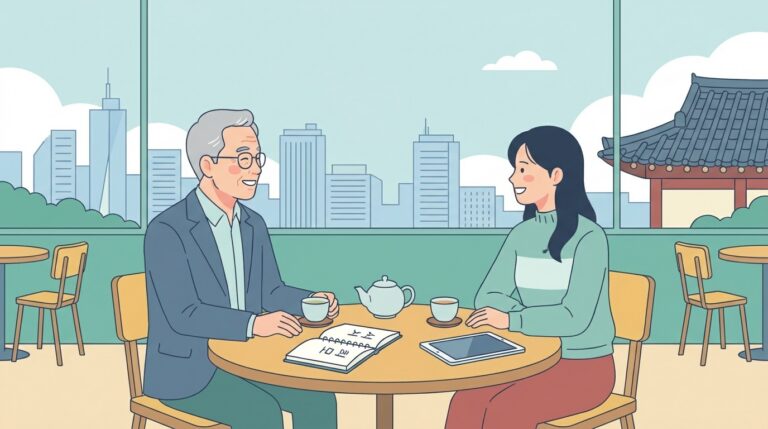
Beyond ‘Back in My Day’: How Real Korean Adults Step Back and Listen
Phase 1: Empathy (Story-Driven Opening)
안녕하세요! 매일한글 에디터입니다. (Hello! This is your Daily Hangul editor.)
Picture this classic K-drama workplace scene: A cozy hoesik (회식 – company dinner) at a bustling Korean barbecue joint in Euljiro. The pork belly is sizzling, soju glasses are clinking, and the atmosphere feels lively. Then, the senior director sets his chopsticks down, clears his throat, and utters the fateful sentence: “내가 신입사원 때는 주말도 반납하고 일했어… 요즘 애들은 근성이 부족해.” (When I was a rookie, I gave up weekends to work… Kids these days lack grit.) Instantly, the junior staff freeze. Smiles turn into polite, tight masks. The vibrant energy evaporates into thin air.
Sounds familiar? If you’ve spent any time working in Korea, interacting with older in-laws, or watching contemporary workplace dramas like Misaeng (미생) or Kkondae Intern (꼰대인턴), you’ve likely witnessed this clash of zeitgeists. South Korea moved from post-war poverty to hyper-modern prosperity in just two generations. The boomer and Gen X generations succeeded through relentless perseverance, sheer grit, and rigid hierarchy. But for younger Koreans (the MZ generation), those past success formulas no longer guarantee housing, stable careers, or personal happiness.
When older adults preach their outdated playbooks instead of recognizing that the rules of the game have fundamentally changed, real communication dies. However, true maturity in Korean culture isn’t about flexing seniority—it’s about becoming a 참된 어른 (chamdoen eoreun), a genuine elder who holds space, listens generously, and embraces cognitive humility. In this C1-level masterclass, we will explore the nuanced discourse surrounding intergenerational empathy, unpacking the exact phrases you need to gracefully navigate, de-escalate, and transform generational conflicts in Korean society.
Phase 2: Deep Dive into 3 Core Expressions
1. 나 때는 그랬지만, 지금은 다를 수 있지요 (Na ttaeneun geuraetjiman, jigeumeun dareul su itjiyo)
- Pronunciation: [Na ttae-neun geu-raet-ji-man, ji-geum-eun da-reul su it-ji-yo] (Sounds like: “nah tteh-noon geh-raet-jee-mahn, jee-goom-oon dah-rool soo eet-jee-yoh”)
- Meaning: Literal: “It was like that in my time, but it could be different now.” / Real Nuance: A proactive disarming phrase used by mature seniors to acknowledge their lived experience without imposing it as universal truth.
- K-Culture Moment: Seen in reflective healing dramas like My Mister (나의 아저씨) or Our Blues (우리들의 블루스), where an older mentor catches themselves drifting into lecture mode and consciously pivots to validate a younger person’s reality.
- Editor’s Insight: This phrase defuses the dreaded “Latte is horse” (나 때는 말이야) trope. By adding -지만 (but) and -ㄹ 수 있지요 (can be/might be), you demonstrate intellectual humility, acknowledging that temporal context alters valid solutions.
- Situation Spectrum: Casual: ⚠️ | Semi-formal: ✅ | Formal: ✅
- 🤔 Think About It: Does your native language have an elegant way to self-correct an unsolicited lecture mid-sentence? Why is acknowledging changing economic eras so comforting to younger generations?
2. 과거의 성공 방정식에 갇히지 않으려 해요 (Gwagweoui seonggong bangjeongsige gachiji aneuryeo haeyo)
- Pronunciation: [Gwa-geo-ui seong-gong bang-jeong-si-ge ga-chi-ji a-neu-ryeo hae-yo] (Sounds like: “gwah-gaw-ooeh sung-gong bahng-jung-shee-geh gah-chee-jee ah-noo-ryaw heh-yoh”)
- Meaning: Literal: “I try not to get trapped in the success formulas of the past.” / Real Nuance: A high-level, reflective admission showing that what worked yesterday might be a recipe for failure today.
- K-Culture Moment: Frequently featured in intellectual panel shows like Alssinjob (알쓸신잡) or tech leader interviews in Pangyo (Korea’s Silicon Valley), where veteran executives discuss leadership adaptation.
- Editor’s Insight: 성공 방정식 (success formula) is a ubiquitous metaphor in Korean corporate and sociopolitical discourse. Pairing it with -에 갇히다 (to be trapped inside) signals that you view traditional dogmas as cognitive prisons rather than badges of honor.
- Situation Spectrum: Casual: ⚠️ | Semi-formal: ✅ | Formal: ✅
- 🤔 Think About It: How does phrasing past wisdom as a “formula that expired” shift the focus from personal fault to collective systemic evolution?
3. 어른다운 태도로 경청하는 게 먼저인 것 같아요 (Eoreundaun taedoro gyeongcheonghaneun ge meonjeoin geot gatayo)
- Pronunciation: [Eo-reun-da-un tae-do-ro gyeong-cheong-ha-neun ge meon-jeo-in geot ga-ta-yo] (Sounds like: “aw-roon-dah-oon teh-doh-roh gyung-chung-hah-noon geh mun-jaw-een gawt gah-tah-yoh”)
- Meaning: Literal: “I think listening attentively in a manner worthy of an adult comes first.” / Real Nuance: Emphasizes that true elderhood (어른다움) is defined by receptive empathy and self-restraint, not verbal authority.
- K-Culture Moment: Common in heartfelt family counseling broadcasts such as Dr. Oh Eun-young’s Golden Clinic (금쪽상담소), encouraging parents to pause their advice reflex.
- Editor’s Insight: In Korean, the suffix -답다 (-dapda) denotes embodying the quintessential, ideal qualities of a noun. 어른다운 (acting like a true elder) contrasts sharply with merely growing older (나이만 먹은). Using 경청 (active/reverent listening) elevates the statement far beyond the basic verb 듣다 (to hear).
- Situation Spectrum: Casual: ⚠️ | Semi-formal: ✅ | Formal: ✅
- 🤔 Think About It: Why does Confucian society often mistake silence from juniors as respect, and how does deliberate elder gyeongcheong (경청) subvert this dynamic?
Phase 3: Textbook Korean vs. Real Korean
Situation 1: Advising a peer not to preach past methods to new recruits
- 📖 교과서 한국어 (Textbook Korean): “과거의 경험만 고집하지 마시고 후배들의 의견을 수용하십시오.” (Please do not insist only on past experience and accept junior staff’s opinions.)
- 🗣️ 진짜 한국어 (Real Korean): “요즘 꼰대 소리 안 들으려면, 일단 지갑은 열고 입은 닫는 게 상책이라잖아요.” (They say if you don’t want to be called a kkondae these days, keeping your wallet open and your mouth closed is the best policy.)
- 💡 왜 다를까? (Why is it different?): Textbook Korean relies on formal, dry imperatives. Native speakers use the popular, humorous adage “지갑은 열고 입은 닫아라” (Open your wallet, shut your mouth) to convey that respectful elders support juniors materially and emotionally without subjecting them to paternalistic monologues.
Situation 2: Expressing an eager intention to learn modern trends from younger people
- 📖 교과서 한국어 (Textbook Korean): “저는 젊은 세대의 새로운 방식을 기꺼이 배우겠습니다.” (I will gladly learn the young generation’s new methods.)
- 🗣️ 진짜 한국어 (Real Korean): “제가 옛날 사람이라 감이 좀 떨어지네요. 한 수 배운다는 자세로 귀 기울일게요.” (I’m an old-timer, so my intuition is a bit rusty. I’ll listen with an open mind, ready to learn from you.)
- 💡 왜 다를까? (Why is it different?): Native Korean leaders adopt self-effacing humor (감이 떨어지다 – lose one’s touch/edge) and martial arts metaphors (한 수 배우다 – learn a secret move/technique from a master) to equalize social hierarchy and make younger counterparts comfortable speaking up.
Phase 4: K-Culture Deep Dive & Non-Verbal Manners
4-1. 눈치 (Nunchi) & Gestures: Embodying the Empathetic Elder
When striving to be an authentic elder in Korea, non-verbal cues carry as much weight as your spoken words:
* Dismantle the ‘Power Posture’: Avoid leaning back with crossed arms or resting your chin on your hands, as this telegraphs evaluation and superiority. Instead, lean slightly forward at a 10-degree angle, open your hands on the table, and maintain soft eye contact.
* The Empathetic Head Nod (고개 끄덕임): When a younger colleague speaks, use frequent, gentle, slow nodding accompanied by subtle vocal cues like “그렇죠” (geureochyo – quite so) or “일리가 있네요” (illiga inneyo – that makes sense). This gives them explicit psychological safety.
* Two-Handed Beverage Handling: When pouring or receiving tea/coffee from a younger colleague, continue to touch your forearm or support the cup with your other hand. This signals: “I do not claim automatic entitlement just because of my age.”
4-2. Cultural Code: The Shift from ‘Kkondae’ to ‘Cham-eoreun’
South Korean entertainment reflects a massive cultural soul-search regarding generational authority. In traditional K-dramas, the grandfather or executive was an infallible patriarch whose word was law. Today, media critically deconstructs this dynamic. In dramas like Kkondae Intern, older managers who rigidly push their old tactics find themselves reporting to the very juniors they once harassed, resulting in comedic yet poignant self-realization.
Conversely, figures who represent 참어른 (authentic elders)—such as actress Youn Yuh-jung in Youn’s Kitchen or the elder mentors in Hospital Playlist—win immense public affection because they listen with dry wit, admit mistakes immediately, and respect generational boundaries. The current zeitgeist values leaders who say: “The world changed; help me understand your reality.”
Phase 5: Real-Life Roleplay Scenario
Setting: A quiet meeting room in a Gangnam marketing agency. Team Leader Choi (52) and Assistant Manager Minji (28) are reviewing an underperforming marketing campaign.
- Turn 1 (최 팀장): “민지 씨, 지난번 팝업스토어 성과 보고서 봤어요. 솔직히 우리 세대 관점에서는 인쇄 전단지나 거리 홍보가 빠지면 불안하거든.” (Minji, I saw the pop-up store report. Honestly, from our generation’s perspective, without printed flyers or street PR, it feels incomplete.)
- Turn 2 (민지):
🎭 조심스럽지만 단호하게 태블릿을 넘기며“팀장님, 요즘 타깃 고객층은 지류 광고를 오히려 피로하게 느껴요. 인스타그램 숏폼과 위치 기반 알림에 집중하는 게 전환율이 훨씬 높았습니다.” (Team Leader, customers these days actually find paper ads annoying. Focusing on short-form Reels and location-based push notifications yielded a much higher conversion rate.) - Turn 3 (최 팀장):
🎭 안경을 벗고 머리를 긁적이며 미소를 띤다“듣고 보니 그렇네. 내가 옛날 성공 방식에 익숙하다 보니 무의식중에 내 방식을 밀어붙일 뻔했군요.” (Hearing that, it makes sense. Because I’m used to old success formulas, I almost pushed my own way subconsciously.) - Turn 4 (민지): “아니에요, 팀장님. 오프라인 행사 기획 자체는 팀장님의 예전 노하우 덕분에 동선 꼬임 없이 잘 마무리됐는걸요.” (Not at all, Team Leader. The offline logistics were flawless thanks to your past expertise in managing crowd flows.)
- Turn 5 (최 팀장): “고마워요. 하지만 나 때는 밤샘 작업하며 발로 뛰는 게 미덕이었을지 몰라도, 지금은 정밀한 데이터와 효율이 핵심이지.” (Thank you. But while all-nighters and pounding the pavement may have been a virtue back in my day, precise data and efficiency are what matter now.)
- Turn 6 (민지):
🎭 편안해진 표정으로 미소를 지으며“그렇게 말씀해 주시니 감사해요. 다음 프로젝트 때는 틱톡 인플루언서 협업을 좀 더 과감하게 시도해 보고 싶습니다.” (Thank you for saying that. For our next project, I’d like to try collaborating more boldly with TikTok creators.) - Turn 7 (최 팀장):
🎭 메모장에 기록하며“좋아요. 그 영역은 민지 씨 세대의 감각이 훨씬 정확하니까, 내가 간섭하기보다 필요한 예산을 밀어주는 역할에 집중할게요.” (Great. Your generation’s intuition is far more accurate in that space, so rather than micromanaging, I’ll focus on securing the budget you need.) - Turn 8 (민지):
🎭 깍듯하게 고개 숙여 인사하며“팀장님 믿음에 보답할 수 있도록 결과로 보여드리겠습니다!” (I will prove your trust right with tangible results!)
🔀 Interactive Decision Point
Suppose Team Leader Choi hesitated at Turn 3. How should he respond to Minji’s pushback?
- Option A: “민지 씨, 그래도 마케팅의 기본은 인간미야. 디지털만 믿다가 큰 코 다쳐요. 내 말대로 전단지도 돌려요.” (Minji, still, the fundamental basis of marketing is human touch. Relying only on digital will burn your fingers. Hand out flyers like I said.)
- Option B: “듣고 보니 그렇네. 내가 옛날 성공 방식에 익숙하다 보니 무의식중에 내 방식을 밀어붙일 뻔했군요. 민지 씨 생각 좀 더 들어봅시다.” (Hearing that, it makes sense. Because I’m used to old success formulas, I almost pushed my own way. Let’s hear more of your thoughts.)
- Option C: “하긴 요즘 애들은 잔소리 들으면 퇴사한다고 하니까, 알아서 해요. 난 책임 못 져요.” (Well, kids these days quit if they hear nagging, so do whatever. I won’t take responsibility.)
Feedback:
* Option A (Bad): Classic Kkondae defensive reaction. Ignores hard data and relies on vague emotional assertions (“인간미”), completely alienating younger colleagues.
* Option B (Best): Demonstrates genuine leadership maturity (참어른의 품격). Acknowledges cognitive bias without losing face, validating junior expertise while opening dialogue.
* Option C (Risk): Passive-aggressive and dismissive. Yielding while abdicating responsibility poisons team psychological safety and destroys mutual trust.
Phase 6: 10-Second Emotion Shadowing Drill
Practice these high-frequency emotional pacing patterns. Pay close attention to pauses (/) and emotional tone anchors.
[🤔 겸허하게 성찰하며 - Thoughtful & Contemplative]
“나 때는 / 그게 정답이었을지 몰라도, / 시대가 바뀐 만큼 / 새로운 해법을 인정해야죠.”
(Na ttae-neun / geu-ge jeong-da-bi-eot-seul-ji mol-la-do, / si-dae-ga ba-kwin man-keum / sae-ro-un hae-beo-beul in-jeong-hae-ya-jyo.)
“It might have been the right answer back in my day, / but as times have changed, / we must acknowledge new solutions.”-
[😊 따뜻하고 온화하게 - Warm & Reassuring]
“충고를 앞세우기보다는 / 요즘 세대가 겪는 고충을 / 먼저 귀담아듣고 싶습니다.”
(Chung-go-reul ap-se-u-gi-bo-da-neun / yo-jeum se-dae-ga gyeong-neun go-chungeul / meon-jeo gwi-da-ma-deut-go sip-seum-ni-da.)
“Rather than putting advice first, / I want to attentively listen / to the struggles today’s generation faces.” -
[🤝 신뢰를 보내며 - Trusting & Encouraging]
“과거의 성공 방식은 / 이제 내려놓을 테니, / 편하게 의견을 펼쳐보세요.”
(Gwa-geo-ui seong-gong bang-jeong-si-geun / i-je nae-ryeo-no-eul te-ni, / pyeon-ha-ge ui-gyeo-neul pyeol-chyeo-bo-se-yo.)
“I will set aside past success formulas, / so please unfold your thoughts freely.”
Phase 7: K-Culture Mini Dictionary
-
참어른 (Cham-eoreun)
- Meaning: True/Authentic Adult.
- Context: While anyone who reaches biological age is an eoreun (어른), a cham-eoreun refers to an elder whose moral maturity, selfless support, and respectful presence earn heartfelt veneration.
- 격세지감 (Gyeok-se-ji-gam)
- Meaning: Feeling a sense of complete generational/epochal change; marveling at how drastically times have evolved.
- Context: Used in formal or semi-formal reflection (e.g., “스마트폰으로 모든 걸 해결하는 걸 보면 격세지감이 느껴집니다” – Seeing everything handled on smartphones gives me a profound sense of how times have transformed).
- 성공 방정식 (Seong-gong bang-jeong-sik)
- Meaning: Formula for success; established blueprint.
- Context: Frequently used when discussing strategic pivots in career or business, especially when warning against dogmatic adherence to historical norms.
- 역지사지 (Yeok-ji-sa-ji)
- Meaning: Putting oneself in the other person’s shoes; reciprocal perspective-taking.
- Context: The primary ethical concept invoked when mediating intergenerational friction between family members or corporate teams.
Phase 8: Traveler’s Survival Kit
Survival Expressions TOP 3
- “제가 요즘 트렌드를 잘 몰라서 그러는데, 추천해 주실 수 있나요?”
- Romanization: Jega yojeum teurendeureul jal mollaseo geureoneunde, chucheonhae jusil su innayo?
- Pro Tip: An incredible phrase when visiting chic neighborhood cafes in Seongsu or Yeonnam. It breaks the ice instantly and invites younger staff to share their genuine favorites without generational tension.
- “선배님 말씀도 맞지만, 이번엔 다른 시각으로 접근해 보면 어떨까요?”
- Romanization: Seonbaenim malsseumdo matjiman, ibeonen dareun sigageuro jeopgeunhae bomyeon eotteolkkayo?
- Pro Tip: When an older colleague or senior group tour mate insists on an outdated method, this polite cushion phrase acknowledges their status while opening the door for change.
- “좋은 말씀 깊이 새겨듣겠습니다.”
- Romanization: Joeun malsseum gipi saegyeodeutgetseumnida.
- Pro Tip: The ultimate polite wrap-up phrase when an older Korean elder shares lengthy advice. It literally means “I will carve your kind words deeply into my mind,” satisfying their desire to help while gracefully allowing the conversation to move forward.
Editor’s Travel Note
When navigating modern Korean urban spaces, bridging generational communication often starts with leveraging the right tools. If you are meeting Korean partners or exploring intergenerational gathering hubs like Insadong or Jongno 3-ga, use the Naver Map App Download to navigate both historic tea houses and cutting-edge concept stores seamlessly. For seamless hailing and navigating social dining meetings without friction, check out our curated guide on Kakao T Transport App Guide.
Phase 9: A Step Deeper (한 발 더 깊이)
In traditional Korean Confucianism, the ethical principle of 장유유서 (Jangyuyuseo – order between elders and youth) established that age dictated deference. For centuries, age was correlated with survival skills, agricultural wisdom, and ethical insight. However, Korea’s hyper-accelerated transition into a post-industrial digital powerhouse created an unprecedented cognitive rupture: for the first time in history, the youth often possess deeper literacy in digital economies, global culture, and technical agility than the elders.
This inversion does not mean elder respect is obsolete; rather, its definition is maturing. True dignity in 21st-century Korea is no longer demanded through seniority—it is bestowed through generous listening. When a senior leader steps down from the pulpit of “I did it in my day” and steps into the humble role of an ally who listens, the generational divide vanishes, replacing grievance with profound cross-generational synergy.
💬 Your Turn: Have you ever experienced a moment where someone from an older generation earned your deep respect by simply listening instead of lecturing? Share your reflections in the comments below in English or Korean!
Phase 10: FAQ & Common Mistakes
Q: Is using the word “꼰대” (Kkondae) acceptable in professional Korean conversation?
A: You should never refer to a specific senior colleague or client as a kkondae to their face—it is considered offensive and derogatory. However, using it in the self-deprecating first person (e.g., “제가 꼰대처럼 들릴까 봐 조심스럽지만…” – I’m careful lest I sound like a kkondae…) is widespread and can disarm tension effectively.
Q: What is the most respectful way for an older adult to accept advice from a junior?
A: Use phrases like “정말 미처 생각지 못한 부분이네요. 하나 배웠습니다.” (That’s something I hadn’t realized at all. I’ve learned something today.) This acknowledges the value of their input with elegance and emotional composure.
Q: How does the term ‘어른’ (Eoreun) differ from ‘선배’ (Seonbae) or ‘어르신’ (Eoreusin)?
A: Seonbae refers strictly to organizational or academic seniority. Eoreusin is an honorific reserved for elderly seniors (typically 70+). Eoreun refers to mature adulthood; it is philosophical and behavioral, describing someone who behaves responsibly and considers the wider community.
🚨 Common Mistakes (흔한 실수) Warning Board
- Mistake: Starting feedback with “내가 젊었을 때는 말이야…” (When I was young…)
- Problem: Instantly triggers listener fatigue and defensive filtering in younger Koreans.
- Correct Action: Reframe: “제 경험이 전부는 아니지만, 참고 삼아 들어보세요.” (My experience isn’t everything, but consider it as a reference.)
- Mistake: Confusing high-level silence with agreement.
- Problem: Younger Koreans often nod or stay silent out of politeness, not endorsement.
- Correct Action: Actively check: “민지 씨 생각은 어때요? 편하게 다른 의견 내도 괜찮아요.” (What are your thoughts, Minji? It’s completely fine to voice a different view.)
- Mistake: Overusing hyper-casual slang (e.g., “킹받네”, “개이득”) to seem relatable.
- Problem: Often sounds artificial and cringeworthy when forced by seniors.
- Correct Action: Keep your dignified C1 vocabulary intact while demonstrating receptivity through posture and open questions.
Phase 11: Action Mission & Engagement
- 🥉 Bronze Mission (Solo Practice): Stand before a mirror and practice saying Phase 6’s Shadowing Sentence #1 three times with a calm, humble facial expression, focusing on natural pauses at the slashes (
/). - 🥈 Silver Mission (Community Sharing): Write a sentence under this post describing one outdated habit you consciously avoid repeating, using the construction: “~의 성공 방식에 갇히지 않으려 해요.”
- 🥇 Gold Mission (Real-World Application): In your next exchange with a Korean colleague, conversation partner, or teacher, deliberately use the phrase: “한 수 배운다는 자세로 경청하겠습니다.” Observe how their body language opens up!
- 🎮 K-Culture Mission: Watch Episode 1 of Kkondae Intern (꼰대인턴) or Episode 2 of My Mister (나의 아저씨). Identify at least one instance where an elder either fails to listen or successfully exhibits true maturity.
Phase 12: Interactive Quiz Challenge
1. Contextual Judgment
Which of the following responses reflects a 참어른 (authentic elder) attitude when a junior colleague proposes utilizing an unfamiliar AI tool over standard Excel spreadsheets?
* A) “엑셀로 직접 계산해야 검산이 되지, 기계를 어떻게 100% 믿나?”
* B) “내가 해봐서 아는데, 그런 툴은 반짝 유행하다 사라져요.”
* C) “내게는 낯선 방식이지만, 업무 효율을 높일 수 있다면 시연을 한번 보여줄래요?”
* D) “알아서 하되, 오류 하나라도 나면 민지 씨가 전부 책임져요.”
2. Fill in the Blank
Complete the sentence using the appropriate C1-level vocabulary:
“과거의 성공 _________에만 안주하다 보면 급변하는 시대의 흐름을 놓치기 십상이다.”
* (1) 수수께끼
* (2) 방정식
* (3) 미로
* (4) 울타리
3. True / False Cultural Challenge
- Statement: In contemporary Korean society, asking junior colleagues for their advice or admitting ignorance about emerging technological tools diminishes an elder’s authority and causes loss of face.
- [True / False]
👉 Click to view answers and explanations
- Answer: C
- Explanation: Option C validates the proposal while acknowledging one’s unfamiliarity without defensiveness. Options A and B reject innovation based purely on past habits, while Option D shifts blame onto the junior.
- Answer: (2) 방정식 (Bangjeongsik – Formula)
- Explanation: The established collocated idiom is “과거의 성공 방정식에 안주하다 / 갇히다” (to become complacent with / trapped in the success formula of the past).
- Answer: False
- Explanation: While uncritical submissiveness was once expected in rigid hierarchical structures, modern Korean society deeply respects leaders who demonstrate intellectual humility, psychological openness, and a genuine willingness to learn from juniors.
- Explanation: While uncritical submissiveness was once expected in rigid hierarchical structures, modern Korean society deeply respects leaders who demonstrate intellectual humility, psychological openness, and a genuine willingness to learn from juniors.







