

Phase 1: 공감 (The Power of What Remains Unsaid)
안녕하세요! 매일한글 에디터입니다.
Picture this classic K-drama climax: two former lovers stand on a snow-dusted platform in Pyeongchang. They haven’t seen each other in years. After an agonizing silence, the male lead looks down, smiles wistfully, and says:
“그때 너에게 하지 못했던 말… 그저 눈꽃만 날리고…”
(Geuttae neoege haji mothaetdeon mal… geujeo nunkkotman nalligo… – The words I couldn’t say to you back then… only snowflakes fluttering…)
Notice anything striking? There is no main verb, no formal ending like -습니다 or -았어요, and certainly no explanatory connector like -때문입니다. The sentence simply drifts into the cold winter air, trailing off with an ellipsis and an evocative snapshot of the scenery. Yet, the scene feels overwhelmingly complete.
As advanced C2 learners, you have already conquered complex syntactic structures, honorific morphology, and native idioms. But paradoxically, many advanced speakers run into a distinct ceiling: the urge to over-explain. In Western argumentative discourse, clarity is king—you declare a premise, articulate reasoning, and conclude firmly. In high-level Korean rhetoric, however, laying bare every nuance strips your language of poetic gravity. True rhetorical mastery in Korean often hinges on Saengnyakbeop (생략법 – Ellipsis) and Yeoun (여운 – Lingering resonance). By deliberately withholding the grammatical finish line—closing instead with open-ended nouns, ellipses, or sensory landscape descriptions—you grant your conversational partner or reader the honor of stepping into the unspoken space between the lines. Based on hundreds of hours coaching diplomatic translators and C2 literature scholars, this guide will unlock the subtle art of saying everything by uttering almost nothing.
Phase 2: 핵심 표현 3선 심층 분석 (Deep Dive into Core Rhetorical Devices)
1. 그저 멍하니 바라볼 뿐… (Geujeo meonghani barabol ppun…)
- Pronunciation: [Geu-jeo meong-ha-ni ba-ra-bol ppun] (Think of ‘ppun’ as the sharp, abrupt pop of ‘spoon’ without the ‘s’, fading like an echo.)
- Meaning: Literal: “Only staring blankly, that is all…” | Nuance: Words fail me; my heart is too heavy or astonished to formulate an explanation.
- K-Culture Moment: Ubiquitous in cinematic voiceovers (think Park Chan-wook’s Decision to Leave) when a protagonist witnesses a heartbreaking reality they cannot alter.
- Editor’s Insight: The dependent noun
뿐(ppun), when followed by a trailing ellipsis rather than이다(to be), transforms an action into an enduring emotional state. You are deliberately refusing to justify your reaction, letting the silence convey the magnitude of the shock. - Situation Spectrum: Casual: ⚠️ | Semi-formal: ✅ | Formal/Literary: ✅
- 🤔 Think About It: Why does explicit explanation feel cheap or defensive in moments of profound sorrow in Korean culture?
2. 우리가 나눈 시간, 그 찬란했던 기억들. (Uriga nanun sigan, geu chanranhaetdeon gieokdeul.)
- Pronunciation: [U-ri-ga na-nun si-gan, geu chal-lan-haet-deon gi-eok-deul] (Flow ‘chan-ran’ smoothly into ‘chal-lan’ through liquid assimilation.)
- Meaning: Literal: “The time we shared, those radiant memories.” | Nuance: An evocative, closed noun phrase that freezes time; nothing more needs to be added.
- K-Culture Moment: The closing sentence of a reflective essay, an evocative album track outro, or a poignant letter in a romance drama.
- Editor’s Insight: This is the gold standard of Myeongsa-hyeong Jonggyeol (명사형 종결 – nominal sentence endings). Rather than stating “The memories were radiant, so I miss them,” you isolate the noun. It functions like a spotlight on an empty stage, forcing the audience to contemplate the weight of that noun alone.
- Situation Spectrum: Casual: ⚠️ | Semi-formal: ✅ | Formal/Literary: ✅
- 🤔 Think About It: How does finishing a thought with a bare noun alter the power dynamic between the speaker and the listener compared to English?
3. 창밖엔 그저 적막한 밤안개만… (Changbakken geujeo jeongmak-han baman-gaeman…)
- Pronunciation: [Chang-bba-kken geu-jeo jeong-ma-kan ba-man-gae-man] (Resonate the nasal ‘ng’ in ‘jeong-mak’ to give it an echoing, hollow texture.)
- Meaning: Literal: “Outside the window, only the desolate night mist…” | Nuance: Substituted imagery; projecting internal desolation onto the external landscape instead of stating “I feel lonely.”
- K-Culture Moment: High-end literature, period dramas (Mr. Sunshine), and evocative memoirs.
- Editor’s Insight: Known rhetorically as an objective correlative (객관적 상관물), this device pairs the exclusive particle
만(only) with a landscape description to replace emotional declaration. It exhibits exquisite self-restraint (Jeolje – 절제). - Situation Spectrum: Casual: 🚫 | Semi-formal: ⚠️ | Formal/Literary: ✅
- 🤔 Think About It: In your native language, is it considered artistic or evasive to describe the weather instead of stating your feelings directly?
Phase 3: 교과서 한국어 vs 진짜 한국어 (Textbook Precision vs. Native Resonance)
Situation 1: Declining an intimate proposal or expressing deep regret
- 📖 교과서 한국어 (Textbook):
“그 제안을 수락할 수 없습니다. 왜냐하면 제 상황이 너무 복잡해서 마음에 여유가 없기 때문입니다.”
(Geu je-aneul surak-hal su eopseumnida. Waenyahamyeon je sanghwangi neomu bokjap-haeseo maeume yeoyuga eopgi ttaemun-imnida. – I cannot accept that proposal. Because my situation is too complicated and I have no mental margin.) - 🗣️ 진짜 한국어 (Real-Native C2):
“그 마음은 참 고마운데… 지금 제 처지에 무슨…”
(Geu maeumeun cham gowaunde… jigeum je cheojie museun… – I am truly grateful for your heart… but given my circumstances, what could I possibly…) - 💡 왜 다를까? Explaining why you cannot accept sounds clinical, like a legal contract rejection. Cutting the sentence off at
무슨...(what could I…) conveys humility, melancholy, and respect, allowing the listener’s empathy to bridge the gap.
Situation 2: Concluding an editorial or critical reflection on modern society
- 📖 교과서 한국어 (Textbook):
“현대인들은 소통의 부재 속에서 고독을 느끼고 있으므로, 진정한 대화의 회복이 시급하다고 생각합니다.”
(Hyeondae-indeureun sotong-ui bujae sogeseo godogeul neukkigo isseumeuro, jinjeonghan daehwa-ui hoebogi sigeuphadago saenggak-hamnida. – Because modern people feel solitude amidst lack of communication, I believe restoring genuine conversation is urgent.) - 🗣️ 진짜 한국어 (Real-Native C2):
“화려한 연결의 시대. 그러나 우리 손에 남겨진 것은, 지독한 침묵과 차가운 화면뿐.”
(Hwaryeohan yeon-gyeol-ui sidae. Geureona uri sone namgyeojin geoseun, jidok-han chimmuk-gwa chagaun hwamyeon-ppun. – An era of dazzling connectivity. Yet what remains in our hands: only bitter silence and cold screens.) - 💡 왜 다를까? C2 native writers avoid clunky causal suffixes like
-으므로and pedestrian conclusions like생각합니다. Using stark noun clusters creates lingering gravitas.
Phase 4: K-Culture 딥다이브 & 비언어적 매너 (Nunchi, Gaze & Visual Aesthetics)
4-1. 눈치 (Nunchi) & Non-Verbal Manners: The Art of the Open Gaze
Mastering linguistic ellipsis is useless if your physical delivery is aggressive. When utilizing Saengnyakbeop:
* The 45-Degree Drop: As your sentence trails into an ellipsis (...), never hold piercing eye contact. Avert your gaze downward at roughly 45 degrees. This signals that your silence is contemplative, not confrontational.
* The Breathing Cadence: An ellipsis must literally be heard through a slow, controlled exhalation. Let your breath carry the trailing syllable away softly.
* Hand Stillness: Restrain hand gestures. High-context Korean silence relies on stillness; fidgeting or expressive hand-waving shatters the delicate aura of restraint (Jeolje).
4-2. Cultural Code: ‘여백의 미’ (The Beauty of Negative Space)
From traditional Joseon ink-and-wash paintings (Sumukhwa) where empty canvas carries more philosophical weight than the painted mountains, Korean aesthetics celebrate the unpainted canvas. In modern K-dramas (e.g., My Mister or Lost), dialogue is notoriously sparse. Director Lee Chang-dong notes that cinematic truth emerges not from what characters say, but from the unbearable silence between their words. Learning ellipsis allows you to wield this cultural heritage in spoken and written expression.
Phase 5: 실전 롤플레이 시나리오 (Bukchon Tea House Encounter)
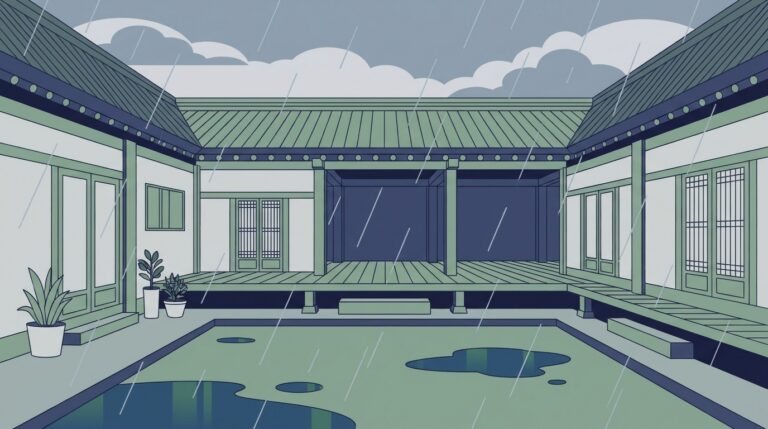
Setting: A dimly lit, quiet Hanok tea house in Bukchon, Seoul. Rain gently trickles down the tiled eaves.
Characters:
* 지완 (Ji-wan): A former creative director who unexpectedly quit his prestigious agency to live a quiet life. Thoughtful, reserved, deeply cultured.
* You: A longtime colleague visiting him after two years to ask why he walked away.
- 지완: 비가 제법 내리네요. 여기까지 오느라 고생 많았습니다.
(Biga jebeop naerineyo. Yeogikkaji oneura gosaeng manasseumnida.)
(It’s raining quite a bit. You must have had a hard journey getting all the way here.)
🎭 따뜻한 차를 두 손으로 조용히 건네며 (Quietly handing over warm tea with both hands) -
You: 고즈넉하고 좋네요. 하지만… 여전히 궁금해요. 그때 왜 아무 말도 없이 떠났는지.
(Gojeuneok-hago jonneyo. Hajiman… yeojeonhi gung-geumhaeyo. Geuttae wae amu maldo eopsi tteonatneunji.)
(It’s serene and lovely. But… I’m still curious. Why you left back then without a single word.)
🎭 찻잔을 만지작거리며 지완의 눈을 가만히 응시한다 (Fiddling with the teacup, quietly meeting Ji-wan's gaze) -
지완: 그 욕망의 소용돌이 속에서… 숨이 잘 쉬어지지 않더군요.
(Geu yongmang-ui soyongdori sogeseo… sumi jal swieojiji anteogunyo.)
(Inside that whirlpool of ambition… I could hardly catch my breath.)
🎭 창밖으로 시선을 돌리며 낮게 읊조린다 (Turning gaze toward the window, murmuring softly) -
You: 그래도 한마디 설명이라도 해줄 수 있었잖아요. 동료들이 얼마나…
(Geuraedo hanmadi seolmyeong-irado haejul su isseotjanayo. Dongnyodeuri eolmana…)
(Still, you could have offered at least a brief explanation. You know how much your colleagues…)
🎭 말을 끝맺지 못하고 말줄임표를 남긴다 (Unable to finish the sentence, leaving an ellipsis behind) -
지완: 구차한 변명 같았어요. 말이라는 게… 뱉을수록 진심과 멀어지기도 하니까요.
(Guchahan byeonmyeong gatasseoyo. Mariraneun ge… baeteulsurok jinsimgwa meoreojigido hanikkayo.)
(It felt like pathetic excuses. Words… sometimes the more you spit them out, the further they stray from sincerity.)
🎭 담담한 미소를 지으며 고개를 젓는다 (Smiling calmly and shaking his head) -
You: 그곳에 남겨진 우리의 혼란, 그리고 허탈함.
(Geugose namgyeojin uri-ui hollan, geurigo heotalham.)
(The confusion left behind in that place, and the sheer emptiness.)
🎭 명사형으로 문장을 매듭지으며 깊은 한숨을 쉰다 (Concluding with nouns and releasing a deep sigh) -
지완: 미안합니다. 하지만 후회는 없어요. 그저 이 고요함만이…
(Mianhamnida. Hajiman huhoeneun eopseoyo. Geujeo i goyohammani…)
(I am sorry. But I have no regrets. Only this serenity…)
🎭 손끝으로 찻잔 테두리를 천천히 쓸어내린다 (Slowly tracing the rim of the teacup with a fingertip) -
You: 알 것 같아요. 마당에 떨어지는 빗소리, 그것으로 충분하네요.
(Al geot gatayo. Madang-e tteoreojineun bitsori, geugeoseuro chungbunhaneyo.)
(I think I understand. The sound of rain falling in the courtyard, that is enough.)
🎭 가볍게 고개를 끄덕이며 엷은 미소를 짓는다 (Nodding gently with a subtle smile)
🔀 인터랙티브 분기점 (Interactive Choice)
How should you deliver your final reflective remark to Ji-wan?
- Choice A: “더 이상 아무것도 묻지 않을게요. 왜냐하면 당신의 침묵 속에서 모든 이유를 다 이해할 수 있었기 때문입니다.”
(Feedback: 🚫 Bad. Highly unnatural. Overly verbose and explains your internal realization like a scholastic essay. Ruins the mood completely.) - Choice B: “당신의 선택, 그리고 마주한 고요… 이제야 보이네요.”
(Feedback: ✅ Best. Exceptional C2 nuance. Pairs nominal phrasing with a graceful ellipsis, matching Ji-wan’s atmospheric restraint.) - Choice C: “그렇군요. 그럼 이제 차나 다 마시고 바로 서울로 올라가시죠.”
(Feedback: ⚠️ Risk. Abrupt and culturally insensitive. Severely ruptures the emotional resonance built throughout the tea ceremony.)
Phase 6: 10초 감정 섀도잉 드릴 (Emotional Shadowing Drill)
Practice reading these out loud. Respect the pause markers (/) and match the emotional cues.
[🌧️ 쓸쓸하고 담담하게]
말을 꺼내려다… / 삼켜버린 마음. / 그저 / 흐린 하늘만 바라볼 뿐…
(Mareul kkeonaeryeoda… / samkyeobeorin maeum. / Geujeo / heurin haneulman barabol ppun…)
Trying to speak… / a feeling swallowed back down. / Merely / looking up at the overcast sky…-
[💭 회한과 아련함을 담아서]
우리가 함께 걸었던 그 언덕길… / 이제는 흩날리는 낙엽만.
(Uriga hamkke geoleotdeon geu eondeokgil… / ijeneun heutnallineun nag-yeopman.)
That hill path we walked together… / now, only fluttering fallen leaves. -
[🥀 무거운 체념의 어조로]
더 설명해서 무엇하겠어요. / 이미 식어버린 찻잔, / 그리고 침묵…
(Deo seolmyeonghaeseo mueothagesseoyo. / Imi sigeobeorin chatjan, / geurigo chimmuk…)
What would be the use of further explanations? / An already chilled teacup, / and silence…
Phase 7: K-Culture 미니 사전 (Core Stylistic Lexicon)
- 여운 (Yeoun) | Lingering Resonance / Afterglow
The persistent emotional vibration that remains after music ends, art is viewed, or words fade. Essential in assessing artistic sophistication in Korea. - 행간 (Haenggan) | Between the Lines (Lit. Between Lines of Text)
The implicit, unspoken emotional subtext. High-context executives and diplomats frequently state: “행간을 읽어야 합니다” (You must read between the lines). - 여백의 미 (Yeobaek-ui mi) | Aesthetics of Emptiness / Negative Space
A foundational Korean aesthetic value prioritizing sparse, intentional voids over dense clutter—applied equally to calligraphy, home decor, and speech. - 말줄임표 (Maljurimpyo) | Ellipsis Dots (
...)
Literally “sentence-shortening punctuation.” In Korean rhetoric, it acts not as an incomplete stutter, but as an active grammatical actor embodying restraint.
Phase 8: 여행자를 위한 생존 키트 (Traveler’s Nuanced Kit)
When traveling beyond tourist hubs into tea houses, art galleries, or historic temple retreats:
- Top 1: “여기 참… 말이 필요 없는 곳이네요.”
(Yeogi cham… mari piryo eomneun gosineyo. – This place truly… needs no words.)
Pro Tip: Perfect comment when entering an awe-inspiring scenic viewpoint or quiet heritage pavilion. - Top 2: “그저 감탄만 나올 뿐입니다…”
(Geujeo gamtanman naol ppunimnida… – Only admiration escapes me…)
Pro Tip: Use when a local artisan, chef, or tea master shares an exquisite creation with you. - Top 3: “차 한잔의 여유, 그리고 이 빗소리.”
(Cha hanjan-ui yeoyu, geurigo i bitsori. – The quiet leisure of a cup of tea, and this rain sound.)
Pro Tip: An evocative caption for photos or a poetic compliment to a boutique cafe owner. -
Editor’s Travel Note: To locate tranquil tea houses and silent retreats off the noisy tourist path, do not search generic terms on Google Maps. Instead, open the 네이버 지도 길찾기 앱 다운로드 portal and search terms like
전통다원(traditional tea grove) or고즈넉한 북카페(tranquil book cafe) around Jongno or Gangneung.
Phase 9: “한 발 더 깊이” (Cultural Philosophy Essay)
In contemporary Western culture, silence during conversation is frequently treated as dead air—a conversational vacuum that demands immediate filling. In traditional Korean thought, however, silence is not the absence of thought; it is the ultimate culmination of etiquette. In an emotionally interconnected (Jeong – 정) society, burdening someone with exhaustive explanations can be viewed as selfishly offloading one’s anxiety. Leaving a sentence open-ended via ellipsis is an act of deep courtesy: it assumes your listener possesses the empathy, cultural intelligence (Nunchi), and maturity to comprehend the full picture without hearing every sordid detail.
💬 Your Turn: In your culture, what happens when a sentence trails off into silence? Is it interpreted as weakness, evasion, or profound wisdom? Drop your thoughts below!
Phase 10: FAQ & 오해 방지 (FAQ Schema)
Q: Does ending sentences with an ellipsis or noun seem rude to Korean elders or superiors?
A: It depends on the structural ending. If you simply chop off a verb (e.g., “밥 먹어…”), it sounds like casual banmal and is rude. However, if you use literary nominal endings with polite tone particles (e.g., “그저 송구한 마음뿐입니다…”) or poetic reflections, it is considered sophisticated and respectful in speeches, letters, and thoughtful reflections.
Q: How often should I use ellipsis in everyday spoken Korean?
A: Sparingly. If used in everyday transactional settings (like ordering food at a counter), trailing off will merely confuse the clerk. Ellipsis belongs in reflective, personal, artistic, or emotionally delicate conversations.
Q: What is the grammatical difference between ‘-ㄹ 뿐이다’ and trailing off with ‘-ㄹ 뿐…’?
A: Adding -이다 turns the phrase into a definitive, declarative assertion (“I was merely watching.”). Trailing off with -ㄹ 뿐... transforms the clause into an open contemplation, lingering with melancholy or wonder.
🚨 흔한 실수 (Common Mistakes) TOP 3
- Overusing dots in formal business emails: Writing “검토 부탁드립니다…” with trailing dots creates uncertainty and comes across as passive-aggressive. In business logistics, use crisp verb closures like “부탁드립니다.”
- Abrupt truncation without contextual priming: Leaving sentences unfinished without non-verbal cues (Nunchi, eye gaze, slow pacing) makes you look forgetful rather than poetic.
- Clashing tones: Combining harsh street slang with refined ellipsis endings creates confusing, incongruent dissonance.
Phase 11: 액션 미션 & 참여 유도 (Action Missions)
- 🥉 Bronze Level: Pick one photo of a scenery or coffee cup on your phone. Write a single poetic line ending in a noun phrase (e.g.,
창가에 맺힌 빗방울, 그리고 커피 향기.). - 🥈 Silver Level: Record a 5-second voice memo practicing Shadowing Drill #1. Pay strict attention to the 45-degree gaze drop and breathing rhythm.
- 🥇 Gold Level: In your next conversation with a Korean friend, gently pause and replace an over-elaborated excuse with “그게… 참 마음대로 안 되네요…” and observe their empathetic reaction.
- 🎮 K-Culture Mission: Watch an episode of a high-subtlety K-drama (My Liberation Notes, Lost). Note down at least two instances where characters use an ellipsis rather than a full verb ending.
Phase 12: 인터랙티브 퀴즈 챌린지 (Interactive Quiz)
Test your grasp of rhetorical ellipsis and understated resonance!
1. 상황 판단 (Situational Judgment)
Which of the following lines represents the most rhetorically refined C2-level response when someone asks why you broke up with your partner?
* (A) 성격 차이 때문에 헤어졌고, 그 사람은 너무 이기적이어서 더는 참을 수 없었어요.
* (B) 그 시절의 서툴렀던 우리, 그리고 지친 마음… 그뿐이에요.
* (C) 왜냐하면 연애라는 것이 서로에게 상처만 남기는 과정이라고 판단했기 때문입니다.
2. 빈칸 채우기 (Fill in the Blank)
Choose the correct phrase to complete the objective correlative (객관적 상관물):
“모든 열정이 지나간 빈자리. ___________________.”
* (A) 그래서 나는 집으로 돌아갔습니다
* (B) 밖에는 그저 차가운 겨울바람만…
* (C) 왜냐하면 방이 너무 춥기 때문입니다
3. True / False 문화 퀴즈
- True or False: In Korean traditional aesthetics (여백의 미), an unpainted portion of a canvas or an unspoken portion of a dialogue indicates that the artist ran out of time or ideas.
Click here to reveal the answer and explanation
1. Answer: (B)
Explanation: Option (B) uses nominal framing (그 시절의 서툴렀던 우리) and an understated trailing closure (그뿐이에요), maintaining dignity and poetic reserve. Options (A) and (C) are pedantic, accusatory, and overly literal.
2. Answer: (B)
Explanation: To achieve poetic ellipsis and understated imagery, closing with a bare landscape image (차가운 겨울바람만...) creates evocative resonance. Options (A) and (C) close the window of imagination through abrupt, mundane logic.
3. Answer: False
Explanation: Negative space (Yeobaek) in both visual and linguistic art is an intentional, highly valued choice that invites the spectator to co-create meaning.






