

Master Korean Cafe Sizing: How to Confidently Say “Regular Size, Please!”
Phase 1: 공감 (A Warm, Story-Driven Opening)
안녕하세요! 매일한글 에디터입니다. (Hello! This is your Daily Hangul editor!)
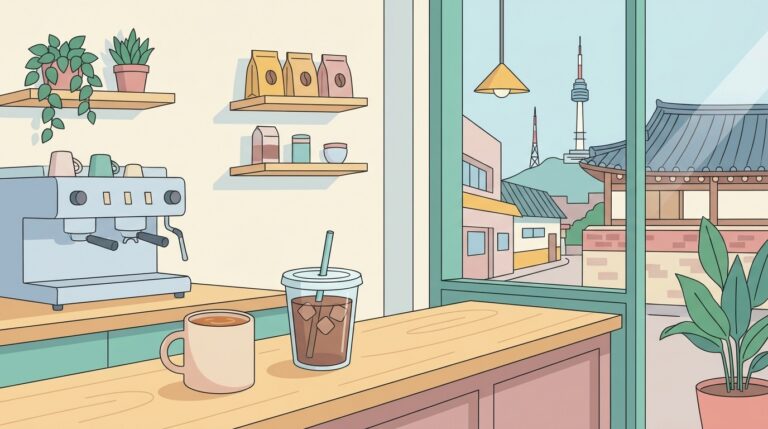
Picture this scene straight out of a K-drama: You step into a trendy cafe in Seongsu-dong or Hongdae on a crisp afternoon. Lo-fi beats are humming softly in the background, sunlight streams through wide windows, and the aroma of freshly roasted beans fills the air. You step up to the counter, proud of yourself for mastering how to say “Ice Americano, please.” You place your order with a smile.
Then, the friendly barista leans in with a lightning-fast question: “드시고 가세요? 사이즈는요?” (Are you drinking here? And what size?)
Suddenly, your mind goes completely blank. The line behind you begins to buzz with office workers grabbing their midday coffee fix. Your heart races. Do they say small, medium, large, or something else entirely? Can you sit down if you get a paper cup? Panicking, you just nod and say “네…” (Yes…)—and end up with a giant bucket-sized iced latte in a plastic takeaway cup, only to realize the cafe doesn’t allow disposable cups at indoor tables due to local eco-laws!
If you have ever felt that sudden wave of cafe-counter anxiety, take a deep breath. You are not alone. As a cultural navigator who has guided hundreds of beginner learners across Korea, I can promise you that mastering cafe sizing and “for here or to go” phrases takes less than five minutes. With this guide, you will breeze through every Seoul coffee counter like a seasoned local.
Phase 2: 핵심 표현 3선 심층 분석 (3 Essential Phrases Deep Dive)
Here are the three golden phrases you need to navigate any Korean coffee order at the A1 beginner level.
1. 레귤러 사이즈로 주세요 (Regular size, please)
- Pronunciation: [Regyulleo saijeuro juseyo] (Sounds like: reh-gyool-luh sah-ee-jeu-roh joo-seh-yo. The “주세요 (juseyo)” rhymes with “zoo-say-yo”!)
- Meaning: Literal: “Give it to me by regular size.” | Actual nuance: “I’d like a regular size, please.”
- K-Culture Moment: Seen in almost every modern Korean rom-com where characters meet at franchise cafes like Twosome Place or Mega Coffee before a busy work shift.
- Editor’s Insight: In Korea, “레귤러 (regyulleo)” is the standard default size at most international and local chain cafes. The particle “-로 (-ro)” indicates your choice or direction (“by means of / as”). If a cafe only uses Small/Medium/Large, substituting “미디엄 (midieom)” works just as smoothly!
- Situation Spectrum: Casual: ✅ | Semi-formal: ✅ | Formal: ✅ (Polite and universally accepted everywhere)
- 🤔 Think About It: In English, we often drop the “size” and simply ask for “a regular.” In Korean, stating “사이즈 (size)” explicitly clarifies your selection instantly amidst noisy cafe background music.
2. 먹고 갈게요 (I’ll have it here / For here)
- Pronunciation: [Meokgo galgeyo] (Sounds like: muck-goh gahl-geh-yoh. Emphasize the crisp ‘k’ sound in ‘meok’!)
- Meaning: Literal: “I will eat and then go.” | Actual nuance: “For here, please.”
- K-Culture Moment: You will hear this exact phrase uttered hundreds of times a day in trendy cafe districts like Ikseon-dong when friends plan an afternoon of chatting.
- Editor’s Insight: Korean separates “for here” into action verbs: “먹다 (to eat)” + “가다 (to go)”. Even if you are drinking coffee or tea, Koreans naturally use “먹고 갈게요” instead of “마시고 갈게요 (I will drink and go)” because “먹다” broadly covers consuming snacks and drinks together.
- Situation Spectrum: Casual: ✅ | Semi-formal: ✅ | Formal: ⚠️ (Use “매장에서 먹고 갈게요 [I’ll enjoy it inside the store]” in formal settings)
- 🤔 Think About It: Why say “eat and go” instead of just “for here”? Korean conversation often focuses on natural movement and relational flow rather than static location.
3. 테이크아웃 할게요 (I’ll take it to go)
- Pronunciation: [Teikeuaut halgeyo] (Sounds like: tay-kuh-ah-oot hahl-geh-yoh)
- Meaning: Literal: “I will do a take-out.” | Actual nuance: “To go, please.”
- K-Culture Moment: Relatable characters in K-workplace dramas sprinting down Teheran-ro in Gangnam, cradling an iced Americano in a cardboard carrier.
- Editor’s Insight: While traditional Korean has “포장해 주세요 (pojanghae juseyo – wrap it up)”, cafes overwhelmingly use the Konglish phrase “테이크아웃 할게요”. Baristas will instantly recognize this, making it virtually foolproof for beginners.
- Situation Spectrum: Casual: ✅ | Semi-formal: ✅ | Formal: ✅
- 🤔 Think About It: Notice how English loanwords integrate seamlessly into daily Korean grammar with the helper verb “-하다 (to do)”. Language adapts to modern speed!
Phase 3: 교과서 한국어 vs 진짜 한국어 (Textbook vs. Real-Life Korean)
Situation 1: Choosing your cup size
- 📖 교과서 한국어 (Textbook): 보통 크기의 컵으로 주십시오. (Botong keugi-ui keobeuro jusipsio. – “Please provide a cup of standard magnitude.”)
- 🗣️ 진짜 한국어 (Real-life): 레귤러 사이즈로 주세요. (Regyulleo saijeuro juseyo. – “Regular size, please.”)
- 💡 왜 다를까? (Why the difference?): Old textbooks translate “regular” to literal Korean vocabulary (“보통 크기”), but in modern Korean coffee shops, English loanwords like “레귤러 (Regular)”, “톨 (Tall)”, or “라지 (Large)” are the industry standard on physical menu boards.
Situation 2: Telling the staff you want it for here
- 📖 교과서 한국어 (Textbook): 여기서 마시겠습니다. (Yeogiseo masigesseumnida. – “I shall drink here.”)
- 🗣️ 진짜 한국어 (Real-life): 먹고 갈게요! (Meokgo galgeyo! – “I’ll have it here!”)
- 💡 왜 다를까? (Why the difference?): “마시겠습니다” sounds overly stiff, like an official military speech or a royal proclamation. “먹고 갈게요” is warm, natural, and instantly understood by every generational demographic.
Phase 4: K-Culture 딥다이브 & 비언어적 매너 (Culture Deep Dive & Non-Verbal Manners)
4-1. 눈치 (Nunchi) & Polite Gestures
- The Two-Handed Handover: When handing over your credit card or cash, always offer it with both hands (or rest your left hand gently under your right wrist/forearm). Doing this shows immediate politeness and warmth, earning you an appreciative smile from the barista.
- Watch the Cup Rules: Korea enforces a strict national environmental law prohibiting single-use plastic cups if you consume drinks inside the cafe. If you say “먹고 갈게요”, you must receive a glass, mug, or reusable cup. If you suddenly change your mind and ask for a plastic cup while seated indoors, the shop can be fined!
- The Self-Service Return Bar (반납대 – Bannapdae): When you finish your beverage, do not leave your empty tray on the table. Bring it back to the counter or designated return shelf marked “반납대”. Separate plastic straws and paper cup sleeves into their designated trash bins.
4-2. Cultural Code: The Nation of “Ah-Ah” (아아)
In Korea, coffee is more than caffeine—it is a cultural ritual. You will quickly encounter the legendary acronym 아아 (A-A), short for 아이스 아메리카노 (Iced Americano). Rain or shine, summer heatwave or sub-zero Siberian freeze, Koreans drink iced coffee year-round under the motto “얼죽아 (Eol-juk-ah)”—an abbreviation for “Even if I freeze to death, iced Americano!” Knowing how to order your regular “Ah-Ah” will make you feel like an honorary Seoulite in no time.
Phase 5: 실전 롤플레이 시나리오 (Real-World Roleplay Scenario)
Setting: A sunlit, bustling cafe near Seongsu Station. Soft indie pop is playing.
Barista Min-jun (민준): A stylish barista wearing a linen apron, ready at the POS terminal.
- Min-jun: 어서 오세요! 주문 도와드릴까요? (Eoseo oseyo! Jumun dowadeurilkkayo?)
🎭 [Smiling warmly, fingers hovering above the touch screen]
(Welcome! May I help you with your order?) - Learner: 안녕하세요! 아이스 아메리카노 한 잔 주세요. (Annyeonghaseyo! Aiseu amerikano han jan juseyo.)
🎭 [Making polite eye contact and smiling]
(Hello! One iced Americano, please.) - Min-jun: 네, 드시고 가세요, 아니면 포장이세요? (Ne, deusigo gaseyo, animyeon pojang-iseyo?)
🎭 [Tilting head slightly, waiting for destination]
(Sure, having here, or is it to go?) - Learner: 먹고 갈게요! (Meokgo galgeyo!)
🎭 [Nodding clearly and pointing toward the open indoor seating]
(I’ll have it here!) - Min-jun: 사이즈는 어떻게 해드릴까요? (Saijeuneun eotteoke haedeurilkkayo?)
🎭 [Pointing at the displayed cup sizes: Regular / Large]
(What size would you like?) - Learner: 레귤러 사이즈로 주세요. (Regyulleo saijeuro juseyo.)
🎭 [Speaking distinctly with confident voice]
(Regular size, please.) - Min-jun: 네, 결제는 카드로 도와드릴게요. 진동벨 챙겨가세요! (Ne, gyeoljeneun kadeuro dowadeurilgeyo. Jindongbel chaenggyeogaseyo!)
🎭 [Receiving payment card with both hands and handing over a vibrating buzzer]
(Okay, I will process payment by card. Please take your buzzer!) - Learner: 감사합니다! (Gamsahamnida!)
🎭 [Bowing head slightly by 15 degrees in thanks]
(Thank you!)
🔀 Interactive Choice Point: When the barista asks “사이즈는요?” (What size?), what will you say?
- Option A: “아무거나요!” (Amugeonayo! – “Whatever!”)
- Feedback (Bad): This sounds indifferent and leaves the barista confused about what to charge you. Never use this!
- Option B: “레귤러 사이즈로 주세요.” (Regyulleo saijeuro juseyo. – “Regular size, please.”)
- Feedback (Best): Flawless, courteous, and crisp. Min-jun will key in your order in two seconds flat.
- Option C: “중간 거요.” (Junggan geoyo. – “The middle one.”)
- Feedback (Risk): Grammatically acceptable in casual settings, but if the cafe only has two sizes (Regular and Large), asking for the “middle” will trigger follow-up questions and awkward silence.
Phase 6: 10초 감정 섀도잉 드릴 (10-Second Emotional Shadowing Drill)
Practice these aloud! Pause at each slash / to nail the natural rhythm.
[😊 Brightly & Confidently]
“아이스 아메리카노 / 한 잔 주세요!”
(A-i-seu a-me-ri-ka-no / han jan ju-se-yo!)-
[🤝 Relaxed & Decisive]
“매장에서 / 먹고 갈게요!”
(Mae-jang-e-seo / meok-go gal-ge-yo!) -
[☕ Clear & Polite]
“레귤러 사이즈로 / 주세요.”
(Re-gyul-leo sa-i-jeu-ro / ju-se-yo.) -
[🙏 Cheerful & Friendly]
“감사합니다, / 수고하세요!”
(Gam-sa-ham-ni-da, / su-go-ha-se-yo! – Thank you, keep up the good work!)
Phase 7: K-Culture 미니 사전 (Mini Culture Dictionary)
- 매장 이용 (Maejang Iyong): Dining in / Using store facilities. You will see this written on kiosk digital screens under the first step of ordering.
- 테이크아웃 (Teikeuaut): Takeout / To go. Used interchangeably with “포장 (pojang)”.
- 텀블러 할인 (Teombeulleo Harin): Personal tumbler discount. Most Korean cafes deduct 200–500 KRW from your bill if you bring your own travel tumbler!
- 아아 (A-A): Iced Americano. The undisputed national drink of South Korea, loved by college students, office workers, and idols alike.
Phase 8: 여행자를 위한 생존 키트 (Traveler’s Survival Kit)
Survival Phrases TOP 3
- “영수증 버려주세요.” (Yeongsujeung beoryeojuseyo.)
Pro Tip: Means “Please throw away the receipt.” Koreans rarely take paper receipts nowadays. - “와이파이 비밀번호가 뭐예요?” (Wa-i-pa-i bimilbeonhoga mwoyeyo?)
Pro Tip: Means “What is the Wi-Fi password?” Check your receipt first; it is usually printed at the very bottom! - “화장실 어디에 있어요?” (Hwajangsil eodie isseoyo?)
Pro Tip: Means “Where is the restroom?” Often requires a key or a 4-digit code written on the receipt.
Editor’s Travel Note
- App Recommendation: When exploring hidden cafes in Yeonnam-dong or Bukchon, Google Maps often lags in Korea. Make sure to complete your Naver Map app download before landing in Incheon for accurate walking navigation, opening hours, and real customer reviews.
- Card Convenience: Almost all cafes in Korea are cashless. Keep your international travel debit or credit card handy. When tapping or inserting your card into the reader machine at the counter, always remember to face the chip forward!
Phase 9: “한 발 더 깊이” (Cultural Reflection Essay)
In many Western cultures, a cafe is viewed as a transactional pitstop for your morning brew. In urban Korea, however, cafes act as communal living rooms. Because compact apartment living is common in dense metropolitan areas, young Koreans rely on cafes to study, socialize, hold casual meetings, and recharge. This shared public trust explains why you will see people leave thousand-dollar laptops and handbags completely unattended on a cafe table while they visit the restroom. Respecting the shared space—clearing your own table and following eco-cup regulations—is an unspoken social contract that keeps this unique culture thriving.
💬 Your Turn: Have you ever experienced ordering at a Korean cafe or kiosk? What drink would you order first when visiting Seoul? Share your favorite cafe moments in the comments below!
Phase 10: FAQ & 오해 방지 (FAQ & Common Mistakes)
Q: Can I order a “Medium” size instead of saying “Regular”?
A: Yes! Most baristas understand “미디엄 (midieom)” without any hesitation. However, on printed Korean menu boards, “레귤러 (Regular)” is the standard term paired with “라지 (Large)”, so sticking to “레귤러” avoids any confusion.
Q: What if I order “먹고 갈게요” (for here) but have leftover coffee I want to take out when leaving?
A: Don’t worry! Simply bring your reusable glass or mug back to the counter and say politely: “남은 음료 테이크아웃 잔에 담아주실 수 있나요?” (Namen eumryo teikeuaut jane dam-ajusil su innayo? – Could you put the leftover drink in a takeout cup?) The barista will gladly transfer it for you.
Q: Why did the barista give me a small buzzer instead of calling my name?
A: Korean cafes rarely take customer names like Starbucks US. Instead, they hand you a circular vibrating buzzer called a 진동벨 (jindongbel). When it flashes red and vibrates, head over to the pickup counter to collect your tray.
🚨 Common Mistakes Warning Board
- Mistake 1: Sitting at an indoor table with a single-use plastic cup.
Correct Action: Always state “먹고 갈게요” if you plan to sit down, even for 10 minutes, to ensure you receive a reusable cup complying with local eco-regulations. - Mistake 2: Handing your payment card with just one hand while looking at your smartphone.
Correct Action: Use both hands to hand over your card and acknowledge the barista with a friendly nod. - Mistake 3: Leaving your empty cup and trash on the table when exiting.
Correct Action: Return your tray to the “반납대 (return bar)” before leaving.
Phase 11: 액션 미션 & 참여 유도 (Action Missions)
- 🥉 Bronze Mission (Solo Practice): Stand in front of your mirror and repeat “먹고 갈게요, 레귤러 사이즈로 주세요!” three times in 10 seconds without stumbling.
- 🥈 Silver Mission (Social Connection): Record yourself saying the phrase on Instagram Stories or TikTok and tag our Daily Hangul community with #DailyHangulCafeChallenge.
- 🥇 Gold Mission (Real-World Application): Walk into a local Korean-run cafe or bubble tea shop in your neighborhood and order your drink completely in Korean using today’s formula!
- 🎮 K-Culture Mission: Watch any modern K-drama episode this week and spot how many times characters carry an iced Americano (아아) during their commute!
Phase 12: 인터랙티브 퀴즈 챌린지 (Interactive Quiz Challenge)
Test your new cafe superpowers! Tap the spoilers below to reveal answers.
Q1. Situation Judgement
You want to relax inside a cafe for an hour with an iced latte. What should you tell the barista when they ask if it’s for here or to go?
* A) 포장해 갈게요 (Pojanghae galgeyo)
* B) 먹고 갈게요 (Meokgo galgeyo)
* C) 테이크아웃이요 (Teikeuaus-iyo)
👉 Click to reveal Answer & Explanation
Correct Answer: B) 먹고 갈게요
Explanation: “먹고 갈게요” indicates you are staying inside the store, allowing the barista to serve your latte in an eco-friendly reusable glass mug!
Q2. Fill-in-the-Blank
Complete the sentence to ask for a regular size:
“_____ 사이즈로 주세요.”
👉 Click to reveal Answer & Explanation
Correct Answer: 레귤러 (Regyulleo)
Full sentence: 레귤러 사이즈로 주세요. (Regular size, please.)
Q3. True or False: Cultural Manner
In South Korea, it is completely acceptable to take a disposable plastic takeaway cup and sit inside the cafe dining area for hours.
👉 Click to reveal Answer & Explanation
Correct Answer: False (거짓)
Explanation: South Korea strictly enforces eco-laws banning single-use plastic cups for customers seated inside cafes. Always opt for “먹고 갈게요” if you plan to enjoy your drink at an indoor table!







