

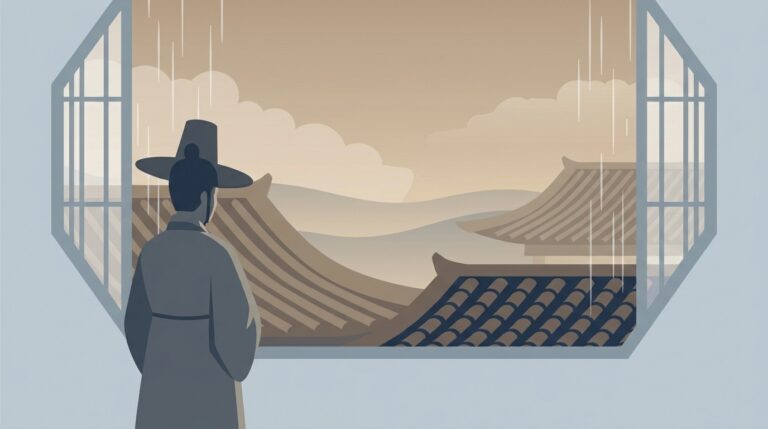
Beyond Sentimentality: How Jeong Jiyong Redefined Modern Korean Poetic Diction
Phase 1: Empathy (Story-Driven Opening)
안녕하세요! 매일한글 에디터입니다. (Hello! This is your Daily Hangul editor.)
Picture this: you are sitting inside an atmospheric, rain-drizzled hanok café in Seochon, Seoul. Surrounded by vintage wood and steaming cups of omija tea, you eavesdrop on two graduate students discussing modern Korean literature. At the C2 level, you have already conquered sophisticated political essays and high-register news broadcasts. Yet, when the conversation turns to colonial-era poetics, you suddenly hit a wall. Why does early modern Korean poetry swing so violently between archaic Sino-Korean laments and overly sentimental melodrama?
Many advanced Korean learners confess that reading pre-war Korean literature feels like navigating an ocean of tearful sighs (신파적 감상주의 – sinpajeok gamsangjuui). That is precisely where Jeong Jiyong (정지용) enters like an ice sculptor. Writing during the dark days of the colonial period, Jeong Jiyong refused to drown in cheap sentimentality. Instead, in groundbreaking masterworks like Hyangsu (향수 – Nostalgia) and Yurichang (유리창 – Windowpane), he carved out razor-sharp, crystalline sensory imagery (감각적 이미지 – gamgakjeok imiji). By transplanting Anglo-American Imagism into the fertile soil of indigenous Korean diction, he single-handedly modernized the syntax and soul of Korean verse. Mastering his linguistic restraint will elevate your Korean from merely grammatically perfect to breathtakingly sophisticated.
Phase 2: Deep Dive into 3 Core Expressions
1. 감각적 절제미 (Gamgakjeok jeoljemi)
- Pronunciation: [Gam-gak-jeok jeol-je-mi] (Think of the crisp snap of an icicle: ‘gahm-gahk-jeok’ followed by a calm, held breath ‘jeol-jeh-mee’)
- Meaning: Literal: “Sensory beauty of moderation” | Real Nuance: Aesthetic mastery where overwhelming emotion is filtered through cool, objective sensory details rather than loud outcries.
- K-Culture Moment: Heard frequently in prestige art critiques, high-end film reviews (such as discussions of Park Chan-wook’s cinematographic restraint), or literary salons in Paju Book City.
- Editor’s Insight: In Yurichang, Jeong writes of wiping a cold windowpane to catch a fleeting glimpse of his deceased child. Instead of writing “I am heartbroken,” he paints the vapor of breath fading like a fragile bird’s wing. That is gamgakjeok jeoljemi.
- Situation Spectrum: Casual 🚫 | Semi-formal ⚠️ | Formal ✅
- 🤔 Think About It: In English literature, T.S. Eliot termed this the ‘Objective Correlative.’ How does Korean linguistic texture—with its abundance of mimetic words (의태어)—render sensory restraint even more tactile than in Western languages?
2. 서늘한 투명성 (Seoneulhan tumyeongseong)
- Pronunciation: [Seo-neul-han tu-myeong-seong] (Glide gently on the first syllable like a brisk autumn breeze: ‘suh-neul-hahn too-myuhng-suhng’)
- Meaning: Literal: “Chilly transparency” | Real Nuance: A stylistic tone characterized by lucid, detached, and unembellished clarity that conveys emotional depth without warmth or melodrama.
- K-Culture Moment: Used by contemporary novelists and indie lyricists when contrasting raw, unpolished heartbreak with crystalline, mature poetic distance.
- Editor’s Insight: Notice the adjective 서늘하다 (seoneulhada – brisk/chilly). It implies both physical coldness and intellectual composure. Jeong Jiyong’s diction never boils over; it stays lucid, glass-like, and cool to the touch.
- Situation Spectrum: Casual 🚫 | Semi-formal ✅ | Formal ✅
- 🤔 Think About It: Does your native tongue equate warmth with authenticity and coolness with aloofness? In modern Korean poetics, coolness often represents the pinnacle of intellectual purity.
3. 비애의 내면화 (Biae-ui naemyeonhwa)
- Pronunciation: [Bi-ae-ui nae-myeon-hwa] (Resonant vowels: ‘bee-eh-ee neh-myun-hwah’)
- Meaning: Literal: “Internalization of grief/sorrow” | Real Nuance: The deliberate sublimation of devastating grief into an interior psychological landscape, transforming sorrow into quiet contemplative power.
- K-Culture Moment: Frequently referenced in literary roundtables and deep-dive actor interviews analyzing period dramas set during the Japanese colonial era (such as Mr. Sunshine or Chicago Typewriter).
- Editor’s Insight: Prior to Jeong Jiyong, colonial grief often sounded like unrestrained wailing (tonggok). Jeong internalized sorrow (naemyeonhwa), locking it behind the pane of glass where it transforms into enduring aesthetic contemplation.
- Situation Spectrum: Casual 🚫 | Semi-formal ⚠️ | Formal ✅
- 🤔 Think About It: Why might a colonized populace choose internalization over open protest in their art? How does censorship shape artistic diction?
Phase 3: Textbook Korean vs Real Korean
Situation 1: Explaining how a poem depicts profound personal loss
- 📖 교과서 한국어 (Textbook Korean):
슬픔을 직접적으로 울면서 표현하지 않고 참는 기법입니다.
(Seulpeumeul jikjeopjeogeuro ulmyeonseo pyohyeonhaji anko chamneun gibeobimnida. – It is a technique of enduring sadness without crying directly.) - 🗣️ 진짜 한국어 (Native Literary Critic Korean):
감정을 날것으로 분출하기보다, 서늘한 감각적 이미지로 삭여내는 절제미가 돋보여요.
(Gamjeongeul nalgeoseuro bunchulhagiboda, seoneulhan gamgakjeok imijiro sagyeonaeneun jeoljemiga dotboyeoyo. – Rather than erupting with raw emotion, it stands out for its aesthetic restraint, dissolving grief into cool sensory imagery.) - 💡 왜 다를까? (Why the difference?):
Elementary textbooks use verbs like 참다 (chamda – to endure), but high-register stylistic critique employs 삭이다 (sag-ida – to digest/ferment emotional turmoil into quiet peace) combined with imagery metaphors.
Situation 2: Praising Jeong Jiyong’s innovative word choice
- 📖 교과서 한국어 (Textbook Korean):
정지용 시인은 시각적 단어를 많이 써서 한국어를 아름답게 발전시켰습니다.
(Jeong Jiyong siineun sigakjeok daneoreul mani sseoseo hangugeoreul areumdapge baljeonsikyeosseumnida. – Poet Jeong Jiyong used many visual words and developed the Korean language beautifully.) - 🗣️ 진짜 한국어 (Native Literary Critic Korean):
정지용은 토착어의 원초적 질감을 선명한 회화적 이미지로 탈바꿈시켜 모국어의 지평을 넓혔죠.
(Jeong Jiyongeun tochageoui wonchojeok jilgameul seonmyeonghan hoehwajeok imijiro talbakkumsikyeo mogugeoui jipyeongeul neolphyeotjyo. – Jeong Jiyong transformed the primal texture of indigenous words into vivid painterly imagery, expanding the horizon of our mother tongue.) - 💡 왜 다를까? (Why the difference?):
C2 discourse utilizes conceptual nouns like 회화적 이미지 (hoehwajeok imiji – painterly imagery) and 질감 (jilgam – texture) to capture stylistic innovation precisely.
Phase 4: K-Culture Deep Dive & Non-Verbal Manners
4-1. Nunchi & Intellectual Posture
When discussing literary modernism with Korean professors, authors, or curators, bodily restraint mirrors linguistic restraint. Avoid expansive, overly casual arm gestures. Instead:
* Maintain a calm, meditative upper-body posture.
* Offer a slow, thoughtful nod (미소와 함께 고개를 천천히 끄덕임) when interlocutors explain nuanced poetic metaphors.
* Never handle vintage colonial poetry anthologies or critical journals with a single hand; always support the spine or page with both hands, symbolizing reverence for the preservation of the mother tongue under colonial duress.
4-2. Cultural Code: The Gyeongseong Modernist Vanguard
In the 1930s, central Seoul was known as Gyeongseong (경성). The literary landscape was splintered between political agitprop and melodramatic weeping. Jeong Jiyong, who studied English literature at Doshisha University in Kyoto and immersed himself in William Carlos Williams and Ezra Pound, brought Imagism to the Circle of Nine (Guinhoe – 구인회).
This aesthetic revolution is the spiritual ancestor of today’s most acclaimed Korean media aesthetics. When you watch the atmospheric cinematography of acclaimed historical dramas, notice how the camera lingers on water droplets, frosted glass, or trembling silk sleeves rather than explicit shouting. Jeong Jiyong proved that modern Korean consciousness achieves its highest power through disciplined, razor-sharp sensory containment.
Phase 5: Real-World Roleplay Scenario
Setting: A quiet archives salon inside a literary foundation near Buam-dong, Seoul. You are discussing the sensory modernity of 1930s poetics with Chief Curator Min-woo (민우).
민우: 정지용의 <유리창>을 처음 접했을 때, 어떤 감각이 가장 먼저 와닿으셨나요?
(Jeong Jiyong-ui
🎭 Leaning forward slightly, eyes glistening with scholarly curiosity.
You: 차가운 유리면에 어리는 입김의 시각적 온도가 가슴을 서늘하게 하더군요.
(Chagaun yurimyeone eorineun ipgimui sigakjeok ondoga gaseumeul seoneulhage hadeogunyo. – The visual temperature of breath misting upon the cold glass chilled my heart.)
🎭 Speaking in a calm, reflective tone without theatrical hand gestures.
민우: 정확하게 짚으셨네요. 당시 1920년대 시단에 팽배했던 감상주의와는 확연히 결이 다르죠?
(Jeonghwakhage jipeusyeotneyo. Dangsi cheongubaek-isipdae sidane paengbaehaetdeon gamsangjuuiwaneun hwagyeonhi gyeori dareujo? – You pinpointed it exactly. Its texture is distinctly different from the sentimentalism prevalent in the 1920s poetry scene, isn’t it?)
🎭 Nodding approvingly, turning the page of a reproduction manuscript.
You: 네, 눈물을 전시하기보다 슬픔을 물성(物性)으로 치환한 점이 경이롭습니다.
(Ne, nunmureul jeonsihagiboda seulpeumeul mulseong-euro chihwanhan jeomi gyeong-iropseumnida. – Yes, the way he replaces public displays of tears with physical materiality is truly astonishing.)
🎭 Looking directly into the curator’s eyes with intellectual focus.
민우: ‘물성으로 치환했다’는 표현, 아주 탁월합니다. 그것이 바로 정지용이 개척한 감각적 이미지즘의 본령이니까요.
(Mulseong-euro chihwanhaetdaneun pyohyeon, aju tagwolhamnida. Geugeosi baro Jeong Jiyongi gaecheokhan gamgakjeok imijijeumui bonryeong-inikkayo. – ‘Replaced with physical materiality’—an outstanding phrasing. That is indeed the true essence of sensory imagism pioneered by Jeong Jiyong.)
🎭 Writing down your remark on his memo pad.
You: 시인의 언어가 감정을 낭비하지 않아서 오히려 울림이 길게 남는 것 같아요.
(Siinui eoneoga gamjeongeul nangbihaji anaseo ohiryeo ullimi gilge namneun geot gatayo. – Because the poet’s language does not squander emotion, the resonance lingers far longer.)
🎭 Offering a gentle, acknowledging nod.
민우: 바로 그렇습니다. 모국어가 식민지 치하에서 질식해가던 시절, 그는 언어를 닦고 갈아 수정처럼 세공했던 것이죠.
(Baro geureoseumnida. Mogugeoga sikminji chihahaeseo jilsik-haegadeon sijeol, geuneun eoneoreul dakko gara sujeongcheoreom segonghaetdeon geosijyo. – Exactly. In an era when our mother tongue was suffocating under colonial rule, he polished and chiseled words like crystals.)
🎭 Gazing out through the gallery window at the misty foothills of Mount Inwang.
You: 그 투명한 언어 감각이야말로 한국 현대시가 도달한 근대성의 정점이라고 봅니다.
(Geu tumyeonghan eoneo gamgagi-yamallo hanguk hyeondaesiga dodalhan geundaeseong-ui jeongjeomirago bomnida. – I believe that transparent linguistic sensibility is the very pinnacle of modernity reached by contemporary Korean poetry.)
🎭 Delivering the concluding thought with quiet certainty.
🔀 Interactive Decision Point
If Curator Min-woo asks: “What do you think was the biggest danger Jeong Jiyong avoided in ‘Nostalgia’ (향수)?” How do you reply?
- Option A: “토속적 방언과 시골 풍경을 너무 낭만적으로 왜곡해서 독자들을 울리려고만 한 신파적 함정을 피했습니다.” (He avoided the sentimental trap of distorting rustic dialects and countryside landscapes purely to make readers weep.)
- Option B: “어려운 한자어를 너무 많이 써서 평범한 대중들이 시를 이해하지 못하게 만드는 지적 허영을 피했습니다.” (He avoided intellectual vanity where using too many complex Sino-Korean characters made it incomprehensible to ordinary people.)
- Option C: “식민지 현실에 대해 대놓고 분노를 표출하며 시를 정치적 선전문구로 전락시키는 실수를 피했습니다.” (He avoided the mistake of openly expressing rage against colonial reality and turning the poem into a political manifesto.)
Curator’s Evaluation:
* Option A (Best 🌟): Perfect! Jeong Jiyong avoided the tear-jerking kitsch of rural romanticism by elevating rustic terms into precise sensory vignettes.
* Option B (Bad ❌): Inaccurate. Jeong did not avoid erudite vocabulary; he intentionally revitalized pure indigenous Korean idioms (soue) rather than simply dodging Hanja.
* Option C (Risk ⚠️): Partially insightful, but in critical poetics, his primary fight in Hyangsu was against formless emotional indulgence rather than censorship evasion.
Phase 6: 10-Second Emotional Shadowing Drill
Sharpen your cadence, pause at the slashes (/), and absorb the emotional mindset:
- [🧊 서늘하고 투명하게 – Cool, detached, and crystal-clear]
유리에 차디찬 입김을 흐리니 / 길쭉한 날개가 / 파닥거린다.
(Yurie chadichan ipgimeul heurini / giljjukhan nalgaega / padakgeorinda. – As I mist the ice-cold glass with breath, / elongated wings / flutter.) -
[🕊️ 애절함을 억누르며 – Sublimating sorrow with absolute restraint]
지우고 보고 / 지우고 보아도 / 새까만 밤이 밀려와 부딪히고.
(Jiu-go bogo / jiu-go bo-ado / saekkaman bami milryeowa budichigo. – I wipe and gaze, / wipe and gaze again, / yet pitch-black night rushes in and shatters.) -
[💎 경탄하듯 단호하게 – Wonderstruck yet intellectually resolute]
감정을 범람시키지 않고 / 감각으로 빚어낸 / 현대시의 결정체입니다.
(Gamjeongeul beomramsikiji anko / gamgageuro bijeonaen / hyeondaesiui gyeoljeongche-imnida. – Without letting emotion overflow, / it is a crystalline masterpiece of modern poetry / shaped purely through the senses.)
Phase 7: K-Culture Mini Dictionary
- 감각적 형상화 (Gamgakjeok hyeongsanghwa) | Sensory Figurative Embodiment
- Real-World Use: Used when an abstract idea (love, grief, existential dread) is turned into tangible touch, sound, or sight. Essential for art reviews and high-level book clubs.
- 절제미 (Jeoljemi) | Aesthetics of Restraint / Understatement
- Real-World Use: Applied broadly in contemporary Korea—from minimalist interior design in Seongsu-dong cafes to subdued, masterful acting in indie cinema.
- 유음화된 시어 (Yueumhwadoen sieo) | Liquidized Poetic Diction
- Real-World Use: Referring to Jeong Jiyong’s linguistic trick of deploying liquid consonants (ㄴ, ㄹ, ㅁ, ㅇ) to make verses glide effortlessly like running mountain water.
- 신파 (Sinpa) | Excessive Sentimentalism / Melodrama
- Real-World Use: In modern colloquial and cultural slang, calling a K-drama “너무 신파야” (neomu sinpaya) means it forces cheap tears with manipulative violins and overacting.
Phase 8: Traveler’s Literary Survival Kit
If you visit Jeong Jiyong’s birthplace in Okcheon (옥천) or explore the modern poetry archives in Buam-dong / Seochon, these expressions are indispensable:
- Phrase 1: “정지용 시인의 육필 원고나 초판본 영인본을 열람할 수 있을까요?”
(Jeong Jiyong siinui yukpil wongo-na chopanbon yeong-inboneul yeollamhal su isseulkkayo? – Could I review the poet Jeong Jiyong’s handwritten manuscripts or facsimile first editions?)- Pro Tip: Use yeollamhada (열람하다) rather than simply boda (보다) when requesting access to archival materials.
- Phrase 2: “이 시집의 장정(裝幀)과 활자 배치가 당시 모더니즘 감각을 그대로 보여주네요.”
(I sijibui jangjeong-gwa hwalja baechiga dangsi modeonijeum gamgageul geudaero boyeojuneyo. – The bookbinding and typographic layout of this poetry collection vividly illustrate the modernist sensibility of that era.)- Pro Tip: Jangjeong refers to the holistic visual book design/binding of early 20th-century books.
- Phrase 3: “시적 화자의 시선이 머무는 지점을 감각적으로 짚어볼 수 있는 코스가 있나요?”
(Sijeok hwajaui siseoni meomuneun jijeomeul gamgakjeogeuro jipeobol su inneun koseuga innayo? – Is there a walking route where I can trace where the poetic speaker’s sensory gaze lingered?)
Editor’s Travel Note: To explore the intellectual haunts of 1930s Gyeongseong modernists, head to Tongin-dong and Seochon. Before setting out, ensure your navigation is seamless via 네이버 지도 앱 다운로드. Many independent literary spaces require prior reservation via Naver Booking, so booking your archive slots early is highly recommended.
Phase 9: “One Step Deeper” (Reflective Humanities Essay)
Under Japanese colonial rule, Korean poets faced an existential crisis: if you cannot speak political truth openly without facing imprisonment, what becomes of your mother tongue? While some poets chose overt martyrdom and others lapsed into tragic, sentimental despair, Jeong Jiyong chose linguistic diamond-cutting. He realized that emotional hysteria eventually exhausts itself, but an image carved in transparent, sensory perfection lives forever. By refusing to let Korean become a language of mere victimhood or sloppy nostalgia, he gave modern Koreans a poetic vocabulary as sharp, sophisticated, and autonomous as any language in the world.
💬 Your Turn: Does your native literature feature a poet who stripped away tearful melodrama in favor of sharp, sensory modernism? Share your thoughts below in Korean using the expression 감각적 절제미!
Phase 10: FAQ & Avoiding Misconceptions
Q: Why is Jeong Jiyong called an ‘Imagist’ instead of a ‘Symbolist’?
A: Symbolism (상징주의) uses concrete objects to stand for mysterious, transcendent, or metaphysical concepts (like a rose symbolizing divine love). Imagism (이미지즘), as practiced by Jeong Jiyong, presents the sensory object itself—its crisp coldness, damp texture, and luminous color—with absolute visual precision and no extraneous moral preaching.
Q: Isn’t ‘Hyangsu’ (Nostalgia) a folk song about missing one’s hometown?
A: While popular singer Lee Dong-won and tenor Park In-soo turned it into a beloved modern vocal duet, the original 1927 poem is not mere folksy homesickness. It is a hyper-modern, montage-like sequence of sensory snapshots that preserves the sights, sounds, and smells of the Korean soil with unprecedented linguistic discipline.
Q: Why was Jeong Jiyong’s work banned for several decades in South Korea?
A: During the Korean War, Jeong disappeared into North Korea under mysterious circumstances (believed to have been taken north or perished during the conflict). Consequently, the authoritarian South Korean government classified him as a ‘defected writer’ (월북 작가) and banned his works until the monumental lifting of literary censorship in 1988 (해금 – haegeum).
🚨 Common Mistakes Alert
- Mistake: Using 슬프다 (seulpeuda) repeatedly to describe Yurichang.
- Correct Action: Use 비애를 형상화하다 (biaereul hyeongsanghwahada – to figuratively materialize sorrow).
- Mistake: Equating literary restraint with emotional emptiness.
- Correct Action: Acknowledge that 절제 (jeolje) heightens emotional resonance rather than extinguishing it.
- Mistake: Treating colonial-era poetry as archaic Joseon Korean.
- Correct Action: Recognize that Jeong Jiyong’s diction was fiercely avant-garde and radically urban for its time.
Phase 11: Action Mission & Engagement
- Bronze Mission (Solo Practice): Read the poem Yurichang out loud three times, focusing on keeping your voice calm, steady, and chilled, without any theatrical sobbing.
- Silver Mission (Community Share): Choose one everyday object (e.g., your smartphone screen, a cold Americano cup) and write a two-sentence description on social media practicing 감각적 절제미.
- Gold Mission (Real-World Execution): Visit an exhibition or art gallery in Korea, locate an abstract or minimalist painting, and explain to a friend or docent why it evokes 서늘한 투명성.
- 🎮 K-Culture Mission: Watch Episode 1 or 2 of Chicago Typewriter (시카고 타자기) and pinpoint moments where 1930s writers deliberate over literary word choice versus political propaganda.
Phase 12: Interactive Quiz Challenge
1. Situational Judgment: You are writing a C2-level dissertation review on Jeong Jiyong’s poetry. Which sentence demonstrates the highest critical nuance?
* (A) 정지용은 슬픈 마음을 아주 솔직하게 다 털어놓아 독자의 눈물을 쏙 뺍니다.
* (B) 정지용은 과도한 감상주의를 걷어내고, 선명한 감각적 이미지로 슬픔의 정서를 객관화했습니다.
* (C) 정지용은 영어를 그대로 번역해서 한국어 고유의 리듬을 완전히 없애버렸습니다.
2. Fill in the Blank: 정지용의 시학은 감정을 날것으로 터뜨리지 않고 차갑고 맑은 언어로 걸러내는 ( )이/가 특징이다.
3. True or False: Jeong Jiyong believed that modern poetry should mimic traditional 19th-century pansori narratives to express colonial pain.
👉 Click to Reveal Answers & Explanations
- Answer: (B). Option (A) describes low-brow melodrama (sinpa), and (C) is historically false. (B) accurately utilizes critical terminology (gamsangjuuireul geodeonaego, gamgakjeok imiji, gaegwanhwahaessseumnida).
- Answer: 절제미 (or 감각적 절제미). This encapsulates his principle of aesthetic containment.
- Answer: False. Jeong Jiyong explicitly broke away from traditional long-form oral storytelling and sentimental folksiness, choosing concise, concentrated Imagist snapshots instead.







