

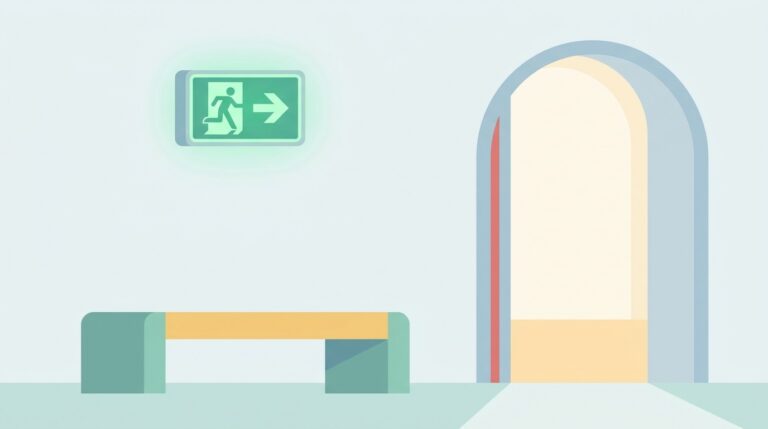
Finding Your Way Out: How to Spot and Ask for Emergency Exits in Korea
Phase 1: Empathy (Story-Driven Opening)
안녕하세요! 매일한글 에디터입니다. (Hello! I’m your Daily Hangul editor.) Have you ever watched the thrilling Korean movie Exit (엑시트)? The main characters sprint across rooftops trying to find a safe way out of a crowded city! While your everyday trip to Korea won’t require climbing skyscrapers, stepping into massive underground transit stations like Gangnam or labyrinth-like mega-malls like COEX can feel just as disorienting.
You urgently need to find public facilities or an exit, but the glowing signs blur together, and you freeze. Knowing how to ask for and understand directions like “The emergency exit is that way” is not just a crucial safety skill—it is your golden ticket to mastering everyday spatial Korean. Hundreds of our beginner students have told us that learning directional markers gave them an instant feeling of security and independence while traveling. Let’s make sure you always know exactly where to go!
Phase 2: Core Expressions Deep Dive
1. 비상구는 저쪽이에요 (Bisangguneun jeojjogieyo)
- Pronunciation: bee-sahng-goo-neun juh-jjohk-ee-eh-yo (Imagine “bee” + “song” without the w, then “juh-choke” smoothly sliding into “ee-eh-yo”)
- Meaning: Literally “As for the emergency exit, it is that way over there.” Real nuance: A polite, clear way to point someone toward an emergency escape route located away from both speaker and listener.
- K-Culture Moment: In disaster dramas, station attendants calmly usher panicked citizens with this exact phrase while pointing toward green illuminated signs.
- Editor’s Insight: 저쪽 (jeojjok) refers to a location far from both you and the listener. Notice the small pause after 비상구는 (bisangguneun)—it lets the listener catch the topic before hearing the direction!
- Situation Spectrum: Casual: ⚠️ (Use 비상구 저쪽이야 (bisanggu jeojjok-iya)) | Semi-formal: ✅ | Formal: ✅ (비상구는 저쪽입니다 (bisangguneun jeojjogimnida))
- 🤔 Think About It: In English, “that way” can be vague, but Korean uses distinct physical coordinates based on proximity to the speaker and listener. How does pointing someone toward safety reflect communal care in Korea?
2. 출구가 어디예요? (Chulguga eodiyeyo?)
- Pronunciation: chool-goo-gah uh-dee-yeh-yo (Sounds like “cool” with a soft ‘ch’ + “goo” + “uh-dee-yeah-yo”)
- Meaning: Literally “Where is the exit?” Nuance: The go-to, universally understood beginner question when searching for the way out of any subway, department store, or concert hall.
- K-Culture Moment: K-pop fans rushing after an arena concert at Olympic Gymnastics Arena (KSPO Dome) asking building staff how to reach the nearest subway line.
- Editor’s Insight: While 비상구 (bisanggu) is specifically an emergency exit, 출구 (chulgu) is any regular everyday exit. Knowing the difference keeps you from accidentally setting off fire alarms!
- Situation Spectrum: Casual: ⚠️ | Semi-formal: ✅ | Formal: ✅
- 🤔 Think About It: Notice the particle 가 (ga) attached to 출구 (chulgu). In Korean, marking the subject helps listeners pick up key nouns instantly in crowded, noisy public spaces.
3. 이쪽으로 오세요 (Ijjogeuro oseyo)
- Pronunciation: ee-jjoh-geu-ro oh-seh-yo (Think “each” without ‘ch’ + “choke” + “ro” + “oh-say-yo”)
- Meaning: Literally “Please come toward this way.” Nuance: An inviting, reassuring phrase used by staff and locals guiding you to safety or showing you where to queue.
- K-Culture Moment: A helpful employee in a busy Hongdae cafe guiding customers through the back corridor toward the restroom.
- Editor’s Insight: The particle -(으)로 (-(eu)ro) indicates direction (“toward”). 이쪽 (ijjok) means “this way” (close to the speaker). When you hear this, follow the speaker!
- Situation Spectrum: Casual: 🚫 | Semi-formal: ✅ | Formal: ✅
- 🤔 Think About It: Why does Korean combine direction with honoring endings (-세요 (-seyo)) even in brief interactions? It reflects a social norm of effortless hospitality.
Phase 3: Textbook Korean vs Real-Life Korean
Situation 1: Asking where the exit is in a crowded station
- 📖 교과서 한국어 (Textbook Korean): 실례지만, 비상 탈출구가 어느 방향에 위치합니까? (Sillyejiman, bisang talchulguga eoneu banghyange wichihamnikka? / “Excuse me, in which direction is the emergency escape exit located?”)
- 🗣️ 진짜 한국어 (Real Korean): 저기요, 비상구 어디예요? (Jeogiyo, bisanggu eodiyeyo? / “Excuse me, where is the emergency exit?”)
- 💡 왜 다를까? (Why is it different?): Real Koreans rarely use clunky words like 탈출구 (talchulgu) or 위치합니까 (wichihamnikka) in spoken conversation. A warm 저기요 (jeogiyo) plus 어디예요? (eodiyeyo?) gets you fast, direct help immediately.
Situation 2: Being directed toward a side corridor
- 📖 교과서 한국어 (Textbook Korean): 귀하는 저편으로 이동하셔야 합니다. (Gwihaneun jeopyeoneuro idonghasyeoya hamnida. / “You must migrate toward that direction.”)
- 🗣️ 진짜 한국어 (Real Korean): 저쪽으로 가시면 돼요! (Jeojjogeuro gasimyeon dwaeyo! / “You can just go that way!”)
- 💡 왜 다를까? (Why is it different?): Koreans favor soft conditional endings like -(으)시면 돼요 (-(eu)simyeon dwaeyo / “it is okay if you do…”) because direct imperatives can sound aggressive or overly robotic.
Phase 4: K-Culture Deep Dive & Non-Verbal Manners
4-1. 눈치 (Nunchi) & Gestures
When asking for directions in Korea, your body language speaks volumes:
* Never point with an isolated index finger: Pointing a single finger directly at a person or right in front of someone’s face is considered disrespectful. Instead, use an open palm facing slightly upward when indicating a direction (저쪽 / jeojjok).
* The Quick Head Bow: Initiate your question with a brief 15-degree head bow and 저기요 (jeogiyo / “excuse me”). This softens your approach instantly.
* Reading Exit Signage Colors: Korean public buildings follow strict safety codes: Glowing green signs with a running figure always designate the 비상구 (bisanggu, emergency exit). Numbers inside yellow circles indicate subway regular exits (출구 / chulgu).
4-2. Culture Code: The Architecture of Korean Safety
South Korea takes public safety infrastructure seriously. Walk into any CGV cinema or Lotte World Mall, and before every movie screening, you will watch a fun animated safety video detailing the nearest 비상구 (bisanggu) and fire extinguisher locations. Notice how subway platforms are lined with glowing floor arrows guiding foot traffic toward exits during power outages. Knowing the word 비상구 (bisanggu) allows you to spot these life-saving checkpoints effortlessly.
Phase 5: Real-Life Roleplay Scenario
Setting: You are inside a bustling movie theater at Yongsan I-Park Mall. The movie just finished, the lights are dim, and you need to find the exit and restroom quickly.
Character: Min-jun (민준), a courteous CGV theater staff member wearing a uniform and carrying a light wand.
- You: 저기요, 출구가 어디예요? (Jeogiyo, chulguga eodiyeyo? / Excuse me, where is the exit?)
🎭 행동 지문: Holding your ticket, making polite eye contact with a gentle head nod. - Min-jun: 네, 손님! 출구는 계단 아래쪽에 있어요. (Ne, sonnim! Chulguneun gyedan araejjoge isseoyo. / Yes, customer! The exit is downstairs.)
🎭 행동 지문: Smiling warmly while gesturing with an open palm toward the stairs. - You: 화장실도 그쪽에 있나요? (Hwajangsi-ldo geujjoge innayo? / Is the restroom that way too?)
🎭 행동 지문: Tilting head slightly with an inquiring expression. - Min-jun: 네, 맞아요. 화장실은 계단 바로 옆이에요. (Ne, majayo. Hwajangsireun gyedan baro yeopieyo. / Yes, that’s right. The restroom is right next to the stairs.)
🎭 행동 지문: Nodding affirmatively. - You: 혹시 비상구는 어디예요? (Hoksi bisangguneun eodiyeyo? / By any chance, where is the emergency exit?)
🎭 행동 지문: Looking around the dark corridor cautiously. - Min-jun: 비상구는 저쪽이에요. 초록색 불 보이시죠? (Bisangguneun jeojjogieyo. Choroksaek bul boisijyo? / The emergency exit is that way. You see the green light, right?)
🎭 행동 지문: Pointing his light wand softly toward the glowing green exit sign at the end of the hall. - You: 아, 저기 초록색 불이요! 감사합니다. (A, jeogi choroksaek buriyo! Gamsahamnida. / Ah, that green light over there! Thank you.)
🎭 행동 지문: Bowing slightly in relief with hands clasped together. - Min-jun: 조심히 내려가세요! (Josimhi naeryeogaseyo! / Please watch your step going down!)
🎭 행동 지문: Giving a friendly bow as you head toward the corridor.
🔀 Interactive Choice Point
You arrive at the staircase landing, but there are two corridors: one with a green running-man sign and one with an open door to an elevator bank.
* Option A: Head toward the green sign and say: 비상구로 갈게요 (Bisangguro galgeyo / I will go via the emergency exit).
* Option B: Shout loudly into the hallway: 출구 어디야?! (Chulgu eodiya?! / Where is the exit?!)
* Option C: Check the door sign and ask a passerby: 실례지만, 엘리베이터는 어디예요? (Sillyejiman, ellibeiteoneun eodiyeyo? / Excuse me, where is the elevator?).
Feedback:
* Option A (Best): Perfect! You correctly recognize safety signage and use polite intention speech.
* Option B (Bad): High risk! Dropping honorifics (반말 / banmal) and shouting creates panic and sounds rude to strangers.
* Option C (Acceptable): Great fallback if you prefer using the lift instead of stairs, spoken politely!
Phase 6: 10-Second Emotion Shadowing Drill
Practice these natural rhythm pauses (/) and emotional deliveries out loud:
[👀 살짝 당황하며 / Feeling a bit lost & urgent]
저기요, / 비상구가 / 어디예요?
(Jeogiyo, / bisangguga / eodiyeyo?)-
[😊 친절하고 확신에 차서 / Helpful & confident]
비상구는 / 저쪽이에요! / 초록색 불을 / 보세요.
(Bisangguneun / jeojjogieyo! / Choroksaek bureul / boseyo.) -
[😌 안도하며 감사하게 / Relieved & grateful]
아, / 저쪽이군요! / 정말 감사합니다.
(A, / jeojjogi-gunyo! / Jeongmal gamsahamnida.)
Phase 7: K-Culture Mini Dictionary
- 비상구 (Bisang-gu) | Emergency Exit
- Every building, train car, and underground arcade in Korea has clearly illuminated green signs with this word. If an alarm sounds, look for this specific term.
- 출구 (Chul-gu) | Exit / Way Out
- Used for routine exits. Subway stops in Korea number their exits (e.g., 강남역 2번 출구 / Gangnam Station Exit 2), making them the #1 meeting point marker for social plans.
- 저쪽 (Jeo-jjok) | That way (over there)
- Essential spatial noun. It indicates a location distant from both the person speaking and the person listening.
- 표지판 (Pyoji-pan) | Direction Sign / Signboard
- Public facilities in Korea feature multi-language signboards (Korean, English, Japanese, Chinese). Looking up at the 표지판 (pyojipan) is your quickest way to find facilities.
Phase 8: Traveler’s Survival Kit
TOP 3 Survival Phrases
- 출구가 어디예요? (Chulguga eodiyeyo?)
- Where is the exit?
- Pro Tip: Use this anytime you feel turned around inside a subway station or mall.
- 저쪽이에요? (Jeojjogieyo?)
- Is it that way?
- Pro Tip: Point gently with an open hand toward a corridor while making a rising intonation to get an instant “Yes/No” confirmation.
- 화장실은 어디에 있어요? (Hwajangsireun eodie isseoyo?)
- Where is the restroom located?
- Pro Tip: Restrooms in Korean subway stations are often located outside the ticket turnstiles. Ask before tapping your card!
Editor’s Travel Note
Before stepping foot into Seoul’s mega-structures, be sure to use real-time local navigation. Google Maps is notoriously limited for walking routes in South Korea due to local data privacy laws. We strongly recommend that you download the Naver Map app for smooth navigation, which accurately labels all numbered subway exits, public restrooms, elevators, and emergency facilities in English!
Phase 9: 한 발 더 깊이 (One Step Deeper)
In Korean, spatial awareness is built on three foundational syllables: 이 (i / this – near me), 그 (geu / that – near you), and 저 (jeo / that over there – far from both of us). When someone says 비상구는 저쪽이에요 (Bisangguneun jeojjogieyo), they are verbally positioning themselves alongside you as a mutual observer looking outward toward safety. It’s a linguistic reflection of Korean community consciousness: navigating an unfamiliar space isn’t an individual battle, but a shared journey where even a stranger will naturally point you toward the right path.
💬 Your Turn: Have you ever gotten lost in an airport or train station abroad? How did you ask for help, and what sign did you look for? Share your story in the comments below!
Phase 10: FAQ & Avoiding Misunderstandings
Q: What is the main difference between 비상구 (bisanggu) and 출구 (chulgu)?
A: 출구 (chulgu) is an everyday regular exit (like subway Exit 1 or mall glass doors). 비상구 (bisanggu) is strictly an emergency fire exit door that usually connects to sealed stairwells or fire escape paths.
Q: Why do emergency exit signs in Korea glow green instead of red?
A: In Korea, safety and rescue markers adhere to international ISO and KS standards: Green denotes safety, escape paths, and medical aid, making it easy to identify through dense smoke, whereas red is strictly reserved for fire alarms and firefighting equipment.
Q: If someone points and says “저쪽이에요” (jeojjogieyo), can I reply with “이쪽이요?” (ijjogiyo)?
A: Yes! When clarifying, you can point toward where you are walking and ask 이쪽이요? (Ijjogiyo? / “This way?”). The speaker will usually nod and say 네, 맞아요 (Ne, majayo / “Yes, correct”).
🚨 Common Mistakes (흔한 실수)
- Mistake: Pointing your index finger aggressively at a stranger’s face while asking 저쪽?! (Jeojjok?!).
- Correct Action: Keep your fingers together and gesture forward with an open palm, using polite sentence endings (저쪽이에요? / Jeojjogieyo?).
- Mistake: Confusing 입구 (ipgu / entrance) with 출구 (chulgu / exit).
- Correct Action: Remember: 입 (ip) relates to entering (like putting food into your mouth 입), while 출 (chul) relates to going out (출발 / departure).
- Mistake: Pushing open heavy doors marked 비상구 (bisanggu) just to take a shortcut outside during normal hours.
- Correct Action: Many emergency doors in Korea trigger loud sirens or magnetic locks if opened during non-emergencies. Stick to regular 출구 (chulgu) unless it’s a real evacuation!
Phase 11: Action Missions
- 🥉 Bronze Mission (Solo Shadowing): Stand in front of your mirror, point your open hand toward the side, and practice saying 비상구는 저쪽이에요 (Bisangguneun jeojjogieyo) 5 times with a calm, friendly tone.
- 🥈 Silver Mission (Social Share): Find a photo of a Korean subway map or K-drama scene showing a green running man sign. Take a screenshot, label it 비상구 (bisanggu), and share it to your study notes or Instagram story!
- 🥇 Gold Mission (Real-Life Application): The next time you visit a Korean restaurant, supermarket, or travel spot, locate both the 화장실 (hwajangsil, restroom) and the 비상구 (bisanggu) without looking at your phone first.
- 🎮 K-Culture Mission: Watch any episode of a Korean variety show (like Running Man) or thriller drama (like All of Us Are Dead). Listen for characters shouting 출구 (chulgu) or searching for the 비상구 (bisanggu) during escape games!
Phase 12: Interactive Quiz Challenge
Test your knowledge before you hit the streets of Seoul!
1. Situation Judgment: You are inside a crowded department store basement food court and need to head outside to meet a friend at Exit 3. Which phrase should you say to the info desk clerk?
* (A) 비상구로 가세요! (Bisangguro gaseyo!)
* (B) 3번 출구가 어디예요? (Sambon chulguga eodiyeyo?)
* (C) 이쪽으로 오지 마세요. (Ijjogeuro oji maseyo.)
2. Fill in the Blank:
“The emergency exit is that way over there.”
= 비상구는 ______이에요. (Hint: It means ‘that way far away’.)
3. True or False:
* In Korea, it is polite to point directly at staff members using your index finger when asking for directions. (True / False)
👉 Click to reveal answers & explanations!
- Answer: (B) 3번 출구가 어디예요? (Sambon chulguga eodiyeyo?)
- Explanation: You are looking for a normal designated exit (Exit 3), not an emergency exit! Option B correctly asks “Where is Exit 3?”.
- Answer: 저쪽 (jeojjok)
- Explanation: 저쪽 (jeojjok) indicates a direction far from both speaker and listener. 비상구는 저쪽이에요 means “The emergency exit is that way.”
- Answer: False
- Explanation: Always use an open palm facing upward or a gentle head tilt when asking for or giving directions in Korea. Index-finger pointing can be perceived as rude or confrontational.
- Explanation: Always use an open palm facing upward or a gentle head tilt when asking for or giving directions in Korea. Index-finger pointing can be perceived as rude or confrontational.






