

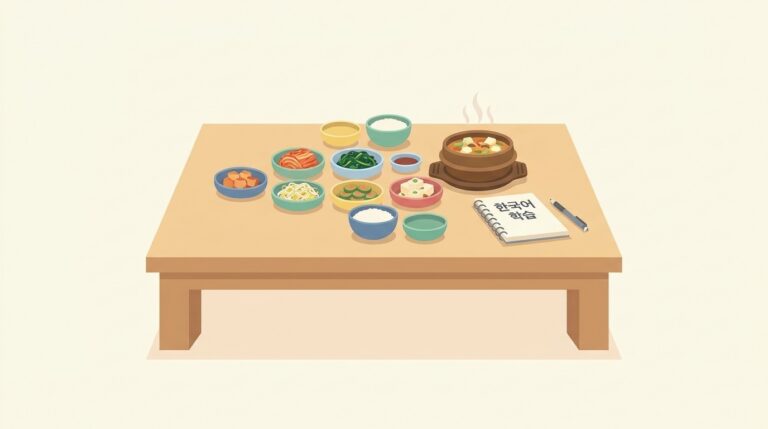
Phase 1: Empathy (Story-Driven Opening)
안녕하세요! 매일한글 에디터입니다. (Hello! This is your Daily Hangul editor.)
Picture this: you have just stepped off the KTX train in Gangneung or landed at Jeju Airport. The sea breeze greets you, your suitcase wheels clatter across the platform, and your stomach announces that it is officially lunch hour. You open your notes app where you drafted your travel itinerary, but suddenly you hit a wall. Back in Seoul, pointing at English picture menus or grabbing a quick kimbap at a convenience store was easy. But out here in regional Korea—surrounded by bustling markets and handwritten signs advertising dishes you have never seen on trendy social media feeds—a wave of panic sets in.
Have you ever watched travel variety shows like 2 Days & 1 Night or travel vlogs where Korean celebrities walk into a quiet seaside alley, ask a grandmother cook for their specialty, and receive a table overflowing with dishes found nowhere else in the world? You want that exact authentic experience! Yet, when stepping toward the door, you freeze. How do you propose going to a local spot instead of a tourist trap? How do you ask for regional dishes without sounding like a robotic translation app?
Take a deep breath! As someone who has navigated every province in South Korea with curious international travelers for over ten years, I assure you that ordering regional food is one of the quickest ways to win a local’s heart. Today, we will master simple, friendly A2-level Korean expressions so you can confidently say: “For lunch, let’s try local specialties you can only eat in that region!”
Phase 2: Top 3 Core Expressions
1. 점심에는 여기서만 먹을 수 있는 거 먹어요! (Jeomsim-eneun yeogiseoman meogeul su inneun geo meogeoyo!)
- Pronunciation: [Jeom-shim-eh-neun yeo-gi-seo-man meo-geul soo in-neun geo meo-geo-yo!] (Sounds like: “Jum-shee-meh-noon” with a gentle lift on “geo meogeoyo”)
- Meaning: Literal: “For lunch, let’s eat something that can be eaten only here!” | Nuance: “Since we are here, let’s get a dish exclusive to this place!”
- K-Culture Moment: The classic line said by your Korean travel partner the moment you arrive in Jeju or Gyeongju right around 12:30 PM.
- Editor’s Insight: The particle -만 (-man) means “only/exclusively,” and 먹을 수 있는 거 (meogeul su inneun geo) simplifies “things one can eat” into natural conversational Korean.
- Situation Spectrum:
- Casual (Friends): ✅
- Semi-formal (Travel buddy/Polite colleague): ✅
- Formal (Official business partner): ⚠️ (Use: 점심에는 이 지역 특색 음식을 드시러 가시죠)
- 🤔 Think About It: In many Western cultures, convenience often dictates lunch on busy travel days. In Korea, missing a town’s signature lunch feels like missing half the journey. What does prioritizing regional food tell us about how Koreans celebrate geography?
2. 이 지역 대표 음식이 뭐예요? (I jiyeok daepyo eumsigi mwoyeyo?)
- Pronunciation: [Ee jee-yeok dae-pyo eum-shee-gee mwo-ye-yo?]
- Meaning: Literal: “What is this region’s representative food?” | Nuance: “What is the signature dish around here?”
- K-Culture Moment: You walk up to a friendly guesthouse host or taxi driver in Gyeongju and ask where to eat.
- Editor’s Insight: 대표 (Daepyo) literally means “representative.” Pairing it with 음식 (eumsik) immediately flags to locals that you want authentic heritage food, not just another pizza chain.
- Situation Spectrum:
- Casual: ⚠️ (Drop ‘-yo’ for close peers: 이 지역 대표 음식이 뭐야?)
- Semi-formal (Taxi drivers, locals, servers): ✅
- Formal: ✅
- 🤔 Think About It: Notice how Koreans use 대표 (representative) instead of just asking “What tastes good?” It connects food directly to civic pride.
3. 강릉에 왔으니까 순두부 먹어 봐야죠! (Gangneung-e wasseunikka sundubu meogeo bwayajyo!)
- Pronunciation: [Gang-neung-eh wah-sseu-nee-kka soon-doo-boo meo-geo bwah-yah-jyo!]
- Meaning: Literal: “Since we came to Gangneung, we ought to try soft tofu!” | Nuance: “We came all the way to Gangneung—trying the soft tofu is an absolute must!”
- K-Culture Moment: A line echoed by every Korean variety show cast member standing in the Chodang Tofu Village pine forest.
- Editor’s Insight: The grammar ending -아/어 봐야죠 (-a/eo bwayajyo) combines “should try doing” with “of course/naturally.” Swap out the city and dish freely (e.g., 제주도에 왔으니까 흑돼지 먹어 봐야죠! – Since we came to Jeju, we must try black pork!).
- Situation Spectrum:
- Casual: ✅
- Semi-formal: ✅
- Formal: ⚠️
- 🤔 Think About It: Why is it common in Korea to connect a city’s name immediately with a food rather than a monument or museum?
Phase 3: Textbook Korean vs. Real-Life Korean
Situation 1: Asking a local what the city is famous for
- 📖 교과서 한국어 (Textbook): 이 고장의 특산물은 무엇입니까? (I gojang-ui teuksanmureun mueosimnikka? – What are the agricultural/local products of this town?)
- 🗣️ 진짜 한국어 (Real-Life): 여기 오면 보통 뭐 먹어요? (Yeogi omyeon botong mwo meogeoyo? – When people come here, what do they usually eat?)
- 💡 왜 다를까? (Why the difference?): Words like 고장 (hometown/region) and 특산물 (specialty crop/product) sound like a government geography exam. Asking “여기 오면 보통 뭐 먹어요?” is warm, conversational, and invites people to share their personal favorites.
Situation 2: Suggesting an authentic eatery instead of a chain
- 📖 교과서 한국어 (Textbook): 프랜차이즈 식당 말고 향토 요리점에 갑시다. (Peuraenchaijeu sikdang malgo hyangto yorijeome gapsida. – Let us go to a regional cuisine restaurant instead of a franchise.)
- 🗣️ 진짜 한국어 (Real-Life): 우리 체인점 말고 현지인 맛집 가요! (Uri cheinjeom malgo hyeonji-in matjip gayo! – Let’s skip the chains and hit a local insider spot!)
- 💡 왜 다를까? (Why the difference?): Young Koreans and travelers love the term 현지인 맛집 (hyeonji-in matjip)—meaning a restaurant cherished by actual neighborhood residents rather than hyped on tourist blogs.
Phase 4: K-Culture Deep Dive & Non-Verbal Manners
4-1. 눈치 (Nunchi) & Gestures at Regional Restaurants
When you enter an authentic regional spot—often run by an energetic older owner referred to as 이모님 (imonim – auntie) or 사장님 (sajangnim – boss)—take note of how people order:
* The Glance-Around (Nunchi Table Scan): Before sitting down, cast a subtle glance at other tables. If 9 out of 10 tables have a sizzling iron plate or a specific stew bubbling in an earthenware pot (뚝배기, ttukbaegi), that is your answer. You do not even need a menu!
* Polite Two-Handed Ordering: When pointing to a regional dish on a wall-mounted board, use an open palm facing upward rather than an index finger point, accompanied by a polite mini-nod.
* Portion Awareness: Regional specialties like Galchi-jorim (braised hairtail fish in Jeju) or Dakgalbi (spicy chicken) are often ordered by person counts (e.g., “2인분 주세요” – Two servings, please). Look for “2인 이상” (minimum 2 orders) on the menu board.
4-2. Cultural Code: 식도락 (Sikdorak) & Local Identity
In South Korea, travel is practically synonymous with 식도락 여행 (sikdorak yeohaeng – culinary travel). Historically, Korea’s mountainous geography separated regions naturally, creating wildly distinct culinary pockets within just a two-hour drive:
* Gangneung: Defined by clean ocean seawater used to curdle tofu at Chodang Village, plus spicy seafood noodles (Jjamppong sundubu).
* Jeju Island: Famous for pasture-raised black pork (Heukdwaeji), sea urchin noodle soup (Seongsan guksu), and buckwheat noodles.
* Gyeongju: Preserves royal and agricultural heritage through lavish vegetable wraps (Ssambap) and ancient royal banquet side-dish traditions.
Choosing a local dish isn’t just about feeding your stomach; it is an act of showing respect to the unique history of that soil.
Phase 5: Real-Life Roleplay Scenario
Setting: Outside a cozy, slate-roofed diner in Gangneung. Alex (learner) and Min-jun (local friend) are looking at a whiteboard menu.
- Min-jun: Alex, 벌써 12시 반이에요. 배고프죠? (Alex, beolsseo yeol-dusi ban-ieyo. Baegopeujyo? / Alex, it’s already 12:30. Hungry, right?)
- Alex:
🎭 Touching stomach and nodding enthusiastically네, 진짜 배고파요! 점심 뭐 먹을까요? (Ne, jinjja baegopayo! Jeomsim mwo meogeulkkayo? / Yes, I’m really hungry! What should we eat for lunch?) - Min-jun: 저기 햄버거 가게도 있고 순두부 식당도 있어요. (Jeogi haembeogeo gagedo itgo sundubu sikdangdo isseoyo. / There’s a burger joint over there, and a soft tofu restaurant right here.)
- Alex:
🎭 Pointing gently toward the soft tofu shop with a bright smile강릉에 왔으니까 순두부 먹어 봐야죠! (Gangneung-e wasseunikka sundubu meogeo bwayajyo! / Since we came to Gangneung, we have to try soft tofu!) - Min-jun: 좋아요! 점심에는 여기서만 먹을 수 있는 거 먹어야 제맛이죠. (Joayo! Jeomsim-eneun yeogiseoman meogeul su inneun geo meogeoya jemasijo. / Great! For lunch, eating something you can only eat here is the real deal.)
- Alex:
🎭 Stepping into the restaurant and making polite eye contact with the owner사장님, 여기 제일 유명한 게 뭐예요? (Sajangnim, yeogi jeil yumyeonghan ge mwoyeyo? / Boss, what is the most famous dish here?) - Owner: 우리 집은 짬뽕순두부가 제일 잘나가요! (Uri jibeun jjamppong sundubuga jeil jalnagayo! / Our Spicy Seafood Soft Tofu is the biggest hit!)
- Alex:
🎭 Giving a cheerful nod그럼 그거 2인분 주세요! (Geureom geugeo i-inbun juseyo! / Then please give us two orders of that!)
🔀 Interactive Branch Point: How do you ask for non-spicy options?
The owner mentions 짬뽕순두부, but you cannot handle fiery red soup! What do you say?
- Choice A: 매운 거 못 먹는데, 하얀 순두부도 있어요? (Maeun geo mot meongneunde, hayan sundubudo isseoyo? – I can’t eat spicy food; do you also have mild white soft tofu?)
- 👉 Feedback: [BEST!] Polite, honest, and uses the natural Korean phrase 하얀 (white) to refer to clear, mild broths. The owner will gladly serve the traditional mild version.
- Choice B: 안 매운 것 주세요. (An maeun geot juseyo. – Give me not spicy thing.)
- 👉 Feedback: [BAD] While grammatically understandable, it sounds blunt and slightly demanding without the polite background explanation (못 먹어서…).
- Choice C: 그냥 물 주세요. (Geunyang mul juseyo. – Just give me water.)
- 👉 Feedback: [RISK] You might starve while your friend eats! Never be shy to ask for a non-spicy variation (덜 맵게 해주세요 – Please make it less spicy).
Phase 6: 10-Second Emotion Shadowing Drill
Practice these lines out loud! Follow the rhythm pauses marked by / and channel the emotion tags:
[😊 excited and determined]
점심에는 / 여기서만 먹을 수 있는 거 / 먹어요!
(Jeomsim-eneun / yeogiseoman meogeul su inneun geo / meogeoyo!)-
[🤔 curious and bright]
이 지역 / 대표 음식이 / 뭐예요?
(I jiyeok / daepyo eumsigi / mwoyeyo?) -
[😋 enthusiastic recommendation]
제주도에 왔으니까 / 흑돼지 / 먹어 봐야죠!
(Jejudoe wasseunikka / heukdwaeji / meogeo bwayajyo!)
Phase 7: K-Culture Mini Dictionary
-
향토 음식 (Hyangto eumsik)
- Meaning: Regional specialty / Traditional local cuisine.
- Real-life use: Used in travel pamphlets, TV culinary shows, and high-end restaurant descriptions to highlight heritage recipes.
- 현지인 맛집 (Hyeonji-in matjip)
- Meaning: A genuine local favorite spot (not an overhyped tourist trap).
- Real-life use: Type this exact term into Korean map apps along with your destination (e.g.,
경주 현지인 맛집) to find places loved by real residents.
- 1인 1메뉴 (Ir-in il-menyu)
- Meaning: “One dish per person” ordering policy.
- Real-life use: Almost all sit-down specialty restaurants outside Seoul post this sign. If two people sit down, you must order at least two meals or portions.
- 밑반찬 (Mitbanchan)
- Meaning: Complimentary side dishes served with a Korean meal.
- Real-life use: In regions like Jeolla-do or Gyeongju, ordering one stew often summons 8 to 15 small plates for free! If you want a refill, say: “반찬 좀 더 주세요” (Banchan jom deo juseyo).
Phase 8: Traveler’s Survival Kit
Survival Expressions TOP 3
- “여기 뭐가 제일 맛있어요?” (Yeogi mwoga jeil masisseoyo?)
- Translation: What tastes best here?
- Pro Tip: Use this when the menu is long and written only in Korean calligraphy on wooden boards.
- “이거 2인분부터 돼요?” (Igeo i-inbun-buteo dwaeyo?)
- Translation: Is this dish available only for two or more servings?
- Pro Tip: Vital when solo traveling, as many famous stews require minimum 2-person tables.
- “덜 맵게 해 주실 수 있어요?” (Deol maepge hae jusil su isseoyo?)
- Translation: Could you please make it less spicy?
- Pro Tip: Say this with a warm smile when ordering spicy seafood tofu or stir-fries.
Editor’s Travel Note
- Navigation Hack: Forget generic search engines when tracking down authentic food. Download the Naver Map app on iOS and Android and search keywords like
강릉 향토 음식or제주 현지인 식당. Look for high review counts from visitors writing in Korean. - Cash & Cards: Virtually all restaurants in Gangneung, Gyeongju, and Jeju accept foreign credit cards, but keeping 10,000 KRW in cash is helpful if you want to sample street food snacks at traditional markets!
Phase 9: One Step Deeper (Thinking Question)
In Korean culinary culture, food is deeply tied to 정 (Jeong – affectionate bonding) and geographical geography (신토불이 – our body and our native soil are one). When Koreans insist on eating soft tofu in Gangneung or bibimbap in Jeonju, it is not simply about tasting ingredients; it is a ritual of absorbing the atmosphere, soil, and living history of that community through lunch.
💬 Your Turn: If a Korean friend visited your hometown or country for just one single afternoon, what is that one local specialty you would insist they eat for lunch? Share your answers in the comments using the pattern: “[Your Town]에 왔으니까 [Food Name] 먹어 봐야죠!”
Phase 10: FAQ & Common Mistakes
Q: Can I order just one portion of regional specialties if I travel alone?
A: Many regional foods (like Heukdwaeji BBQ in Jeju or Ssambap sets in Gyeongju) have a strict 2-portion minimum (2인분 이상). However, if you travel solo, you can politely offer to pay for 2 portions (“혼자인데 2인분 시켜도 될까요?”) or search for 혼밥 맛집 (solo dining gems).
Q: What is the polite way to get the server’s attention in a noisy regional restaurant?
A: Avoid shouting or waving wildly. First look for a small call bell button (호출벨) on the corner of your wooden table. If there isn’t one, make gentle eye contact and call out: “사장님!” (Sajangnim! / Boss!) or “저기요!” (Jeogiyo! / Excuse me!) at medium volume.
Q: How do I know if side dishes are refillable?
A: Almost all standard vegetable and kimchi side dishes (밑반찬) are complimentary and refillable! If there is a stainless steel counter with dishes labeled 셀프바 (Self-bar), grab your own refills. If not, ask the staff nicely.
🚨 Common Mistakes Alert!
- Mistake 1: Confusing “특산물” with “향토 음식” in casual conversation.
- Wrong: “여기 특산물 먹으러 가요!” (Sounds like you want to buy raw garlic bulbs or raw dried squid.)
- Correct Action: Say “여기 향토 음식 먹으러 가요!” or “여기 맛있는 거 먹으러 가요!”
- Mistake 2: Leaving out the particle ‘-만 (-man)’ when emphasizing uniqueness.
- Wrong: “여기서 먹을 수 있는 거 먹어요.” (Let’s eat things we can eat here – lacks punch.)
- Correct Action: Say “여기서’만’ 먹을 수 있는 거 먹어요!” (The ‘-man’ adds that critical nuance of “exclusively here”!)
- Mistake 3: Forgetting to specify portion numbers.
- Wrong: Just pointing and saying “이거 주세요” for shared stews.
- Correct Action: State the headcount clearly: “이거 2인분 주세요” (Two portions of this, please).
Phase 11: Action Mission & Engagement
Put your learning to work right now with these three missions:
- 🥉 Bronze Mission (Solo Shadowing): Stand in front of your mirror and practice saying: “점심에는 여기서만 먹을 수 있는 거 먹어요!” with a confident, joyful smile 3 times.
- 🥈 Silver Mission (Social Share): Pick your favorite regional Korean city (Jeju, Gangneung, or Gyeongju). Post a photo on your Instagram Story or study notes with the caption: “[City Name]에 왔으니까 [Food] 먹어 봐야죠!”
- 🥇 Gold Mission (Real-World Use): Visit a Korean restaurant in your area or on your next trip to Korea. Don’t look at the English menu—ask the server directly: “여기 제일 유명한 게 뭐예요?”
🎮 K-Culture Mission: Watch any episode of a Korean travel variety show (such as Earth Arcade or 2 Days & 1 Night). Listen closely when the cast stops for lunch. Did you hear the word 유명한 (famous) or the suffix -먹어 봐야죠 (-have to try)? Note the exact timestamp!
Phase 12: Interactive Quiz Challenge
Test your skills before packing your bags!
1. Situational Choice: You and your travel friend arrive in Jeju Island at 1:00 PM. You want to persuade them to eat famous Jeju black pork instead of fast food. What is the most natural sentence?
* (A) 빨리 빵이나 먹읍시다.
* (B) 제주도에 왔으니까 흑돼지 먹어 봐야죠!
* (C) 여기서 외국 음식만 먹을 수 있어요.
2. Fill-in-the-Blank: Complete the sentence to ask for the signature dish:
* 이 지역 ( ) 음식이 뭐예요? [Hint: Representative / signature]
3. True or False: In Korea, asking a restaurant owner “여기 제일 유명한 게 뭐예요?” is considered impolite because it implies you didn’t read their menu board.
* (True / False)
🔍 Click to reveal answers and explanations
Answers:
1. (B) 제주도에 왔으니까 흑돼지 먹어 봐야죠! (Perfect application of “Since we came to [Region], we must try [Dish]!”)
2. 대표 (daepyo) (Creates “대표 음식” – regional signature dish).
3. False! (Restaurant owners love this question! It signals that you trust their culinary skill and pride in their signature recipes.)







