

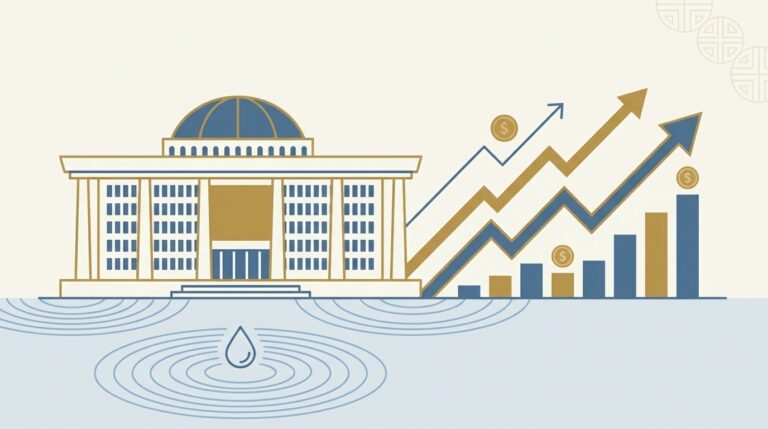
Phase 1: 공감 (Story-driven Opening)
안녕하세요! 매일한글 에디터입니다.
Imagine sitting across from your Korean colleagues at a high-stakes strategy dinner in Yeouido, Seoul’s Wall Street. The conversation shifts from casual office banter to the headlines flashing on the wall-mounted television: a fierce National Assembly debate on whether to pass a multi-trillion won supplementary budget. A senior director looks over his glass of somaek and sighs, “결국 민간 소비가 얼어붙었는데 정부가 손 놓고 있을 수는 없잖아요? (Gyeolguk mingan sobiga eoreobuteonneunde jeongbuga son noko isseul suneun eopjanayo? / In the end, private consumption is frozen—the government can’t just sit idly by, can it?)” You want to weigh in with a nuanced point about Keynesian stimulus versus fiscal sustainability, but your mind races through textbook vocabulary. You know the word for “money” and “government,” but how do educated Korean native speakers articulate the concept of “priming the pump” or “economic multiplier effects” without sounding like an automated translation tool?
Many advanced Korean learners face a frustrating wall at the C1 level: you can debate daily topics with ease, yet boardroom economics and public policy discourse feel impossibly dense. This masterclass is designed directly from our editorial clinic’s real-world professional coaching sessions. Today, we bridge the gap between high-level macroeconomic theory and the vivid, metaphorical idioms Korean professionals actually use to articulate expansionary finance.
Phase 2: 핵심 표현 3선 심층 분석 (Deep Dive: 3 Essential Expressions)
1. 마중물이 되다 (Majeungmuri doeda)
- Pronunciation: [Majeungmuri doeda] (Sounds like mah-joong-moo-ree dweh-dah)
- Meaning: Literally “to become the priming water poured into a manual pump to draw up groundwater”; metaphorically “to act as a catalyst or pump-priming expenditure.”
- K-Culture Moment: In political dramas like JTBC’s Chief of Staff (보좌관), whenever legislators fight over regional development funds or startup subsidies, the finance committee invariably declares: “이번 추경안이 침체된 지역 경제의 마중물이 되어야 합니다 (Ibeon chugyeong-ani chimchedwoen jiyeok gyeongje-ui majeungmuri doe-eoya hamnida / This supplementary budget must serve as the pump primer for the depressed regional economy).”
- Editor’s Insight: English speakers often rely on abstract loanwords like “촉매제 (catalyst),” but Koreans instinctively gravitate toward the rustic, agrarian image of “마중물 (majeungmul)”—water sent out to greet new water. Using this shows an exceptional grasp of native metaphorical nuance.
- Situation Spectrum: Casual: ⚠️ | Semi-formal: ✅ | Formal: ✅
- 🤔 Think About It: Why does a hyper-modern economy like Korea preserve traditional agrarian metaphors in state-level fiscal debates? What does this reveal about how history shapes modern business speech?
2. 민간 수요가 얼어붙다 (Mingan suyoga eoreobutda)
- Pronunciation: [Min-gan su-yo-ga eo-reo-but-da] (Think of mean-gahn soo-yo-gah uh-ruh-boot-dah)
- Meaning: Literally “private demand freezes tight”; contextually “consumer and private-sector spending grinds to a complete standstill.”
- K-Culture Moment: Seen regularly on prime-time news reports (like SBS 8 News) during recessions: “고금리 기조 속에 민간 수요가 완전히 얼어붙었습니다 (Gogeumri gijo soge mingan suyoga wanjeonhi eoreobuteotseumnida / Amid elevated interest rates, private domestic demand has completely frozen over).”
- Editor’s Insight: Instead of the bland “수요가 감소하다 (demand decreases),” “얼어붙다 (to freeze solid)” paints a vivid tactile picture of market paralysis. It evokes an image of money refusing to circulate through the economic bloodstream.
- Situation Spectrum: Casual: ⚠️ | Semi-formal: ✅ | Formal: ✅
- 🤔 Think About It: Notice how Korean financial media frequently utilizes temperature metaphors (얼어붙다, 과열되다, 훈풍이 불다) rather than merely numerical descriptions. How does your native language personify market stagnation?
3. 승수 효과를 내다 (Seungsu hyogwareul naeda)
- Pronunciation: [Seung-su hyo-gwa-reul nae-da] (Pronounced like sung-soo hyo-gwah-reul neh-dah)
- Meaning: “To yield a fiscal multiplier effect”; turning an initial public investment into compound economic output.
- K-Culture Moment: Frequently debated by economic panelists on current affairs shows like 100-Minute Discussion (100분 토론) when comparing tax cuts versus cash vouchers.
- Editor’s Insight: The verb “내다 (to produce/bring forth)” pairs naturally with “효과 (effect).” In high-level debates, combining this with conditional connectors like “~어야 승수 효과를 냅니다” shows that you are proposing a rigorous strategic prerequisite, not just wishing for results.
- Situation Spectrum: Casual: 🚫 | Semi-formal: ✅ | Formal: ✅
- 🤔 Think About It: Contrast the pragmatic optimism of “승수 효과를 내다” with more passive structures. How does phrasing determine authority in policy meetings?
Phase 3: 교과서 한국어 vs 진짜 한국어 (Textbook vs. Real Native Korean)
Situation 1: Arguing that the government must spend during a recession
- 📖 교과서 한국어: 정부는 지출을 증가시켜 경제를 회복시켜야 합니다. (Jeongbuneun jichureul jeunggasikyeo gyeongjereul hoeboksikyeoya hamnida. / The government must increase expenditure to restore the economy.)
- 🗣️ 진짜 한국어: 지금처럼 내수가 꽁꽁 묶였을 땐, 정부 재정이 마중물 역할을 해서 숨통을 틔워 줘야죠. (Jigeumcheoreom naesuga kkongkkong mukyeosseul ttaen, jeongbu jaejeongi majeungmul yeokhaleul haeseo sumtong-eul tiwo jwoyajo. / When domestic demand is frozen solid like this, government fiscal spending has to act as the pump primer to give the market room to breathe.)
- 💡 왜 다를까?: Native economic policy professionals rarely use robotic phrases like “지출을 증가시키다.” They employ organic metaphors like “숨통을 틔우다 (to clear the breathing pipe/provide breathing room)” alongside “마중물,” making the argument emotionally persuasive and culturally grounded.
Situation 2: Cautioning against runaway public debt
- 📖 교과서 한국어: 과도한 재정 지출은 국가 부채를 증가시킬 수 있습니다. (Gwadohan jaejeong jichureun gukga buchaereul jeunggasikil su itseumnida. / Excessive fiscal spending can increase the national debt.)
- 🗣️ 진짜 한국어: 무턱대고 곳간을 열다간, 나중에 감당 못 할 빚더미에 앉게 될 수도 있어요. (Muteokdaego gotganeul yeoldagan, najunge gamdang mot hal bitdeomie antge doel sudo isseoyo. / If we blindly fling open the national storehouse now, we might end up sitting on an unmanageable mountain of debt down the line.)
- 💡 왜 다를까?: Educated Koreans refer to national fiscal reserves using the evocative traditional term “곳간 (storehouse/granary).” The imagery of “곳간을 열다” (opening the storehouse) and “빚더미에 앉다” (sitting atop a heap of debt) cuts deeper than academic jargon.
Phase 4: K-Culture 딥다이브 & 비언어적 매너 (Non-Verbal Nuance & Cultural Code)
4-1. 눈치 (Nunchi) & Professional Body Language
When debating fiscal policy with Korean colleagues, direct confrontation is perceived as crude and aggressive. To voice a dissenting Keynesian or fiscal hawk stance:
* The Reflective Pause & Head Tilt: Before offering a counterpoint, tilt your head slightly and nod slowly while uttering a soft filler: “말씀하신 취지는 충분히 공감합니다만… (Malsseumhasin chwijineun chungbunhi gonggamhamnidaman… / I fully sympathize with the intent of your point, however…).”
* Softening Pronouncements: Avoid absolute declaratives like “틀렸습니다 (You are wrong).” Frame your assertion through the sophisticated C1 pattern “~다고 봐요 (I view it as…)” or “~지 않을까 싶습니다 (I wonder if it might not be…)”. This displays impeccable nunchi, asserting intellectual authority while preserving collective harmony.
4-2. Cultural Code: The Trauma of 1997 & “곳간 지키기”
To truly understand Korean fiscal policy debates, one must understand the 1997 Asian Financial Crisis (known domestically simply as “IMF 사태”). Korea experienced the collapse of major conglomerates, widespread layoffs, and sovereign humiliation. Consequently, fiscal conservatism—maintaining an ultra-healthy national debt-to-GDP ratio—is deeply etched into the collective psyche as an existential survival instinct. When progressives propose expansionary fiscal policies (“확장 재정”), conservatives counter with fiscal rectitude (“건전 재정”). Using the phrase “곳간을 지키다 (guarding the national granary)” immediately resonates with this historical vulnerability.
Phase 5: 실전 롤플레이 시나리오 (Boardroom Roleplay Scenario)
Setting: A conference room at the Government Complex Sejong (정부세종청사). A policy research unit under the Ministry of Economy and Finance is reviewing the next quarter’s fiscal guidelines.
Characters:
* Deputy Director Kang Ji-won (강지원 사무관): A rigorous fiscal conservative worried about bond yields.
* Senior Fellow Alex (당신 / 알렉스 연구원): An insightful macroeconomic consultant advocating expansionary intervention.
Dialogues:
- 강지원: 알렉스 위원님, 세수 결손이 심각한 상황에서 또 추경을 편성하자는 건 지나친 모험 아닐까요?
(Kang Ji-won: Alex wiwon-nim, sesu gyeolsoni simgak-han sanghwang-eseo tto chugyeong-eul pyeonseong-hajaneun geon jinachin mo-heom anilkkayo?)
[English: Senior Fellow Alex, with tax revenues falling significantly short, isn’t proposing another supplementary budget an excessive gamble?]
🎭 표정을 진지하게 굳히며 서류를 내려놓는다 (Sets down the papers with a grave expression) -
알렉스: 재정 건전성에 대한 우려는 십분 이해합니다. 하지만 지금은 비상시국입니다.
(Alex: Jaejeong geonjeonseong-e daehan uryeoneun sipbun ihaehamnida. Hajimeun jigeumeun bisangsikuk-imnida.)
[English: I completely understand your concerns regarding fiscal soundness. However, we are facing extraordinary circumstances right now.]
🎭 차분하게 눈을 맞추며 고개를 가볍게 끄덕인다 (Maintains steady eye contact with a gentle nod) -
강지원: 비상시국일수록 정부가 허리띠를 졸라매야 시장에 신뢰를 줄 수 있지 않겠습니까?
(Kang Ji-won: Bisangsikuk-ilsurok jeongbuga heorittireul jollamaeya sijang-e sinroereul jul su itji anketseumnikka?)
[English: Especially in times of crisis, shouldn’t the government tighten its belt to signal fiscal credibility to the market?]
🎭 펜 끝으로 메모판을 톡톡 두드리며 반문한다 (Taps the memo pad lightly with the tip of his pen) -
알렉스: 확장 재정론은 민간 수요가 얼어붙었을 때 정부 지출이 승수 효과를 내는 마중물이 되어야 한다고 봐요.
(Alex: Hwakjang jaejeongnoneun mingan suyoga eoreobuteosseul ttae jeongbu jichuri seungsu hyogwareul naeneun majeungmuri doe-eoya handago bwayo.)
[English: Expansionary advocates argue public spending must prime the pump when private demand freezes to produce a multiplier effect.]
🎭 손바닥을 위로 펼치며 설득력 있는 어조로 설명한다 (Gestures palms upward with a persuasive tone) -
강지원: 하지만 그 지출이 단순한 일회성 소비 쿠폰으로 증발해 버린다면요?
(Kang Ji-won: Hajiman geu jichuri dansunhan ilhoeseong sobi kupon-euro jeungbalhae beorindamyeon-yo?)
[English: But what if that expenditure simply evaporates into one-off consumption vouchers?]
🎭 팔짱을 끼며 의구심을 표한다 (Crosses arms with a skeptical gaze) -
알렉스: 바로 그렇기 때문에 R&D와 신산업 인프라에 집중 투자해 승수 효과를 극대화하자는 겁니다.
(Alex: Baro geureoki ttaemune Al-en-di-wa sinsaneop inpeura-e jipjung tujahae seungsu hyogwareul geukdaehwahajaneun geomnida.)
[English: That is precisely why we must concentrate investments into R&D and frontier infrastructure to maximize the multiplier effect.]
🎭 핵심 정책 슬라이드를 가리키며 단호하게 말한다 (Points firmly at the core policy slide) -
강지원: 흠… 미래 성장 동력을 위한 타깃형 투자라면 기재부 내부에서도 설득력이 있겠네요.
(Kang Ji-won: Heum… mirae seongjang dongryeog-eul wihan tagit-hyeong tujaramyeon Gijaebu naebueseodo seoldeungnyeogi itgenneyo.)
[English: Hmm… If it is targeted investment for future growth drivers, that could gain traction even within the Ministry of Finance.]
🎭 안경을 고쳐 쓰며 보고서를 다시 꼼꼼히 살핀다 (Adjusts glasses and scrutinizes the report afresh) -
알렉스: 맞습니다. 곳간을 꽁꽁 닫아두는 것만이 능사가 아니라, 생산적인 마중물을 부어야 할 때입니다.
(Alex: Matseumnida. Gotganeul kkongkkong dadaduneun geonmani neungsa-ga anira, saengsanjeogin majeungmureul bueoya hal ttae-imnida.)
[English: Precisely. Simply bolting the storehouse shut is not a panacea; it is time to pour productive priming water.]
🎭 온화하면서도 확신에 찬 미소를 짓는다 (Smiles warmly yet with resolute conviction)
🔀 인터랙티브 분기점 (Interactive Decision Point)
At Turn 4, if Kang Ji-won pushes back hard, how should you frame your counterargument?
- Option A: “사무관님 논리는 너무 구시대적이에요. 케인스 경제학 다시 공부하고 오세요! (Your logic is outdated. Go study Keynesian economics again!)”
- Feedback: 🚫 Bad: Instant career hazard. Destroys personal rapport and violates hierarchical etiquette.
- Option B: “맞는 말씀입니다. 그럼 그냥 예산을 전부 삭감하고 지켜보죠. (You are right. Let us just slash the entire budget and wait.)”
- Feedback: ⚠️ Risk: Passive-aggressive. Shows a lack of professional tenacity and conviction in policy advisory.
- Option C: “말씀하신 재정 건전성 우려도 일리 있습니다만, 지금 투자를 실기하면 미래 세수 기반 자체가 무너질 위험이 있습니다. (Your concern over fiscal sustainability is well taken; however, if we miss the window to invest now, we risk eroding the very tax revenue base of future generations.)”
- Feedback: ✅ Best: A masterclass in C1 rhetoric. Validates the counterpart’s concern while introducing the sophisticated concept of “실기하다 (to miss the opportune window of time).”
Phase 6: 10초 감정 섀도잉 드릴 (10-Second Shadowing Drill)
Master the subtle cadence, breathing, and pacing of Korean professional argumentation. Follow the slash markers / for natural pauses.
[🧐 진중하고 논리적으로 / Thoughtful and Analytical]
확장 재정론은 / 민간 수요가 얼어붙었을 때 / 정부 지출이 승수 효과를 내는 / 마중물이 되어야 한다고 봐요.
(Hwakjang jaejeongnoneun / mingan suyoga eoreobuteosseul ttae / jeongbu jichuri seungsu hyogwareul naeneun / majeungmuri doe-eoya handago bwayo.)-
[🤝 상대의 우려를 존중하며 / Empathetic yet Firm]
재정 건전성도 중요하지만 / 지금처럼 내수가 침체되었을 때는 / 마중물 역할을 / 피할 수 없습니다.
(Jaejeong geonjeonseongdo jungyohajiman / jigeumcheoreom naesuga chimchedoe-eosseul ttaeneun / majeungmul yeokhaleul / pihal su eopseumnida.) -
[💼 확신에 차서 단호하게 / Resolute and Visionary]
곳간을 잠그는 것만이 능사가 아니라 / 적재적소에 재정을 투입해야 / 지속 가능한 성장이 가능합니다.
(Gotganeul jamgeuneun geonmani neungsaga anira / jeokjaejeoksoe jaejeong-eul tu-iphaeya / jisok ganeung-han seongjang-i ganeunghamnida.)
Phase 7: K-Culture 미니 사전 (Core Lexicon)
-
마중물 (Majeungmul) | Pump-priming water / Catalyst
Originally water poured into an empty hand-pump to restore hydraulic pressure. In business and policy, it designates catalytic seed capital, state funding, or strategic investments that unlock greater private capital. -
돈맥경화 (Donmaek-gyeonghwa) | Financial liquidity blockage
A brilliant portmanteau blending “돈 (money)” and “동맥경화 (arteriosclerosis)”. Used in high-level financial media to describe a credit crunch where funds sit idle in banks rather than circulating to businesses. -
숨통을 틔우다 (Sumtong-eul tiuda) | To provide breathing space / Relieve asphyxiation
An anatomical metaphor for reviving an economy, business, or household strangled by cash flow problems. Essential for policy pitches. -
승수 효과 (Seungsu hyogwa) | Multiplier effect
The economic principle where an initial incremental expenditure creates ripples of increased consumption and national income. Crucial for budget justification.
Phase 8: 전문가를 위한 생존 키트 (Survival Kit for Professionals)
Top 3 Boardroom Survival Expressions
- 시기상조입니다 (Sigi-sangjo-imnida)
Meaning: “It is premature.”
Pro Tip: Use this elegant four-character idiom (時機尙早) when politely blocking an unvetted fiscal measure without saying “I disagree.” - 실기(失期)해서는 안 됩니다 (Silgi-haeseoneun an doemnida)
Meaning: “We must not miss the opportune moment.”
Pro Tip: Combine this with expansionary arguments to emphasize that spending delayed is economic vitality lost. - 적재적소에 투입해야 합니다 (Jeokjae-jeoksoe tu-iphaeya hamnida)
Meaning: “It must be deployed in the right place at the right time.”
Pro Tip: The ultimate diplomatic compromise between fiscal hawks and doves.
Editor’s Travel & Research Note
Attending an academic symposium or economic conference at COEX or the Korea Development Institute (KDI)? Do not rely on generic search portals for official government statistics. Check the latest macroeconomic bulletins directly via the 한국은행 경제통계시스템 ECOS 웹사이트 to reference authoritative data on base interest rates, M2 liquidity, and household leverage.
Phase 9: “한 발 더 깊이” (Cultural Essay: The Balance of the State)
In Western economic traditions, discussions of fiscal stimulus frequently focus on individual utility, personal liberties, and mechanical Keynesian-Hayekian dialectics. In Korea, however, the state is historically conceived not as an indifferent referee, but as the patriarch of the collective economic household. When the public asks for fiscal intervention, they invoke the historic memory of state-led industrialization—where government guidance was the engine that built heavy industry out of post-war ruins. Yet simultaneously, the lingering memory of the 1997 foreign exchange crisis demands that the national household never overextend its credit. Thus, every fiscal debate in Korea is an emotional negotiation between the communal drive for renewal and the ancestral dread of bankruptcy.
💬 Your Turn: How does public discourse in your home country view the national debt? Is government spending seen as a creative “마중물 (pump primer)” or an unwelcome burden on future taxpayers? Share your perspective below!
Phase 10: FAQ & 오해 방지 (FAQ Schema & Common Pitfalls)
Q: Can I use “마중물 (majeungmul)” in everyday conversational Korean, or is it strictly economic jargon?
A: You can absolutely use it in personal life! For example, when introducing two shy friends at a networking mixer, you can say: “이 가벼운 대화가 두 분의 우정을 위한 마중물이 되었으면 좋겠네요 (I hope this light chat serves as a pump primer for your friendship).” It sounds remarkably poetic and articulate.
Q: What is the exact difference between “추경 (chugyeong)” and regular budget allocation?
A: “추경 (chugyeong)” is short for “추가경정예산 (Supplementary Budget).” It represents an emergency fiscal package assembled midway through a fiscal year to cope with unforeseen disasters, war, or severe economic recessions outside the regular annual budget cycle.
Q: Is “얼어붙다” only applied to demand (수요)?
A: Not at all! You will often hear Korean executives describe hiring freezes as “채용 시장이 얼어붙었다 (the job recruitment market has frozen over)” or geopolitical chill as “남북 관계가 얼어붙었다 (inter-Korean relations have frozen over).”
🚨 흔한 실수 (Common Mistakes) Board
- Mistake 1: Translating “pump-priming” as a mechanical loanword 펌프 프라이밍.
- Correct Action: Always substitute 마중물 (majeungmul). Native speakers will instantly recognize your command of idiomatic Korean.
- Mistake 2: Using informal endings like “~해야 돼요” during policy presentations.
- Correct Action: Upgrade to the C1-level professional conclusion “~되어야 마땅하다고 사료됩니다 (I consider it fitting that it should become…)” or “~해야 한다고 봅니다.”
- Mistake 3: Pronouncing 효과 (hyogwa) strictly as [hyo-gwa] in speech.
- Correct Action: While [hyo-gwa] is standard, most Korean native professionals and broadcast journalists pronounce it colloquially as [효꽈 (hyo-kkwa)]. Emphasizing the glottal sound conveys an authoritative spoken cadence.
Phase 11: 액션 미션 & 참여 유도 (Action Missions)
- 🥉 Bronze Mission (Solo Shadowing): Read the Phase 5 dialogue aloud 3 times, paying close attention to the breath pauses at each
/mark in Phase 6. - 🥈 Silver Mission (Social Sentence Construction): Write your own sentence analyzing your local city or favorite startup using the phrase “[Noun]이/가 마중물 역할을 해야 한다” and share it in the comments below.
- 🥇 Gold Mission (Media Immersion): Search YouTube for “기획재정부 브리핑 (Ministry of Economy and Finance Briefing)” or “100분 토론 확장 재정”. Listen for at least two of our four Phase 7 keywords being spoken live!
- 🎮 K-Culture Mission: Watch Episode 1 or 2 of the political drama Chief of Staff (보좌관) and identify how advisors bow their heads while delivering sharp analytical counterpoints.
Phase 12: 인터랙티브 퀴즈 챌린지 (Interactive Quiz)
1. 상황 판단 (Situational Judgment)
You are attending a quarterly board meeting. Consumer sentiment has plummeted, and domestic sales have stalled. You wish to propose an immediate marketing fund injection to kickstart sales. Which phrase is the most natural, persuasive, and professional?
- (A) 사장님, 우리 돈을 다 써서 물건을 강제로 팔아야 합니다.
- (B) 내수가 얼어붙은 상황에서, 이번 프로모션이 소비 심리를 되살릴 마중물이 되어야 합니다.
- (C) 지금은 돈맥경화니까 아무것도 하지 말고 곳간 문을 잠급시다.
2. 빈칸 채우기 (Fill in the Blank)
정부의 과감한 R&D 투자가 민간 기업의 혁신을 촉진하여 막대한 ( )를 낼 것으로 기대됩니다.
* Clue: A two-word phrase meaning “multiplier effect.”
3. True / False 문화 퀴즈
In Korean corporate and political settings, directly telling a senior counterpart “당신 생각은 틀렸습니다 (Your thinking is wrong)” during a fiscal policy disagreement is considered an admirable show of transparent leadership. (True / False)
정답 및 해설 확인하기 (Click for Answers & Explanations)
- 정답: (B)
해설: (B) uses the vivid metaphor “얼어붙은 상황 (frozen situation)” alongside “마중물이 되어야 합니다 (must serve as pump-priming),” balancing refined tone and persuasive urgency. (A) is overly blunt and ungrammatical; (C) advocates inaction. -
정답: 승수 효과 (or 승수 효과를)
해설: Combining “승수 효과 (seungsu hyogwa / multiplier effect)” with “내다” forms the standard professional colocation in economic planning. -
정답: False
해설: Direct negation violates professional nunchi and decorum. C1 speakers soften disagreement using framing formulas like “말씀하신 취지에는 공감합니다만… (While I sympathize with your intent…)” before offering an alternative proposal.






