

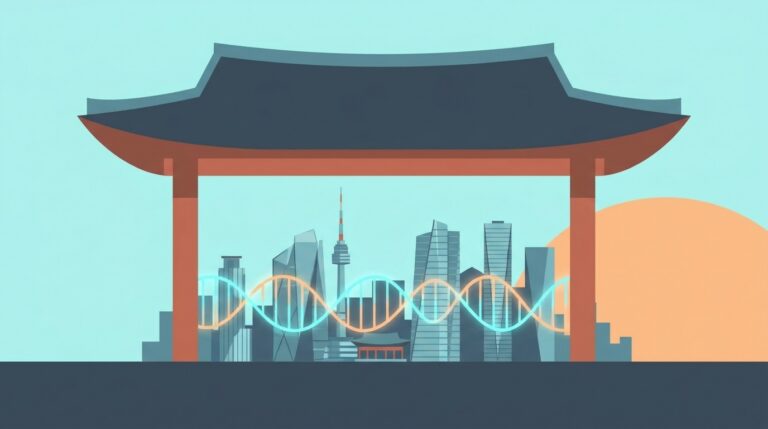
Beyond the Petri Dish: Debating Transhumanism and Genetic Inequality in C2 Korean
Phase 1: Empathy (스토리 몰입형 오프닝)
안녕하세요! It’s your Daily Hangul editor here! Have you ever sat through a late-night debate with Korean colleagues after screening Yeon Sang-ho’s sci-fi film Jung_E or discussing radical CRISPR anti-aging breakthroughs, only to find yourself tongue-tied when the conversation turned deeply philosophical?
You know the feeling: in your native English, you can effortlessly dissect transhumanist teleology, existential risk, and socio-economic divergence. But in Korean, you suddenly find yourself resorting to rudimentary phrases like 기술이 너무 빨라요 (Technology is too fast) or 부자들만 좋아요 (Only rich people like it). It feels frustratingly reductive, almost childish, especially when you are aiming for that sophisticated, academic C2 fluency.
Korea is one of the most hyper-connected, biologically forward-thinking nations on Earth—home to trailblazing stem cell research, advanced genomics in Pangyo, and aesthetic bio-enhancements in Gangnam. Yet, precisely because Korean society experienced compressed modernization (압축성장), debates surrounding technological hubris, genetic determinism, and “biological class divides” strike an intensely raw societal nerve. When transhumanism threatens to solidify social stratification from economic status into genetic heritage, Korean intellectual discourse reaches an unprecedented boiling point.
This guide was forged directly from real coaching sessions with advanced diplomacy scholars, tech ethicists, and expatriate executives in Seoul. By mastering the high-register idioms and socio-ethical vocabulary in this unit, you will no longer merely observe high-level symposiums or panel discussions—you will command them with nuance, elegance, and native-level gravity.
Phase 2: 핵심 표현 3선 심층 분석
Here are three indispensable C2-level expressions essential for articulating the bioethical and socio-philosophical tensions of human enhancement.
1. 유전적 계급 양극화 (Yujeonjeok gyegeup yanggeukhwa)
- Pronunciation: [Yu-jeon-jeok gye-geup yang-geuk-hwa] (Think of ‘Yu-jeon’ like ‘you-john’, ‘gye-geup’ like ‘kay-geup’, and ‘yang-geuk-hwa’ like the crisp clack of two polarized magnetic ends)
- Meaning: Genetic class polarization / biological caste stratification
- K-Culture Moment: Echoed in Korean media critiques of dystopian biotechnology, such as films exploring how gene-editing therapies become exclusive privileges of the top 0.01% chaebol tier.
- Editor’s Insight: While 양극화 (polarization) is frequently applied to wealth (소득 양극화), compounding it with 유전적 계급 (genetic class) elevates the discourse from routine economic disparity to an existential, irreversible biological caste system. It resonates directly with Korea’s infamous 수저론 (“Spoon Class Theory”), projecting it into human DNA.
- Situation Spectrum: Casual 🚫 | Semi-formal ⚠️ | Formal ✅
- 🤔 Think About It: Does your native tongue distinguish between mere socio-economic divergence and biological entrenchment as vividly as the Korean marriage of 계급 (class/caste) and 양극화 (polarization)?
2. 인간의 존엄성을 훼손하다 (In-gan-ui jon-eom-seong-eul hwe-son-ha-da)
- Pronunciation: [In-gan-ui jon-eom-seong-eul hwe-son-ha-da] (Pronounce ‘hwe-son’ sharply, rhyming with ‘way-sawn’, articulating the irreversible damage done to a sacred construct)
- Meaning: To compromise, violate, or undermine human dignity
- K-Culture Moment: Frequently invoked by bioethics committees at the National Assembly (국회) or during televised university debates when discussing the commodification of cloned consciousness.
- Editor’s Insight: Do not confuse 훼손하다 (to damage/deface an abstract or sacred value, or physical heritage) with ordinary verbs like 망치다 (to ruin) or 줄이다 (to reduce). Using 훼손하다 with 존엄성 (dignity) immediately signals philosophical maturity and constitutional gravity.
- Situation Spectrum: Casual 🚫 | Semi-formal ⚠️ | Formal ✅
- 🤔 Think About It: In Korean ethical debates, 존엄 carries Kantian undertones of an unconditional intrinsic end. How does violating this dignity reframe technology from a tool of liberation to an instrument of dehumanization?
3. 생명윤리의 마지노선을 넘나들다 (Saeng-myeong-yun-ri-ui ma-ji-no-seon-eul neom-na-deul-da)
- Pronunciation: [Saeng-myeong-yun-ri-ui ma-ji-no-seon-eul neom-na-deul-da] (Note the liquid ‘l’ assimilation in ‘yun-ri’ becoming [yul-li], followed by ‘ma-ji-no-seon’, derived from the historical Maginot Line)
- Meaning: To straddle or flirt with the ultimate non-negotiable boundaries of bioethics
- K-Culture Moment: Used by leading Korean science commentators when a biotech startup initiates experimental cognitive-enhancement trials that brush up against medical regulations.
- Editor’s Insight: 마지노선 (Maginot Line) signifies the absolute last line of defense. Paired with 넘나들다 (to repeatedly cross in and out), it depicts a precarious, morally risky endeavor that teeters on the brink of an ethical catastrophe rather than a clean transgression.
- Situation Spectrum: Casual ⚠️ | Semi-formal ✅ | Formal ✅
- 🤔 Think About It: Why has the military term “Maginot Line” become such a ubiquitous cognitive anchor in Korean intellectual rhetoric when marking moral boundaries?
Phase 3: 교과서 한국어 vs 진짜 한국어
Leveling up to C2 means trading functional sentence patterns for rhetoric that conveys ideological weight and socio-cultural cadence.
Situation 1: Arguing that genetic enhancement will entrench generational inequality
- 📖 교과서 한국어 (Textbook Style):
“유전자 치료 기술이 비싸지면 가난한 사람들은 이용할 수 없어서 불평등이 심해질 것입니다.”
(Yujeonja chiryo gisuri bissajimyeon gananhan saramdeureun iyonghal su eopseoseo bulpyeongdeungi simhaejil geosimnida. / If gene therapy technology is expensive, poor people cannot use it, so inequality will worsen.) - 🗣️ 진짜 한국어 (Authentic Elite Discourse):
“생물학적 증강 기술이 자본의 논리에 종속되는 순간, 유전자 맞춤형 신흥 귀족층이 등장하며 계급 고착화의 정점을 찍게 될 겁니다.”
(Saengmulhakjeok jeung-gang gisuri jabon-ui nolli-e jongsokdoeneun sungan, yujeonja matchumhyeong sinheung gwijokcheungi deungjanghamyeo gyegeup gochakhwa-ui jeongjeom-eul jjikge doel geomnida. / The moment biological enhancement technology is subordinated to the logic of capital, a new gene-customized aristocracy will emerge, marking the absolute zenith of class calcification.) - 💡 왜 다를까? (Why the Difference?): Advanced Korean thinkers rarely say “inequality gets worse.” Instead, they deploy socio-historic constructs like 계급 고착화 (class calcification) and 자본의 논리에 종속되다 (subordinated to the logic of capital) to highlight structural entrapment.
Situation 2: Emphasizing that unchecked human modification crosses a red line
- 📖 교과서 한국어 (Textbook Style):
“기술로 수명을 늘리는 것은 좋지만 윤리적인 문제를 깊이 생각해야 합니다.”
(Gisullo sumyeong-eul neullineun geoseun jochiman yunrijeogin munjereul gipi saenggakhaeya hamnida. / Extending lifespan with technology is good, but we must think deeply about ethical problems.) - 🗣️ 진짜 한국어 (Authentic Elite Discourse):
“무병장수라는 트랜스휴머니즘적 유혹에 매몰되어, 노화와 죽음이 지닌 실존적 가치와 인간성 본연의 마지노선을 간과해서는 안 됩니다.”
(Mubyeongjangsuraneun teuraenseuhyumeonijeumjeok yuhog-e maemoldoeeo, nohwa-wa jugeumi jinin siljonjeok gachi-wa inganseong bon-yeon-ui majinoseon-eul gang-gwahaeseoneun an doemnida. / Submerged in the transhumanist temptation of disease-free immortality, we must never overlook the existential value of aging and mortality, nor the fundamental red line of humanity.) - 💡 왜 다를까? (Why the Difference?): Native academic discourse integrates traditional idiomatic concepts like 무병장수 (long life without illness) with Western philosophical notions like 실존적 가치 (existential value), capturing both cultural legacy and high-level dialectic tension.
Phase 4: K-Culture 딥다이브 & 비언어적 매너
4-1. 눈치 (Nunchi) & Intellectual Non-Verbal Manners
When engaging in high-stakes ethical debates in Korea, intellectual aggression is perceived very differently than in Western adversarial rhetoric. While Western debaters often employ direct eye contact, sharp gesticulation, and immediate refutations, sophisticated Korean disputants practice 지적 겸양 (intellectual deference):
- The Angled Gaze & Temporal Pause: When launching a devastating counterargument regarding genetic class divide, do not lock dead-center eye contact immediately. Instead, drop your gaze slightly to your notes or hands for a split second, tilt your head slightly (approx. 5 degrees), and emit a muted 글쎄요, 위원님 말씀도 일리가 있습니다만… (Well, your perspective certainly holds merit, however…). This signals that you have processed their position through rigorous Nunchi before challenging them.
- Open-Palmed Restraint: Keep hand gestures low—below chest level. Use an open-palmed upward motion rather than pointing a finger (삿대질) or chopping the air when referencing ethical red lines (마지노선). Emotional detachment (평정심) is equated with moral authority.
4-2. Cultural Code Analysis: The Ghost of the “Spoon Theory” in Bio-Capitalism
Korea’s contemporary social critique is indelibly stamped by 수저 계급론 (“Spoon Class Theory”)—the deterministic despair that whether you hold a Gold Spoon (금수저) or Dirt Spoon (흙수저) dictates your trajectory from birth.
When transhumanist longevity tech and cognitive enhancements enter Korean discourse, they do not arrive as liberating cyberpunk fantasies. Rather, they ignite visceral panic that the Dirt Spoon status will become biologically permanent. If a wealthy family in Gangnam can purchase genomic cognitive enhancement and epigenetic rejuvenation for their children, social mobility (계층 사다리) is completely obliterated. Thus, discussing transhumanism in Korea inherently intersects with generational traumas of hyper-competition (입시 지옥), housing inequality, and corporate hereditary dominance (재벌 체제).
Phase 5: 실전 롤플레이 시나리오
Setting: A televised bioethics symposium at the Pangyo Global R&D Center in Gyeonggi-do.
NPC Character: Dr. Park Ji-min (박지민 박사), a fiercely articulate senior bioethicist advocating for strict state intervention against private cognitive enhancement.
- Turn 1 (Dr. Park):
🎭 자료집을 엄숙하게 넘기며 안경을 고쳐 쓴다.
“이번 민간 유전자 클리닉의 인지 능력 증강 패키지 출시는 명백히 생명윤리의 마지노선을 넘나드는 행태입니다.”
(Ibeon mingan yujeonja keullinik-ui inji neungnyeok jeung-gang paekkiji chulsineun myeongbaekhi saengmyeong-yunri-ui majinoseon-eul neomnadeuneun haengtaeimnida.)
“The release of private gene-clinic cognitive enhancement packages this time is an unequivocal flirtation with the red lines of bioethics.” -
Turn 2 (You):
🎭 고개를 부드럽게 끄덕이며 양손을 모은 채 차분하게 응수한다.
“박 박사님의 우려에 깊이 공감합니다. 하지만 이를 단순 규제만으로 막는다면, 오히려 암시장을 통한 유전적 계급 양극화가 가속화되지 않겠습니까?”
(Bak baksanim-ui uryeo-e gipi gong-gamhamnida. Hajiman ireul dansun gyujemaneuro mangneondamyeon, ohiryeo amsijang-eul tonghan yujeonjeok gyegeup yanggeukhwaga gaseokhwoedoeji anketseumnikka?)
“I share your profound concern, Dr. Park. However, if we suppress this solely through blunt regulation, wouldn’t it paradoxically accelerate genetic class polarization through black markets?” -
Turn 3 (Dr. Park):
🎭 미간을 살짝 찌푸리며 마이크를 바짝 당긴다.
“암시장 통제는 사법의 영역입니다. 국가가 공적으로 인간 존엄성을 훼손하는 생명 공학적 개입을 용인하는 것과는 차원이 다른 문제입니다.”
(Amsijang tongjeneun sabeop-ui yeong-yeok-imnida. Gukkaga gongjeogeuro in-gan joneomseong-eul hwesonhaneun saengmyeong gonghakjeok gaeib-eul yong-inhaneun geot-gwaneun chawoni dareun munjeimnida.)
“Controlling black markets is the jurisdiction of law enforcement. That is on a fundamentally different plane from the state publicly tolerating biotechnological interventions that violate human dignity.” -
Turn 4 (You):
🎭 차분한 어조로 시선을 마주하며 논점을 심화시킨다.
“그렇다면 박사님께서는 치료적 목적의 유전자 편집과 인간 증강 사이의 경계를 어디서 획정해야 한다고 보십니까?”
(Geureotdamyeon baksanim-kkeseoneun chiryojeok mokjeok-ui yujeonja pyeonjip-gwa in-gan jeung-gang sai-ui gyeonggye-reul eodiseo hoekjeonghaeya handago bosimnikka?)
“In that case, Doctor, where do you believe we must delineate the boundary between therapeutic gene editing and posthuman enhancement?” -
Turn 5 (Dr. Park):
🎭 숨을 고르며 방청객을 향해 단호하게 손바닥을 펼쳐 보인다.
“질병의 예방과 치료는 회복의 개념이지만, 노화와 수명의 인위적 조작은 ‘인간 예외주의’의 오만이며 계급적 우생학의 변종일 뿐입니다.”
(Jilbyeong-ui yepang-gwa chiryoneun hoebok-ui gaenyeom-ijiman, nohwa-wa sumyeong-ui in-wijeok jojag-eun ‘in-gan yewoejuui’-ui oman-imyeo gyegeupjeok usaenghak-ui byeonjong-il ppun-imnida.)
“Disease prevention and treatment are concepts of restoration; however, artificial manipulation of aging and longevity is mere arrogance born of ‘human exceptionalism’ and nothing more than a variant of class-based eugenics.” -
Turn 6 (You):
🎭 가볍게 펜을 내려놓으며 포괄적인 절충안을 제시한다.
“결국 핵심은 기술의 원천 봉쇄가 아니라, 공공재로서의 기술 분배를 통해 계열화된 신체 자본 격차를 어떻게 완화할 것인가에 달려 있겠군요.”
(Gyeolguk haeksimeun gisul-ui woncheon bongshoega anira, gong-gongjae-roseo-ui gisul bunbaereul tonghae gyeyeolhwadoen sinche jabon gyeokchareul eotteoke wanhwahal geosin-ga-e dallyeo itgetgunyo.)
“Ultimately, then, the crux lies not in fundamentally blockading the technology, but in how we mitigate stratified somatic capital divides through distributing tech as a public utility.” -
Turn 7 (Dr. Park):
🎭 표정이 한결 부드러워지며 고개를 끄덕인다.
“정확한 지적이십니다. 공론화 과정 없이 시장 논리에 맡기는 순간 우리는 디스토피아적 분기점에 직면하게 될 것입니다.”
(Jeonghwakhan jijeog-isimnida. Gongronhwa gwajeong eopsi sijang nolli-e matgineun sungan urineun diseutopiajeok bun-gijeom-e jingmyeonhage doel geosimnida.)
“That is an exact observation. The moment we abandon this to market forces without public discourse, we will face an irreversible dystopian crossroads.” -
Turn 8 (You):
🎭 청중을 둘러보며 마무리 발언을 매듭짓는다.
“따라서 기술 혁신의 속도에 발맞추어 제도적 안정망과 윤리적 합의점을 도출하는 다학제적 논의가 시급합니다.”
(Ttaraseo gisul hyeoksin-ui sokdo-e balmatchueo jedojeok anjeongmang-gwa yunrijeok hab-uijeom-eul dochulhaneun dahakjedeok non-uiga sigeuphamnida.)
“Therefore, interdisciplinary discourse aimed at deriving institutional safety nets and ethical consensus in lockstep with the speed of innovation is profoundly urgent.”
🔀 인터랙티브 분기점 (Choose Your Turn 6 Response)
At Turn 6, instead of proposing public distribution of technology, what if you chose an alternative rhetorical path?
- Option A (Radical Technolibertarian):
“인간은 본래 불평등하게 태어납니다. 자본주의 사회에서 돈으로 능력을 사는 것을 왜 국가가 억압해야 합니까?”
(Humans are born unequal anyway. In a capitalist society, why should the state suppress buying capabilities with wealth?)- Feedback: 🚫 Bad Choice. In Korean formal deliberations, aggressively glorifying social Darwinism destroys your standing. You will be perceived as lacking ethical sensibility (도덕적 불감증) and disqualifying yourself from civic consensus building.
- Option B (Unilateral Prohibition):
“인간 존엄을 위해 일체의 유전자 연구와 인간 증강 실험을 법적으로 전면 금지해야 합니다.”
(For human dignity, we must legally enact a total ban on all genetic research and human enhancement experiments.)- Feedback: ⚠️ Risk Choice. While ethically unassailable on paper, this ignores global scientific realities and economic competitiveness. Panelists will likely dismiss your argument as naive Luddism (시대착오적 발상).
- Option C (Public Good Synthesis – Selected Path):
“기술의 원천 봉쇄가 아니라, 공공재로서의 기술 분배를 통해 계열화된 격차를 완화할 공적 프레임워크를 짜야 합니다.”
(Rather than blockading technology, we must craft a public framework mitigating stratified disparity by treating technology as a public good.)- Feedback: ✅ Best Choice. Perfectly balances realistic recognition of scientific momentum with an unwavering commitment to societal equity and distributive justice.
Phase 6: 10초 감정 섀도잉 드릴
Read these lines aloud, adjusting your breath strictly at each slash (/), channeling the indicated emotional register.
- [🤔 깊은 고뇌와 학술적 비판을 담아 / Deep Contemplation & Philosophical Gravity]
“생명공학의 비약적 발전이 / 과연 인간 해방을 이끌 것인가, / 아니면 유전적 불평등의 영구적 고착화인가에 대한 / 통렬한 성찰이 필요합니다.”
(Saengmyeong-gonghak-ui biyakjeok baljeoni / gwayeon in-gan haebang-eul ikkeul geosin-ga, / animyeon yujeonjeok bulpyeongdeung-ui yeong-gujeok gochakhwain-ga-e daehan / tongnyeolhan seongchari piryohamnida.) -
[🔥 단호하고 원칙적인 어조로 / Firm, Unwavering Ethical Conviction]
“노화의 극복이라는 장밋빛 환상이 / 인간 존엄의 마지노선을 허무는 / 면죄부가 되어서는 안 됩니다.”
(Nohwa-ui geukbog-iraneun jangmitbit hwansang-i / in-gan joneom-ui majinoseon-eul heomuneun / myeonjoebuga doeeoseoneun an doemnida.) -
[🤝 상호 존중과 합의 도출의 뉘앙스로 / Measured, Diplomatic Consensus Building]
“기술 결정론적 사고에서 탈피하여, / 사회적 약자까지 포괄하는 / 제도적 안전망 구축에 / 머리를 맞대어야 할 때입니다.”
(Gisul gyeoljeongnonjeok sagoneseon talpihayeo, / sahoejeok yakjakkaji pogwalhaneun / jedojeok anjeonmang guchug-e / meorireul matdaeeoya hal ttaeimnida.)
Phase 7: K-Culture 미니 사전 (핵심 키워드 4개)
- 트랜스휴머니즘 (Teu-raen-seu-hyu-meo-ni-jeum) | Transhumanism
- Real-world usage: Central term in modern academic seminars, literary SF criticism, and tech ethics roundtables addressing AGI and human biological enhancement.
- 유전적 결정론 (Yu-jeon-jeok gyeol-jeong-ron) | Genetic Determinism
- Real-world usage: Frequently weaponized in social sociology columns when analyzing how hereditary factors threaten to supersede educational and professional effort (노력주의).
- 계급 고착화 (Gye-geup go-chak-hwa) | Class Calcification / Stratification Lock-in
- Real-world usage: High-frequency economic and editorial term denoting the extinction of intergenerational social mobility; vital in debates on bio-capitalism.
- 인간 예외주의 (In-gan ye-woe-ju-ui) | Human Exceptionalism
- Real-world usage: Employed in posthumanist philosophy and bioethics when critiquing humanity’s anthropocentric assertion that our species possesses a distinct, privileged moral status above synthetic or non-human entities.
Phase 8: 여행자를 위한 생존 키트 (학술·비즈니스 방문자 편)
Heading to Seoul for an academic conference at Seoul National University, an AI ethics summit in COEX, or an R&D partnership meeting in Pangyo?
Survival Tech-Ethics Expressions TOP 3
- “이 사안은 학제 간 융합 연구와 공론화가 선행되어야 합니다.”
(I sa-aneun hakje gan yunghap yeon-gu-wa gongronhwaga seonhaengdoeeoya hamnida.)- Pro Tip: When a tech founder pushes a purely commercial agenda, drop this phrase to pivot the room toward rigorous socio-ethical accountability.
- “원론적인 총론에는 동의하나, 각론에서의 규제 기준은 재검토가 필요합니다.”
(Wonronjeogin chongnon-eneun dong-uihana, gakron-eseoui gyuje gijuneun jaegeomtoga piryohamnida.)- Pro Tip: Perfect debate maneuver: “I agree with the general philosophy in principle, but the specific regulatory criteria demand re-examination.”
- “생명윤리 심의위원회(IRB)의 승인 기준을 엄격히 준용해야 합니다.”
(Saengmyeong-yunri sim-ui-wiwonhoe-ui seung-in gijun-eul eomgyeokhi jun-yonghaeya hamnida.)- Pro Tip: Instantly grounds wild technological speculation in standard institutional compliance language.
Editor’s Travel Note: Navigating Korea’s Intellectual Hubs
When traveling between tech corridors, ditch Google Maps (which has degraded transit mapping in South Korea due to national security data regulations). Make sure to utilize the 네이버 지도 앱 다운로드 to seamlessly navigate from Incheon Airport to Pangyo Techno Valley’s advanced bio-incubators. Take the Shinbundang Line (신분당선)—its rapid driverless transit itself feels like a prelude to the transhuman future you’re about to debate.
Phase 9: “한 발 더 깊이” (생각 질문)
Korea experienced compressed modernization (압축성장), vaulting from agrarian post-war ruins to a semiconductor and biotech powerhouse in mere decades. But this miraculous hyper-acceleration came at a psychological cost: an intense societal neurosis regarding fairness (공정) and meritocracy.
When Korean intellectuals ponder posthumanism, they carry the historic scar of the early-2000s Hwang Woo-suk stem cell controversy, which instilled a heightened, collective wariness against scientific hubris. Transhumanism is not viewed merely as a speculative techno-wonderland; it is audited against the fragile societal compact of equal opportunity. When flesh itself can be upgraded by capital, the ultimate democratic premise—that we all face the great equalizer of mortality—evaporates.
💬 Your Turn: How does your home culture perceive transhumanism? Is human biological augmentation viewed as the ultimate expression of personal individual liberty, or as an existential threat to collective human dignity? Drop your thoughts below in advanced Korean or English!
Phase 10: FAQ & 오해 방지 (FAQ Schema)
Q: Can I use the word ‘우생학’ (Eugenics) freely in modern debates in Korea?
A: Handle with extreme caution. 우생학 (U-saeng-hak / Eugenics) carries profound historical stigma. Accusing an opponent’s transhumanist argument of being “우생학” can be perceived as an ad hominem insult rather than an objective analysis. Instead, soften the diagnostic frame by using phrases like 계급적 우생학의 변종으로 흐를 위험성 (“the risk of drifting into a variant of class-based eugenics”) to critique systemic structures rather than personal moral character.
Q: What is the exact difference between ‘인간 존엄’ and ‘인간 존엄성’?
A: 인간 존엄 (In-gan jon-eom) is a broad conceptual compound (Human Dignity), while 인간 존엄성 (In-gan jon-eom-seong) specifically emphasizes the intrinsic quality/property of dignity (-성 = suffix for -ness/-ity). In philosophical contexts discussing violations or rights, 존엄성 is preferred (e.g., 인간의 존엄성을 침해하다 / 훼손하다).
Q: How do I express “playing God” naturally in high-level Korean bioethics?
A: Instead of translating literally as 신 놀음을 하다 (which sounds colloquial or like a B-movie villain line), use the academic equivalent: 자연의 질서에 대한 오만한 개입 (arrogant intervention into the natural order) or 신의 영역을 침범하다 (trespassing into the divine realm).
🚨 흔한 실수 (Common Mistakes) 경고판
- Misusing ‘수저’ in formal forums: Saying 유전자 금수저 (Genetic Gold Spoon) in an academic symposium sounds excessively journalistic.
- Correct Action: Replace it with 유전적 특권층 (Genetically privileged class) or 생물학적 자본을 독점한 계층 (Stratum monopolizing biological capital).
- Confusing ‘수명 연장’ with ‘영생’: In English, speakers often alternate between “life extension” and “immortality.” In academic Korean, 영생 (immortality) sounds theological or fantastical.
- Correct Action: Stick to 급진적 수명 연장 (Radical life extension) or 노화의 종식 (Extinction of aging).
- Using plain negatives like ‘나쁘다’: Advanced debates avoid 그 기술은 나쁩니다.
- Correct Action: Use 윤리적 정당성을 확보하기 어렵습니다 (It is difficult to secure ethical justification).
Phase 11: 액션 미션 & 참여 유도
- 🥉 Bronze Mission (Solo Shadowing): Practice Phase 6’s Shadowing Drill 3 times out loud. Focus on articulating the terminal clusters of 계급 고착화의 정점 without pausing.
- 🥈 Silver Mission (Social Application): Share a short Korean post on LinkedIn or X discussing an emerging AI/biotech development, using the phrase: 기술 혁신도 중요하지만, 인간 존엄성의 마지노선에 대한 사회적 합의가 선행되어야 합니다.
- 🥇 Gold Mission (Real Debate): During your next Korean language exchange, academic seminar, or dinner discussion, introduce the theme: “만약 유전자 증강 기술이 상용화된다면, 이것이 유전적 계급 양극화로 이어지는 것을 막을 방법이 있을까요?”
🎮 K-Culture Mission: Watch the classic Korean sci-fi drama SF8 (specifically the episode Manxin or Joan’s Galaxy) and transcribe three instances where characters debate the moral boundary between human nature and technological optimization.
Phase 12: 인터랙티브 퀴즈 챌린지
1. Contextual Word Choice
Choose the most rhetorically appropriate verb to complete this formal debate statement:
“무분별한 생체 증강 기술의 도입은 헌법이 보장하는 인간의 존엄성을 심각하게 (_______) 위험이 있습니다.”
* A) 부술
* B) 훼손할
* C) 깎아내릴
* D) 흩어놓을
2. Fill-in-the-Blank
Fill in the idiomatic military metaphor meaning “the non-negotiable red line” in bioethics:
“우리는 기술 진보라는 미명 아래 생명윤리의 (________)을 무너뜨려서는 안 됩니다.”
3. True / False Cultural Check
- True or False: In Korean formal debates, the idiom 수저 계급론 should be cited verbatim without adaptation when addressing international academic panels.
정답 및 해설 보기 (Click to reveal answers & explanations)
- Answer: B) 훼손할
- Explanation: 존엄성 (dignity) collogates natively and intellectually with 훼손하다 (to violate/undermine). Options A, C, and D are physical or colloquial expressions unsuited for constitutional or philosophical rhetoric.
- Answer: 마지노선 (Maginot Line)
- Explanation: 마지노선을 무너뜨리다 or 마지노선을 넘다 is the definitive standard idiom in contemporary Korean intellectual journalism for crossing a moral or strategic point of no return.
- Answer: False
- Explanation: While 수저 계급론 is iconic in everyday social satire, formal academic registers require elevated conceptual phrasing such as 사회경제적 계층 고착화 (socio-economic class calcification) or 세습 자본 격차 (hereditary capital disparity).
- Explanation: While 수저 계급론 is iconic in everyday social satire, formal academic registers require elevated conceptual phrasing such as 사회경제적 계층 고착화 (socio-economic class calcification) or 세습 자본 격차 (hereditary capital disparity).







