

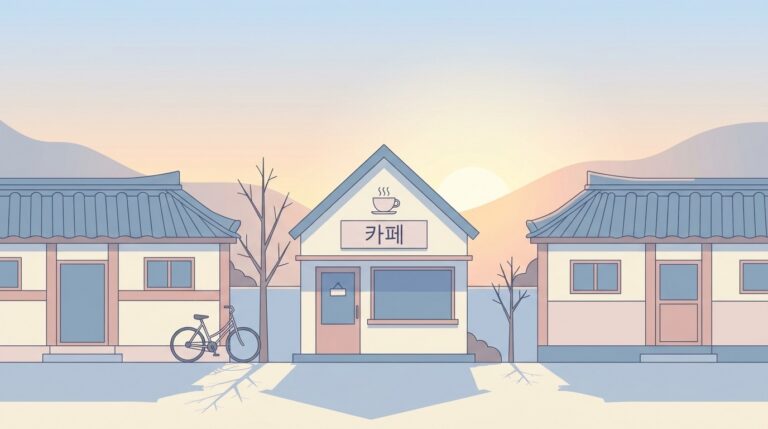
Phase 1: Empathy (Story-driven Opening)
안녕하세요! 매일한글 에디터입니다. (Hello! I’m your Daily Hangul editor.)
Picture this: You step into a sunlit bakery in the trendy streets of Seongsu-dong, Seoul. The aroma of freshly baked salt bread and roasted coffee fills the air. Eager to show off your Korean skills, you look the barista in the eye, beam proudly, and say: 좋은 아침이에요 (Joeun achimieyo!).
Instead of a delighted reaction, the barista blinks, pauses for half a second, and gives you a polite but amused smile. You walk away wondering, Wait, did I say something wrong? Isn’t that ‘Good morning’?
You didn’t make a grammatical error, but you did bump into one of Korean’s most fascinating cultural quirks! Direct translations from English to Korean often sound like dialogue dubbed from a 90s Hollywood movie. Based on feedback from hundreds of our beginner students, mastering natural morning greetings is the single quickest way to turn awkward interactions into instant connections. Let’s unlock how native speakers really start their day!
Phase 2: Top 3 Core Expressions Deep Dive
1. 안녕하세요 (Annyeonghaseyo)
- Pronunciation: Ahn-nyawng-ha-seh-yo (Think of “ahn” like the start of ‘honest’, “nyawng” rhyming with ‘song’, and “seh-yo” flowing smoothly).
- Meaning: Literal: “Are you at peace?” | Real Nuance: The undisputed golden standard for “Hello” and “Good morning” at any time of day.
- K-Culture Moment: Seen in nearly every K-Drama office scene when colleagues enter the lobby holding iced coffees, bowing slightly to security guards and coworkers.
- Editor’s Insight: English speakers crave a time-specific phrase like “Good morning,” but in Korea, wishing peace across the whole day is the ultimate polite gesture.
- Situation Spectrum: Casual ⚠️ | Semi-formal ✅ | Formal ✅
- 🤔 Think About It: In English, we focus on the objective time of day (“Good morning”). Why do you think Korean traditionally centers around the other person’s state of peace instead?
2. 잘 잤어요? (Jal jasseoyo?)
- Pronunciation: Jahl jahs-saw-yo? (“Jal” rhymes with ‘pal’, “jas-saw” sounds like ‘just saw’ said quickly).
- Meaning: Literal: “Did you sleep well?” | Real Nuance: The warm, caring morning greeting used between close people.
- K-Culture Moment: In slice-of-life K-Dramas or reality shows like In the SOOP, members wake up with messy hair, stretch, and softly ask each other, “잘 잤어? (Jal jasseo?)”
- Editor’s Insight: Add 요 (yo) at the end for polite tone with older acquaintances. Drop the 요 (yo) to say 잘 잤어? (Jal jasseo?) strictly with close friends and kids.
- Situation Spectrum: Casual ✅ | Semi-formal ✅ | Formal 🚫
- 🤔 Think About It: Why does Korean link greetings to biological well-being (sleep, meals) rather than environmental factors like the sun or time?
3. 좋은 아침이에요 (Joeun achimieyo)
- Pronunciation: Joh-eun ah-chim-ee-eh-yo (“Joh-eun” sounds like ‘Joe-oon’, “ah-chim” like ‘ah-team’ with ‘ch’).
- Meaning: Literal: “It is a good morning.” | Real Nuance: A cheerful, Western-influenced greeting increasingly common among younger generations and creative workplaces.
- K-Culture Moment: Often heard on morning radio shows or bubbly YouTube vlogs where hosts greet their audience with high energy.
- Editor’s Insight: It sounds bright and sweet, but traditional elders might find it slightly theatrical. Use it safely among peers or when you want to bring extra sunshine into the room.
- Situation Spectrum: Casual ✅ | Semi-formal ✅ | Formal ⚠️
- 🤔 Think About It: How does media globalization change local languages over time?
Phase 3: Textbook Korean vs. Real Korean
Situation 1: Arriving at the office or morning class
- 📖 Textbook Korean: 좋은 아침입니다! (Joeun achimimnida!) — “It is a good morning!”
- 🗣️ Real Korean: 안녕하세요! 출근하셨어요? (Annyeonghaseyo! Chulgeunhasyeosseoyo?) — “Hello! You arrived at work?”
- 💡 Why is it different? Koreans build rapport by acknowledging shared shared realities (like commuting to work or school) rather than making declarative statements about the weather.
Situation 2: Waking up in a guesthouse or greeting a friend
- 📖 Textbook Korean: 안녕히 주무셨습니까? (Annyeonghi jumusyeotseumnikka?) — “Did you sleep peacefully? (Ultra-formal)”
- 🗣️ Real Korean: 꿀잠 잤어요? (Kkuljam jasseoyo?) or 잘 잤어? (Jal jasseo?) — “Did you get sweet honey sleep? / Did you sleep well?”
- 💡 Why is it different? The textbook phrase belongs in historical dramas or military barracks. Everyday Korean prioritizes warmth and comfort over stiff etiquette.
Phase 4: K-Culture Deep Dive & Non-Verbal Manners
4-1. 눈치 (Nunchi) & Gestures
In Korea, your posture speaks louder than your vocal cords. When delivering a morning greeting:
* The 15-Degree Bow: You don’t need a deep theatrical bow. A crisp, respectful 15-degree nod of the upper torso while saying 안녕하세요 (Annyeonghaseyo) shows instant politeness.
* Two-Hand Rule: If you are handing over a morning credit card or receiving a coffee receipt, keep both hands involved (or hold your right forearm lightly with your left hand).
* Eye Contact: Avoid piercing, unblinking eye contact while bowing; let your gaze drop naturally with your head before returning to meet their eyes with a gentle smile.
4-2. Culture Code: The “Morning Wellness” Check
Have you ever noticed how Korean greetings revolve around basic survival and comfort? Throughout Korea’s turbulent history, making it through the night safely and having enough food were real concerns. That’s why asking 밥 먹었어요? (Bap meogeosseoyo? – “Did you eat?”) and 잘 잤어요? (Jal jasseoyo? – “Did you sleep well?”) became the ultimate expressions of affection and etiquette.
Phase 5: Real-life Roleplay Scenario
Setting: Café Haru, a cozy neighborhood coffee spot in Mangwon-dong, 8:30 AM.
Character: Minho, a friendly 20-something barista wearing a linen apron, steaming milk behind the counter.
- Turn 1 (You): 🎭 Push open the glass door and make eye contact with a gentle smile.
안녕하세요! (Annyeonghaseyo!) — “Hello!” - Turn 2 (Minho): 🎭 Looks up and bows politely.
어서 오세요! 일찍 오셨네요! (Eoseo oseyo! Iljjik osyeonneyo!) — “Welcome! You came early today!” - Turn 3 (You): 🎭 Nods lightly.
네, 좋은 아침이에요! (Ne, joeun achimieyo!) — “Yes, good morning!” - Turn 4 (Minho): 🎭 Smiles warmly.
오늘 날씨 쌀쌀하죠? 잘 주무셨어요? (Oneul nalssi ssalssalhajyo? Jal jumusyeosseoyo?) — “Chilly weather today, right? Did you sleep well?” - Turn 5 (You): 🎭 Rubs hands together against the chill.
네, 푹 잤어요! (Ne, puk jasseo-yo!) — “Yes, I slept deeply!” - Turn 6 (Minho): 🎭 Taps the POS register.
다행이네요. 오늘은 어떤 커피로 드릴까요? (Dahaeng-iney-yo. Oneureun eotteon keopiro deurilkkayo?) — “Glad to hear that. What coffee can I get you today?” - Turn 7 (You): 🎭 Points toward the menu with an open palm.
따뜻한 아메리카노 한 잔 주세요. (Ttatteutan amaricano han jan juseyo.) — “One hot Americano, please.” - Turn 8 (Minho): 🎭 Nods and enters the order.
네, 금방 준비해 드릴게요! (Ne, geumbang junbihae deurilgeyo!) — “Sure thing, I’ll prepare it right away!”
🔀 Interactive Decision Point
Minho suddenly asks: “아침 식사 하셨어요? (Achim siksa hasyeosseoyo? – Did you have breakfast?)”
* Choice A: “네, 먹었어요! (Ne, meogeosseoyo! – Yes, I ate!)”
* Feedback (Best): Perfect! Natural, cheerful, and acknowledges the barista’s polite check-in smoothly.
* Choice B: “좋은 아침이에요. (Joeun achimieyo. – Good morning.)”
* Feedback (Bad): Oops! Repeating the greeting sounds like a robotic glitch and ignores his direct question.
* Choice C: “아니요, 배고파 죽겠어요. (Aniyo, baegopa jukgesseoyo. – No, I’m dying of hunger.)”
* Feedback (Risk): Super authentic slang, but maybe a bit too dramatic for someone you just met! Save it for close buddies.
Phase 6: 10-Second Emotion Shadowing Drill
Practice these lines out loud with the designated pauses (/) and emotional tone!
[😊 Bright & Sunny]안녕하세요! / 좋은 아침이에요! (Annyeonghaseyo! / Joeun achimieyo!)[😴 Sleepy but Polite]네… / 푹 잘 잤어요. (Ne… / puk jal jasseoyo.)[☕ Eager & Friendly]따뜻한 커피 / 한 잔 주세요! (Ttatteutan keopi / han jan juseyo!)
Phase 7: K-Culture Mini Dictionary
- 출근 (Chulgeun): Heading to work or clocking in. Commonly heard in morning subways: “출근길 (Chulgeun-gil – the morning commute)”.
- 얼죽아 (Eol-juk-ah): Acronym for ‘Eoreojukdo Aiseu Amerikano’ (Even if I freeze to death, Iced Americano!). The legendary Korean habit of sipping iced coffee in freezing winter mornings.
- 꿀잠 (Kkul-jam): Literal “Honey sleep.” Slang for having an uninterrupted, refreshing sleep.
- 모닝커피 (Moning-keopi): Konglish for “Morning coffee,” considered an indispensable survival ritual across Korean offices.
Phase 8: Traveler’s Survival Kit
Survival Expressions TOP 3
- 안녕하세요 (Annyeonghaseyo) — Use this with everyone: convenience store clerks, bus drivers, hotel staff.
- Pro Tip: Pair with a soft head tilt.
- 좋은 하루 보내세요! (Joeun haru bonaeseyo!) — “Have a good day!”
- Pro Tip: Say this as you leave a café or store in the morning.
- 잘 잤어요? (Jal jasseoyo?) — “Did you sleep well?”
- Pro Tip: Use this with your Airbnb host, homestay family, or travel buddies.
Editor’s Travel Note
Before stepping out for your morning adventure, make sure to get the official Naver Map navigation app on your smartphone. Google Maps won’t show real-time walking directions in South Korea! Also, remember that Seoul metro morning rush hours (8:00 AM – 9:00 AM) are intense; keep your phone on silent and backpack in front of your chest.
Phase 9: “One Step Deeper” (Reflective Question)
In Western cultures, language often prioritizes self-expression, objective clarity, and environmental greetings (“Good morning, good evening”). In contrast, Korean linguistic etiquette is built around relationship maintenance and communal care. Asking if someone slept well or ate breakfast transforms a mundane greeting into an act of empathy.
💬 Your Turn: How does your native language handle morning greetings? Do you comment on the time of day, or do you ask about health and rest? Tell us in the comments below!
Phase 10: FAQ & Common Mistakes
Q: Can I use “좋은 아침 (Joeun achim)” without any honorifics?
A: Only with people younger than you or very close friends! Using it with elders or cashiers will sound impolite or overly casual.
Q: Is “안녕 (Annyeong)” okay to say in the morning?
A: Yes, but strictly with close peers, classmates of the same age, or children. Never say “안녕” to a hotel receptionist or taxi driver.
Q: What should I say when I bump into a neighbor in the apartment elevator?
A: A simple “안녕하세요! (Annyeonghaseyo!)” accompanied by a slight bow is the gold standard.
🚨 Common Mistakes Board
- ❌ Mistake 1: Translating “Good morning” word-for-word into formal situations (e.g., saying 좋은 아침입니다 to your CEO).
- Correct Action: Stick to “안녕하세요! (Annyeonghaseyo!)” or “안녕하십니까! (Annyeonghasimnikka!)”.
- ❌ Mistake 2: Bowing with hands clasped together like in prayer.
- Correct Action: In Korea, keep your hands gently at your sides or resting folded over your lower abdomen.
- ❌ Mistake 3: Not replying when an elder asks “잘 잤어요? (Jal jasseoyo?)”.
- Correct Action: Always answer with “네, 잘 잤어요! (Ne, jal jasseoyo! – Yes, I slept well!)” or “덕분에 푹 잤습니다 (Deokbune puk jatseumnida – Thanks to you, I slept well).
Phase 11: Action Missions
- 🥉 Bronze Mission: Stand in front of your bathroom mirror tomorrow morning, bow 15 degrees, and repeat 안녕하세요 (Annyeonghaseyo) 5 times.
- 🥈 Silver Mission: Post an Instagram Story of your morning coffee and write: “오늘도 좋은 아침이에요! ☕ (Oneuldo joeun achimieyo! – Another good morning!)”.
- 🥇 Gold Mission: Go to a local Korean bakery or café and greet the staff with “안녕하세요! (Annyeonghaseyo!)” before ordering.
- 🎮 K-Culture Mission: Watch the first 15 minutes of any modern K-Drama morning scene and spot whether characters say 안녕하세요, 잘 잤어, or something else!
Phase 12: Interactive Quiz Challenge
1. Situational Judgment:
You meet your Korean language teacher in the hallway at 9:00 AM. Which greeting is the most natural and polite?
* A) 안녕! (Annyeong!)
* B) 선생님, 안녕하세요! (Seonsaengnim, annyeonghaseyo!)
* C) 꿀잠 잤어? (Kkuljam jasseo?)
👉 Click to see the answer!
Correct Answer: B
Calling your teacher by their title “선생님 (Seonsaengnim)” followed by “안녕하세요!” is the quintessential polite Korean greeting. Choice A and C are informal (반말) and would be disrespectful to a teacher!
2. Fill in the Blank:
When someone asks you “잘 잤어요? (Jal jasseoyo?)”, you want to say “Yes, I slept deeply.” Fill in the missing adverb:
“네, [ ] 잤어요!”
👉 Click to see the answer!
Correct Answer: 푹 (Puk)
“푹 (Puk)” is an expressive Korean word describing deep, uninterrupted, and refreshing rest.
3. True or False Culture Check:
True or False: Koreans consider it rude to greet someone with “밥 먹었어요? (Did you eat?)” in the morning because it’s too personal.
👉 Click to see the answer!
Correct Answer: False!
Asking if someone ate breakfast is one of the warmest expressions of care and friendliness in Korean daily life.







