

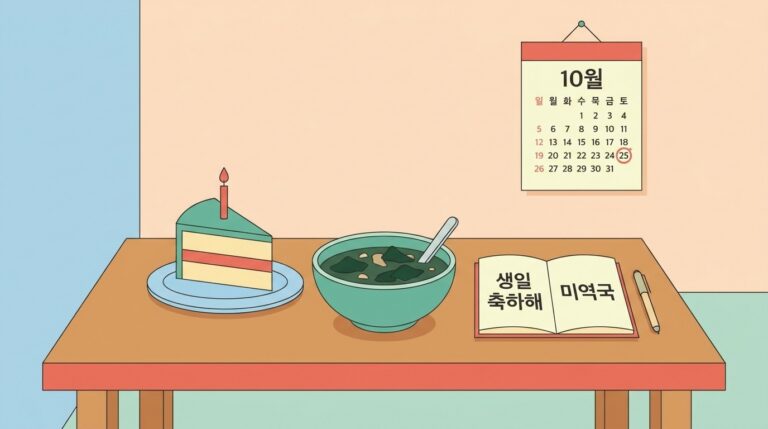
When Is Your Birthday? How to Ask and Share Dates in Korean Like a True Bestie
Phase 1: Empathy (Story-Immersive Opening)
안녕하세요! 매일한글 에디터입니다. (Hello! It’s your Daily Hangul editor.)
Picture this: You are watching a live stream of your ultimate K-Pop bias. Suddenly, comments flood the chat: “생일이 언제예요?” Your idol smiles warmly, tilts their head, and answers with numbers you vaguely recognize from your vocabulary flashcards. Or maybe you’re sitting at a cozy dessert cafe in Yeonnam-dong with new Korean friends. Someone slides a slice of strawberry shortcake toward you and asks, “When is your birthday?” Suddenly, your mind freezes. Do you use Native Korean numbers or Sino-Korean numbers? How do you say “October” without stuttering? You smile nervously and miss the chance to share a sweet bonding moment. Don’t worry—every single Korean learner has hit this exact roadblock! Based on feedback from hundreds of our beginner students, mastering birthday small talk is your golden ticket to unlocking genuine friendships and understanding K-dramas on a deeper level. Let’s make this simple, painless, and super fun together.
Phase 2: Top 3 Core Expressions Deep Dive
1. 생일이 언제예요? (Saeng-il-i eon-je-ye-yo?)
- Pronunciation: [Saeng-il-i eon-je-ye-yo?] (Think of saeng like “sang” in English, il-i like “eel-ee”, and eon-je like the “un-” in “under” followed by “jeh”).
- Meaning: Literal: “Birthday when is it?” | Actual Nuance: “When is your birthday?” (Polite, friendly, and natural).
- K-Culture Moment: Commonly heard during idol fan signs or in romance K-dramas when the lead shyly tries to plan a surprise party.
- Editor’s Insight: The suffix -예요 (-ye-yo) adds a warm, respectful tone suitable for anyone you aren’t childhood buddies with yet.
- Situation Spectrum: Casual: ⚠️ | Semi-formal: ✅ | Formal: ⚠️
- 🤔 Think About It: In Korean, the question word “언제 (when)” sits right before the verb rather than at the front of the sentence. How does this word order change what you emphasize first?
2. 제 생일은 [월] [일]이에요 (Je saeng-il-eun [wol] [il]-i-e-yo)
- Pronunciation: [Je saeng-il-eun … wol … il-i-e-yo] (Je sounds like “juh”, wol rhymes with “wall”, and il sounds like “eel”).
- Meaning: Literal: “My birthday [month] [day] is.” | Actual Nuance: “My birthday is [Month] [Day].”
- K-Culture Moment: Used when filling out membership forms at Olive Young or introducing yourself in variety show auditions.
- Editor’s Insight: For months and days, Koreans exclusively use Sino-Korean numbers (일, 이, 삼, 사…). Remember that June (6월) is 유월 (yu-wol), not 육월, and October (10월) is 시월 (si-wol), not 십월!
- Situation Spectrum: Casual: ⚠️ | Semi-formal: ✅ | Formal: ✅
- 🤔 Think About It: In English, we often say “May 5th” using ordinal numbers. Why do you think Korean keeps it simple by using plain cardinal Sino-Korean numbers followed by counter words?
3. 생일 축하해요! (Saeng-il chuk-ha-hae-yo!)
- Pronunciation: [Saeng-il chuk-ka-hae-yo] (Notice the “k” and “h” merge into a crisp, aspirated “k” sound, just like “cook-car”).
- Meaning: Literal: “Birthday celebrate!” | Actual Nuance: “Happy Birthday!”
- K-Culture Moment: Sung before blowing out candles on a bento cake in trendy cafes or written across celebratory cup-sleeves.
- Editor’s Insight: Add 정말 (jeong-mal – really) or 진짜 (jin-jja – truly) in front to sound extra affectionate: 생일 진짜 축하해요! (Saeng-il jin-jja chuk-ha-hae-yo!)
- Situation Spectrum: Casual: ⚠️ | Semi-formal: ✅ | Formal: ✅
- 🤔 Think About It: Notice how Korean birthday greetings focus on the action of celebrating (축하). What does this reveal about the communal spirit of Korean celebrations?
Phase 3: Textbook Korean vs. Real Korean
Situation 1: Asking someone’s birthday in casual conversation
* 📖 교과서 한국어 (Textbook Korean): 당신의 생년월일은 언제입니까? (Dang-sin-ui saeng-nyeon-wol-il-eun eon-je-im-ni-kka? – “What is your date of birth?”)
* 🗣️ 진짜 한국어 (Real Korean): 생일이 언제예요? (Saeng-il-i eon-je-ye-yo? – “When is your birthday?”) / 몇 월생이에요? (Myeot wol-saeng-i-e-yo? – “Which month were you born in?”)
* 💡 왜 다를까?: “당신 (Dang-sin)” sounds confrontational in spoken Korean, and “생년월일” is purely bureaucratic language for government forms or hospital desks.
Situation 2: Cheering a close friend on their special day
* 📖 교과서 한국어 (Textbook Korean): 생일을 진심으로 축하드립니다. (Saeng-il-eul jin-sim-eu-ro chuk-ha-deu-rim-ni-da. – “I sincerely congratulate your birthday.”)
* 🗣️ 진짜 한국어 (Real Korean): 생일 축하해! 오늘 맛있는 거 많이 먹어! (Saeng-il chuk-ha-hae! O-neul mas-in-neun geo man-i meog-eo! – “Happy birthday! Eat lots of yummy food today!”)
* 💡 왜 다를까?: Close peers drop honorifics (-요) and almost always wish each other delicious food as an expression of love and care.
Phase 4: K-Culture Deep Dive & Non-Verbal Manners
4-1. Nunchi & Birthday Gestures
When someone tells you it’s their birthday, never just nod statically. Koreans express warmth with expressive physical empathy! Clasp your hands together lightly, widen your eyes with pleasant surprise, and exclaim, “우와, 정말요? (U-wa, jeong-mal-yo? – Wow, really?)”. When handing over a birthday gift or even a small cup of coffee, use both hands (or place your left hand gently under your right elbow/wrist) to convey genuine politeness.
4-2. The Soul Food Code: Miyeokguk (미역국)
If you watch any slice-of-life K-drama, you will see a steaming bowl of brown sea-tangle soup served early in the morning: 미역국 (Miyeokguk – Seaweed Soup). Historically, mothers eat nutrient-dense seaweed soup after childbirth for postpartum recovery. Eating it on your birthday is a heartfelt gesture honoring the mother who brought you into the world. If you ask a Korean friend, “오늘 미역국 먹었어요? (O-neul mi-yeok-guk meog-eoss-eo-yo? – Did you eat seaweed soup today?)”, their heart will instantly melt!
Phase 5: Real-Life Roleplay Scenario
- Setting: A sunlit dessert cafe in Hongdae. Soft indie pop plays in the background.
- Character: Minji (민지), a friendly university exchange buddy who noticed a tiny calendar notification on her phone.
-
Minji: 혹시 생일이 언제예요? (Hok-si saeng-il-i eon-je-ye-yo?)
🎭 Tapping a notebook with a friendly smile.
(By any chance, when is your birthday?) -
You: 제 생일은 10월 15일이에요. (Je saeng-il-eun si-wol sip-o-il-i-e-yo.)
🎭 Looking up calmly and speaking clearly.
(My birthday is October 15th.) -
Minji: 대박! 진짜 얼마 안 남았네요! (Dae-bak! Jin-jja eol-ma an nam-an-ne-yo!)
🎭 Clapping hands together excitedly.
(Awesome! That’s coming up so soon!) -
You: 민지 씨는 생일이 언제예요? (Min-ji ssi-neun saeng-il-i eon-je-ye-yo?)
🎭 Leaning forward with curious eyes.
(When is your birthday, Minji?) -
Minji: 저는 3월 2일이에요. 봄에 태어났어요. (Jeo-neun sam-wol i-il-i-e-yo. Bom-e tae-eo-nass-eo-yo.)
🎭 Smiling warmly while sipping iced tea.
(Mine is March 2nd. I was born in spring.) -
You: 와, 봄에 태어났군요! 잘 어울려요. (Wa, bom-e tae-eo-nat-gun-yo! Jal eo-ul-lyeo-yo.)
🎭 Nodding approvingly.
(Wow, you were born in spring! That suits you well.) -
Minji: 고마워요! 우리 이번 생일에 맛있는 거 먹으러 가요! (Go-ma-wo-yo! U-ri i-beon saeng-il-e mas-in-neun geo meog-eu-reo ga-yo!)
🎭 Offering a bright high-five.
(Thank you! Let’s go eat something delicious for your birthday!) -
You: 좋아요! 꼭 같이 가요. (Joh-a-yo! Kkok gat-i ga-yo.)
🎭 Returning the high-five happily.
(Sounds great! Let’s definitely go together.)
🔀 Interactive Decision Point
Minji asks: “이번 생일에 뭐 하고 싶어요? (What do you want to do this birthday?)”
* Option A: “그냥 친구들이랑 삼겹살 먹고 싶어요!” (Geu-nyang chin-gu-deul-i-rang sam-gyeop-sal meok-go sip-eo-yo!)
👉 Feedback [Best]: Natural, grounded, and very Korean! Minji will immediately offer to find the best local K-BBQ spot.
* Option B: “아무것도 안 해요. 묻지 마세요.” (A-mu-geot-do an hae-yo. Mut-ji ma-se-yo.)
👉 Feedback [Bad]: Extremely abrupt and cold. It abruptly shuts down the conversation.
* Option C: “나 파티 열 거야! 너 돈 내!” (Na pa-ti yeol geo-ya! Neo don nae!)
👉 Feedback [Risk]: Uses informal language (반말) without permission and demands money. Sounds rude even as a joke!
Phase 6: 10-Second Emotion Shadowing Drill
Practice matching both the rhythm and the emotional heart of these native lines:
[😊 Bright & curious]
혹시 / 생일이 / 언제예요?
(Hok-si / saeng-il-i / eon-je-ye-yo?)-
[✨ Proud & clear]
제 생일은 / 7월 20일이에요!
(Je saeng-il-eun / chil-wol i-sip-il-i-e-yo!) -
[🎉 Enthusiastic & loving]
생일 / 진짜 진짜 / 축하해요!
(Saeng-il / jin-jja jin-jja / chuk-ha-hae-yo!)
Phase 7: K-Culture Mini Dictionary
- 생일 (Saeng-il): Birthday. The fundamental term used for friends, peers, and younger people.
- 생신 (Saeng-sin): The elevated honorific form of birthday, strictly reserved for parents, grandparents, and elders.
- 생파 (Saeng-pa): Trendy slang abbreviation for 생일 파티 (Saeng-il pa-ti – birthday party). Example: “오늘 저녁에 생파 있어!”
- 생카 (Saeng-ka): Short for 생일 카페 (Saeng-il ka-pe – Birthday Cafe). Fan-organized pop-up events celebrating K-Pop idols’ birthdays filled with cup-sleeves and photo cards.
Phase 8: Traveler’s Survival Kit
Top 3 Survival Expressions
- 생일 할인 돼요? (Saeng-il hal-in dwae-yo?)
Pronunciation: [Saeng-il hal-in dwae-yo?]
Pro Tip: Many Korean theme parks (like Lotte World), cinema chains, and cosmetics stores offer birthday perks. Show your ID! - 초 몇 개 필요하세요? (Cho myeot gae pil-yo-ha-se-yo?)
Pronunciation: [Cho myeot gae pil-yo-ha-se-yo?]
Pro Tip: When buying a cake at Paris Baguette or Tous Les Jours, the clerk will ask how many candles you need. Long candles = 10s, short candles = 1s. - 생일 선물이에요. (Saeng-il seon-mul-i-e-yo.)
Pronunciation: [Saeng-il seon-mul-i-e-yo.]
Pro Tip: Say this with a warm smile when handing a small gift to a Korean acquaintance.
Editor’s Travel Note
Before heading to Korea, make sure you complete the Naver Map app download for seamless navigation. When searching for famous birthday bakeries in Hongdae or Seongsu-dong, Google Maps often lags, but Naver Map shows live opening hours, reviews, and candle options instantly!
Phase 9: One Step Deeper (Reflective Insight)
In Western cultures, asking someone’s age or birthday too early can occasionally feel overly personal. In Korea, however, learning when you were born isn’t nosy—it is an act of social calibration. It helps people establish polite relational comfort, figure out if you share a birth season, and prepare thoughtful hospitality. Even with South Korea officially adopting the international age counting system, birthdays remain a heartwarming milestone of community connection.
💬 Your Turn: What month were you born in? Practice leaving your birthday in the comments below using Sino-Korean numbers: “제 생일은 [ ]월 [ ]일이에요!”
Phase 10: FAQ & Misconception Prevention
Q: Can I use “생일 (Saeng-il)” for my boss or Korean grandmother?
A: No! For elders, professors, or seniors, you must use the honorific word 생신 (Saeng-sin). Say “생신 축하드려요 (Saeng-sin chuk-ha-deu-ryeo-yo)” instead of “생일 축하해요” to show proper respect.
Q: Why do June and October sound different from their normal numbers?
A: In standard Sino-Korean counting, 6 is 육 (yuk) and 10 is 십 (sip). However, for phonetic fluency and ease of pronunciation, June drops the final consonant to become 유월 (yu-wol), and October becomes 시월 (si-wol).
Q: How do I reply if someone wishes me Happy Birthday first?
A: Simply smile and say, “축하해 주셔서 감사합니다! (Chuk-ha-hae ju-syeo-seo gam-sa-ham-ni-da! – Thank you for celebrating with me!)”.
🚨 Common Mistakes Alert
- Saying 육월 (Yuk-wol) or 십월 (Sip-wol): Native speakers will understand, but it sounds unnatural. Always remember: 유월 (June) and 시월 (October)!
- Mixing Native and Sino-Korean numbers: Never say 다섯월 (Daseot-wol) for May. Months and days always take Sino-Korean numbers (5월 = 오월).
- Calling your own birthday “생신”: Honorifics are never applied to oneself! Always refer to your own birthday as 생일 (saeng-il).
Phase 11: Action Missions
- 🥉 Bronze Mission (Solo Practice): Write today’s date and your own birthday on a piece of paper, pronouncing the month (월) and day (일) aloud 5 times.
- 🥈 Silver Mission (Social Connection): Leave a supportive comment on your favorite K-drama actor’s or K-Pop singer’s social media: “생일 축하해요! 늘 응원해요! (Happy birthday! Always supporting you!)”.
- 🥇 Gold Mission (Real Life Execution): The next time you meet a Korean speaker or practice partner, ask them “생일이 언제예요?” and follow up with a genuine reaction!
- 🎮 K-Culture Mission: Search your favorite idol’s name on X (Twitter) followed by “생카” to discover the aesthetic birthday cafe culture in Seoul.
Phase 12: Interactive Quiz Challenge
Test your knowledge before you hit the streets of Seoul!
- Situational Judgment: You want to ask your college classmate when their birthday is. Which sentence is the most natural?
- A) 생년월일이 어떻게 되십니까?
- B) 생일이 언제예요?
- C) 나이가 언제입니까?
- Fill in the Blank: My birthday is June 25th.
- “제 생일은 (____) 25일이에요.”
- True or False: It is completely polite to say “생일 축하해요” to your Korean friend’s 80-year-old grandfather.
👉 Click to reveal answers & explanations!
- Answer: B
Explanation: 생일이 언제예요? is the most natural, polite semi-formal phrase for classmates and friends. Option A is overly stiff/document-style, and Option C is grammatically incorrect. - Answer: 유월 (Yu-wol)
Explanation: 6월 must drop the batchim ‘ㄱ’ to become 유월, never 육월! - Answer: False
Explanation: For elders like grandfathers, use the honorific word 생신 (Saeng-sin): “생신 축하드려요, 할아버지!”







