

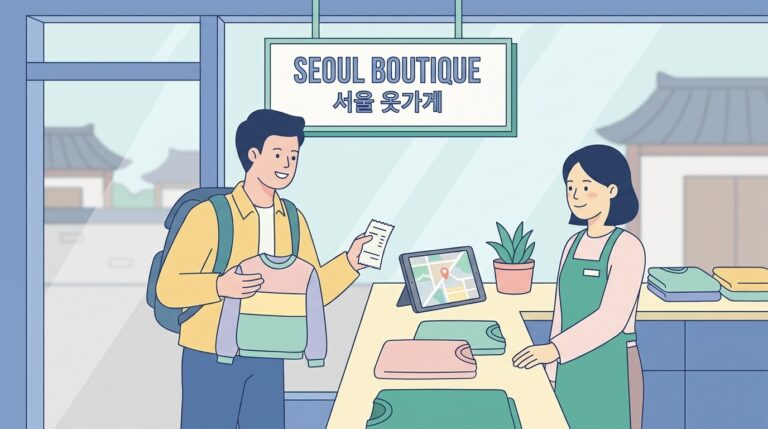
When You Get Home and Find a Stain: How to Politely Request an Exchange in Korea
Phase 1: 공감 (Story-driven Opening)
안녕하세요! 매일한글 에디터입니다. (Hello! I’m your Daily Hangul editor.)
Picture this: You just had an unforgettable afternoon strolling through the bustling, trendy lanes of Seongsu-dong or Hongdae. You stepped into an aesthetic boutique, spotted a cozy oversized knit sweater, and fell in love with it instantly. You proudly swiped your travel card, tucked the crisp paper bag into your arm, and couldn’t wait to try it on back at your hotel.
Back in your room, under the bright mirror lights, your excitement hits an unexpected wall. Right there along the sleeve cuff sits a distinct, dark coffee smudge. Your heart drops. Can I actually take this back? What if the clerk thinks I stained it? How do I explain this in polite Korean without sounding aggressive or awkward?
Take a deep breath! Returning or exchanging flawed items in Korea is totally standard and hassle-free once you know the secret polite formulas. Korean shop staff pride themselves on swift customer care. With just three easy A2-level sentences, you can walk straight to the counter, show your receipt, and get a crisp, fresh replacement without a drop of sweat. Let’s master the exact words and manners native Koreans use every single day!
Phase 2: 핵심 표현 3선 심층 분석
1. 집에 가서 확인해 보니까 소매에 얼룩이 있어요 (Jibe gaseo hwaginhae bonikka somae-e eollugi isseoyo)
- Pronunciation: [Jee-beh gah-seo hwa-gin-hae boh-nee-kka soh-mae-eh eol-loo-gee ee-sseo-yoh] (Think of ‘bonikka’ like saying ‘bony-car’ quickly with a pop on ‘kka’)
- Meaning: Literal: “I went home and checked, and there is a stain on the sleeve.” / Real Nuance: “I only discovered this after getting home—there’s a small stain on the sleeve.”
- K-Culture Moment: You hear this softened reporting style constantly in lifestyle K-Dramas whenever a character discovers a delivery mistake or unwraps a damaged parcel without wanting to accuse the courier directly.
- Editor’s Insight: The magical grammar pattern
-아/어 보니까(-a/eo bonikka) expresses “upon doing something, I realized…”. By explaining that you only saw the stain after you reached home, you gently demonstrate that you didn’t create the stain on purpose. - Situation Spectrum: Casual ⚠️ | Semi-formal ✅ | Formal ✅
- 🤔 Think About It: In English, people often jump to “You gave me a damaged item.” Why does Korean prioritize sharing the personal observation first before discussing the fault?
2. 영수증 있는데 교환해 주실 수 있나요? (Yeongsujeung inneunde gyohwanhae jusil su innayo?)
- Pronunciation: [Yeong-soo-jeung een-neun-deh gyo-hwan-hae joo-sheel soo een-nah-yoh?] (Rhyme ‘yeong’ with ‘young’ and ‘sujeung’ with ‘soo-jung’)
- Meaning: Literal: “I have the receipt, could you exchange this for me?” / Real Nuance: “I’ve got my receipt right here, would it be possible to swap this for another one?”
- K-Culture Moment: Commonly heard at department store customer desks in Myeongdong or The Hyundai Seoul when shoppers make routine exchanges.
- Editor’s Insight: Adding
-는데(-neunde) acts as a linguistic cushion. It provides background context (“I have the receipt”) before you ask the favor, which makes your tone sound considerate rather than demanding. - Situation Spectrum: Casual 🚫 | Semi-formal ✅ | Formal ✅
- 🤔 Think About It: Notice how Korean speakers almost always offer proof of compliance (the receipt) before asking for an action. How does this reflect the mutual respect in Korean service culture?
3. 새 제품으로 바꿀 수 있을까요? (Sae jepumeuro bakkul su isseulkkayo?)
- Pronunciation: [Seh jeh-poom-eu-roh bah-kkool soo ee-sseul-kka-yoh?] (Pronounce ‘sae’ like ‘say’ without the diphthong glide, and double ‘kk’ with crisp tension)
- Meaning: Literal: “Could I change it to a new product?” / Real Nuance: “Could I swap this out for an unopened, fresh piece?”
- K-Culture Moment: K-Pop fans buying album merchandise at pop-up stores use this exact phrase when they notice a dent on the collectible photocard box!
- Editor’s Insight: While
교환하다(gyohwanhada) is the formal Sino-Korean verb for exchange, native speakers in real boutiques often say바꾸다(bakkuda – to swap/change). Pairing it with-ㄹ 수 있을까요?creates the gold standard of polite beginner requests. - Situation Spectrum: Casual ⚠️ | Semi-formal ✅ | Formal ✅
- 🤔 Think About It: Why does phrasing a request as a speculative question (“Could it be possible?”) feel much warmer than saying “Please do this” in Korean?
Phase 3: 교과서 한국어 vs 진짜 한국어
Situation 1: Explaining the Flaw on the Garment
- 📖 교과서 한국어: 이 의류에 오염이 존재합니다. (I u-ryu-e o-yeom-i jon-jae-ham-ni-da.) – “Contamination exists on this apparel.”
- 🗣️ 진짜 한국어: 소매 쪽에 작은 얼룩이 묻어 있어요. (Somae jjoge jageun eollugi mudeo isseoyo.) – “There’s a little stain on the sleeve area.”
- 💡 왜 다를까?: Textbook phrases rely on stiff technical vocabulary like
오염(contamination). Everyday native speech prefers descriptive everyday terms like얼룩(stain) and softening direction markers like~쪽(around/side) so you don’t sound like a health inspector!
Situation 2: Presenting Your Proof of Purchase
- 📖 교과서 한국어: 여기 구매 영수증을 제시하겠습니다. (Yeogi gumae yeongsujeungeul jesihagetseumnida.) – “I shall present the purchase receipt here.”
- 🗣️ 진짜 한국어: 영수증 여기 있어요! (Yeongsujeung yeogi isseoyo!) – “Here is my receipt!”
- 💡 왜 다를까?: Words like
제시하다(to present officially) are reserved for immigration officers or legal contracts. At a clothing store, a smiling여기 있어요accompanied by both hands holding the paper is 100% natural, polite, and warmly received.
Phase 4: K-Culture 딥다이브 & 비언어적 매너
4-1. 눈치 (Nunchi) & Body Language
When approaching the sales counter with a defective item, body language does half the talking:
* The Two-Handed Handover: Always pass both the folded garment and your paper receipt using two hands (or resting your left hand gently under your right wrist/forearm). In Korean etiquette, handing anything over with one hand can look dismissive.
* The Gentle Point: When showing the stain, point with an open palm or your index finger paired with a soft head tilt. Avoid tapping or jabbing at the fabric aggressively.
* The Soft Smile: Approach with an apologetic, friendly demeanor rather than an irritated frown. In Korea, showing that you regret having to trouble the clerk activates their protective service spirit (친절 마인드), prompting them to resolve your issue immediately.
4-2. Cultural Code: The Sacred Rule of ‘택 (Taek)’
In Korean retail—from subway station boutiques to luxury flagship stores in Apgujeong—clothing tags are known as 택 (Taek). The cardinal rule of Korean shopping is: 택 제거 시 교환/환불 불가 (No exchanges or refunds once the tag is removed).
Even if an item is visibly stained or flawed, cutting the tag off before bringing it back creates an uphill battle because stores cannot verify if it was worn outside. Always keep the tags intact, keep the item folded in its original shopping bag, and return within the standard window (typically 7 to 14 days with receipt in hand).
Phase 5: 실전 롤플레이 시나리오
Setting: A chic boutique in Seongsu-dong. Soft indie music plays. Alex (traveler) walks to the wooden counter where Minji (friendly store clerk) is organizing accessories.
- Alex: 저기요, 안녕하세요! (Jeogiyo, annyeonghaseyo!) – “Excuse me, hello!”
🎭 Smiles warmly and waits for Minji to make eye contact - Minji: 네, 고객님! 무엇을 도와드릴까요? (Ne, gogaengnim! Mueoseul dowadeurilkkayo?) – “Yes, customer! How may I help you?”
🎭 Bows lightly with hands clasped together - Alex: 어제 여기서 니트를 샀는데요, 집에 가서 확인해 보니까 소매 부분에 작은 얼룩이 있어요. (Eoje yeogiseo niteureul sanneundeyo, jibe gaseo hwaginhae bonikka somae bubune jageun eollugi isseoyo.) – “I bought a knit sweater here yesterday, and when I checked at home, there is a small stain on the sleeve area.”
🎭 Unfolds the garment gently and points to the sleeve with an open hand - Minji: 아, 정말요? 어머, 죄송해요. 한번 확인해 볼게요. (A, jeongmalyo? Eomeo, joesonghaeyo. Hanbeon hwaginhae bolgeyo.) – “Oh, really? Oh my, I’m so sorry. Let me inspect it.”
🎭 Examines the cuff carefully under the lamp - Alex: 혹시 새 제품으로 교환할 수 있을까요? 영수증 여기 있어요. (Hoksi sae jepumeuro gyohwanhal su isseulkkayo? Yeongsujeung yeogi isseoyo.) – “By any chance, could I exchange this for a new piece? Here is my receipt.”
🎭 Hands over the receipt using both hands - Minji: 네, 태그도 그대로 있고 영수증도 확인되셨어요! 새 상품으로 바로 가져다드릴게요. (Ne, taegeudo geudaero itgo yeongsujeungdo hwagindoesyeosseoyo! Sae sangpumeuro baro gajyeodadeurilgeyo.) – “Yes, the tag is intact and receipt verified! I’ll bring you a brand-new one right away.”
🎭 Hurries to the back stockroom and returns with a packaged sweater - Minji: 여기 새 상품입니다. 소매 쪽 깨끗한지 한번 확인해 보시겠어요? (Yeogi sae sangpuminida. Somae jjok kkaekkeuthanji hanbeon hwaginhae bosigesseoyo?) – “Here is the new item. Would you like to check if the sleeves are spotless?”
🎭 Opens the packaging so Alex can verify - Alex: 네, 정말 깨끗해요! 친절하게 바꿔 주셔서 감사합니다. (Ne, jeongmal kkaekkeuthaeyo! Chinjeolhage bakkwo jusyeoseo gamsahamnida.) – “Yes, it’s totally clean! Thank you so much for kindly exchanging it.”
🎭 Bows with a delighted smile and takes the shopping bag
🔀 인터랙티브 분기점 (Interactive Decision Point)
Imagine the clerk says they are currently out of stock for that exact sweater. What do you say?
- Option A: 그럼 환불해 주실 수 있나요? 카드 영수증 있어요. (Geureom hwanbulhae jusil su innayo? Kadeu yeongsujeung isseoyo. – Then could you please process a refund? I have the card receipt.)
👉 Feedback [Best]: Perfect! If a replacement is unavailable, requesting a polite refund with your card receipt is standard and completely acceptable. - Option B: 왜 재고가 없어요? 그냥 새 옷 내놔요! (Wae jaegoga eopseoyo? Geunyang sae ot naenwayo! – Why is there no stock? Just give me new clothes!)
👉 Feedback [Bad]: Using informal commands and rude phrasing will make the situation tense and uncomfortable. - Option C: 아… 알겠어요… 그냥 갈게요. (A… algesseoyo… geunyang galgeyo. – Ah… okay… I’ll just leave.)
👉 Feedback [Risk]: Don’t walk away with damaged merchandise! You have every consumer right to pick another item or receive a full refund.
Phase 6: 10초 감정 섀도잉 드릴
Practice these lines out loud! Follow the pause markers (/) and embody each emotional milestone:
[🥺 조심스럽고 공손하게 - Hesitant and Polite]
저기요, / 집에 가서 확인해 보니까 / 소매에 얼룩이 있어요.
(Jeogiyo, / jibe gaseo hwaginhae bonikka / somae-e eollugi isseoyo.)
“Excuse me, / when I checked at home, / there was a stain on the sleeve.”-
[🙏 정중하게 부탁하듯이 - Courteous and Respectful]
영수증 있는데, / 다른 새 제품으로 / 바꿀 수 있을까요?
(Yeongsujeung inneunde, / dareun sae jepumeuro / bakkul su isseulkkayo?)
“I have the receipt, / but for another new item, / could I swap it?” -
[😊 안도하며 환하게 - Relieved and Bright]
와, / 정말 깨끗하네요! / 친절하게 도와주셔서 감사합니다!
(Wa, / jeongmal kkaekkeuthaneyo! / Chinjeolhage dowajusyeoseo gamsahamnida!)
“Wow, / it’s completely clean! / Thank you for helping me so kindly!”
Phase 7: K-Culture 미니 사전 (Core Vocab)
- 교환 (Gyohwan) | Exchange
- Everyday Use: Swapping one item for another of equal value, another size, or a defect-free version. Essential verb form:
교환하다(to exchange).
- Everyday Use: Swapping one item for another of equal value, another size, or a defect-free version. Essential verb form:
- 환불 (Hwanbul) | Refund
- Everyday Use: Returning the product to receive your money back. Essential verb form:
환불하다(to refund). Commonly paired with카드 취소(card cancellation).
- Everyday Use: Returning the product to receive your money back. Essential verb form:
- 영수증 (Yeongsujeung) | Receipt
- Everyday Use: The absolute key to after-sales service in Korea. Even at convenience stores, clerks will ask:
영수증 드릴까요?(Would you like your receipt?). Always keep it when buying clothes!
- Everyday Use: The absolute key to after-sales service in Korea. Even at convenience stores, clerks will ask:
- 택 (Taek) | Clothing Tag / Price Tag
- Everyday Use: Derived from the English word “tag.” Used in phrases like
택을 떼다(to cut off the tag) or택 달린 새 상품(brand-new item with tags attached).
- Everyday Use: Derived from the English word “tag.” Used in phrases like
Phase 8: 여행자를 위한 생존 키트
Survival Expressions TOP 3
- 다른 색상이나 사이즈로 교환돼요? (Dareun saeksang-ina sa-i-jeu-ro gyohwandoeyo?) – “Can I exchange this for a different color or size?”
- Pro Tip: Use this when the sweater fits awkwardly or you prefer the charcoal color over cream.
- 카드 결제 취소해 주세요. (Kadeu gyeolje chwisohae juseyo.) – “Please cancel the credit card payment.”
- Pro Tip: Use this when opting for a refund rather than an exchange.
- 종이 영수증 버려 주세요. (Jongi yeongsujeung beoryeo juseyo.) – “Please throw away the paper receipt.”
- Pro Tip: Once your exchange is finished and you don’t need the final scrap of paper, use this handy line.
Editor’s Travel Note
- Essential Tool Guide: When tracking down the original store branch in sprawling shopping areas like Dongdaemun or Express Bus Terminal (Goto Mall), make sure you check your location via 네이버 지도 앱 다운로드. If you encounter complex store policy notices posted at the register, use 파파고 번역 앱 다운로드 to scan and translate the Korean policy in real time.
- Card Refund Protocol: Always bring the exact physical credit card you used during purchase! Korean card terminals cannot refund back to an Apple Pay token or a different card if the original physical card is missing.
Phase 9: “한 발 더 깊이” (Cultural Insight)
In Korean society, communication operates heavily on 배려 (Baeryeo – thoughtful consideration for others) and 체면 (Chemyon – saving face). When a customer walks in shouting “You sold me junk!”, it causes public embarrassment for the clerk and creates defensive resistance.
Conversely, when you frame the defect through the lens of personal discovery using -아/어 보니까 (“I got home and found…”), you give the shopkeeper comfortable room to apologize gracefully without feeling attacked. Politeness in Korean isn’t just about grammar endings like -요; it’s an art of phrasing situations so everyone leaves the conversation with their dignity intact.
💬 Your Turn: Have you ever had to return or swap an item while traveling overseas? How did the experience compare to your home country? Drop your story in the comments below!
Phase 10: FAQ & 오해 방지
Q: Can I exchange clothes bought at underground subway shopping malls?
A: Underground malls (like Goto Mall or Gangnam Station) have fantastic budget fashion, but many small stalls maintain a strict 환불 불가 (No Refund) policy. However, almost all stalls will happily let you do a 교환 (Exchange) for another size or item within 3 to 7 days if the tags are attached and you have the paper sales slip. Always verify at purchase!
Q: What should I do if I accidentally threw away the paper receipt?
A: If you shopped at a major chain brand (e.g., Spao, Topten, Musinsa Standard, Olive Young), they can look up your transaction history using the exact credit card and time of purchase. For smaller indie shops, however, returning without a paper receipt is very difficult, so keep receipts tucked safely into your passport wallet!
Q: Does the exchange policy apply to sale or clearance items?
A: Look out for the phrase 세일 상품 교환/환불 불가 (Sale items cannot be exchanged or refunded). While stores must legally address genuine manufacturing defects (like broken zippers or ink stains), they won’t exchange sale items simply due to a change of mind.
🚨 흔한 실수 (Common Mistakes) 경고판
- Using Banmal by accident: Saying
이거 바꿔 줘(Swap this) sounds like an order. Correct Action: Always add polite honorifics:이거 교환해 주실 수 있나요? - Leaving the card at the hotel: Asking for a refund while only holding the receipt. Correct Action: Always carry the original payment card along with the receipt.
- Washing the garment first: Trying to wash out the stain before taking it to the store. If the store smells detergent or sees wash wear, they will assume you caused the stain! Correct Action: Bring it back untouched immediately.
Phase 11: 액션 미션 & 참여 유도
- 🥉 Bronze Mission: Stand in front of your mirror and practice the 3 core sentences 3 times each using smooth pronunciation.
- 🥈 Silver Mission: Open your social media or language exchange app (like HelloTalk) and record a 15-second voice note asking for an exchange in polite Korean.
- 🥇 Gold Mission: Next time you go shopping in Korea or order Korean items online, check your tags and inspect the items immediately while murmuring:
집에 가서 확인해 보니까... - 🎮 K-Culture Mission: Watch an episode of a shopping or lifestyle K-drama (like She Was Pretty or Because This Is My First Life) and see if you can spot someone handling an exchange or saying
영수증at checkout!
Phase 12: 인터랙티브 퀴즈 챌린지
Q1. Situation Judgment: You bought a jacket in Myeongdong yesterday, but the zipper gets stuck. Which expression is the most natural and polite way to speak to the clerk?
* A) 지퍼 고장 났어. 새 거 줘. (Jipeo gojang nasseo. Sae geo jwo.)
* B) 집에 가서 입어 보니까 지퍼가 잘 안 돼요. 교환해 주실 수 있나요? (Jibe gaseo ibeo bonikka jipeoga jal an dwaeyo. Gyohwanhae jusil su innayo?)
* C) 이 매장 옷은 왜 다 고장이에요? (I maejang oseun wae da gojang-ieyo?)
Q2. Fill in the Blank: Complete the sentence to ask for a refund with your receipt.
“영수증 여기 있는데, 혹시 _______해 주실 수 있나요?”
* Choices: [ 교환 / 환불 / 주문 ]
Q3. Cultural True or False: In Korea, as long as you have the original receipt, you can always exchange clothing even if you clipped off and discarded the clothing tag (택). (True / False)
👉 Click here to reveal Answers & Explanations!
- Q1 Answer: B
- Explanation: Option B uses the respectful
-아/어 보니까structure to softly present the problem without hostile accusation, followed by the polite request-해 주실 수 있나요?. Option A is rude banmal, and Option C is needlessly aggressive.
- Explanation: Option B uses the respectful
- Q2 Answer: 환불 (Hwanbul)
- Explanation:
환불means refund! (The completed sentence means: “I have the receipt right here, could you possibly give me a refund?”). If you wanted to swap items,교환would also grammatically fit.
- Explanation:
- Q3 Answer: False
- Explanation: The clothing tag (
택) is essential! Almost all Korean retailers strictly refuse exchanges if the tag has been removed or cut off, even if you still possess the paper receipt.
- Explanation: The clothing tag (







