

Phase 1: Empathy & Connection
안녕하세요! I’m your Daily Hangul editor.
Picture this: You are standing in the middle of the National Museum of Modern and Contemporary Art (MMCA) in Seoul. The minimalist concrete walls look super sleek, and you are staring directly at an enormous canvas painted entirely in shades of blue. You read the tiny plaque beside it, but it only says the title and the year. You wonder, “What does this blue square even mean?”
Suddenly, you notice a group of stylish locals quietly following a charismatic guide wearing a subtle lapel microphone. Everyone leans in, smiles, and gasps as the guide whispers the dramatic, heart-wrenching real story behind the artist’s solitary life during the 1960s. That guide is a 도슨트 (docent), and catching their tour is the ultimate secret to unlocking Korea’s vibrant art scene.
Many of our beginner learners tell us: “I wanted to join the docent walk, but I was terrified of being asked questions or missing the schedule!” Don’t worry. You don’t need fluent Korean to follow along. With just a few polite A2-level phrases, you can effortlessly ask about tour times, grab an audio guide, and enjoy museum culture just like a local Seoulite. Let’s dive in!
Phase 2: Core 3 Expressions Deep-Dive
1. 도슨트 투어 몇 시에 시작해요? (Doseunteu tueo myeot si-e sijakaeyo?)
- Pronunciation: Doh-seun-teu too-uh myut she-eh she-jahk-hae-yo? (Rhymes loosely with asking someone “What time is your show today?” with a soft rise at the end).
- Meaning: Direct translation: “What time does the docent tour start?” | Real nuance: A friendly, polite inquiry at the front desk or info booth to catch the live guided walk.
- K-Culture Moment: In popular K-Dramas like Her Private Life (그녀의 사생활), art gallery curators and docents run timed tours where the protagonist sneaks in to hear exclusive background tales.
- Editor’s Insight: In Korea, people rarely say “가이드 투어 (guide tour)” for art museums. The loanword 도슨트 (docent) is universally used and understood by all gallery staff.
- Situation Spectrum:
- Casual (Friends): 🚫 도슨트 몇 시에 해? (Doseunteu myeot si-e hae?)
- Semi-formal (Polite everyday): ✅ 도슨트 투어 몇 시에 시작해요? (Doseunteu tueo myeot si-e sijakaeyo?)
- Formal (Official desk): ✅ 도슨트 해설은 몇 시에 진행되나요? (Doseunteu haeseoreun myeot si-e jinhaengdoenayo?)
- 🤔 Think About It: In English, we often ask “Are there any tours today?” but Koreans prefer asking directly about the exact hour (몇 시에) because docents run strictly on designated timetables.
2. 해설 들으면서 보니까 훨씬 재미있어요. (Haeseol deureumyeonseo bonikka hwolssin jaemiisseoyo.)
- Pronunciation: Hae-seol deu-reu-myeon-seo boh-nee-kka hwol-sshin jae-mee-iss-uh-yo. (Sounds like “Hae-soul dream-young-saw bo-knee-car hole-sheen jae-me-ee-so-yo”).
- Meaning: Direct translation: “Because I watch while listening to the commentary, it is much more fun.” | Real nuance: “Hearing the background story makes the art come alive!”
- K-Culture Moment: You will often hear this phrase from Korean YouTubers doing art vlogs in Samcheong-dong or Hannam-dong after finishing a gallery walk.
- Editor’s Insight: The grammar pattern
-(으)면서means doing two things at once (listening while looking). It’s an A2 gold-standard phrase to express appreciation to the docent at the end. - Situation Spectrum:
- Casual: ✅ 해설 들으니까 진짜 재밌다! (Haeseol deureunikka jinjja jaemitda!)
- Semi-formal: ✅ 해설 들으면서 보니까 훨씬 재미있어요. (Haeseol deureumyeonseo bonikka hwolssin jaemiisseoyo.)
- Formal: ✅ 설명을 들으며 관람하니 매우 유익합니다. (Seolmyeongeul deureumyeo gwallamhany maeu yuikhamnida.)
- 🤔 Think About It: Notice how Korean culture loves the concept of 공감 (empathy/shared emotion); sharing your enjoyment with the speaker builds instant warmth.
3. 오디오 가이드 대여할 수 있나요? (Odio gaideu daeyeohal su innayo?)
- Pronunciation: Oh-dee-oh gah-ee-deu dae-yuh-hahl soo een-nah-yo? (Flows gently: Oh-dee-oh guy-deu day-yuh-hal soo in-na-yo?).
- Meaning: Direct translation: “Is it possible to rent an audio guide?” | Real nuance: “Can I borrow an audio guide device / headset?”
- K-Culture Moment: Many big exhibitions in Seoul feature recorded voices from K-Pop idols (like BTS RM) or famous actors. You rent the device at the lobby kiosk using this exact phrase!
- Editor’s Insight: While
빌리다 (to borrow)is common in casual talk, the term대여하다 (daeyeohada - to rent/borrow institutionally)is standard in museums and libraries. - Situation Spectrum:
- Casual: 🚫 오디오 가이드 빌려줘. (Odio gaideu billyeojwo.)
- Semi-formal: ✅ 오디오 가이드 대여할 수 있나요? (Odio gaideu daeyeohal su innayo?)
- Formal: ✅ 오디오 가이드 대여가 가능합니까? (Odio gaideu daeyeoga ganeunghamnikka?)
- 🤔 Think About It: Why do museums ask for a physical ID card when renting devices in Korea? It’s a mutual trust verification deeply rooted in institutional civic culture.
Phase 3: Textbook Korean vs. Real Korean
Situation 1: Inquiring about the Docent Schedule
- 📖 교과서 한국어 (Textbook Korean): 미술관 안내 해설사 프로그램이 몇 시에 예정되어 있습니까? (Misulgwan annae haeseolsa peurogeuraemi myeot si-e yejeongdoe-eo itseumnikka? – At what time is the museum guide commentator program scheduled?)
- 🗣️ 진짜 한국어 (Real-World Korean): 오늘 도슨트 몇 시에 있어요? (Oneul doseunteu myeot si-e isseoyo? – What time is the docent tour today?)
- 💡 왜 다를까? (Why the difference?): Real Koreans prefer crisp, straightforward phrasing. Instead of saying “해설사 프로그램이 예정되어 있다”, everyday museum-goers combine the loanword “도슨트” with the simple existential verb “있어요 (is there/do you have)”.
Situation 2: Asking for English Information
- 📖 교과서 한국어 (Textbook Korean): 외국인을 위한 영어 설명 책자를 교부해 주실 수 있습니까? (Oegugineul wihan yeongeo seolmyeong chaekjareul gyobuhae jusil su itseumnikka? – Could you distribute an English explanatory booklet intended for foreigners?)
- 🗣️ 진짜 한국어 (Real-World Korean): 혹시 영어 팸플릿이나 오디오 가이드도 있어요? (Hoksi yeongeo paempllisina odio gaidedo isseoyo? – By any chance, do you also have an English brochure or audio guide?)
- 💡 왜 다를까? (Why the difference?): Textbook phrasing often sounds like a legal petition! Real Koreans soften requests using “혹시 (by any chance)” and use borrowed words like “팸플릿 (pamphlet)” naturally.
Phase 4: K-Culture Deep Dive & Non-Verbal Manners
4-1. Nunchi (눈치) & Docent Etiquette
- The Semi-Circle Rule: When the docent stops in front of a painting, don’t stand directly next to them shoulder-to-shoulder. Form a polite semi-circle about two large steps back. This ensures everyone behind you has a clear sightline.
- The Muted Head Nod: In Korean docent tours, asking loud questions in the middle of a sentence can disrupt the group’s immersion. Instead, use active non-verbal reactions: tilt your head slightly and give small, continuous nods (끄덕끄덕). If you have a question, wait until the docent pauses and asks: “궁금한 점 있으신가요? (Any questions?)”.
- Phone Volume Manners: Always turn your phone to vibration (진동) or silent (무음) before stepping past the ticket gate. If taking photos is permitted, make sure your shutter sound is discreet.
4-2. Cultural Code: The “Art Date” & Idol Docents
In Korea, visiting exhibitions isn’t just an academic activity—it’s one of the top 데이트 코스 (date courses) and healing rituals (전시회 힐링) for people in their 20s and 30s. Moreover, famous figures frequently narrate audio guides. For example, BTS’s RM is famous for curating and recording insightful audio tours for Korean modern art. Following a docent tour has become a trendy cultural experience where learning the behind-the-scenes drama (비하인드 스토리) of an artist makes the art aesthetic and personally meaningful.
Phase 5: Real-World Roleplay Scenario
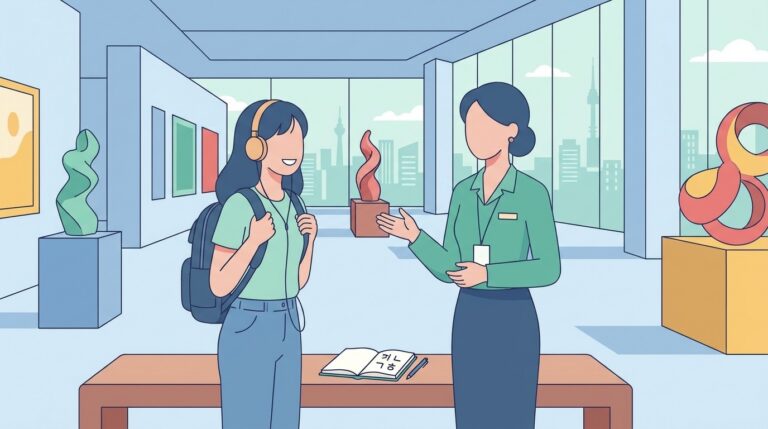
Setting: The sleek information lobby of MMCA Seoul in Samcheong-dong.
Character: Min-ji (민지), a friendly museum staff member wearing a navy uniform and name tag.
- Turn 1 (Min-ji): 🎭 Smiling politely with hands clasped in front
안녕하세요! 전시 관람 도와드릴까요?
(Annyeonghaseyo! Jeonsi gwallam dowadeurilkkayo?)
Hello! May I help you with your exhibition visit? -
Turn 2 (Learner): 🎭 Pointing gently toward the main exhibition hall
네, 혹시 오늘 도슨트 투어 몇 시에 시작해요?
(Ne, hoksi oneul doseunteu tueo myeot si-e sijakaeyo?)
Yes, by any chance, what time does the docent tour start today? -
Turn 3 (Min-ji): 🎭 Checking the timetable clipboard on the desk
오후 두 시에 2전시실 입구에서 시작해요. 10분 정도 남았네요!
(Ohu du si-e i-jeonsisil ipgueseo sijakaeyo. Sip-bun jeongdo namatneyo!)
It starts at 2:00 PM at the entrance of Gallery 2. There are about 10 minutes left! -
Turn 4 (Learner): 🎭 Looking surprised and delighted
아, 정말요? 예약 없이 그냥 참여해도 돼요?
(A, jeongmalyo? Yeyak eopsi geunyang chamyeohaedo dwaeyo?)
Oh, really? Can I just join without a reservation? -
Turn 5 (Min-ji): 🎭 Nodding encouragingly
네! 무료 해설이라 시간 맞춰서 입구로 가시면 돼요.
(Ne! Muryo haeseorira sigan matchwoseo ipguro gasimyeon dwaeyo.)
Yes! It’s a free guided tour, so you just need to be at the entrance on time. -
Turn 6 (Learner): 🎭 Reaching into bag
혹시 외국어 오디오 가이드도 대여할 수 있나요?
(Hoksi oegugeo odio gaidedo daeyeohal su innayo?)
By any chance, can I also rent a foreign language audio guide? -
Turn 7 (Min-ji): 🎭 Gesturing toward the scanner machine
네, 신분증 맡겨주시면 영어 오디오 가이드 무료로 대여해 드려요.
(Ne, sinbunjeung matgyeojusimyeon yeongeo odio gaideu muryoro daeyeohae deuryeoyo.)
Yes, if you leave an ID card, we rent out the English audio guide for free. -
Turn 8 (Learner): 🎭 Handing over ID with a warm smile
여기 여권 있어요. 친절하게 알려주셔서 감사합니다!
(Yeogi yeogwon isseoyo. Chinjeolhage allyeojusyeoseo gamsahamnida!)
Here is my passport. Thank you for kindly letting me know!
🔀 Interactive Branching Moment
After hearing that the tour starts in 10 minutes, what would you say to Min-ji?
- Option A: “지금 빨리 뛰어갈게요! 고마워요!” (Jigeum ppalli ttwieogalgeyo! Gomawoyo!)
👉 Feedback [RISK]: Running inside museum lobbies is frowned upon due to safety and quiet atmosphere regulations. Better to walk briskly! - Option B: “시간 맞춰서 2전시실 앞으로 갈게요. 감사합니다!” (Sigan matchwoseo i-jeonsisil apeuro galgeyo. Gamsahamnida!)
👉 Feedback [BEST]: Natural, polite, and confirms the exact location. Min-ji will be super impressed with your clear Korean! - Option C: “도슨트 나 기다리라고 해.” (Doseunteu na gidarirago hae.)
👉 Feedback [BAD]: This uses aggressive informal speech meaning “Tell the docent to wait for me.” Definitely an etiquette disaster!
Phase 6: 10-Second Emotion Shadowing Drill
Practice these lines out loud! Pay attention to the pauses (/) and embody the emotions.
[🤔 호기심 가득, 정중하게 / Curious and polite]
저기요, / 혹시 도슨트 투어 / 몇 시에 시작해요?
(Jeogiyo, / hoksi doseunteu tueo / myeot si-e sijakaeyo?)-
[✨ 눈을 반짝이며 감탄하듯 / Eyes glowing with wonder]
해설 들으면서 보니까 / 작품이 훨씬 / 살아있는 것 같아요!
(Haeseol deureumyeonseo bonikka / jakpumi hwolssin / sarainneun geot gatayo!) -
[🙏 감사하고 깔끔한 마무리 / Warm and appreciative conclusion]
작품 비하인드 스토리 / 들려주셔서 / 정말 감사합니다!
(Jakpum bihaindeu seutori / deullyeojusyeoseo / jeongmal gamsahamnida!)
Phase 7: K-Culture Mini Dictionary
- 도슨트 (Doseunteu) | Docent / Museum Guide
Refers to knowledgeable volunteers or professional art guides who conduct scheduled gallery walks to explain the historical and aesthetic context of the artworks. - 오디오 가이드 (Odio Gaideu) | Audio Guide Device or App
Handheld rental units or smartphone apps providing recorded commentary. In Korea, you frequently need to leave a physical ID card (신분증) at the desk to rent one. - 기획전시 (Gihoek-jeonsi) | Special / Temporary Exhibition
Curated thematic exhibitions that run for a limited time (usually 2–4 months), often requiring a separate ticket from the permanent collection. - 상설전시 (Sangseol-jeonsi) | Permanent Exhibition
The museum’s core archival collection on display year-round. In many Korean public museums (like the National Museum of Korea), permanent exhibits are completely free to enter!
Phase 8: Traveler’s Survival Kit
TOP 3 Survival Phrases
- 한국어 해설 몇 시예요? (Hangugeo haeseol myeot si-yeyo?)
What time is the Korean commentary?
Pro Tip: Even if your Korean is A2, following along lets you observe which paintings locals find most meaningful. - 신분증 여기 있어요. (Sinbunjeung yeogi isseoyo.)
Here is my ID card.
Pro Tip: Use this when swapping your passport or foreign registration card for an audio guide wand. - 사진 촬영 가능한가요? (Sajin chwaryeong ganeunghangayo?)
Is photography permitted?
Pro Tip: Look out for the “No Flash” sign. Even when photos are allowed, Korean galleries strictly prohibit flash photography.
Editor’s Travel Note
- Check schedules in advance: Don’t just show up unannounced! Check the schedule beforehand using the official 국립현대미술관 웹사이트 or search for your venue on the 네이버 지도 앱 다운로드 to see live docent timetables in the venue announcement tab.
- Bring Wired Earphones: Several Korean museums now offer audio guides directly via downloadable QR codes on your smartphone. Carrying a pair of standard 3.5mm or USB-C wired earphones in your daypack will save you from holding your phone to your ear for an hour!
Phase 9: “One Step Deeper” (Reflective Essay)
In many Western galleries, viewing art is predominantly an individual, solitary exercise of quiet contemplation. However, in Korea, you will notice that culture is deeply rooted in 공유된 경험 (shared collective experience). When people gather around a docent, they form a temporary community. They laugh together at the artist’s quirky anecdotes and sigh in collective sympathy over historical struggles. Attending a docent tour isn’t just about absorbing dates and styles; it is an intimate glimpse into how Koreans bond emotionally through shared storytelling.
💬 Your Turn: What kind of stories do you enjoy hearing most when looking at art—the historical background, or the artist’s scandalous private life? Let us know in the comments below!
Phase 10: FAQ & Common Mistakes
Q: Do I have to pay extra money to join a docent tour in Korea?
A: In almost all public and major private museums in Korea, docent tours are completely free of charge once you have entered the exhibition. You just need to show up at the designated meeting point at the scheduled time.
Q: What if my Korean is only A2 level? Will I understand anything?
A: Absolutely! Docents use visual cues, pointing to specific brushstrokes, figures, and dates. You will catch key emotional words like 사랑 (love), 전쟁 (war), 슬픔 (sorrow), and 가족 (family). It is also fantastic listening practice in a contextual setting.
Q: Can I leave in the middle of a docent tour if my feet hurt?
A: Yes! Docent tours in Korea are informal and walk-in friendly. If you need to rest, you can quietly step backward away from the group without drawing attention. No formal apology is required.
🚨 Common Mistakes Alert
- ❌ Mistake 1: Leaving your credit card instead of an ID for an audio guide.
Correct Action: Museum desks specifically require government-issued photo IDs (Passport, ARC, or Driver’s License) to guarantee return. - ❌ Mistake 2: Talking on the phone while walking near the docent group.
Correct Action: If you receive a call, quickly step into the hallway or restrooms outside the exhibition hall. - ❌ Mistake 3: Touching the floor line right in front of the artwork.
Correct Action: Keep your feet behind the protective line marked on the floor (관람선), even when leaning in to hear the docent better.
Phase 11: Action Missions
- 🥉 Bronze Mission (Solo Practice): Practice saying “도슨트 투어 몇 시에 시작해요?” in front of a mirror three times using polite rising intonation.
- 🥈 Silver Mission (Social / Community): Visit the website or Instagram page of a Korean museum (like MMCA or Seoul Museum of Art) and find the word 도슨트 in their schedule announcements. Take a screenshot!
- 🥇 Gold Mission (Real Life): Visit a gallery or museum in Korea, ask the front desk staff for the docent time or rent an audio guide using our Phase 5 roleplay phrases!
- 🎮 K-Culture Mission: Search YouTube for “RM 국립현대미술관 오디오 가이드” and listen to BTS RM explain Korean modern art masterpieces. Notice how calm and articulate his tone is!
Phase 12: Interactive Quiz Challenge
Test what you learned today before your next museum visit!
1. Situation Quiz: You arrive at the museum at 1:50 PM. You want to ask the staff if there is a guided tour at 2:00 PM. Which sentence is most natural?
* (A) 2시에 도슨트 있어요? (Du si-e doseunteu isseoyo?)
* (B) 2시에 나를 가르쳐 주세요. (Du si-e nareul gareuchyeo juseyo.)
* (C) 2시에 그림을 읽어라. (Du si-e geurimeul阅读/ilgeora.)
2. Fill-in-the-Blank: Complete the phrase meaning “Because I watch while listening to the explanation, it’s much more fun!”
* 해설 들으면서 보니까 _______ 재미있어요! (hwolssin)
3. True or False: In Korean museums, you must always make an advance paid booking online several weeks early just to follow a docent walking tour. (True / False)
👉 Click here to reveal answers & explanations!
-
Answer: (A)
Explanation: Asking “2시에 도슨트 있어요?” is natural, polite, and common. (B) sounds awkward and demanding, while (C) is an impolite command. -
Answer: 훨씬 (hwolssin)
Explanation: 훨씬 means “much more” or “far more,” used to emphasize comparison when your enjoyment increases! -
Answer: False
Explanation: The vast majority of docent tours in Korean galleries are free walk-in sessions that you can join simply by gathering at the meeting spot at the right time!







