

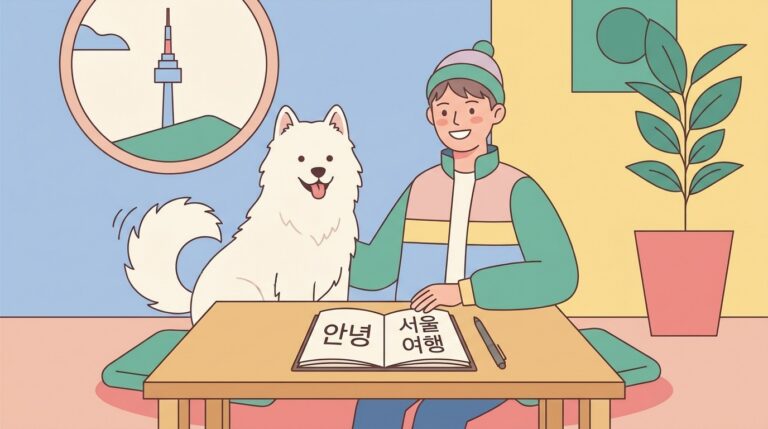
Phase 1: Empathy & Storytelling Opening
안녕하세요! 매일한글 에디터입니다. (Hello! I am your Daily Hangul editor.)
Have you ever been completely charmed by a fluffy Pomeranian trotting down the streets of Yeonnam-dong or watched a supernatural K-drama where a magical Nine-Tailed Fox (구미호 – Gumiho) tries desperately to hide their mythical identity? You eagerly want to point and say, “Look at that fluffy tail!” But as soon as you attempt the word for tail, 꼬리 (kko-ri), your voice hesitates. Does it sound like gori (which means a loop or key ring)? Or does it sound like a raspy, over-breathy khori? The Korean listener tilts their head in confusion, and suddenly you feel tongue-tied.
You are not alone. Hangul double consonants (쌍자음)—especially ㄲ (ssang-giyeok / double k)—are universally notorious among beginners. Unlike English, where ‘K’ is either breezy or voiced, Korean splits consonants into three distinct acoustic dimensions: plain (ㄱ), aspirated (ㅋ), and tense (ㄲ). Making that tight, pop-less ㄲ sound can feel like trying to play a guitar string that’s wound twice as tight!
Mastering ㄲ with the foundational word 꼬리 (kko-ri) unlocks a world of playful, essential vocabulary—from cute puppy tails to heartfelt pinky promises with 꼭 (kkok). Based on over ten years of coaching beginner expats and K-culture enthusiasts, this practical guide breaks down the physical mechanics and cultural flavor of ㄲ. Let’s make this crisp Korean sound second nature for you!
Phase 2: Core Expressions Breakdown
1. 꼬리 (kko-ri)
- Pronunciation: [kko-ri] (Crisp, tight ‘k’ sound with zero breath puffs, exactly like the ‘k’ in English skate or sky).
- Meaning: Literal: Animal tail. Actual Nuance: Used anatomically for pets, playfully in myth (fox tails), or idiomatically for leaving tracks/evidence.
- K-Culture Moment: In fantasy K-dramas like Tale of the Nine Tailed (구미호뎐), characters conceal their secret spiritual animal identity whenever their golden fox tail (꼬리) accidentally pops out.
- Editor’s Insight: In daily conversation, Koreans often use the idiom “꼬리가 길면 밟힌다” (If your tail is long, it gets stepped on), meaning if you keep doing something sneaky, you will eventually get caught!
- Situation Spectrum: Casual: ✅ | Semi-formal: ✅ | Formal: ✅
- 🤔 Think About It: In English, “tailing” someone means following them suspiciously. In Korean, having a long “tail” (꼬리) implies leaving traces of bad habits. How do animal body metaphors reflect cultural instincts about honesty?
2. 꼬마 (kko-ma)
- Pronunciation: [kko-ma] (Compact, tense ‘k’ sound followed by a soft ‘ma’, just like the first syllable in skid-mark).
- Meaning: Literal: Little kid / toddler. Actual Nuance: A term of warm, doting endearment used by adults for small children.
- K-Culture Moment: An elderly merchant grandmother (할머니) at a traditional market giving an extra sweet fish cake (어묵) to a visiting child, saying “우리 꼬마, 많이 먹어!” (Eat up, our little one!).
- Editor’s Insight: While the textbook word for child is 아이 (a-i), native speakers almost always use 꼬마 (kko-ma) when talking about or to young kids in a tender, affectionate neighborhood tone.
- Situation Spectrum: Casual: ✅ | Semi-formal: ✅ | Formal: 🚫 (Too endearing for official forms or academic discourse)
- 🤔 Think About It: Korean has many layered terms for age ranks. Why does a diminutive term like 꼬마 carry communal warmth rather than sounding condescending?
3. 꼭 (kkok)
- Pronunciation: [kkok] (Begins with a tense double-k and ends with a sharp, cut-off sound; imagine whispering coke without letting out the final breath puff).
- Meaning: Literal: Surely / definitely. Actual Nuance: A heartfelt promise word that elevates an invitation into a binding, affectionate commitment.
- K-Culture Moment: A K-pop idol wrapping up an energetic Weverse live stream, holding up a pinky finger and saying to fans: “내일 라이브에서 꼭 만나요!” (Definitely meet me on tomorrow’s live!).
- Editor’s Insight: Whenever you make plans with a Korean friend, appending 꼭 shows that you truly care about the meetup, turning polite small talk into a real date.
- Situation Spectrum: Casual: ✅ | Semi-formal: ✅ | Formal: ✅
- 🤔 Think About It: In many Western cultures, “we must hang out” can just be a polite parting remark. Why does saying “꼭” in Korea imply a social debt of sincerity?
Phase 3: Textbook Korean vs. Real Korean
Situation 1: Promising to see a new friend again
- 📖 교과서 한국어 (Textbook): 다음 주에 약속을 지키세요. (Daeum jue yaksogeul jikiseyo. – Keep your appointment next week.)
- 🗣️ 진짜 한국어 (Real-life): 다음 주에 우리 꼭 봐요! (Daeum jue uri kkok bwayo! – Let’s definitely see each other next week!)
- 💡 왜 다를까? (Why the difference?): The textbook phrasing sounds like a strict contract reminder from a dentist’s office! Native speakers express excitement and warmth using 꼭 alongside the natural verb 보다 (to see/meet).
Situation 2: Reacting to a cute puppy in a neighborhood cafe
- 📖 교과서 한국어 (Textbook): 개가 꼬리를 흔듭니다. (Gaega kkorireul heundeumnida. – The dog wags its tail.)
- 🗣️ 진짜 한국어 (Real-life): 강아지 꼬리 흔드는 것 좀 봐, 심쿵! (Gang-aji kkori heundeuneun geot jom bwa, simkung! – Look at that puppy wagging its tail, heart attack cute!)
- 💡 왜 다를까? (Why the difference?): Real Korean speakers naturally opt for diminutive nouns like 강아지 (puppy) over 개 (dog) and use lively expressions like 심쿵 (heart-flutter) when observing pet behavior.
Phase 4: K-Culture Deep Dive & Non-verbal Manners
4-1. Nunchi & Physical Gestures
When using the double consonant word 꼭 (kkok) in a promise, Korean non-verbal body language has a dedicated ritual. You don’t just nod: you hook little pinky fingers (약속 – promise), press thumbprints together (도장 – stamp), and sweep thumbs against each other’s palms (복사 – copy/photostat). Doing this while maintaining soft, smiling eye contact proves your total emotional investment.
When meeting dogs or cats in Korea’s pet cafes, never lean straight over them to touch their 꼬리 (tail). A dog’s tail is sensitive; touching it without permission violates pet nunchi (social tact)! Instead, offer the back of your curled hand for sniffing first before marveling at their wagging tail.
4-2. Culture Code: The Legend of the Gumiho & Pet Healing Culture
In traditional folklore popularized by countless K-Dramas (such as My Roommate is a Gumiho), the fox tail (꼬리) represents magical power, allure, and hidden truth. If a fox successfully hides all nine tails for one thousand days, it becomes human.
Fast forward to modern urban Korea, where pets have replaced mythical companions as emotional anchors. In bustling Seoul neighborhoods like Mapo and Seongsu, “pet-welcoming” culture has exploded. Walking your dog and commenting politely on another neighbor’s dog’s happy wagging 꼬리 (tail) is one of the most natural icebreakers for foreigners to start organic Korean conversations!
Phase 5: Real-Life Roleplay Scenario
Setting: A cozy animal-friendly cafe in Yeonnam-dong, Seoul. Soft indie music plays while a gentle Samoyed named Gureum (Cloud) approaches your table.
Characters:
* You: An enthusiastic traveler and beginner Korean speaker (A1).
* Minho (민호): Friendly cafe barista and Gureum’s guardian.
Turn 1
* You: 안녕하세요! 강아지가 정말 예뻐요. (Annyeonghaseyo! Gang-ajiga jeongmal yeppeoyo.) [🎭 Pointing gently with open palms at the fluffy dog] — Hello! The puppy is really pretty.
Turn 2
* Minho: 어서 오세요! 이름은 구름이에요. (Eoseo oseyo! Ireumeun Gureum-ieyo.) [🎭 Smiling warmly while handing over the drink menu] — Welcome! His name is Gureum (Cloud).
Turn 3
* You: 구름이 꼬리 봐요! 엄청 빨라요. (Gureumi kkori bwayo! Eomcheong ppallayo.) [🎭 Crouching slightly to eye level without invading the dog’s personal space] — Look at Gureum’s tail! It is so fast.
Turn 4
* Minho: 반가워서 그래요. 손님을 보면 꼬리를 흔들어요. (Bangawoseo geuraeyo. Sonnimeul bomyeon kkorireul heundeureoyo.) [🎭 Gently scratching behind Gureum’s ears] — It’s because he’s glad to see you. He wags his tail whenever he sees guests.
Turn 5
* You: 꼬리가 복슬복슬해서 구름 같아요. (Kkoriga bokseul-bokseulhaeseo gureum gat-ayo.) [🎭 Smiling admiringly at the fluffy fur] — His tail is so fluffy, it looks just like a cloud.
Turn 6
* Minho: 간식 조금 주실래요? 꼬마 손님들도 다 좋아해요. (Gansik jogeum jusillaeyo? Kkoma sonnimdeuldo da joahaeyo.) [🎭 Offering a tiny dish of dried chicken treats] — Would you like to give him a treat? Even our little kid visitors love doing it.
Turn 7
* You: 네, 좋아요! 구름아, 꼭 앉아! (Ne, joayo! Gureuma, kkok anja!) [🎭 Holding the treat firmly above Gureum’s nose] — Yes, please! Gureum, definitely sit!
Turn 8
* Minho: 와, 바로 앉네요! 한국어 발음이 정말 정확하세요! (Wa, baro anne-yo! Hangugeo baleumi jeongmal jeonghwakhaseyo!) [🎭 Clapping hands together in genuine admiration] — Wow, he sat immediately! Your Korean pronunciation is really accurate!
🔀 Interactive Choice Point
Minho smiles and says, “주말에는 구름이가 더 신나요! 주말에도 놀러 오세요!” (Gureum is even more excited on weekends! Come hang out this weekend too!). How do you respond?
- Choice A: “감사합니다! 이번 주말에 꼭 다시 올게요!” (Gamsahamnida! Ibeon jumare kkok dasi olgeyo!)
- Feedback (Best Choice!): Outstanding! Using 꼭 here signals sincere enthusiasm and cements a friendly connection with the host.
- Choice B: “네, 약속을 지키겠습니다.” (Ne, yaksogeul jikigesseumnida.)
- Feedback (Risk): Grammatically acceptable, but stiff as an army cadet. It sounds like you are signing an administrative agreement rather than hanging out with a dog.
- Choice C: “강아지 꼬리가 맛없어요.” (Gang-aji kkoriga mateopseoyo.)
- Feedback (Bad): Oh no! You confused a friendly reply with an absurd sentence claiming the dog’s tail doesn’t taste good! Minho will wonder what you are planning!
Phase 6: 10-Second Emotion Shadowing Drill
Practice these three lines aloud. Pay attention to the breath pauses marked by / and channel the targeted emotional mindset!
[🥰 Sweetly & Fondly]
강아지 / 꼬리가 / 너무 귀여워요!
(Gang-aji / kko-ri-ga / neomu gwiyeowoyo!)
“The puppy’s / tail / is so cute!”-
[🤝 Sincere & Resolute]
우리 / 다음 주에 / 꼭 만나요!
(Uri / daeum jue / kkok mannayo!)
“Let’s / definitely / meet next week!” -
[😮 Impressed & Chuckling]
저 꼬마 / 한국말 / 진짜 잘하네요!
(Jeo kko-ma / hangungmal / jinjja jalhane-yo!)
“That little kid / speaks Korean / so well!”
Phase 7: K-Culture Mini Dictionary
- 꼬리 (kko-ri) | Noun | Animal tail. Beyond zoology, it’s used in the traditional playground tag game “꼬리잡기” (Catching the Dragon’s Tail) played frequently on Korean variety shows like Running Man.
- 꼬마 (kko-ma) | Noun | Little toddler / child. Frequently used affectionately across Korean media, such as the famous retro snack “꼬마김밥” (bite-sized mini gimbap rolls).
- 꼭 (kkok) | Adverb | Surely, without fail, tightly. An essential social glue word used whenever sealing promises, booking trips, or expressing deep intent.
- 꿀잼 (kkul-jaem) | Slang Noun | Extremely fun / hilarious. Begins with the tense ㄲ consonant (꿀 = honey + 재미 = fun). You will hear Gen Z Koreans use this everywhere when talking about hit K-dramas or games.
Phase 8: Survival Kit for Travelers
TOP 3 Emergency Travel Expressions
- “여기 꼭 가봐야 해요?” (Yeogi kkok gabwaya haeyo?)
- Meaning: Do I definitely have to visit here?
- Pro Tip: Ask this to local cafe baristas or guesthouse hosts to filter out tourist traps and find authentic local spots!
- “다음에 꼭 또 올게요!” (Daeume kkok tto olgeyo!)
- Meaning: I will definitely come back again next time!
- Pro Tip: Say this with a warm slight head bow when paying the bill at a small neighborhood diner (식당). The owners will adore you.
- “꼬마 메뉴도 있나요?” (Kkoma menyudo innayo?)
- Meaning: Do you also have small/kids’ menu portions?
- Pro Tip: Great for light eaters or parents traveling with little ones at dessert shops.
Editor’s Travel Note
When hunting for hidden cafes with resident pets in Yeonnam-dong or Ikseon-dong, overseas map apps often display inaccurate walking pins. Make sure to consult our guide on 네이버 지도 앱 다운로드 (Naver Map App Download) before navigating traditional Korean alleyways. Remember: many animal cafes require changing into indoor slippers (실내화) at the entrance and using hand sanitizer before greeting furry friends!
Phase 9: “One Step Deeper” (Reflective Essay)
In the phonetic architecture of Hangul, tense consonants like ㄲ demand a deliberate pause, a firm closure of the vocal cords, and a sudden release with zero breathiness. This acoustic tension mirrors an essential aspect of Korean social psychology: 정 (Jeong – relational warmth) and intentionality. When you tell a friend “내일 만나요” (See you tomorrow), it is casual; but the moment you add “꼭 만나요” (Definitely see you tomorrow), the sound itself feels anchored, tight, and unbreakable. Language reflects the community’s desire to build dependable, heartfelt ties in a fast-paced society.
💬 Your Turn: Does your native language have sounds that require extra physical tension to convey serious intent? How did your throat feel when pronouncing the crisp “ㄲ” in 꼬리 versus a soft “k”? Share your practice stories in the comments below!
Phase 10: FAQ & Common Mistakes
Q: What is the physical secret to making the ㄲ sound instead of ㄱ or ㅋ?
A: Think of vocal tension rather than breath. For ㅋ, air rushes out freely (like blowing out a candle). For ㄱ, a tiny breath escapes. For ㄲ, swallow your breath slightly, tighten your throat as if you’re bracing your core, and release the consonant without letting any breath escape. It sounds just like the unvoiced ‘k’ in English words like skate, sky, or basket.
Q: If I accidentally pronounce 꼬리 (kkori) as 고리 (gori), will Koreans still understand me?
A: Usually context saves the day, but 고리 (gori) means a metal ring, link, or hook! If you point at a golden retriever and say “Look at the gori,” people might think you are asking about the dog’s leash clip or collar ring. Mastering the tense ㄲ ensures you are clearly admiring the tail!
Q: How can I verify my ㄲ pronunciation at home without a teacher?
A: Use the classic Paper Napkin Test! Hold a single ply of thin facial tissue 5 centimeters in front of your mouth. Say 코 (kho)—the tissue should flap vigorously. Say 고 (go)—the tissue will twitch slightly. Now say 꼬 (kko)—the tissue should stay completely motionless. If it doesn’t move, your double consonant is flawless!
🚨 흔한 실수 (Common Mistakes) Warning Board
| Mistake | What Learners Do | Correct Action |
|---|---|---|
| Aspirating the ㄲ | Letting out a burst of air like “kite” | Block the air at the back of your palate; mimic the ‘k’ in spooky or skate. |
| Confusing 꼬리 with 코끼리 | Mixing up kkori (tail) with kokkiri (elephant) | Remember: 코 (nose) + 끼리 = the animal with a long nose (elephant)! 꼬리 on its own is the tail. |
| Splitting the double letter | Trying to pronounce two distinct ‘k’ sounds separated by a pause | Treat ㄲ as one single, reinforced letter pronounced with higher pitch and muscular tension. |
Phase 11: Action Mission
- 🥉 Bronze Mission (Solo Practice): Grab a tissue, stand in front of a mirror, and say “꼬리 (kko-ri), 꼬마 (kko-ma), 꼭 (kkok)” three times without moving the paper. Feel the throat lock!
- 🥈 Silver Mission (Social Practice): Find a photo of a cute animal on Instagram or Pinterest, and write a one-sentence Korean caption: “꼬리가 너무 귀여워요! (The tail is so cute!)”.
- 🥇 Gold Mission (Real World): Next time you finish an interaction with a Korean speaker, clerk, or pen pal, sign off with: “다음에 꼭 다시 만나요! (Let’s definitely meet again next time!)”.
- 🎮 K-Culture Mission: Watch an episode of a Korean variety show or fantasy drama this week. Count how many times people hook pinky fingers while shouting “꼭!” or point at an animal’s “꼬리“.
Phase 12: Interactive Quiz Challenge
1. Situational Judgment
You are leaving a delightful dinner with your Korean language exchange partner. You want to warmly express that you must eat dinner together again next week. Which sentence should you use?
a) 다음 주에 고기 꼬리를 흔드세요.
b) 다음 주에 우리 꼭 다시 만나요!
c) 다음 주에 꼬마가 되세요.
2. Fill-in-the-Blank
강아지가 기분이 좋아서 ________(을/를) 흔들어요. (The puppy wags its ________ because it feels happy.)
Hint: The Hangul word for tail!
3. True or False
In standard Korean pronunciation, ㄲ produces more exhaled breath from your mouth than ㅋ.
* (True / False)
👉 Click here to reveal the Quiz Answers & Explanations!
- Answer: b) 다음 주에 우리 꼭 다시 만나요!
- Explanation: 꼭 is the definitive promise adverb that turns plans into warm, sincere dates. Option (a) makes no sense with tails, and option (c) tells your friend to turn into a toddler!
- Answer: 꼬리 (kko-ri)
- Explanation: 꼬리 means animal tail! “강아지가 기분이 좋아서 꼬리를 흔들어요.”
- Answer: False
- Explanation: ㅋ is aspirated (heavy burst of breath), while ㄲ is tense with zero breath leakage!
- Explanation: ㅋ is aspirated (heavy burst of breath), while ㄲ is tense with zero breath leakage!







